Showing posts with label qur'anic commentary. Show all posts

Wednesday, February 5, 2025

The Divine and the Mundane: Scriptural life lessons

 Introduction


The Qur’an is a scripture of great depth, nuance and wisdom. The more it is consulted, the more utility that emerges. It can take seemingly mundane, everyday situations, address it as necessary, mixing in great lessons. The classical examples are the texts of Soorah Al Hujuraat (chapter 49), which discusses topics such as etiquette and social behaviour, inserting in the midst of those Ahkam the famous text of 49:13, which tells us the reason behind the existence of varying peoples and tribes, a verse which removes destructive notions such as racism. The other classical example is in Soorat An Noor (chapter 24), which deals with some legal prescriptions, dress code and the like, and inserts therein the very profound Ayatun Noor, the verse of Divine light (24:35).


Much of the following discourse centers around revelation given to the Prophet Muhammad- Sall Allahu ‘alayhi wa sallam, that addresses his domestic life. In the midst of family issues, the Divine revelation addresses these issues and places important lessons there. 


The Prophet cannot make everyone happy all of the time, even his own wives.


The sixty-sixth chapter of the Qur’an begins with Allah subhaanahu wa ta’alaa telling Muhammad   “O Prophet, why do you consistently forbid (harrima) what Allah has made lawful for you? Do you seek to please your wives? Yet, Allah is intense in granting forgiveness and mercy. Allah has sanctioned for you the expiation of your oath, Allah is your protector, and He is the All Knowing, The all-wise” (Q 66:1-2)


یٰۤاَیُّہَا النَّبِیُّ لِمَ تُحَرِّمُ مَاۤ اَحَلَّ اللّٰہُ لَکَ ۚ تَبۡتَغِیۡ مَرۡضَاتَ اَزۡوَاجِکَ ؕ وَاللّٰہُ غَفُوۡرٌ رَّحِیۡمٌ


قَدۡ فَرَضَ اللّٰہُ لَکُمۡ تَحِلَّۃَ اَیۡمَانِکُمۡ ۚ وَاللّٰہُ مَوۡلٰٮکُمۡ ۚ وَہُوَ الۡعَلِیۡمُ الۡحَکِیۡمُ


Prophet Muhammad, upon whom be peace and blessings, was God’s messenger, the prophet for all humanity, and of course leader within his own society. As such, he has great burdens and responsibilities. The tafseer literature is filled with accounts that seek to explain these verses, to connect them to specific incidents. The historicity of these accounts are disputed, and even if the examples cited in the tafseer literature is correct, ultimately the take-away is clearly presented: Muhammad was a congenial person, sympathetic and kind, and had a habit of self-denial and trying to keep people happy  that ultimately got in the way of his own life and therefore his abilities to function as a leader for society and a prophet of God. 


The Prophet was dismissed by his opponents as “an ear”. The exegete Muhammad Ash-Shawkani understood this to mean that people would assert that the Prophet would “listen to all, and having no ability to distinguish between truth and falsehood”. (Fat-hul Qadeer, Kuwait, wazeeratul Awqaaf, 1980 edition). This shows us that his nature was to give an ear, to try to make everyone happy, especially his wives, even if their demands were unreasonable or fueled by misplaced emotions.  God tells the Prophet that he is to drop this habit of his. One of the accounts given asserts that he (peace be upon him) had promised to stop consuming honey, as a way to keep his wives happy.  While there is much more to that account (assuming its true), we are to understand that God knows what he is doing by allowing something and forbidding something else. We are not going to be held to account by Allah on an issue as small as honey consumption.


The Prophet, and indeed men in general, are to obey Allah, and if his wives are not interested in that, in making his role and life easier, God can most certainly remove such women in exchange for those who will indeed be better, regardless of their previous status (Q 66:5). The job of the Prophet, and indeed of believers in general, is to guide their flock, by saving them from “ a fire fueled by people and stones” (Q 66:6).


This is a big picture role, and frankly cannot be ignored by the presence of petty, limited interests- itself a product of immature thinking! 


Light 



In the midst of this discourse, we are told how the people of paradise, themselves surrounded by light, invoke (i.e. in du’aa) “Our Lord, Complete for us our light, and bestow on us forgiveness, Indeed, you are powerful over all things.” ( Q 66:8).


The placement of this clause suggests that growth is still attainable, the ability to see the bigger picture is still possible, at all stages of life, when faith and efforts are present. We can understand light to mean the tools by which to see the bigger picture and to stay focused on that.


In polemics, I have noticed that Christian apologists, in their criticisms of Islam, almost never address the religious content of the Qur’an and Sunnah, rather, they focus on attacking the Prophet’s character himself. They will distort and misrepresent reports about him to paint an ugly picture of him. This is an example of not looking at the bigger picture. Moreover, they are guided by unhealthy emotions and will advocate the same from their followers. 


Having light is important for all parties to have, particularly in the marriage relationship. If light is drowned out in the darkness of negative emotions, it presents a stagnation that ultimately can lead to hell. Islam is a great source of stability and safety, whereas impulses can lead to destruction. 


Learning from women 


The text gives an example of the wives of Prophets Noah and Lot (Nuuh and Luut, ‘alayhimas salaam) who were not upon the same foundation  their husbands were upon. The presence of these Prophets in the Soorah is poignant, in that these were prophets who were more clearly identified as doing intense actions to save their societies from destruction. Unfortunately, their wives had behavior and thinking patterns that reflected the misguidance of mainstream society, and thus, they-along with everyone else- experienced the fires of destruction (Q 66:10).


The husbands obviously made efforts to save their families, but it is up to each individual to make their efforts, to be committed to Islam and avoid the misguidance of kufr.


The Soorah(vv.11-12) gives another contrast, the believing wife of the Pharaoh, and Mary. Their faith allowed them to see the Noor, the big picture, and thus have salvation, not only for themselves, but ultimately to function as examples to humanity.


Returning to the Prophet Muhammad (peace be upon him), it seems that at times they would give such headaches that he is told by God that if they (the wives) want to be released from the relationship, he would (Q 33:28). Yet, the choice is also outlined to them as follows:


“ And if you desire God and his messenger, and the ultimate abode, God has prepared for those who strive for Ihsaan a magnificent reward” ( Q 33:29).


Ihsaan is that next level in one’s spiritual evolution. What is interesting about this text is that the Prophet’s wives (known as “mothers of believers” Ummahaat al mu’mineen) became known as highly spiritual people. Sayyidah ‘A’ishaa herself is the most reliable transmitter of hadeeth. 


Conclusion


The big picture is not necessarily wealth or power. The big picture success is a strong relationship with Allah, overcoming the negative whispers of Satan, both internal and external, and peaceful existence here and in the hereafter. That is what authentic religion teaches. 


We live in a time when negative emotions are actually promoted as a good thing, where conflict is not something that needs to be resolved, but rather recorded for views online. If we want ultimate success, we have to obey Allah and follow the examples of the best of mankind.


Simply arguing for the sake of arguments, holding unnecessary grudges, will stimulate no success at all. Let us take the beautiful lessons, even in the midst of seemingly mundane incidents mentioned in scripture. 

Friday, July 19, 2024

Guarding the soul: practical guidance from Islamic sources

 Introduction

Ours is a fast- paced world, perhaps the fastest in the history of mankind, evident not only in the relatively quick technological developments, but also in the social, political, economic and entertainment realms. It is widely acknowledged that physical goods are now built with a very limited lifespan, forcing customers to replace them on a semi-regular basis. Mobile phones, entertainment technology, and the like are obvious examples. This also has bearing on subjects such as spiritual development, relationships and statecraft. Thus, everything and everyone is now deemed replaceable if (and when) the winds of popularity change (be it organically or otherwise), presenting a level of instability that would not be imagined in times past.


It is in this backdrop that we have decided to have a look at the soul, the core of a human being, a nonphysical item that is (almost) universally acknowledged to exist even after death, that which faces some level of Divine scrutiny, an item that has been ignored, neglected, even abused. The purpose of this article is to generate thought, positive development, and the presentation of this rather complex subject in a succinct fashion. In the end, success in achieving the above-mentioned goals comes from Allah. Wa Billaahit Tawfeeq.


Soul is like a sponge


At the outset, it seems necessary to explain that we tend to use the term "soul" as synonymous with other terms such as "the self" "spirit" "mind/mental foundation" " and even "psychological foundation". (ft.1) All recognize the importance of delivering positive reinforcement, discipline, love and attention to children, and similarly understand that the experience of childhood has profound impact on the same individuals as adults. 


Thus, it is true that the soul is like a sponge, yet its arrival in our world is totally pure, without blemish or sin. Thus, Islam disagrees with the Christian notion of original sin, and further refutes the idea that the original sin would have to be dealt with through the blood atonement of Jesus (depicted as son of God, but also God himself in mainstream Christianity). Yet, over time, the soul will absorb both good and bad, beautiful and ugly, largely as a result of outside influences. 


The Qur'an says that the most successful has been the one who has been keen on purifying it, keeping it clean (Q 91:9, 87:14). Similarly, it also asserts that the biggest lost is experienced by the one who damages the soul by corrupting it (Q 91:10).


What corrupts the soul?


The world religions tend to have similar ethical considerations (i.e. murder, theft, etc.) and thus see the violation of its commandments as not only actions bringing spiritual harm, but worldly damage as well. Today's world has made these things a bit murky, in that both capitalism and individualism (worldviews that are actually cousins) have had an impact on modern religious perceptions. Thus, religion itself is widely seen as a personal journey, confined to rituals and a set of theological assumptions. 


The other side of this coin is that (wrong-headed) religion itself can be manipulated through technicalities, its rules abused, leading to ridicule and outright rejection of religion. These points, the manipulation and misuse of religion, can actually corrupt the soul.


This is partly the reason behind Almighty Allah sending forth messengers, prophets and scriptures. The New Testament presents Jesus (peace be upon him) as overturning the tables of the moneychangers in the temple, and of course the Prophet Muhammad (peace be upon him) himself removed the idols that were present at the Ka'bah, itself a sanctuary built for the worship of God by the Prophet Abraham.


Thus, among the other items in the modern world which corrupt the soul, as seen by this writer, include

(1) Narrow-mindedness: A thinking of "I am always right and cannot be wrong or ever change". A stubbornness that leads to long-term harm to self-interest. This particularly happens in family conflict (itself possibly on petty grounds). 

(2) Addictions: Intoxicants such as drugs, alcohol and the like. The Qur'an has placed gambling and even occult practices in the same realm (Wal Ansaabu wal azlaam see Q 5:90) of discussion. 

(3) Harmful entertainment: At no other time in history has entertainment been so readily available. Television programs, music, even the messages of influencers of social media and politicians themselves generate conflict, misinformation, the breakdown of family units, gender wars, can lead to harm, if not outright corruption, of the soul. This includes the so-called hookup culture and low commitment relationships. The consumption of pornography is also grouped within this heading. 


(4) Idolatry: Recognized in Islam as the one sin that-if maintained till death- has the likelihood of never being forgiven, we have placed it as number 4 on this list rather than number 1, because we tend to have a limited way of thinking of it. Shirk is not simply bowing to a statue or photo.! Rather, it can be manifested in arrogance (worship of self), racism (worship of color or clan), partisanship as well as the holding unto negative thoughts and emotions, making (false) victimization one's primary identity. This is a sort of worship (of other than God) which is harder to recognize and combat, nonetheless it is still a problem that needs to be seen and dealt with via the authentic spiritual resources. 


(5) Bad influences: The Prophet Muhammad- Sall Allahu 'alayhi wa sallam- is reported to have said " The man is upon the deen of his close friend (khalilihi), so each of you should look carefully (falyandhoor)  regarding who becomes his close friend" (At Tirmidhee). Having close friends who don't share your spiritual interests can be very damaging. In the name of friendship, questionable or outright haraam actions take place, one is influenced in the wrong direction. In an American context in particular, a phenomenon exits in which men and women in their 50's have the mentality and actions of teenagers! 


What saves the soul?


(1) Tauheed: Recognizing that God alone deserves to be worshiped. This is more than abandoning the gods of Greek or Hindu mythology. This means making Allah as primary focus in the spiritual and mental realm. In a practical sense, this entails giving priority to the priorities in the Qur'an. Notice that Tauheed is connected to justice and the acquisition of knowledge, and shirk is connected to injustice (Q 3:19, 31:30 etc.).


(2) Spiritual practices: This has to be done on a regular basis to be affective, just as bathing. The Muslim practice is five daily prayers, but there are also supplementary actions such as dhikr (which can be done at any time, in which God's name or a Divine attribute is verbalized- loudly or softly), du'aa (asking God directly), and the recognition of God in everyday activities by terms such as Inshaa Allah (God-willing), Alhamdulillaah (praise belongs to God), Maa-Shaa-Allah (this was Allah's will) and so forth. In a broad sense, we can place the five pillars under this category, three of them are spiritual practices in nature. 


(3) Actions of regular charity: As with number 2 above, zakaat is a pillar of the Islamic religion, and in the Qur'an prayer and the regular charity (zakaat) are almost always placed together. Engaging in charity, at whatever level possible, does tremendous work in delivering salvation to the soul, and it generates good feelings in the person who does it. Q 74:44 mentions that refusal to engage in charity (in this case, feeding the poor) is listed as a reason to be placed in Hell. Refusal of engaging in charity is the symbol of ultimate selfishness, a lack of care that is devastating for spiritual development. 


(4) Goodly company: In all contexts (including romantic) this is needed to attain spiritual progress. This is not only supported by texts (of the Qur'an and hadeeth) but also by real life experiences. Indeed, every culture has recognition of this at some level. Some faiths (such as early Christianity and aspects of Buddhism) seem to hold the view that spiritual growth is attained on a personal level and that other people's presence is a distraction from that goal. Islam teaches that the opposite is the case. The Prophet is reported to have said that marriage is half of one's faith, and another hadeeth asserts that praying in congregation (jamaa'ah) is twenty-seven times greater in reward than offering the same prayer in a solitary fashion. 


(5) Dropping unnecessary grudges: Negative feelings and memories can hold a person back and as seen earlier, can be a sort of idolatry! The Qur'an teaches that spiritual awareness (here a reference to taqwaa) is connected to humans dealing with one another, even to the point that it can supersede rituals (Q 4:1). While some grievances are rightly held and cannot be easily dismissed, it is often the case nowadays that a person will hold a grudge over a minor situation, to the extent that even when said issue is addressed, the 'aggrieved' party will continue to harbor ill-will, ultimately bringing harm to themselves. Islam teaches that God is Intense in delivering forgiveness and mercy (Al-Ghafoor Ar-Raheem), if we want that from God, should we not use it for ourselves? The Qur'an asserts that believers have certain characteristics, let us have a read: " And what is with Allah is better and more lasting for those who have believed and have trust in their Lord, those who abstain from sin, great and small, as well as immorality, and when angered, forgive (wa idhaa maa ghadiboo, hum yaghfiroon.)" (Q 42:36-38). The same Soorah goes on to say that those who engages in pardoning and reconciliation ('faman 'afaa wa as-laha) receive rewards from God"(Q 42:40) (ft.2).


While the above is brief, it provides a foundation for salvation, happiness in this life and the life to come. There are of course more details given in the Islamic texts, but this should be sufficient to begin the process of introspection, thought and discussion where needed. 


Footnotes


(1) There are a number of terms used within Islamic texts and amongst Muslims generally that carry slightly different meanings, such as nafs, rooh, (plural being arwaah), 'aql, 'ilmun nafs, etc. For the purpose of this article, all the slightly different concepts should be seen as being addressed here, in the sense of discussing the inner reality of man.


(2) The term 'afaa is related to the term 'afuww (coming from the same root), the latter having the connotation of 'erasing'. The latter term is in the du'aa traditionally made when seeking out the apex of the Ramadan experience known as Laylatul Qadr. If we are asking God to 'erase' our bad points or actions, would it not be expedient to do that as human beings with one another?  Q 42:37 uses the verb yaghfiroon for forgiveness being a quality of believers, this term has-at core, covering up, cutting off or being protected from bad consequences of an act. The term comes from the same root as a number of God's names in Islamic texts, such as Al-Ghaffar (The ever forgiving), Al-Ghafoor (the intense in delivering forgiveness). God is described in one text as "The forgiver of sins" Ghaafir adh-dhanb Q 40:2).  For more on Laylatul Qadr, see Shamsuddin Waheed: Las Vegas Metro Police Department presentation on Laylatul Qadr as well as Shamsuddin Waheed: Ramadan reflections: towards new beginnings


Friday, April 15, 2022

Interfaith Interactions as a believing Muslim

Introduction


For a number of years now, in addition to being active in Muslim community, I have also been involved in what is often called the interfaith movement. On the official level, this has involved attending events in places of worship other than those of my own religion, being an audience member at programs, ceremonies and panels, as well as a speaker in these programs.  


On an unofficial level, this has led to the cultivation of many sincere friendships, growth in knowledge and experiences, opening of doors which otherwise would be inaccessible, and a host of other benefits. The purpose of these few words is to address some of the concerns that from time to time are expressed by fellow Muslims, who, like others outside of the Muslim community, perceive a religious threat. 


Motivations


It is certainly the case that many enter into these activities with certain agendas in mind, and, like anything else, sincere intentions can be subjected to manipulation by others. My general motivations are summarized as follows (a) Improving my own knowledge of other faith traditions and perceptions on mutual topics of interest. (b) Presenting a Muslim voice, perspective in arenas wherein we would typically be absent. (c) Working with others to address shared social needs. 


The interfaith circles are ideal for the three items mentioned above. We cannot control the actions, beliefs or intentions of others, even within the shared (Islamic) religious space. We can only do our own part, in accordance with our own conscious. The Qur'an says simply "For us is our actions, and for you your actions" (Q 2:139 et al)


Towards understanding realities

The Islamic faith has been consistent in telling its followers to be diligent in acquiring information. The Prophet Muhammad (Sall Allahu 'alayhi wa sallam) has remarked that seeking knowledge is an obligation (fareedah) upon every Muslim. The Qur'an itself (Q 49:13) asserts that one of the reasons that God has created different racial and tribal groups is that they "get to know" one another. This refers to the enrichment process generated by observing and appreciating the differences as well as commonalities.


The Qur'an clearly advocates both travel and the study of the universe, history and the like (Q 6:11, 41:53, etc.). This process extends a bit further insofar as interactions with those outside of traditional comfort zones.


Having a presence


Despite the historical, economic and social importance of Muslims on a global scale, we have little to no representation in arenas such as media, politics, and society. Moreover, it is often the case that when there is representation there is a great deal of disservice because of lack of qualifications, language barriers and the like. 


If we don't speak for ourselves, share our beliefs and perceptions, others will, and this will cause a huge amount of disservice to the community.


Can we work with non-Muslims?


The Qur'an allows marriage and social relations with Non-Muslims (Q 5:5) and advocates that we be just with them (Q 60:7-9) as a general principle. If we are allowed those, certainly we are allowed to work with them in areas of mutual interest.


The Prophet Muhammad (peace be upon him) himself in an early part of his life (before nabuwwah) had worked with others in a collective effort to address poverty, known as Hulful Fudool. In Madinah, where he had some measure of political (and moral) authority, he made treaties of defense with both Jewish and pagan forces. The Makkan opposition violated the treaty of Hudaybiyah by attacking non-Muslim forces allied with the Prophet. The Muslims responded to this with a march on Makkah, leading to its peaceful surrender.


Issues of food and housing deprivation, social justice, economic disparities, are very common in our society, and faith-based communities have always been expected to pick up the slack when government initiatives and organizations fail. Thus, it is only common sense that religious communities have levels of cooperation to address these shared social problems.


The Qur'an has praised the "steep path" of delivering emancipation to those held on bondage, feeding the poor, and supporting those who are isolated and unable to help themselves (Q 90:11-18). 


Similarly, the Qur'an has told us directly to compete in being beneficial, that God will be the one to bring us together (Q 2:148). It even says that in terms of religious disputes that Allah will address those clearly on the day of Judgement (Q 45:17). 


(Grand Imam of Al Azhar Shaikh Ahmed El-Tayeb meets with Pope Francis)


(Pope Paul John II meets with Imam W.Deen Mohammed)


Does such work contradict religious truth claims?  


While it is understandable that many would feel that involvement in such work dilutes faith, I actually see it as helping to increase my faith in the essential truths of Islam. It helps in understanding the views of others and the logic of certain principles/teachings found within Islam.


For religious and political leadership, I think such work is vital, if for no other reason than learning and interacting with the leaders and scholars of other faiths, which forces us to learn correct information on their perspectives, as well as them learning ours. 


Entering a house of worship outside of your own tradition

For Muslims, I don't see any strong evidence that this is prohibited. It is certainly inappropriate for Muslims to participate in religious rites which contradict the very core of our faith, but in terms of attending other houses of worship, be it for social or other occasions, there is no text which prohibits this.


Some Christian based movements have this sort of thinking, such as the Jehovah Witnesses. Their faith forbids entering into places of worship other than their own sites (called Kingdom Halls) and are deeply against any sort of work with those outside of their ranks. 


Such attitudes, while perhaps regrettable, have to be respected. Indeed, interfaith dialogues are not for everybody. We all have our comfort zones and perspectives on matters of faith and life, and compulsion should never even be considered in these regards.

As a Muslim, I am comfortable in such work, for the reasons that have been articulated above, and I pray to be an agent of positive change and education.


Wednesday, July 22, 2020

Q & A session in sunday school

Note: The following videos are from Sunday school gathering, in which an exchange took place between teachers and one of our students. Click on the video comments for time stamps, which summarizes the subjects.

Although the discussion was geared towards addressing the questions of a child, I think the contents of the videos are beneficial for adults as well.


Q and A session part 1


Q and A session part 2


Friday, June 19, 2020

An environment for growth: reflections on Soorah Al A'laa


(Note: the following are reflections based upon the 87th chapter of the Qur'an. The translation, unless otherwise stated, has not been shared. This allows the reader to consult the English translation of their own choice. All translations are my own, unless otherwise stated.)


One of the main functions of the Qur'an is that it compels us to think, to ponder on its words, its message, as well as how that plays out in our lives or the world around us. This Soorah is particularly interesting, in that it weaves together a tapestry of images designed to evoke deep thought. This Soorah is often recited in Salaat Al Witr and Salaat Al 'Eid.


(A) Q 87:1-5

The symmetry is beautiful. The structure of the creation, the physical world, is evidence of Allah's work, displaying reasons we should glorify him.

(B) Q 87:6-7


It reads "We (God) will relate to you, so forget not, except as Allah has willed, Indeed, He knows the visible as well as the hidden". Some have taken this as textual evidence of abrogation (Naskh) in the Qur'an, not only in the development of laws, but even texts. Some have read this as proof that the Prophet was to "Forget" some of the Quranic revelation. The latter view is particularly disturbing, as it presents the Qur'an in a very weak position, as if it is so unworthy of adherence that it has to literally be forgotten. The nature of the Qur'an is the opposite, it is read, memorized and pondered upon by millions, ever since its revelation. To attribute dismissing any Quranic revelation to the Prophet is to do a disservice to both the Prophet, (peace and blessings of Allah be upon him) and the Qur'an itself.


In his comments, the Qur'an commentator and translator Muhammad Asad  (whose work is called The Message of the Qur'an) alludes to these verses not actually referencing the Prophet or the Quranic revelation given to him. He argues that these verses refer to "mankind's cumulative acquisition of empirical and rational knowledge, handed down from generation to generation and from one civilization to another"(ft.1)

We state this in another way, Allah conveys lessons, points of reference or information, that will be submerged when more important or useful points are needed. This is the Divine system, alluded to elsewhere in the Qur'an, and can be related to all points in the life of  a single human being.

(C) 87: 8-13

"And We (Allah) will make the easiness easy for you, so do remind, because reminder is beneficial, such reminder will be really beneficial for those who have fear of God, yet, that reminder will be shunned by the most wretched ones, who will enter the great fire, therefore, in it they neither experience death nor life."

The core commands of God are easy, and He has made them easy. Being open to guidance is-in fact- a characteristic of guidance. Those who shun reminders are those who carry arrogance within themselves, who eventually enter a fire (in this life, fully experienced in the life to come) that consumes them, they can not life healthily therein, nor can they mercifully expire.

(D) Q 87:14-15

There is a logical flow present in this Soorah. Being open to Divine blessings, being able to see the big picture and praise God for it, dropping what God wants you to drop, in order to progress in life.

The rectification of the soul (Tazkiyatun Nafs) is am important subject within Islam, rooted in the Qur'an, it has been noticed by the many great minds of the Muslim civilization, such as Imam Al-Ghazali, but the point being is that we have to be consistent in looking at self, just as we are consistent in bathing!

Vigilance in purifying efforts is mainly exercised, as the verses indicate, through reciting the name(s) of Allah and through prayer.

The classical commentator Abul Qasim Mahmud Az-Zamakhshari  (d.1144) cites the importance of purification from idolatry, disobedience, as well as acts of physical purification which precedes prayer, as concrete examples of things to do to be vigilant in soul-care (ft.2).

(E) 87:16-19

It is my view that these verses can apply to both the life now (Dunya) and the life after death, as well as life with and without guidance.

The life without guidance can be glittery. It is glitter. It is attractive in many ways. However, the life of substance, of real and tangible core values, morals and ethics, a life of God-connection, that is the real life, the enduring life.

These insights were presented and symbolized by both Abraham and Moses, upon both of them be peace. They stood for God and were connected to him.

Footnotes

(1) The Message of the Qur'an by Muhammad Asad (Gibralter 1980) page 1080.

(2) Al Kashaaf 'An Haqaaiq At Tanzeel, page 556, Vol.2 ( Beirut edition, 2016)

Tuesday, July 2, 2019

Cultivation Of The Garden: An Islamic View

Note: The following is a video of our Friday Khutbah (sermon) which mainly deals with the implications of three Quranic supplications, as well as gives an explanation of the concepts of Paradise and Hell as being both initially created and experienced in this life by our own hands.

Comments are welcome.


CULTIVATION OF THE GARDEN: AN ISLAMIC PERSPECTIVE

Tuesday, August 28, 2018

The Real Miracle

The following video is a Friday Khutbah (Sermon) which  argues that the most powerful miracles are those produced by humans, inspired by God.


Friday, May 18, 2018

Does Islam sanction slavery?

Introduction

There are a number of issues that are raised by detractors and sincere questioners alike, among them being the institution of slavery, in particular sex slavery. In recent years, the emergence of ISIS and BOKO HARAM in Nigeria  ( whose leadership actually declared themselves loyal to ISIS), and their actions of kidnapping  girls and reportedly selling them on the open market has led to this particular question being asked once again raised in the world stage.

The answers that are typically given are either incorrect, over-simplified, or simply misrepresented, without depth both theologically and historically.

This is understandable when we consider that as a term, slavery has been universally outlawed and not practiced on the world stage for a long time, as well as a natural aversion to images of oppression that comes from the areas where these activities are taking place.

ISIS themselves presented a long document defending their taking Yazidi and Shiite  girls as slaves, replete with references to Islamic texts. As if this was not bad enough, in more recent times migrants from a number of African countries, seeking to work in Europe, have been captured in war-torn Libya by groups who have been filmed beating, torturing, extorting for ransom and actually selling as slaves has rightly caused an outrage.

With these realities in mind, let us look at the Islamic texts and history.


Slavery as a social institution during Prophet Muhammad's time

It is undeniable that for a good portion of human history, slavery in some forms has existed. It did exist in Arabia in the time of Prophet Muhammad, peace be upon him.  Slavery, in much of the world's history, would happen in a number of ways, such as  (1) Enemies captured during conflict. (2) Debts. (3) As punishment for certain crimes.

It is also to be noted that the Quranic revelation acknowledged the presence of this institute, and sought to deal with it in a number of ways.

Righteousness is not that you turn your faces toward the east or the west, but [true] righteousness is [in] one who believes in Allah, the Last Day, the angels, the Book, and the prophets and gives wealth, in spite of love for it, to relatives, orphans, the needy, the traveler, those who ask [for help], and for freeing slaves; [and who] establishes prayer and gives zakah; [those who] fulfill their promise when they promise; and [those who] are patient in poverty and hardship and during battle. Those are the ones who have been true, and it is those who are the righteous.(Q 2:177, Saheeh International translation).

There are other verses which has a similar message of freeing of slaves as an expiation for certain incorrect actions(Ft.1), but in the above verse we see the emancipation of slaves as a demonstration of virtue. Thus, the Prophet (Sall Allahu 'alayhi wa sallam) and the early Muslims were known to purchase slaves from their owners in order to free them.

In the Prophet's final address, he says "feed and clothe them (your slaves) as you feed and clothe yourselves".


The words of the above ahadeeth, if practiced, actually put an end to slavery practically.

We do not claim that this actually happened on a massive scale after the Prophet's death. Indeed, it is our view that many of the Islamic principles enshrined in the Qur'an and Prophetic tradition were in fact never fully crystallized(2), nonetheless the point is that throughout the Qur'an itself, we find that it preaches a religion that seeks to remove harm and oppression, and it is this reason that it had such wide appeal(3). 

Slavery in Muslim history

As an institution, slavery was not eliminated, and would occur largely in the ways described in the introduction, in particular through the process of war and debt. Yet, this institution did not prevent social advancement. Slaves actually became the rulers in places such as Egypt and India.

One narration attributed to the Prophet states "If a maimed slave is appointed leader, and he conducts your affairs according to the Book of Allah, obey him.( Saheeh Muslim, 20:4533).

Slavery in Muslim jurisprudence (Fiqh)

There are a number of rules associated with slavery. Indeed, the discussions are extremely lengthy, and often uses examples that are related to owning and regulating slaves.

Slaves could negotiate their way to freedom by agreeing upon a contract, in which after payment, he was freed. A woman who gives birth to the child of the master( known as Umm Al Walad)  is automatically freed, even hitting a slave could win the latter's freedom, according to some authorities.

Slaves themselves, according to the jurists, had almost the same rights as the free. One rather pointed 
example is that of marriage. Maliki jurisprudence allows for a slave to have four wives, whereas other madhaahib allowed only two.

This sort of debate shows us that the lives of slaves in Muslim control was nothing like the chattel slavery of the Western hemisphere, to which we are so accustomed to knowing about.


Sex slavery

It is our view that this aspect is the most misunderstood aspect of this topic, in part because of the presence of the Arabic term in the Qur'an known as  Milk-ul-Yameen, which is typically translated into English  as "right hand possessed" or even "handmaid". Even among Muslims whose first language is Arabic, this term is understood to reference a woman captured and sold to a buyer.

It is sometimes said that the Prophet himself had a harem (Arabic "Hareem"), filled with captured women, to serve him at his whims. The Prophet, upon whom be peace and blessings, certainly had wives, but he lived in an extremely humble manner, so much so that the Qur'an itself mentions his wives complaining about this, and they are given a choice to divorce the Prophet or to stay with him in such a living situation ( Q 33: 28-29).

Linguistically, Milk Ul Yameen {Malakat Aymaanakum often in the Quranic phraseology} refers to those whose maintenance and livelihood are largely dependent upon one person. Perhaps a person who does not have family support, because of being a foreigner in a strange land, or financial hardships, or other reasons. Such a person in such a situation needs a solution to their problems.

The Qur'an uses the term in both intimate and non intimate contexts. It appears in the context of working in a household ( 24:58 and 33:55- the latter speaking of malakat aymaanahunna, for women) .

It seems to be a sort of relationship that is not socially seen as the same level as that of a wife, yet treated as an equal relationship in the Qur'an itself ( 4:3, 24, 25 23:6, and other places).

So, it should be seen that Milk Ul Yameen is not a slave, at least not as conceptualized according to the Qur'an, but rather a relationship that is similar to the marriage relationship.

Islam does not teach or allow rape, murder, kidnapping, exploitation and mistreatment of others. Indeed, even if one were to concede that Milk ul yameen meant a slave, the Qur'an itself says Milkulyameen is to be treated well ( Q 4:36) . One other text even says that female and male slaves alike should be sought out as marriage partners if they are found to have righteous character ( 24:32).

If people indeed transgress bounds and commit crimes against other human beings, they will be accountable before Allah for that.

Islam is a faith that has a very realistic approach to life and the issues one encounters therein. It is nice to give charity occasionally to an orphan or a widow, but the best solution is the long-term or permanent solution. Solutions are not only financial, but they also are found within emotional, physical, and family support. The Quranic term Milk Ul Yameen is one of those solutions, but in no way should it be mistaken for slavery.


Endnotes
[1] Freeing of slaves as an expiation for certain wrong acts are found in many places in the Qur'an, such as 5:89, 24:33, 58:3 and 90:13. With regards to Q 2:177, I think another application for the term "liberation of one in bondage"(Fir Riqaab) is funding an education.

[2] One important example is that of Shuraa, or consultation as necessary for governing. The Qur'an (42:38) has this as next to religious rituals, yet while we have understood the ritual of Salaah and spending in charity, yet, unfortunately, much of our history has been filled with dictators, some of whom even saw themselves as "God's shadow on Earth".

[3] Slaves counted as among the earliest followers of the Prophet, but more importantly is that the Islamic message of worship of God and brotherhood of man, as well as universal justice. The Qur'an  even says that it is necessary to stand for justice, even if it runs counter to family ( 4:135)


Tuesday, February 27, 2018

Being Successful In Life: A Quranic Perspective


Introduction

Today's world has largely accepted the notion that ''success" is determined by the amount of items and cash one has been able to acquire. In fact, most institutions of learning, sciences, and social building are built upon this premise. This has also infiltrated the realm of religion, the most relevant example being within the Christian community, which has a theological movement therein known as The Gospel Of Prosperity. (#1)

These assertions are not meant to convey an idea that mankind needs to become wandering ascetics, in the tradition of Buddhist monks in Thailand and other places. Indeed, if anything, the Qur'an teaches us a balanced perspective when it comes to the acquisition of material comforts. We need only quote two  Quranic  references:

"Say: Who has eternally forbidden (Harrama) God's pleasant (things)  which He has produced for his servants, as well as that which is wholesome from His (own) provision? Say: They are for those who believe, in this life, as well as [being manifested ] specially on the Day of Resurrection. Thus, We (Allah) explain signs to a people of knowledge." ( Q 7:32)

 Our Lord! Give on us that which is pleasant in this life, as well as that which is pleasant in the after-life, and protect us from the punishment of the fire ( Q 2:201).

The latter is a supplication (du'aa) to be made, invoking Allah. It also provides us with evidence of a balanced worldview advocated by Islamic teachings.

What constitutes success?

The Qur'an is very clear that there is this life as well as the life to come. They are related and- in a sense- codependent upon each other, and that connection can often create some misunderstandings in terms of how we approach and understand the Qur'an. One particular Soorah which is the victim of this is Soorah Al Qaari'ah [Chapter 101].

It does talk about the Judgement day, as does chapters which are in the same general location in the Quranic codex. Yet it also speaks of something else entirely, related yet different from the afterlife and from the day of Judgement.

Repeatedly, the Qur'an tells us of scales, by which actions will be weighed on the day of Judgement. However, it is also has impact here in this very life. Carefully read the following verses from Soorah Al-Qaari'ah.

 
"Therefore, those whose scale is heavy, for him is a happy existence" ( Q 101:6-7).

We understand that these scales are to be heavy with worship, charity and fasting, but we also should understand that the scales should be heavy with positive and productive initiatives.  We are talking beyond simply political and economic power, rather, we are talking about things such as the cultivation of good character, deeds, knowledge, understanding, compassion and trustworthiness.

The only way the scale can be heavy is when these acts of cultivation are done on a regular basis. Allah says here in these verses that such who engage in this will be blessed with a sense of satisfaction in this life, as well as to be expected in the life to come.

This is summarized elsewhere in the Qur'an as "Alas, in the remembrance of Allah, hearts find contentment" ( Q 13:28).

In other words, recalling God's blessings to you, as well as his own attributes- in the here and now can bring forth the benefit of a happy life in the hear and now. That awareness and understanding translates practically in the cultivation of good personal ethics, actions and ultimately satisfaction.

Success's opposite

"And those whose scales are light, then his 'refuge' is whims " ( Q 101:8-9).


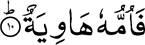
These two verses have to be read alongside vv.6-7 as mentioned above. These verses here show us that satisfaction has not been achieved by such folks. They are discontented, so they seek to attain contentment/happiness by making their goal or their refuge in whims. This is captured very well in the expression Fa-Ummuhu Haawiyah.(#2)

Haawiya is from Hawaa, which means whims, lusts, and the like. In other words, it is speaking to the narcissistic personalities,   people whose only goals are the satisfaction of their egos [an eternal hunger, which is actually never satisfied] and the trappings of materialism and all that glitters.

"And what will teach you about [the reality of ] whims?  It is [actually] a blazing fire" ( Q 101:10-11)


While it is clear that an afterlife exists, which has categories we know of as paradise ( Jannah) and Hell (Jahannam), it should also be clear that the foundations of that are manifested here in this life. The personality whose focus is only on ego and control is never secure. That personality hates and actually is likewise hated by others, yet does not care. That personality attains power and yields it in with destructive results.

The Qur'an phrases it in this fashion:

"Have you not observed the one who takes his whims [Hawaahu] as his object of worship? God has made such most astray, upon His own knowledge ( of that character's inner realities) placed a seal on his hearing, heart, and has veiled his vision..." ( Q 45:23).

In short, success is happiness, doing good, positive attitudes and inner-cultivation. If we can remember that and work on that, we will naturally fall out of the orbit of those who don't have that same interest, and, thus, be protected from their harm.

If we see the qualities of the hell-bound in our own thinking and actions, that should inspire us to BE BETTER, to aspire to change.

That can happen, with God's help as well as our own efforts ( Q 13: 11)

Endnotes

[1]  The Gospel Of Prosperity is essentially a movement within American Christianity which places emphasis on material things as evidence that God has blessed you. This writer recalls attending a panel discussion at a University, in which a Pastor who follows this ideology spoke against charity! The historical development of this concept is too complex to explain in a footnote, but it is important to know that many of the famous Televangelists adhere to this thinking. For a summary of the historical development of this trend, see https://www.thegospelcoalition.org/article/prosperity-gospel-born-in-the-usa/.

[2] "Umm" can mean "mother", "source" as well as "refuge". In other  words, here the Qur'an is telling us that the whole goal of those seemingly hell-bound is their Hawaa. The phraseology in Arabic is very profound, and admittedly I find it difficult to translate the same feeling into written English. 


Monday, July 17, 2017

Study notes : Soorah Al Hijr [Qur'an 15:10-30]

[ Note: The following are some reflections on texts from the fifteenth Soorah of the Qur'an. We have examined the first ten verses, available at http://shamsuddinwaheed.blogspot.com/2017/07/study-notes-brief-thoughts-on-quranic.html. The English translation has not been given, unless otherwise stated, allowing the reader to look up the translation of their choice.]


[15:10]


وَلَقَدْ أَرْسَلْنَا مِن قَبْلِكَ فِي شِيَعِ الأَوَّلِينَ

As stated in our previous article, just as God's message has been ever consistent, the response of the leadership of rejection [A-immah al Kufr] has, likewise, been consistent. Ever demanding of what amounts to little more than magic tricks, diminishing the real import of the Divine imperative.


[15: 11-15]

‏وَمَا يَأْتِيهِم مِّن رَّسُولٍ إِلاَّ كَانُواْ بِهِ يَسْتَهْزِؤُونَ
كَذَلِكَ نَسْلُكُهُ فِي قُلُوبِ الْمُجْرِمِينَ
لاَ يُؤْمِنُونَ بِهِ وَقَدْ خَلَتْ سُنَّةُ الأَوَّلِينَ
وَلَوْ فَتَحْنَا عَلَيْهِم بَابًا مِّنَ السَّمَاء فَظَلُّواْ فِيهِ يَعْرُجُونَ
لَقَالُواْ إِنَّمَا سُكِّرَتْ أَبْصَارُنَا بَلْ نَحْنُ قَوْمٌ مَّسْحُورُونَ

If one were to read other places within the Qur'an or even the Christian Bible ( Matthew 16:1, Luke 11:16], this basic pattern is the same.

Notice here in verse 12 that the "hearts of the criminals" is said to have been corrupted, so that they cannot and will not change. This assertion has been given repeatedly in the Qur'an [see 2: 7-17 for a clear series of examples]. It is important to remember that "Mujrimeen" [Criminals] and Kaafireen [Rejectors] are terms referring to the same reality. In other words, these are synonymous expressions, and are referring to the A-immah al Kufr. They reject the signs of Allah with all sorts of excuses.

[15:16-18]

وَلَقَدْ جَعَلْنَا فِي السَّمَاء بُرُوجًا وَزَيَّنَّاهَا لِلنَّاظِرِينَ
وَحَفِظْنَاهَا مِن كُلِّ شَيْطَانٍ رَّجِيمٍ

إِلاَّ مَنِ اسْتَرَقَ السَّمْعَ فَأَتْبَعَهُ شِهَابٌ مُّبِينٌ
There are similar passages in the Qur'an. One example reads: " The Adorned Sky, adorned with heavenly bodies [Kawaakib]...rebellious devils  being unable to get a full hearing of Al Mala' Al A'laa ( high assembly), chased away by a burning flame." ( Q 37:6-10).

It is popularly imagined that these verses are referring to Shayateen being chased away from the gathering of angels in an heavenly assembly by a comet.

Looking at context, and after many years of pondering upon these set of Ayaat, this writer is of the view that the text is not talking about the sky, but rather, about the Qur'an itself!

In other words, criminally minded folks, be they with a "Muslim" name or a "Non Muslim" name, with wrong-headed interpretations of the Qur'an eventually gets discovered, and any success they have will be short lived.

It does not matter if those engaged in wrongful or deliberate misrepresentations are from the Khawaarij( ft.1) of old or their modern day manifestations in the form of ISIS, or if they are from the Right-wing bigots posting video commentary, they eventually become discovered and their misrepresentation will not hold long term traction.

It is interesting to note here that The Prophet Muhammad Sall Allahu 'alayhi wa sallam is reported to have said "My Ummah will not agree upon that which is misguidance". [Tirmidhee]

In other words, while elements of deviance and disagreement will always be in the Muslim community, as with any community, the core principles and teachings are all agreed upon. For Muslims, that agreement is manifested in things from the same prayer, same scripture, same pillars, and so forth.

If the vast majority are saying, for example, that the sex slavery reportedly practiced by ISIS is incorrect, and that terrorism is contrary to religious ethics, that should be an evidence that it is the vast majority got it right!

[15:19-20]


‏وَالأَرْضَ مَدَدْنَاهَا وَأَلْقَيْنَا فِيهَا رَوَاسِيَ وَأَنبَتْنَا فِيهَا مِن كُلِّ شَيْءٍ مَّوْزُونٍ

وَجَعَلْنَا لَكُمْ فِيهَا مَعَايِشَ وَمَن لَّسْتُمْ لَهُ بِرَازِقِينَ


The Qur'an is from the one who has made the Earth, and provides for all. Allah's provision reaches all things. We invite a reader to go to a zoo, or to a community garden, and have the custodians explain the processes of farming and gardening, the reader will reach the conclusion that God provides for all.

Revelation is often connected to the natural world.

"The Merciful [God], Teacher of the Qur'an, He created humanity, He taught man articulate expression. The Sun and The Moon operate on a course predetermined." [Q 55:1-5]

"Read! In the name of your Lord who created, created man from a clot, Read, and your Lord is the Most Generous, Who teaches by means of the Pen, teaches man what he did not know." [Q 96:1-5]

[15:21-24]

وَإِن مِّن شَيْءٍ إِلاَّ عِندَنَا خَزَائِنُهُ وَمَا نُنَزِّلُهُ إِلاَّ بِقَدَرٍ مَّعْلُومٍ
وَأَرْسَلْنَا الرِّيَاحَ لَوَاقِحَ فَأَنزَلْنَا مِنَ السَّمَاء مَاء فَأَسْقَيْنَاكُمُوهُ وَمَا أَنتُمْ لَهُ 
بِخَازِنِينَ
وَإنَّا لَنَحْنُ نُحْيِي وَنُمِيتُ وَنَحْنُ الْوَارِثُونَ
وَلَقَدْ عَلِمْنَا الْمُسْتَقْدِمِينَ مِنكُمْ وَلَقَدْ عَلِمْنَا الْمُسْتَأْخِرِينَ 


The source of the Qur'an, as well as for provison of all, is God, The All-Knowing.

The Qur'an functions as a clarifier [See Q 27:76 for example] and does so particularly on issues relating to God concept [see Q 2:255, 24:35, and 112:1-4], contrasting to the views of some religions, which depict God in language suggesting 'resting' [Genesis 2:2] or that God is the knower of headlines, not small details [ such as in the Hindu sect Brahman Kumaris]

[!5:25]

وَإِنَّ رَبَّكَ هُوَ يَحْشُرُهُمْ إِنَّهُ حَكِيمٌ عَلِيمٌ

An obvious reference to the day of Judgement. It is important to note here that this is a fundamental Islamic teaching. If one denies that there will be a time in which one is held accountable before Allah, that person has a defective understanding of the faith.

[15:26-27]

وَلَقَدْ خَلَقْنَا الإِنسَانَ مِن صَلْصَالٍ مِّنْ حَمَإٍ مَّسْنُونٍ
وَالْجَآنَّ خَلَقْنَاهُ مِن قَبْلُ مِن نَّارِ السَّمُومِ

The Nation of Islam [NOI] uses these verses, as well as some other texts [although they tend to use Biblical allusions more] to support a racist interpretation.

Their belief system includes a story that Whites were created by an evil Black Scientist named Yacub. In essence, according to them, Whites are actually Non Human!(Ft.2)

"And Indeed, We [Allah] have created humanity from Salsaal, from Hamaa-in Masnoon."

Salsaal: "Dried clay that emits a sound when struck". The Qur'an translator and commentator Muhammad Asad takes this to mean "an allusion to articulate speech..as well as the brittleness of his existence." [The Message of the Qur'an, 1980, Gibraltar]

Hamaa: "dark or black clay". This is found in Tafseer Al Jalalayn(ft.3]  as well as other Tafaseer.

Masnoon: "Shaped into human form, hollowed out"(ft.4)

Here, we have some matter-of-fact descriptions of human creation. Other verses highlight other items, such as blood and water.

These verses should not be read in a racial or racist way! Indeed, the Qur'an (Q 30:22) says that the different colors and languages exist by God's will, as evidence of his power and artistry, and Q 49:13, the most famous Quranic passage on issues involving race and tribe, says that his making people as different groupings allow for learning!

In other words, the interaction between the different human societies or sub-societies benefit all involved. Be it in food, music, clothing, any field.

It is also important to share the observation that those who seek racial division and advocate hatred based on color, language and the like, are people who have been influenced by devilish influences. It is the view and experience of this writer that such voices are power seeking, power hungry, irrational beings at their core, not in need of hatred, but of spiritual reformation.

Verse 27 tells us briefly about the creation of the Jinn, in contrast to that of humankind. It is imagined that Jinn are equal to Genies, made famous by legends and of course Disney movies. It is impossible to verify one way or the other most of those tales, so it is important to stick as much as possible to what is contained in the Qur'an and authentic Sunnah.

"Jinn" basically means "hidden". It is a life form or force whose reality we cannot fully grasp. It's nature is fiery, in contrast to the "pottery type" of nature humans have!

[15:28-30]
وَإِذْ قَالَ رَبُّكَ لِلْمَلاَئِكَةِ إِنِّي خَالِقٌ بَشَرًا مِّن صَلْصَالٍ مِّنْ حَمَإٍ مَّسْنُونٍ
فَإِذَا سَوَّيْتُهُ وَنَفَخْتُ فِيهِ مِن رُّوحِي فَقَعُواْ لَهُ سَاجِدِينَ
فَسَجَدَ الْمَلآئِكَةُ كُلُّهُمْ أَجْمَعُونَ

Iblees is made from the fire, he is a Jinn creature. He saw himself as superior to Adam, which is why he refuses to prostrate to Adam even though ordered by God to do so [15:30].

Iblees is not an angel, he was in angelic company, but he was a Jinn. Verse 29 tells us Allah breathed into Adam "My spirit", a referece to the breath of life.

Iblees-in a sense- is the first racist. The Quranic narrative is so strong, and here, looking at vv.26-27 before, it seems an even stronger evidence is being provided to show that those playing racial or nationalistic politics are actually playing from Satan's own playbook!

It is important not to fall into those traps. The Prophet said that among the signs of the nearing of Judgement day, one would find "Knowledge in low estimation, and an abundance of ignorance." (Yaqillul 'ilmu wa yaktharul Jahl].

The "Ignorance" spoken of in the Qur'an and Ahadeeth has many aspects. A good way to begin to understand what the texts speak of is to consider the age that preceded the Prophet's emergence on the Arabian peninsula. Idolatry and tribal wars, but also racism and tribalism [which Muslims call traditionally 'Asabiyyah].

The presence of the Prophet -upon whom be peace and blessings- as well as the Quranic revelation-did much to remove those diseases from the hearts of the Arabians of that time. "Muslims" should not have those issues anymore, but unfortunately we do!

Racism of all types exists, and is manifested in varying ways. Sometimes it is those proclaiming to be victims of racism that are, in fact, the biggest promoters of it!

If such folks claim an allegience to Islam, it is important for them to look inward rather than always playing the victim card. It is important to have one's faith and confidence in Allah and in Allah's words, above the calls of others. Islam is a faith that requires not only outward submission, but internal conformity to the Divine Imperatives!


Footnotes

[1] The Kharijies were an early extremist trend which emerged in Southern Iraq, roughly the same location ISIS as a movement came from. They were famous for their views that they alone possessed religious truth, and launched a bloody campaign for power. One of their members even killed the Prophet's own cousin, 'Ali ibn Abi Taalib, while the latter was praying in a Kufa, Iraq  Mosque [661 CE].

[2] It is possible that Elijah Muhammad [who records the Yacub account in his Message to the Blackman] meant for the account to be a dramatized social commentary, nonetheless, it has become a doctrinal teaching that still finds expression in today's NOI led by Minister Louis Farrakhan.

While it seems to this writer that Farrakhan has tried to distance himself from that rhetoric of the past, nonetheless commentaries on it still appears from time to time, composed by such persons as the late Tynetta Muhammad and Jabril Muhammad,  in his weekly publication, The Final Call. 

[3] Tafseer Al Jalalayn is a brief classical commentary, by two scholars carrying the same first name {Jalaluddin Al Mahalli in 1459 and his student Jalaluddin As Suyooti, his student, completing it is 1505}. The edition we have consulted is 2007, Damasus, Darul Kalam At-Teeb.

[4] Tafseer wa Bayaanu Kalimaat Al Qur'an, by the famed Egyptian scholar, Shaikh Hasanayn Muhammad Makhlouf (d. 1990]. The edition consulted is 2006, Amman, Daar Usaama.