Showing posts with label personality. Show all posts

Friday, December 10, 2021

Towards Honest self-inventory: an Islamic perspective (Friday Khutbah)

 (Note: The following is an edited version of the Friday prayer service sermon conducted 12/10/21 at Masjid Ibrahim, Las Vegas, Nevada. The opening words of praise for God (hamd) have been omitted.)


Allah has created us to be different


The Friday prayer sermons from the last two weeks have dealt broadly with the subject of self-enrichment, and have posited the argument that Allah has created us to embody differences, not just in language and skin color, but personalities, interests, tastes, habits and the like. (ft.1)  


Similarly, we have looked at Abu Bakr and 'Umar b. Al-Khattab, may Allah be pleased with them. Abu Bakr was known to be very gentle and soft-hearted, whereas 'Umar was known to have a tough personality, yet, when they became the leaders of the Muslims after the death of the Prophet ( Sall Allahu 'alayhi wa sallam), they made contributions that led to the growth of the community, despite their unique traits.


A beautiful recollection of 'Umar

Years after he became Muslim, 'Umar recalled two incidents which made him laugh and cry respectively. One was an occasion in which he had done acts of worship to dates, a food item widely available in the middle east. Later on, upon getting hungry, he consumed these dates. This story has been shared often at our Sunday School classes, using the analogy of worship of a cereal box(ft.2). 


The reason he worshiped the dates is because that was the social norm at that time in the Arab peninsula. He sincerely believed these practices were legitimate. It should be noted that idolatry (shirk) takes on many forms globally, worship of food stuff being one of them.


The above made him laugh, but what made him cry? He recalled a time in which he had buried his baby daughter alive. This was also a practice common among the Arabs of that time. Upon honest reflection, he cried at this incident.


Exposure to Islam, as taught to him by no greater a figure than the Prophet Muhammad, caused him to engage in honest self-inventory. This did not diminish his courage, intelligence and strength. Islam made him look at himself, at his own actions, despite those actions having been the norm in Jaahili times, nonetheless it shows that he corrected himself. 


Islam advocates retaining and cultivating positive traits, and limiting, if not eliminating, negative ones. The ultimate source of judging such things is Divine guidance. "Blessed is He who has sent forth the Criterion (al-Furqaan) upon his servant, so it may serve as a warning to all nations." (Q 25:1)

تَبٰرَکَ الَّذِیۡ نَزَّلَ الۡفُرۡقَانَ عَلٰی عَبۡدِہٖ لِیَکُوۡنَ لِلۡعٰلَمِیۡنَ نَذِیۡرَا

What is Islam? Second section


Islam is more than a list of allowances and prohibitions. It is the summary of Divine guidance as conveyed to all the Prophets and messengers globally, and, as a side note, not restricted to one particular section of humanity. 


It is Allah's deen which should be the most important source of worldview. This does not negate unique identity, tastes and the like, as God has created us to be unique. Once we make Divine guidance, and not necessarily social or family expectations, the ultimate source, life becomes easier.


This does not mean we become angels or saints, but it means that Allah's deen, known as Islam, provides an unmatched safety net. Thus, the Qur'an says "and Allah invites towards a peaceful abode."( 10:25)وَ اللّٰہُ یَدۡعُوۡۤا اِلٰی دَارِ السَّلٰمِ


Allah wants stability and happiness for us. Allah's guidance is for our security in this life! 


It is imperative that we incorporate Islam into our lives and our worldviews. There are some simple things we can do, such as read Qur'an, even if just a little, once a week, be consistent in daily prayers, avoid the prohibited actions and items, all of which are clear, stay away from intoxicants of any kind, regardless of their legality, surround yourself with positivity, be clean and organized.


Footnotes

(1) The Friday prayer service sermons referenced are "self -diagnosis and enrichment" part one. found here and part two, found here


(2) Masjid Ibrahim offers quality Islamic education for children 6 and up. For more information, please contact the Masjid office at (702) 395-7013 or Masjidibrahimimam@gmail.com.


Saturday, August 24, 2019

Towards creating a balanced personality: brief reflections on the role of Prophet Muhammad)

( Note: the following is an article that is based on reflections shared in our Friday Khutbah 8/23/19. Both that khutbah and this article  should be viewed as a follow up on our Khutbah entitled " The Islamic Formula for Happiness: A Quranic perspective", which can be found part 1 as well as Part 2 . We recommend, in the interest of viewing the whole context, that  the above referenced Khutbah be viewed.)


Why Prophet Muhammad?

لَقَدۡ کَانَ لَکُمۡ فِیۡ رَسُوۡلِ اللّٰہِ اُسۡوَۃٌ حَسَنَۃٌ لِّمَنۡ کَانَ یَرۡجُوا اللّٰہَ وَ الۡیَوۡمَ الۡاٰخِرَ وَ ذَکَرَ اللّٰہَ کَثِیۡرًا

" Indeed, you have in the Messenger of Allah, a goodly model, for any who has hope in Allah, the final day, and who recall Allah abundantly." ( Q 33:21)

While the above quotation is often viewed superficially(ft.1), this Quranic verse tells us to look at the Prophet as an example of real success. He functions as an example for those who have hope in the future, hope in God's designs and plan.

While the Qur'an does tell us ( Q 9:129) that the core characteristics of the Prophet was that of kindness and compassion, there is another side that is present.

Another characteristic of the Prophet

"Muhammad is the Messenger of Allah, and those with him display strength(ashidda) with those who reject, yet display mercy with each other. You see them, in rukoo' (bowing), in sajdah (prostration), seeking bounty from Allah and His pleasure, in their faces ( i.e. the core of their being) are the traces of that submission ( min atharis sujood)" ( Q 48:29).
 
 مُحَمَّدٌ رَّسُوۡلُ اللّٰہِ ؕ وَ الَّذِیۡنَ مَعَہٗۤ اَشِدَّآءُ عَلَی الۡکُفَّارِ رُحَمَآءُ بَیۡنَہُمۡ تَرٰٮہُمۡ رُکَّعًا سُجَّدًا یَّبۡتَغُوۡنَ فَضۡلًا مِّنَ اللّٰہِ وَ رِضۡوَانًا ۫ سِیۡمَاہُمۡ فِیۡ وُجُوۡہِہِمۡ مِّنۡ اَثَرِ السُّجُوۡدِ ؕ
The above verse highlights the characteristics of strength and resolve. That requires working hard to accomplish necessary goals. The Prophet was not so "merciful" as to be passive!

The idea of passivity, of surrendering to tyranny (of whatever form) in the name of "surrender to God's will" exists within every religious community in some form or another, but what we learn from the Prophet Muhammad is that he had to face those who sought to destroy him, his followers and his community, and he faced those challenges by being proactive.

Both texts (33:21 and 48:29) have connecting to God in common. In Soorah 9:128-129 we see not only that the Prophet was kindly and compassionate, we  read therein a formula that he was to recite, to seek out God's presence and protection.

Some people believe that a passive, weak personality, is necessary for a healthy spirituality and even assert that such have moral superiority over Prophet Muhammad. Christian apologists cite Jesus's supposed passivity in the face of opposition as an example of his moral superiority over Muhammad.(ft.2).

When a personality is both spiritual and displaying strength, it can breed jealousy, opposition as well as slander. Worldly motivations are projected unto the Prophet, as well as the creation of stories of atrocities.

This happens to Prophets as well as Non Prophets. Good people, who want to see good within themselves and their societies, become targets by those opponents with jealousy within their hearts, or by those who themselves derive some power or benefit from an evil status quo.  It can be disheartening to those trying to do good.

When feeling like this, the Qur'an says to look to the Prophet Muhammad, upon whom be peace.  The Qur'an says, in essence, to the modern reader, "Look at what the Prophet was able to accomplish."

Arabian society had so much serious baggage in those days, well known social and religious ills, and the Prophet was largely successful in removing those bad elements, turning rough people into brave, yet contemplative, personalities, such as 'Umar b.Al-Khattab. His followers became people who looked inward, who worked hard on themselves. They did so by following the Prophet's example, by prayers, contemplation upon Allah (ft.3), discipline, and cultivation of the self.

Thus, the Prophet Muhammad is a model of success, not simply in the religious realm, but in the worldly life as well. The teaching that he conveyed-from Allah-has within it things which we could all use to create happiness and security in life. It is true that not all that he conveyed ("allowed" is perhaps a better term) is always to our pleasing, being as we all come with our own personal and cultural baggage, nonetheless those options are there.

More importantly, the personality of the Prophet is that of a balanced human being. He can be strong when fighting is necessary, but he can likewise be calm, kind and compassionate at those other times when strive is not present.

There are exaggerations and outright slanders against him. These things are brought up as attempts to indicate that the Prophet was a vicious and petty criminal. If such accusations were valid, Islam would have never went anywhere! It would have died out or become of marginal affect.

Yet, the contrast is the reality. Islam is here to stay. It is here to benefit all humanity. It is not here to be imposed by force, but it functions as a blessing.


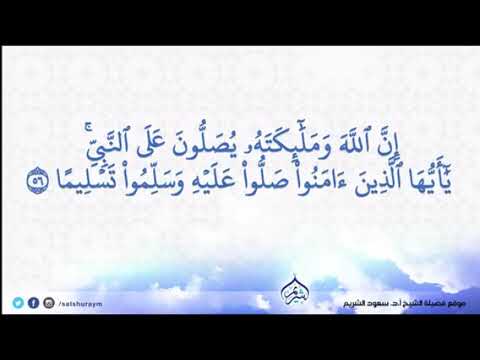
 Image result for quran 33:56

Footnotes

(1)  It is to our dismay that Muslims tend to quote this verse as evidence of a superficial following of the Prophet, taking only things such as dress and eating style from him. Muslim scholarship has wisely stated that there are things we follow of the Prophet when it has religious impact, but that there are things of the Prophet that exist only due to his place and time, such as the dressing style and other things common to all Arabs.  A superficial reading of the Quranic verse does a disservice to the Prophet.

(2) Other assertions made by Christian critics assert that the Prophet's married life was governed by sensual concerns, whereas Jesus was a higher moral code due to being celibate. These type of accusations have been addressed elsewhere by this writer See Here .

(3) The Hadeeth literature is full of examples of individuals coming to the Prophet, seeking out advice on making themselves better. There are even accounts of a self-accusatory nature, wherein people would even embarrass themselves in public by sharing their shortcomings, yet the Prophet would generally find ways to make them feel better about themselves. One example is found in both Al-Bukhari and Muslim, summarized thusly: A man wanted to confess to an indiscretion, the Prophet kept pretending not to hear him. After prayers, the man repeated the confession, the Prophet asked him if he had just prayed with him, the man replies in the affirmative. The Prophet replies that God had already forgiven him (i.e. the questioner).