Showing posts with label Zamakhshari. Show all posts

Monday, December 5, 2022

Musa and Khidr: a brief reply to controversy


Our brothers and sisters in faith,


As salaamu 'alaikum wa rahmatullahi wa barakaatuh.  This post is meant to briefly address misunderstandings which have emerged as a result of comments I made during the Jumu'ah Khutbah two days ago in Las Vegas, Nevada.

On the outset, I would like to say that I am like any other human being. I welcome discussion and questions, so as long as they are posed with decorum (adab). Moreover, I am able to make mistakes in speech, choice of words, and even conclusions, just like anyone else. It is for this reason that Muslims always have within our speeches the expression "God knows best" (Allahu A'lam), particularly when exploring scriptural texts.


With that said, it is important to say, as a matter of personal faith, that I am a believer in the Qur'an. I am 100% convinced that it is from God!  I have no doubt that its contents are conveyed by Allah, that it is preserved and intact, from the time of revelation till now. The more information I encounter in life only reinforces this conviction. 

إِنَّمَا ٱلْمُؤْمِنُونَ ٱلَّذِينَ إِذَا ذُكِرَ ٱللَّهُ وَجِلَتْ قُلُوبُهُمْ وَإِذَا تُلِيَتْ عَلَيْهِمْ ءَايَـٰتُهُۥ زَادَتْهُمْ إِيمَـٰنًۭا وَعَلَىٰ رَبِّهِمْ يَتَوَكَّلُونَ

" Verily, believers are only those when Allah is mentioned, their hearts are moved. And when His signs (i.e. Quranic verses) are related to them, it increases them in faith (imaanan), and upon their Sustainer they have reliance" ( Q 8:2)

During the khutbah, I mentioned in passing that I am more inclined to take the account of Moses (Prophet Musa, 'alayhis salaam) encounter with the mysterious teacher known as Khidr (a name meaning "greenish", an allusion to fresh, healthy knowledge) in metaphorical terms. 


Let me clarify, metaphor does not equate fiction nor something fake. In this context, the intended meaning of my words is that there are important lessons that are being delivered to the readers by means of the account, some of which were highlighted within the khutbah itself. 


While it is acknowledged by all hands that symbolic terminology exists within the texts of the Qur'an and Sunnah, disagreements naturally arise as to which texts fall under the category of clear and which are open to interpretation. The Qur'an itself speaks on this " He it is who sent down upon you (O Muhammad) The scripture, of it are verses of decisive character (Aayaatun Muhkamaat) , they are the foundational for the scripture (ummul Kitaab), and others are flexible in understanding (mutashaabihaat)...and none knows its (ultimate) explanation (Ta'weel) except Allah and those grounded in knowledge (war raasikhoona fil 'ilm): They assert "We believe in it, all of it is from Our Lord's presence" and none grasp (all of) this except those of understanding " ( Q 3:7)


ہُوَ الَّذِیۡۤ اَنۡزَلَ عَلَیۡکَ الۡکِتٰبَ مِنۡہُ اٰیٰتٌ مُّحۡکَمٰتٌ ہُنَّ اُمُّ الۡکِتٰبِ وَاُخَرُ مُتَشٰبِہٰتٌ ؕ فَاَمَّا الَّذِیۡنَ فِیۡ قُلُوۡبِہِمۡ زَیۡغٌ فَیَتَّبِعُوۡنَ مَا تَشَابَہَ مِنۡہُ ابۡتِغَآءَ الۡفِتۡنَۃِ وَابۡتِغَآءَ تَاۡوِیۡلِہٖ ۚ؃ وَمَا یَعۡلَمُ تَاۡوِیۡلَہٗۤ اِلَّا اللّٰہُ ۘؔ وَالرّٰسِخُوۡنَ فِی الۡعِلۡمِ یَقُوۡلُوۡنَ اٰمَنَّا بِہٖ ۙ کُلٌّ مِّنۡ عِنۡدِ رَبِّنَا ۚ وَمَا یَذَّکَّرُ اِلَّاۤ اُولُوا الۡاَلۡبَابِ ﴿۸

The goal of Divine revelation is to give us direction, a firm foundation in both religious and worldly senses. It employs both direct and subtle means to accomplish this, and similarly delivers guidelines which are easily recognized. 


Is there any precedent for symbolic interpretations of Moses and Khidr account among Ahlus Sunnah wal jamaa'ah?


The account only appears in Soorat al Kahf, a text which reports in the hadeeth literature assert provides protection from false messianic figure (Al Maseeh id Dajjal) as well as a light from week to week (the latter being the source for the practice of reading it on Fridays). Thus, it has a theological, practical and phycological importance. 


While a number of thinkers and scholars within the Islamic community have, throughout the centuries, opined rather interesting allegorical interpretations, the outstanding voices within Ahlus Sunnah that shared this include figures such as Naasirudeen Al Baydawi (d. 1319 c.e.). His famous Quranic exegesis, Anwaar at tanzeel wa Asraar at-ta'weel, better known as Tasfeer Al Baydawi,  in speaking on the text which introduces the account, writes "It is said that the two oceans are Moses and Khidr, Moses was ocean of outer knowledge (ilm udh dhaahir) and Khidr was knowledge of the inner ('ilmul Baatin)." ( Tafseer Al Baydawi, vol. 3, pg. 287, Beirut, Lebanon, Mu'assat Tareeekhul 'Arabi edition).


Zamakhshari, (d. 1143) in his famed commentary (Al Kashshaaf) has said similar words. " Some of the commentaries assert "Verily, the two oceans are Moses and Khidr, for the two of them were certainly two oceans of knowledge (li-annahumaa kaanaa bahrayni fil 'ilm). (Al Kashshaaf, vol.1, pg 537, Beirut, Darul Kitaab al Arabi edition).  Remember that in the account, Moses, peace be upon him, had made a vow to travel to the junction of the two oceans. There, he meets Khidr, and the above exegetes have shared how they themselves embody those oceans, i.e., two types of knowledge, an allegorical image.


It is worth noting that the term "metaphor" is found within the Soorah itself, (32, 45, and 54). In 18:54, it tells us that the Qur'an employs "every (type of) metaphor" (kulli mathalin) to benefit people.


There is acceptable divergence allowed in hermeneutics, this is part of spiritual and intellectual growth. Nonetheless, I pray that this brief post allows that the confusion has been cleared up, wa billaahit Tawfeeq. 


Friday, June 19, 2020

An environment for growth: reflections on Soorah Al A'laa


(Note: the following are reflections based upon the 87th chapter of the Qur'an. The translation, unless otherwise stated, has not been shared. This allows the reader to consult the English translation of their own choice. All translations are my own, unless otherwise stated.)


One of the main functions of the Qur'an is that it compels us to think, to ponder on its words, its message, as well as how that plays out in our lives or the world around us. This Soorah is particularly interesting, in that it weaves together a tapestry of images designed to evoke deep thought. This Soorah is often recited in Salaat Al Witr and Salaat Al 'Eid.


(A) Q 87:1-5

The symmetry is beautiful. The structure of the creation, the physical world, is evidence of Allah's work, displaying reasons we should glorify him.

(B) Q 87:6-7


It reads "We (God) will relate to you, so forget not, except as Allah has willed, Indeed, He knows the visible as well as the hidden". Some have taken this as textual evidence of abrogation (Naskh) in the Qur'an, not only in the development of laws, but even texts. Some have read this as proof that the Prophet was to "Forget" some of the Quranic revelation. The latter view is particularly disturbing, as it presents the Qur'an in a very weak position, as if it is so unworthy of adherence that it has to literally be forgotten. The nature of the Qur'an is the opposite, it is read, memorized and pondered upon by millions, ever since its revelation. To attribute dismissing any Quranic revelation to the Prophet is to do a disservice to both the Prophet, (peace and blessings of Allah be upon him) and the Qur'an itself.


In his comments, the Qur'an commentator and translator Muhammad Asad  (whose work is called The Message of the Qur'an) alludes to these verses not actually referencing the Prophet or the Quranic revelation given to him. He argues that these verses refer to "mankind's cumulative acquisition of empirical and rational knowledge, handed down from generation to generation and from one civilization to another"(ft.1)

We state this in another way, Allah conveys lessons, points of reference or information, that will be submerged when more important or useful points are needed. This is the Divine system, alluded to elsewhere in the Qur'an, and can be related to all points in the life of  a single human being.

(C) 87: 8-13

"And We (Allah) will make the easiness easy for you, so do remind, because reminder is beneficial, such reminder will be really beneficial for those who have fear of God, yet, that reminder will be shunned by the most wretched ones, who will enter the great fire, therefore, in it they neither experience death nor life."

The core commands of God are easy, and He has made them easy. Being open to guidance is-in fact- a characteristic of guidance. Those who shun reminders are those who carry arrogance within themselves, who eventually enter a fire (in this life, fully experienced in the life to come) that consumes them, they can not life healthily therein, nor can they mercifully expire.

(D) Q 87:14-15

There is a logical flow present in this Soorah. Being open to Divine blessings, being able to see the big picture and praise God for it, dropping what God wants you to drop, in order to progress in life.

The rectification of the soul (Tazkiyatun Nafs) is am important subject within Islam, rooted in the Qur'an, it has been noticed by the many great minds of the Muslim civilization, such as Imam Al-Ghazali, but the point being is that we have to be consistent in looking at self, just as we are consistent in bathing!

Vigilance in purifying efforts is mainly exercised, as the verses indicate, through reciting the name(s) of Allah and through prayer.

The classical commentator Abul Qasim Mahmud Az-Zamakhshari  (d.1144) cites the importance of purification from idolatry, disobedience, as well as acts of physical purification which precedes prayer, as concrete examples of things to do to be vigilant in soul-care (ft.2).

(E) 87:16-19

It is my view that these verses can apply to both the life now (Dunya) and the life after death, as well as life with and without guidance.

The life without guidance can be glittery. It is glitter. It is attractive in many ways. However, the life of substance, of real and tangible core values, morals and ethics, a life of God-connection, that is the real life, the enduring life.

These insights were presented and symbolized by both Abraham and Moses, upon both of them be peace. They stood for God and were connected to him.

Footnotes

(1) The Message of the Qur'an by Muhammad Asad (Gibralter 1980) page 1080.

(2) Al Kashaaf 'An Haqaaiq At Tanzeel, page 556, Vol.2 ( Beirut edition, 2016)

Monday, September 11, 2017

Study Notes: Accepting God's will: Refections upon Soorah Al Hijr ( 15: 80-90)

( Note: The following is an edited version of my reflections on a handful of Quranic verses. Previously, we have looked at vv. 70-80, which can be found here . The English translation has not been included, unless otherwise stated. This allows the reader to consult the translation of their choice. The Arabic text has been included, and, as always, discussion is welcome.]


[ Q 15:80]

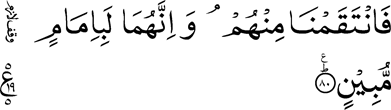
As found in the previous article, we have a brief gloss of the regions Madyan and Hijr. The famed Zamakhshari has suggested ( as quoted by Muhammad Asad) that "Messengers" is a reference to not only the Prophet Saaleh, but rather to his followers, suggesting that the followers of the Prophet Saaleh [and perhaps, by the followers of all Prophets] have a Prophetic mission themselves.


[ Q 15: 81-84]



It is generally imagined that Prophets are figures speaking to primitive societies, however the words of the Qur'an point towards the opposite conclusion. We are talking about highly advanced, materially rich, cultures. We should also consider connecting these verses to the Sodom and Gommorah situation, in the sense that both had the same issues of moral decay.

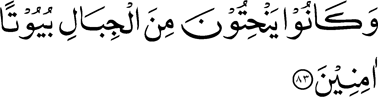
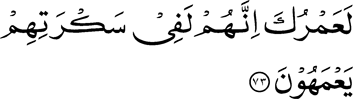
Q 15:72 states that Sodom and Gomorrah existed in a drunken condition, blindly wandering. Now, in v.82, we see that these groups would ignore Allah's signs and exist "feeling secure" because their homes were built in seemingly solid places such as mountains. However, that did not save them!

This is a lesson that we in the developed world need to learn. As we compose these words, the USA is facing Hurricanes in our southern regions. Indeed, it has to be admitted that those of us living in the USA and in other highly developed nations perceive ourselves as largely immune to the disasters, both natural and man-made, that other societies face on a regular basis. The feeling of complacency, in the face of eventualities as well as in the face of social and moral injustices, can very well be the seeds that plant our eventual destruction.

We are not advocating a negative view on everything, only that we keep our eyes open, and our hearts firmly planted within Allah's guidance.


[Q 15:85]
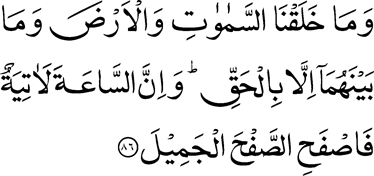
Haqq has a plethora of meanings and implications, here, it is best to render it as "Purpose". In another verse, Allah says "And We ( i.e. Allah) have not created the sky and the earth and what is between them for play" [Q 21:16].

The One who created the universe for Haqq, will, likewise, end it all in Haqq. The ending is the "hour" of Judgement. That day is also called The Last Day [Yawm Al Aakhir]. Because the beginning and ending all exists within God's purposes, we are told "So forgive with gracious forgiveness" (Saheeh International translation).

This last sentence in the verse is clear enough, yet Tafseer Al Jalalayn asserts that it is abrogated by "The verse of the sword", which reads, as translated by Saheeh International  : "And when the inviolable months have passed, then kill the polytheists whereever you find them and beseige them and sit in wait for them at every place of ambush.." ( Q 9:5)

We find this assertion to be unsupported by the context, moreover, the assertion is a violation of well known principles. Q 9:5 is clearly in a certain war context at a certain place and time. Indeed, all one really needs to do is read the contex [Starting from 9:1 and ending in 9:10]. In other words, verses regarding war are at a particular place and moment, specific to that, whereas the principle of graciousness, humility, forgiveness and kindness are general and timeless.

The general principle, when and where general situations are applicable, have nothing to do with war and fimness during periods of imposed conflict.

Throughout the Qur'an, we read statements such as "and when the ignorant address you, say "peace"" [Q 25:63].

Therefore, we cannot agree with the claim that this text has been abrogated. We question the entire basis for the claim that any verse of the Qur'an has been abrogated(ft.1)


[Q 15:86]



Al Khallaq means the ever-Creating. It is different from Al-Khaaliq {The Creator}. The former shows us that God is constantly at work in creating!

This is an important nuance because as scripture readers, we tend to think of Allah as only acting in the past, whereas the fact of the matter is is that Allah is still and will always be at work in the universe He runs.  The importance of Ayatul Kursiyy  ( Q 2:255) is highlighted in such a discussion. If God is simply a historical figure, a being who worked in the past, the presence of Ayatul Kursiyy in the Qur'an would be pointless, as would the numberous Prophetic traditions encouraging us to regularly recite that text!


[Q 15:87]
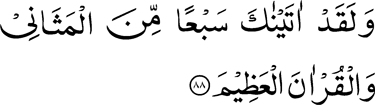


"Seven oft repeated" is universally understood to refer to Soorah Al-Faatihah. That chapter, the Qur'an's opening words, is recited several times daily in Muslim prayers.

It is signifigant to this writer that all Muslim demoninations without exception agree that Al-Faatihah is necessary for the daily prayers, even though there is no verse which directly says that one must recite it in the prayers.(Ft.2)


[ Q 15:88-90]
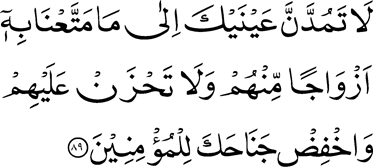


This is directed to Prophet Muhammad, upon whom be peace and blessings, moreso than anyone else. In essence, it says to him to never be tempted to give up your faith and the company of those sincere in their faith, because God has already given you so much. The material or worldly trappings in the hands of the disbelievers should not dissuade you.

Other Quranic texts tell the Prophet, Sall Allahu 'alayhi wa sallam, the same message. In particular, many of the texts in the Juz 'Amma section . I would recommend reading some of those Soorahs, such as Ad Duhaa ( chapter 93), Inshiraah ( chapter 94) and Al Kawthar (chapter 108).

Verse 90 is more difficult to grapple, and that difficulty is reflected in the different interpretations found in the books of Tafseer.

If connected with vv.91-92, the context seems to be a warning, just as warning is found in general in the story of Lot's people and the Madyan and Hijr above, to not pick and choose what one accepts of Divine Revelation.

The Qur'an states "..and those firmly grounded in knowledge assert 'We believe in it, all of what is from the presence of our Lord.." ( Q 3:7).

In today's world, we have trends which attempt to carve up the scripture, both figuratevly and literally. We have writers and lecturers, of Muslim family backround, asserting that Muhammad made up parts of the Qur'an in order to justify genocide and to have women!

We have "Muslims" who esentially reject what the Qur'an says on race relations, who attempt to use the Scripture to justify racism, hatred, misogny, and immoral behaviour.

The Qur'an can never have textual corruption (called Tahreef in the literature) but it can have distortions based upon a copy/paste approach. This is done by extremist groups all the time among Muslim ranks, but it is also done diverse groups as Islamophobes ( folks with an irrational fear of Islam and Muslims) and liberal voices in the Muslim community.

I think it is better for people to admit that they have weaknesses rather than to justify the unjustifiable in Islam. It would be more honest.

In any case, there are other interpretations of verse 90 [and the verses following it] that could be the correct understanding. For now, we share our views above and conclude with the reminder that at the end, only Allah knows best.


Conclusion

The world and life therein can be a confusing place. The diversity of personalities, cultures, egos and agendas can bring people to a state of loss, of feeling lost. The Qur'an comes along to help us on life's journey, but in order for it to really be effective, one must reflect on it in a continous manner, regularly studying it, reciting it, and acting upon it.

This should not be done in a superficial way, nor should it be dogmatic, in the sense that the text gets manipulated to suit our whims.

In our previous article, we looked at the story of Lot, how the people there were "wandering about blindly, in a drunken state". In this article here, we read how Allah says that another group felt that they were secure from any catastrophe because their homes were built within mountains.

We should consider taking the above sentiments further, not just in social analysis, but within our own circles or existence of life. Are we walking blindly or acting drunk in our lives and in our thinking? Are we oblivious to realities? Are we painting the doors while the house is on fire?

May Allah show us truth as truth, and give us the ability to follow it, and falsehood as falsehood, and give us the ability to abstain therefrom.


Footnotes

[1] For more on the question of abrogation [known as Naskh] go to this link .

[2] We have a number of Prophetic Ahadeeth which tell us that Al-Faatihah is to be included in prayers. All the groupings, despite their many theological and methodological differences, accept that Al-Faatihah is needed to be included in their prayers. The necessity for Al-Faatihah in worship is also accepted by most of those who reject Hadeeth as a source of Islamic understanding, known widely as Quranites or "Quran alone". Thus, one can find the writings and videos of Rashad Khalifa, one of the most well-known proponents of a hadeeth-free understanding of Islam, advocating that Al-Faatihah be recited in prayers.

Al-Faatihah is known as Umm Al Qur'an, the essence of the Qur'an. It is the perfect text for worship, and logically we should be able to see why the Prophet Muhammad said that any prayer in which that Soorah was not included was "Incomplete" ghayr Tamaam. The source of this hadeeth is Saheeh Muslim.

Monday, September 4, 2017

Study Notes: Soorah Al Hijr [ 15: 70-80]. The implications of the story of Lot [Luut عليه السلام]

[ Note: The following is an edited version of some reflections on ten verses from the Qur'an. Originally, these notes were prepared for a weekly Quranic discussion I participate in, however I have decided to share them here, with the hopes of generating discussion and thinking. Also please note that unless otherwise seen in the text, the English translation has not been included. This will influence the reader to check the translation of their choice. The Arabic text is included.]


Some backround

This particular section deals with the story of Prophet Lot, known as Luutعليه السلام  in Arabic. The immediate context preceding the verses in question tell us that Lot's own household contained contrasting elements therein, as do all families. While Lot is connected to Allah, his wife is counted as being among the 'criminal class' [15:58-60]. Eventually, God's angelic messengers conveys notice to Abrahamعليه السلام ,  Lot's uncle,  that Sodom and Gommorah will be destroyed. The Qur'an says elsewhere ( Q 7:80-81 among other places) that the society engaged in intimate activity that cannot be deemed natural .

This particular issue is a deeply sensitive and potentially divisive one in today's world. I think it is important to see all of this in connection to what is repeatedly stated in these verses, and that is the title "The Family of Lot " [Aal Luut]. Lot is the family patriarch, the caring, wise and loving father and perhaps grandfather that we all have in our family units, seeking to preserve the morals of those under his care. Lot recognizes that wild behavior is something which leads to disastorous consequences ( Q 15: 61-64).

Lot advocates that the thinking of his family and followers be upon correct or healthy boundaries. He tells them to neither long for the social ties with those engaged in destructive behavior, nor even be in their company. In our age, the wise parent may instruct his child to stay away from certain other children because of their behavior, and the same parent may put restrictions [or even remove] the television or the cell phone when such devices of entertainment are found to be detrimental to the oveall development of his child [15: 65-66].

The society, probably more in particular the elites in power [called Al Mala' throughout the Quranic narrations], had places restrictions on Lot. In a sense, he seemed to have been a character that they wanted to silence, to be under house arrest. Lot  has some "guests" [who are actually these angelic messengers mentioned earlier] . These guests were threatened with attack, and the text implies that they were even threatened with rape! Lot makes a final appeal to any Taqwaaa [reverence for God Almighty] as well as any sense of social propriety, but alas, his pleas fall upon deaf ears. [Q 15: 67-69]

But as we come to know, attempts to restrict or suppress the truth eventually come to naught! Truth cannot be defeated( 15:70) . The Qur'an says "And say: Truth has come, and falsehood vanishes. Indeed, falsehood is, by it's nature, a vanishing [thing]' [Q 17:81]

[15:71]


In his comments, the translator Yusuf Ali righly points out that this language is the language of a family patriarch, an older man trying to push atleast a little bit in a different direction.
Thus, "My daughters" are not literal, nor is he seeking to sacrifice the women in his society to be raped, as sometimes thought by some critical readers. Perhaps marriage between men and women was a dying institute, as it is in our society today, and sought, out of desperation, to revive it.

[15:72]


The social order of  Sodom and Gomorrah was blinding and intoxicating. The verse uses the term  لفي to denote the intensity of this condition. 

It is very difficult for those affected by such conditions to see the reality of their existence. 

Prophets and Scripture comes forth in order to open up the eyes and to have foundations for proper thinking. I see the Prophet Muhammad's   صلى الله عليه وسلم   supplication as particularly relevant here in the sense that one not only invokes Allah but it also provides a philosophical foundation for acting in the real world.


His prayer is "O Allah, show us truth as truth, and give us the ability to follow it, and show us falsehood [Baatil] as falsehood, and give us the ability to abstain therefrom." 

[ 15: 73-74]


Sayhah is also translated as "scream", and seems to denote a general overturning of the social order.


[15:75]


The translator Muhammad Asad, quoting Imam Razi and the famed grammarian and commentator Zamakhshari, points out in his note that Mutawassim means " One who applies his mind to the study of the outward appearance of a thing with the view to understand it's real nature and inner characterstics".

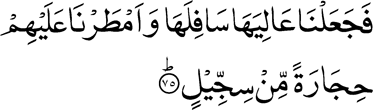
This is a deeply important verse here. When connected to 15:72, we can see that the argument is that a society of blinded, drunken (in their thinking and actions) human beings brings forth their own destruction. God says here that such societies should be studied, and this is precisely what social scientists, archaeologists, and related fields do. This also occurs with intelligent figures interested in the betterment of their own societies. One need only look at the libraries of such figures as Dr Martin Luther King, Jr and Malcolm X.  The latter, in his autobiography, mentions the many books he studied, they include histories, political theory, philiosophy, and more. 

The Qur'an is not a book that encourages blind faith. In fact, it points to the sciences, to certain fields and disciplines that would be deemed by many today as non religious! The guidance of God tells us that we should take lessons from the mistakes of past societies. It has been my observation that those who are deeply influenced by the Qur'an, personalities whom I know personally and others whom I have not interacted with, are people who are not limited to the Qur'an. Their interests are expansive, usually to include history, the physical world, science,  and the fate of civilizations. This does not mean that they all reach the same conclusions on all subjects, or that their conclusions are always correct. However, it does indicate that they are pondering deeply upon the words of Allah, which makes them look at the other important subjects. 

I would dare take this further to say that those who claim to study the Qur'an and yet have no interest in these [and other related] subjects, have in fact not studied the Qur'an properly! Perhaps a better way of saying that is that their "studies" are actually superficial at best. The need to study these other important fields is particularly acute in our Imams, scholars and speakers, especially the famous ones or those up and coming! 

There is no need for us to become like many who are referred to as Biblical fundamentalists, people who read and study only  the [translations of] Bible. Such reading may be a nice pious exercise, however the results can be very problematic, and we don't want to follow in the same mistakes.


[15: 76]


The location of Sodom and Gommorah is well known, as was known at the time of the revelation. God lets such remmants exist in order to be a lesson for future generations. Yet. today, at the site, it is not taken seriously. Indeed, it is now a swimming attraction today.


[15: 77]


Believers do take the warnings and signs of past civilizational failures seriously.

[15: 78-80] 


Madyan is in NorthWest Arabia, to whom a Prophet named Shu'ayb      عليه السلام   was sent.

Hijr is said to be between the Hijaz [Western Arabia, where Makkah and Madinah are located] and Syria. To them, a Prophet named Saaleh  عليه السلام         was sent forth.

Zamakhshari [as quoted by Muhammad Asad] suggests that the term "Messengers" here means Saaleh and his followers. This would suggest that the followers of Prophets likewise have a Prophetic mission.


These observations are not meant to be dogmatic, but rather to point out that the Quranic treatment of subjects are very nuanced. Indeed, even with the Sodom and Gomorrah story, we should be able to see that the prevalence of sexual relations outside of the norm is only a sympton of a deeper illness. We should also be able to see that the Qur'an advocates a serious study and search for solutions to the issues we face in today's world.

Wallaahu A'laam

Wa Billaahit Tawfeeq