As we enter the 10th day of the blessed month, let us take advantage of it while we can. Ramadan is the month in which the revelation of the Qur'an commenced, it is, according to Hadeeth narrations, a time of forgiveness, mercy and freedom from Hell. It's a time of deep introspection, and of improving our spiritual condition.
One of its most salient features is the Laylatul Qadr. A period, which we are told, is "better than a thousand months" [Khayrum min alfi shahr]. this expression, which appears in the Qur'an 97:3, denotes a benefit from a certain period that can last a lifetime, or even more than that.
We seek this period in the last ten nights of Ramadan specifically [although many suggest other times, even outside of Ramadan], but we have to be prepared for it. Fasting, charity, good deeds, more prayers and Qur'an reading all prepare ourselves for that opportunity, to have access to spiritual forces that can give us greater faith, confidence, drive in life, and- in addition, God-willing, Paradise.
May Allah allow us to get prepared, forgive our sins, accept our repentance, fasting and acts of worship.
Showing posts with label siyaam. Show all posts
Showing posts with label siyaam. Show all posts
Friday, August 20, 2010

Wednesday, November 4, 2009
Enhancement: the goal of Islam
"The best of you in [the days of] Islam is also the best of you in the days of ignorance" [Hadeeth, related in Bukhari, Al Adab al Mufrad 7: 71:129]
 Offered a minimum of five times daily [dawn, noon, mid-afternoon, sunset and evening], it is described by the Qur'an itself as having the ability to "restrain from hateful, shameful activity" [Q 29:45]. Apparently, a person who offers the Salaah with full awareness and consciousness will be less likely to enter into activities that are illicit, immoral or otherwise harmful. There is no coercion involved here. No fear of the police or of vigilantes. The person's awareness of God is enhanced by connecting with the Divine reality by the method of Salaah, a connection or awareness not easily dismissed or forgotten. In addition to this, there are some other benefits as well;
[A] Discipline: Salaah is to be observed at stated times, if offered at other times, it is considered "late" and not having the same merit or blessing as when performed at the stated times. If a Muslim can have the discipline to offer prayers five times daily, which also involves physical preparations [i.e. being in a clean state and making Wudoo' [ablution] beforehand], then he or she can have the discipline for any secular pursuit in life as well. A Muslim conscious of praying "on time" will also be "on time" for work, completing study/work tasks in a timely manner.
[B] Education: In Salaah, we mainly recite the Qur'an. This is very powerful, especially in congregation [Jamaa'ah][ft.1], when the prayer leader [Imam] recites texts that may be unfamiliar to the ones praying behind him. The Qur'an speaks to many subjects, and actually integrates seemingly unrelated subjects, so the prayers act as a sort of learning session, making the Musalli [the one praying] learn, become more well rounded. This is especially true of the Taraweeh prayers, offered in the evenings during Ramadan, wherein the entire Qur'an is often recited.[ft.2]
[C] Feeling of brotherhood
Much like the Hajj, Salaah is an equalizer. Rich and poor, black and White, all standing shoulder to shoulder, performing the same actions, reciting the same texts, the same rituals in the same language. In fact, there are several narrations in the Hadeeth literature which has the Prophet Muhammad instructing that there should be no gap between the praying people, because Satan can take advantage of that. Meaning, it's something that brings people close, whereas Satan seeks to divide.
Zakaah
The spiritual an societal benefits of paying 2 1/2% of one's wealth are obvious.
In an Islamic society, this can be collected as a tax and distributed according to he guidelines of the above Qur'anic text. In a Non-Muslim society, the Zakaah is usually given to Mosques or organizations who then distribute it according to the guidelines of the above verse. I believe it's especially meaningful to pay Zakaat while living in a Non-Muslim environment, because it makes the Muslim think, contemplate on who and what is most deserving of these funds.
Zakaah has the meaning of purification. Islam teaches that all personal wealth, even when legally and morally acquired, has a societal due. Hoarding is something not looked on favorably in the spiritual realm. The Bible reports Jesus, upon whom be peace, as saying
The distribution of Zakaah goes a long way in combating starvation, famine and the like. In addition to this, Zakaah funds can be used to address societal needs as well, such as education. Resources dedicated to this purpose are generally given the name Sadaqah Jareeyah [perpetual charity].
Funds that exceed the minimum requirements, called Sadaqah, are also given during times not generally considered. The Qur'an gives a "remedy" to personal transgressions by engaging one's wealth in Sadaqah. Below is a verse speaking about Dhihaar, a divorce practice observed by the Pre-Islamic Arabs in which a woman was denied both marital rights as well as the right to seek another marriage, leaving her in a limbo. Now, the Qur'an outlawed this practice, and gives the following guidelines to those Muslims who had done this.
Thus, Islam joins personal salvation with societal development and assistance.
Siyaam-Fasting
The Qur'an [2:183-185] tells Muslims to fast in the daylight hours of the lunar month of Ramadan. Fasting encourages us to be more conscious of the struggles others face to even eat once a day, thus, encouraging us to be charitable and distribute food to the needy.
Fasting is also a discipline building exercise. It should teach us to give up excess waste, junk food, cigarettes, vain talk, and strengthen personal morals. All of this and more can be found in the Quranic statement regarding the purpose of fasting, given in the words La'allakum Tattaqoon [So that perhaps you will gain Taqwa. Q 2:185]. The word La'alla shows us that there is a possibility of failure in accomplishing this goal, which is why we are to fast again and again. The Qur'an mandates the Ramadan fast, but we can also engage in voluntary fasting, to build up our morals, and above all the main thrust of Taqwa, to become closer to God.
Hajj

This is the last, and arguably a conditional pillar of Islamic practice, in the sense that one is obligated to make the pilgrimage to the site of the Ka'bah, built by Abraham and his son for the purpose of worshiping God, when financial and physical means are available. The Ka'bah is located in Makkah, in the Kingdom of Saudi Arabia.
During Hajj, we are once again made equals. The White seamless wraps, called the Ihram, does not allow that one's financial or education status be recognized. The King and the pauper both endure the same struggles, performing the same rituals, and each learning something, be it about others and their needs, or of a personal nature, that they were suppose to learn. This is why we have a tradition in Islam, attributed to no greater a figure than the Prophet Muhammad himself, upon whom be peace and blessings, that a successful Hajj [pilgrimage] wipes out prior sins, a person is renewed, pure as if a new born baby.
A recent study shows that returning pilgrims are 22% more likely to see Non-Muslims as equals, twice as likely to condemn terrorism, and 8% more likely to hope their daughters would adopt professional careers. [ "Muslim pilgrimage; a journey towards Tolerance?" Think; the magazine of Case Western Reserve University, Fall/Winter 2009 edition, page 18]
Conclusion
The foundation of Islamic practice is one that places emphasis on personal development, enlightenment, charity, sobriety and every other good characteristic. Islam is wrongly associated with violence and criminal activity. The recent death of a Detroit Imam, Luqman Abdullah, and the arrest of several of his supporters has once again brought the idea that Islam and criminality are linked to the public. One charge alleges that Abdullah gave legitimacy to theft, on the grounds that as long as they prayed and the thefts "benefits Islam", it was legitimate. Given the public works and reputation of the deceased Abdullah, the charges are very suspect, but nonetheless in terms of what Islam teaches, it's pillars hold up people's hearts and minds to always be conscious of Allah, of one's personal responsibilities and societal responsibilities.
Islam is a tool from God that can enlighten all who wish it, who actively seek it. This does not mean we will become monks, nor does it require that we give up enjoyment in life or comforts. It simply means that we train, that we refine the goodness that is present in the hearts of all humanity, utilize that goodness, apply it in both a systematic and random manner. Random acts of violence can become random acts of kindness.
Footnotes
[1] Congregational prayers are highly preferred, especially the obligatory ones, which can be done in a Mosque or with a group anywhere. One Hadeeth describes it as being "twenty-seven times greater than prayer alone." [ Bukhari, 10:30]
[2] The Shi'ah Muslims do not follow this practice, instead, their tradition places emphasis on individual prayer at night [in contrast to communal]. They do, however, gather together in Mosques to read the Qur'an together in the nights of the Ramadan month.
There is a great emphasis on change in today's world. It's a powerful word that everyone uses. The winning slogan in [then] Presidential candidate Barack Obama's campaign was his assertion "Don't tell me we can't change."
For those who have a distrust of Islam and Muslims, change is something to fear. They assert that when people accept Islam, they "change" into candidates for violence. At the very least, when dietary practices, dress and even names are altered by Muslim converts, these folks express fears even about those changes. I can recall reading online a statement that all who accept Islam freely "must have mental problems."
Muslim writers and leaders often adopt quite the opposite approach. They are quick to say "Actions must change." This or that "must change"!
Certainly all of this is in the eye of the beholder. We hope to examine a bit the foundation of Islamic practice, as found in four of the five pillars [ the first pillar will not be examined in this post, however we do recommend reading Shamsuddinwaheed.blogspot.com/2008/10/only-one-god-forgotten-aspects-of.html]
The best of you in Islam was also the best during the period without Islam
The Hadeeth quoted at the beginning of this post shows us that Islam is not [by necessity, anyways] about change. It is about enhancement. Its distinguishing characteristics are the pillars of Islamic practice, and it will be seen that all of them serve to emphasis- in some fashion or another- various morals, ethics and practical benefit, they are not without meaning.
Salaah
For those who have a distrust of Islam and Muslims, change is something to fear. They assert that when people accept Islam, they "change" into candidates for violence. At the very least, when dietary practices, dress and even names are altered by Muslim converts, these folks express fears even about those changes. I can recall reading online a statement that all who accept Islam freely "must have mental problems."
Muslim writers and leaders often adopt quite the opposite approach. They are quick to say "Actions must change." This or that "must change"!
Certainly all of this is in the eye of the beholder. We hope to examine a bit the foundation of Islamic practice, as found in four of the five pillars [ the first pillar will not be examined in this post, however we do recommend reading Shamsuddinwaheed.blogspot.com/2008/10/only-one-god-forgotten-aspects-of.html]
The best of you in Islam was also the best during the period without Islam
The Hadeeth quoted at the beginning of this post shows us that Islam is not [by necessity, anyways] about change. It is about enhancement. Its distinguishing characteristics are the pillars of Islamic practice, and it will be seen that all of them serve to emphasis- in some fashion or another- various morals, ethics and practical benefit, they are not without meaning.
Salaah
 Offered a minimum of five times daily [dawn, noon, mid-afternoon, sunset and evening], it is described by the Qur'an itself as having the ability to "restrain from hateful, shameful activity" [Q 29:45]. Apparently, a person who offers the Salaah with full awareness and consciousness will be less likely to enter into activities that are illicit, immoral or otherwise harmful. There is no coercion involved here. No fear of the police or of vigilantes. The person's awareness of God is enhanced by connecting with the Divine reality by the method of Salaah, a connection or awareness not easily dismissed or forgotten. In addition to this, there are some other benefits as well;
[A] Discipline: Salaah is to be observed at stated times, if offered at other times, it is considered "late" and not having the same merit or blessing as when performed at the stated times. If a Muslim can have the discipline to offer prayers five times daily, which also involves physical preparations [i.e. being in a clean state and making Wudoo' [ablution] beforehand], then he or she can have the discipline for any secular pursuit in life as well. A Muslim conscious of praying "on time" will also be "on time" for work, completing study/work tasks in a timely manner.
[B] Education: In Salaah, we mainly recite the Qur'an. This is very powerful, especially in congregation [Jamaa'ah][ft.1], when the prayer leader [Imam] recites texts that may be unfamiliar to the ones praying behind him. The Qur'an speaks to many subjects, and actually integrates seemingly unrelated subjects, so the prayers act as a sort of learning session, making the Musalli [the one praying] learn, become more well rounded. This is especially true of the Taraweeh prayers, offered in the evenings during Ramadan, wherein the entire Qur'an is often recited.[ft.2]
[C] Feeling of brotherhood
Much like the Hajj, Salaah is an equalizer. Rich and poor, black and White, all standing shoulder to shoulder, performing the same actions, reciting the same texts, the same rituals in the same language. In fact, there are several narrations in the Hadeeth literature which has the Prophet Muhammad instructing that there should be no gap between the praying people, because Satan can take advantage of that. Meaning, it's something that brings people close, whereas Satan seeks to divide.
Zakaah
The spiritual an societal benefits of paying 2 1/2% of one's wealth are obvious.
The offerings given for the sake of God are [meant] only for the poor and the needy, and those who are in charge thereof, and those whose hearts are to be won over, and for the freeing of human beings from bondage, and [for] those who are over burdened with debts, and [for every struggle] in God's cause, and [for] the wayfarer: [this is] an ordinance from God - and God is all-knowing, wise.[ Q 9:60, Muhammad Asad translation]
In an Islamic society, this can be collected as a tax and distributed according to he guidelines of the above Qur'anic text. In a Non-Muslim society, the Zakaah is usually given to Mosques or organizations who then distribute it according to the guidelines of the above verse. I believe it's especially meaningful to pay Zakaat while living in a Non-Muslim environment, because it makes the Muslim think, contemplate on who and what is most deserving of these funds.
Zakaah has the meaning of purification. Islam teaches that all personal wealth, even when legally and morally acquired, has a societal due. Hoarding is something not looked on favorably in the spiritual realm. The Bible reports Jesus, upon whom be peace, as saying
Sell your posessions and give to the poor…For where your treasure is, there your heart will be also.“ Luke 12:22-34.
The distribution of Zakaah goes a long way in combating starvation, famine and the like. In addition to this, Zakaah funds can be used to address societal needs as well, such as education. Resources dedicated to this purpose are generally given the name Sadaqah Jareeyah [perpetual charity].
Funds that exceed the minimum requirements, called Sadaqah, are also given during times not generally considered. The Qur'an gives a "remedy" to personal transgressions by engaging one's wealth in Sadaqah. Below is a verse speaking about Dhihaar, a divorce practice observed by the Pre-Islamic Arabs in which a woman was denied both marital rights as well as the right to seek another marriage, leaving her in a limbo. Now, the Qur'an outlawed this practice, and gives the following guidelines to those Muslims who had done this.
And those [men] who pronounced Dhihaar to their wives and recant their declaration, they must [A] Free a captive before touching each other. This is what you are admonished to do, and Allah is aware of your actions. So, those who do not find [the means to free a captive] should [B] Fast two months before touching each other. Those unable to do that should [C] feed sixty poor people [Sitteena Miskeena]..."{ Q 58:3-4}
Thus, Islam joins personal salvation with societal development and assistance.
Siyaam-Fasting
The Qur'an [2:183-185] tells Muslims to fast in the daylight hours of the lunar month of Ramadan. Fasting encourages us to be more conscious of the struggles others face to even eat once a day, thus, encouraging us to be charitable and distribute food to the needy.
Fasting is also a discipline building exercise. It should teach us to give up excess waste, junk food, cigarettes, vain talk, and strengthen personal morals. All of this and more can be found in the Quranic statement regarding the purpose of fasting, given in the words La'allakum Tattaqoon [So that perhaps you will gain Taqwa. Q 2:185]. The word La'alla shows us that there is a possibility of failure in accomplishing this goal, which is why we are to fast again and again. The Qur'an mandates the Ramadan fast, but we can also engage in voluntary fasting, to build up our morals, and above all the main thrust of Taqwa, to become closer to God.
Hajj
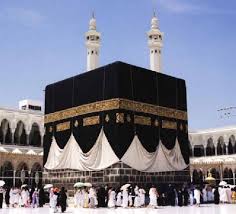
This is the last, and arguably a conditional pillar of Islamic practice, in the sense that one is obligated to make the pilgrimage to the site of the Ka'bah, built by Abraham and his son for the purpose of worshiping God, when financial and physical means are available. The Ka'bah is located in Makkah, in the Kingdom of Saudi Arabia.
During Hajj, we are once again made equals. The White seamless wraps, called the Ihram, does not allow that one's financial or education status be recognized. The King and the pauper both endure the same struggles, performing the same rituals, and each learning something, be it about others and their needs, or of a personal nature, that they were suppose to learn. This is why we have a tradition in Islam, attributed to no greater a figure than the Prophet Muhammad himself, upon whom be peace and blessings, that a successful Hajj [pilgrimage] wipes out prior sins, a person is renewed, pure as if a new born baby.
A recent study shows that returning pilgrims are 22% more likely to see Non-Muslims as equals, twice as likely to condemn terrorism, and 8% more likely to hope their daughters would adopt professional careers. [ "Muslim pilgrimage; a journey towards Tolerance?" Think; the magazine of Case Western Reserve University, Fall/Winter 2009 edition, page 18]
Conclusion
The foundation of Islamic practice is one that places emphasis on personal development, enlightenment, charity, sobriety and every other good characteristic. Islam is wrongly associated with violence and criminal activity. The recent death of a Detroit Imam, Luqman Abdullah, and the arrest of several of his supporters has once again brought the idea that Islam and criminality are linked to the public. One charge alleges that Abdullah gave legitimacy to theft, on the grounds that as long as they prayed and the thefts "benefits Islam", it was legitimate. Given the public works and reputation of the deceased Abdullah, the charges are very suspect, but nonetheless in terms of what Islam teaches, it's pillars hold up people's hearts and minds to always be conscious of Allah, of one's personal responsibilities and societal responsibilities.
Islam is a tool from God that can enlighten all who wish it, who actively seek it. This does not mean we will become monks, nor does it require that we give up enjoyment in life or comforts. It simply means that we train, that we refine the goodness that is present in the hearts of all humanity, utilize that goodness, apply it in both a systematic and random manner. Random acts of violence can become random acts of kindness.
Footnotes
[1] Congregational prayers are highly preferred, especially the obligatory ones, which can be done in a Mosque or with a group anywhere. One Hadeeth describes it as being "twenty-seven times greater than prayer alone." [ Bukhari, 10:30]
[2] The Shi'ah Muslims do not follow this practice, instead, their tradition places emphasis on individual prayer at night [in contrast to communal]. They do, however, gather together in Mosques to read the Qur'an together in the nights of the Ramadan month.
Saturday, July 25, 2009
Ramadan Al-Mubaarak: thoughts on the fasting month
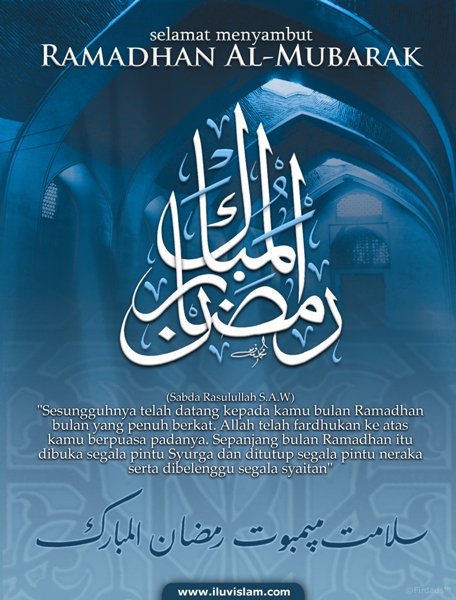
The above Arabic title stems from the traditional greeting "Blessed Ramadan" [Ramadan Mubaarak]. Certainly even the most non-observant Muslim finds the month of Ramadan to be one of great joy, laughter and family gatherings. Perhaps its cultural impact can be compared to the feelings Americans, even Non-Christians, have during the Thanksgiving and Christmas holidays.
We are always questioned by our colleagues on the type of fasting, the motivations behind it, and finally "How can you do it?". It is seen as an exercise in futility,unnecessary hardship and outright ridiculous by many people. It is my hope to share some useful information on this institution found in Islam.
Fasting
We abstain from food, drink and sexual contact during the daylight for a month-long period. This is an obligation on every Muslim, with exceptions for the ill, those who cannot survive without consuming something [such as diabetics], and a few others. The Qur'an gives the following command regarding the fast [called Siyaam in Arabic] as well as the reason behind its legislation;
O you who believe, fasting is ordained for you, as it was on those before you, so that perhaps you will become [more] God-respecting [La'allakoom Tattaqoon][2:183]
The focus is on Taqwaa, a word that is very hard to translate with just one or two English semi-equivalents. It is usually rendered as piety, however as a word, piety is very limiting. Taqwaa carries the meaning of respect, fear, duty, responsibilities, and caution.
Fasting is a very private form of worship, in the sense that a person can easily hide the fact he is not fasting, and just as equally hide the fact that he is fasting.
So, we see why the fasting has been ordained.
The traditional practices
In order to be able to function through the day, we are encouraged to have a meal before dawn, when the fasting officially starts. This breakfast is called Suhoor [Sehri in Urdu]. At sunset, when the fasting period ends, a snack of dates [or some other fruits and vegetables] precedes the dinner. Eating dates is not an obligation, but it has entered our practice on the basis of the Prophet Muhammad's manner of breaking the fast. The dinner itself is usually called Iftar.
As the Qur'an's first revelation to the Prophet [upon whom be peace] occurred in Ramadan , we also generally make it our business to read the entire Qur'an in the month. Besides that, people offer prayers more, and give more in charity.
Effect of fasting
One must understand that fasting in Ramadan is not for diet reasons, to follow some hype, rather the motivations are spiritual. Reading the Qur'an while fasting makes us re-examine our lives in light of what God instructs us. We are to avoid even those things we knowingly engage in, such as gossip, arguments, backbiting, immoral surroundings [that can be found in Television, Music etc..] lust and the like.
Fasting with consciousness makes the person a better human being. It also makes him spiritually stronger, which can influence the physical strength as well, even though the intake of food/drink has been limited. Muslim history is full of victories on the battlefield happening during that month.
That is what I want this year, to be able to gain from reading the Qur'an while fasting, to strengthen morals and get rid of any vices. To engage in an honest self-assessment. May Allah give us all the same. Ameen!
Subscribe to:
Posts (Atom)