Showing posts with label Abraham. Show all posts

Thursday, August 28, 2025

Balancing Religious Judgement

 Religion is often an integral part of one's identity, particularly cultural. While it certainly has its expressions of theological truth claims, it also undoubtedly gives a sense of security, familiarity and value to its adherents. Thus, weddings, funerals, and a host of other activities, even within an otherwise secular setting, occur within a religious framework.


Rodney Stark, a prolific writer and professor of the social sciences at Baylor University,  shares the following observation in his book DISCOVERING GOD: THE ORIGINS OF THE GREAT RELIGIONS AND THE EVOLUTION OF BELIEF 


Religion consists of explanations of existence (or ultimate meaning) based on supernatural assumptions and including statements about the nature of the supernatural, which may specify methods or procedures for exchanging with the supernatural.

(Pg 46, New York: Harper One 2007).


While Stark's assertion cannot be disputed wholly, the above quote does not take into consideration the impact of religion on the other areas such as those highlighted in the opening words of this article. Indeed, it is often the familiar background that we not only find comfort in, but also create the foundation by which we make our judgement. Another angle that cannot be ignored is that of emotion. 


The judging of a religious truth based on emotion or an inexplicable experience (itself an example of emotions at play)  is something that I have noticed in recent years, and the issue hit home when, during a recent interview with a Christian YouTube  channel, I was asked if I would change my religion (I.e. convert to Christianity) if Jesus was to come to me. This question has at its roots a miraculous  experience, a dream, a vision, an unusual experience that would be so strong   that it would supersede all of my reasoning abilities and just accept. Perhaps an even stronger word would be seduction, in which the person being the object of it throws all other considerations to the wind,  embracing the passion, excitement and feelings of the moment. 


An Islamic explanation  of miracles. emotions &  the ultimate judgement on the fundamentals of truth claims


The Qur'an undoubtedly speaks of events that can be seen as examples of miracles. Abraham (Ibrahim, 'alayhis salaam) is said to have been placed in a fire, only for Allah to make it "cool" and "a safety" (Q 21:68-70). Moses is given the ability to divide the Red Sea, allowing his followers to cross and thus avoid the enemy army in pursuit (Q 26:63-68), and Jesus himself is clearly depicted as having been born of the Virgin Mary ( Q 19:21. et.al). 


While the above-mentioned events can have different interpretations of them,  regardless of the actual meaning of these texts, these events are more or less relevant to the immediate audiences of their place and time. In other words, we were not physically present at these events, we know of them only through scripture! 


Scripture itself-while telling us of some events in the lives of the personalities it presents- has also told us that "miracles" and emotional events should not be the primary reason to judge the veracity of any claim. The Qur'an is critical of those who neither use reasoning nor their physical senses to make good judgement, they are classed as being "even more astray" than cattle ( Q 7:179).  Similarly, the Qur'an says such people are the worst in God's sight because they refuse to engage their intellect  ( 8:22). The Qur'an itself says repeatedly that it has been sent so "that perhaps you will use your intellect" (La'allakum Ta'qiloon 12:1, et.al).


In other words, miracles and emotional events should not form the basis of our conclusions. The Muslims are asked by missionaries of other faiths to look at these extraordinary  events  and actually abandon reason and logic. I have had numerous conversations with people who admit that Islam is rational, logical and reasonable, yet it is emotion that they call us towards. The irony in this is that for our Christian friends, a text in the New Testament has Jesus express strong criticism of the notion that miracles and the like deliver ultimate evidence of the veracity of religious claims


Many will say to me in that day Lord, Lord, have we not prophesied in thy name? And in thy name cast out devils? and in thy name name done many wonderful works? And then I will profess unto them, I never knew you; depart from me, ye that work iniquity." ( Matthew 7:22-23, KJV).


Islam, in its social manifestation and theological content, has logic, wisdom and benefit to those who are willing to embrace it. The Qur'an itself tells us that religion is specifically for God ( Q 39:3). Meaning, the primary focus is on understanding the reality of God and His guidance for the world.  Authentic Islam will never be useless for its adherents, it will always be a source of strength and stability. It is the summary of the teachings of all the Prophets, and a clarification on issues of confusion. 


Let us benefit from Islam, use our intellect, and not surrender to random emotions or trends. Indeed, one of its blessings is that it does not advocate giving up one's cultural or family identity. It embraces diversity as a healthy fixture to human life. 


Sunday, May 30, 2021

Issac and Ishmael: Some thoughts

 The latest round of violence which has occurred in the Middle East has prompted much discussion on the origins of the tensions. There is a great deal of disinformation regarding both the contemporary problems, as well as their origins, deliberate and outright evil attempts to control the narrative, to brainwash the next generation of human beings to be in favor of a system that is inherently unjust.


One of the theories that is often cited, especially in the last two weeks, is that the "Middle East conflict" is simply an extension of an old family feud, a feud between two brothers, themselves, while having different mothers, bear the same father. Indeed, Islam itself is claimed by those who hold that view to be a creation born from that feud!


Abraham 

According to the scriptures, Abraham ("father of many nations") was blessed by God to received guidance, delivery from idol-worship, and was given a covenant. Broadly speaking, this is agreed upon by the adherents of Judaism, Christianity and Islam. Indeed, these faiths are referred to as the Abrahamic religions, as they see themselves as having their roots in  Abraham's experiences.


The Bible (Gen. 16:1-9) asserts that a wife of Abraham, by the name of Sarai (also known as Sarah) unable to give birth on her own, encouraged him to have a relationship with her "maidservant" (known as Hagar), conceive with her, so that the family line would go on. However, problems developed between the two women, causing the latter to leave.(#1)


The two sons from the Bible


Hagar gives birth to Ishmael, who is seen as the progenitor of the Arabs, whereas years later, Sarai gives birth to Isaac, viewed as the progenitor of the Hebrew group. 


The problems between their mothers were visited upon the sons, as the story goes. The Bible, while acknowledging that Hagar has not done anything wrong, nonetheless asserts  that Hagar was told that her son, who is the progenitor of the Arabs, would be "a wild donkey of a man".(Gen.16:12).


Isaac, although younger, is said to embody the covenant. Ishmael is disinherited from that. It is interesting that throughout the Bible, expressions such as "The Lord God of the house of Israel" and "The Lord God of Abraham, Issac and Jacob" are common.


The two sons from the Qur'an


The Qur'an does not entertain any problems between the two sons. They are both mentioned with respect (Q 6:84, 14:39-41, 2:136 and other places), and it is common practice to say "peace be upon him" when referencing both. 


There is never a disrespectful passage in the Qur'an about Issac, even though he is viewed as the progenitor of the Jews. Indeed, Isaac  is viewed as a recipient of Divine guidance.


It is important here to note that the Qur'an contrasts from the Biblical style in that it NEVER uses racist or nationalistic language. It refers to God as the "Caretaker of the universe" (Q 1:2), and never as being restricted or exclusively connected to Arabs.


Religious rhetoric has certainly been exploited throughout the "Middle East conflict". Arabs are routinely portrayed as savages, and antisemitism is a charge regularly made by the supporters of the state of Israel, as a means to disarm criticism. Indeed, the ghosts of the holocaust are routinely resurrected to accomplish this, even though the Arabs and Muslim world had no relation to the Nazi-led holocaust that occurred (in Christian Europe) during the days of the second world war. 


Evangelical figure John Hagee, in almost all of his speeches and writing, has exemplified this pattern, as well as stated in no uncertain terms that he expects a time in the near future when "Israel will own an control all of present-day Israel, including Jerusalem, Lebanon, The West Bank of Jordan, and most of Syria, Iraq and Saudi Arabia".(#2)


Such rhetoric cannot be ignored, especially when it is backed by financial and political drive. One need only conduct a google search to see the reach this figure and this trend has.


If there ever was conflict between Isaac and Ishmael, or between  Hagar and Sarah, that conflict is no excuse to perpetuate oppression. Moreover, in the spiritual realm, it is Islam, which has been conveyed via the Qur'an to Muhammad, which has stated clearly that blood ties has no bearing on one's ties to God. It is Islam which has clearly stated that respect and love be had not only for one son of Abraham, but the other one as well. 


This post has only been some brief thoughts, meant to convey that the Islamic position is actually very reasonable, for any who use reason, when it comes to issues surrounding the descendants of Abraham(#3).In conclusion, we pray "Glorified is Your Lord, the Lord of honor and glory, he is above what is wrongly attributed to him, peace be upon the messengers, and praise belongs to God, the caretaker of the universe." ( Q 37:180-182).


Endnotes

 (1) Robert Alter, in his Torah translation THE FIVE BOOKS OF MOSES ( New York, Norton& Company Limited, 2004) pg.78 uses the word "harassed" to describe Sarah's attitude towards Hagar.

 (2) This quotation is taken from John Hagee's book CAN AMERICA SURVIVE? 10 PROPHETIC SIGNS THAT WE ARE THE TERMINAL GENERATION ( New York, Howard Books, 2010) pg.109. 

(3) The following article has a thorough explanation of the Muslim understanding of issue such as the covenant, sacrifice, etc.. associated with Abraham. http://www.why-christians-convert-to-islam.com/nice201.htm


Saturday, January 5, 2019

THE PATH OF THE PROPHETS: TIMELESS GUIDANCE

( Note: The following is an edited version of our Salaat al Jumu'ah Khutbah delivered 1/4/19 at Masjid Ibrahim, Las Vegas, Nevada. The opening Hamd, as well as the expressions of peace for the Messengers of God, have been omitted here.)


The Path as described by the Qur'an

لَہٗ مَقَالِیۡدُ السَّمٰوٰتِ وَ الۡاَرۡضِ ۚ یَبۡسُطُ الرِّزۡقَ لِمَنۡ یَّشَآءُ وَ یَقۡدِرُ ؕ اِنَّہٗ بِکُلِّ شَیۡءٍ عَلِیۡمٌ
 شَرَعَ لَکُمۡ مِّنَ الدِّیۡنِ مَا وَصّٰی بِہٖ نُوۡحًا وَّ الَّذِیۡۤ اَوۡحَیۡنَاۤ اِلَیۡکَ وَ مَا وَصَّیۡنَا بِہٖۤ اِبۡرٰہِیۡمَ وَ مُوۡسٰی وَ عِیۡسٰۤی اَنۡ اَقِیۡمُوا الدِّیۡنَ وَ لَا تَتَفَرَّقُوۡا فِیۡہِ ؕ


In the Tafseer field, there is a principal known as Tasfeer ul Qur'an bil Qur'an, meaning that the Qur'an is best explained or understood by referencing other places within the Qur'an. Often, this practically means studying the context in which a particular verse or assertion is placed, rather than developing a stand-alone understanding based on a single text. Here, we have a beautiful example of this principal.

" To Him ( i.e. Allah) belongs the keys of the heavens and the Earth. He widens provision to whom He wills, and limits ( as well). Indeed, He is the One knowing all things." ( Q 42:12)
In other words, God is the "owner" of the universe, and as the one who possesses the keys, to open and close doors, Allah does that for whom He wills, in accordance to His plan and wisdom, according to his own schedule. Other texts to recall in these regards include Ayatul Kursiyy (ft.1) and Ayah An-Noor(ft.2).

Next, we are told " He ( Allah) has made you ( O followers of Muhammad) traverse on the same path, in terms of deen (Shara'a lakum min ad deen) which We (Allah) enjoined on Noah, which has been sent to you (O Muhammad), and what has been enjoined on Abraham, Moses and Jesus-establish deen, and do not place division therein.." ( Q 42:13).

These verses are to be read together, as they clearly indicate that Allah opened the doors of spiritual provision to the followers of Prophet Muhammad, the same doors He (soobhaanahu wa ta'alaa) opened for four other prophets.

These four prophets are all associated with safety on some level. Noah and his ark, Abraham's teachings, which-when followed, "save" a person from idolatry, Moses, who led his followers away from the tyranny of Pharaoh, and Jesus, who was leading people away from the traps of anger and self-deception.

To be on that path, the path of maximum benefit and safety, is truly a blessing This is why we should be consistent in  proclaiming praise to Allah for the blessing of Islam (Alhamdulillaahi 'ala Ni'matil Islaam).


The operative word is "path". On this path, there are people ahead of us and people behind us. In this ayah, Allah says to "establish deen, and don't create division therein" (Aqeemud-deen, wa Laa Tatafarraqoo feeh.). 

"Establish" means to build, and building takes patience, intelligence and planning.  It takes team work as well, to establish firmly deen, be it in personal or communal application.

In whatever stage of the journey we are on, we should help each other and remember that it takes patience, commitment, and planning. So have the Niyyah to build up your deen, not only in practice but in particular in thinking right.

Addressing sectarian divisions

The verse (42:13) also asserts that there should be no breaking apart or divisions with regards to deen. This assertion can be taken in a number of ways. We can take it as a command (amr) for unity, meaning not to break up into sectarian denominations, or it can be taken as instructing us to recognize that the prophets and messengers all taught the same deen, and thus, we should not view them as teaching different things, also implying that we should make no distinctions between God's messengers ( Q 2:285).

A reply to the above can be made, pointing out that there are divisions among the Muslim community. This is true, among the Ahlus Sunnah we have different Madhaahib (ft.3), and of course the main sectarian difference being with the Shiites. However, in general these divisions are on secondary points (furoo') and not on fundamental principles(usool) . Thus, all Muslims, of all theological colors, have the same Qur'an, the same pillars of faith, same prayers, and same ethical and behavioral principles.

This is a reflection of Allah's blessing for the deen, a deen which has been completed and protected ( Q 5:3). Thus, in the big scheme of things, the sectarian divisions among Muslims should not be exaggerated.

Footnotes

(1) The "Throne verse" ( Q 2:255), for which see here

(2) ''The verse of God's light" ( Q 24:35) , which describes the reach of Allah's guidance. See here

(3) The schools of jurisprudence only differ in terms of applications of legal methodology, and not really on theological points. There are theological differences between the Sunnis and the Shiites, some of them important, however in terms of fundamentals, both groups share that in common.

Monday, September 4, 2017

Study Notes: Soorah Al Hijr [ 15: 70-80]. The implications of the story of Lot [Luut عليه السلام]

[ Note: The following is an edited version of some reflections on ten verses from the Qur'an. Originally, these notes were prepared for a weekly Quranic discussion I participate in, however I have decided to share them here, with the hopes of generating discussion and thinking. Also please note that unless otherwise seen in the text, the English translation has not been included. This will influence the reader to check the translation of their choice. The Arabic text is included.]


Some backround

This particular section deals with the story of Prophet Lot, known as Luutعليه السلام  in Arabic. The immediate context preceding the verses in question tell us that Lot's own household contained contrasting elements therein, as do all families. While Lot is connected to Allah, his wife is counted as being among the 'criminal class' [15:58-60]. Eventually, God's angelic messengers conveys notice to Abrahamعليه السلام ,  Lot's uncle,  that Sodom and Gommorah will be destroyed. The Qur'an says elsewhere ( Q 7:80-81 among other places) that the society engaged in intimate activity that cannot be deemed natural .

This particular issue is a deeply sensitive and potentially divisive one in today's world. I think it is important to see all of this in connection to what is repeatedly stated in these verses, and that is the title "The Family of Lot " [Aal Luut]. Lot is the family patriarch, the caring, wise and loving father and perhaps grandfather that we all have in our family units, seeking to preserve the morals of those under his care. Lot recognizes that wild behavior is something which leads to disastorous consequences ( Q 15: 61-64).

Lot advocates that the thinking of his family and followers be upon correct or healthy boundaries. He tells them to neither long for the social ties with those engaged in destructive behavior, nor even be in their company. In our age, the wise parent may instruct his child to stay away from certain other children because of their behavior, and the same parent may put restrictions [or even remove] the television or the cell phone when such devices of entertainment are found to be detrimental to the oveall development of his child [15: 65-66].

The society, probably more in particular the elites in power [called Al Mala' throughout the Quranic narrations], had places restrictions on Lot. In a sense, he seemed to have been a character that they wanted to silence, to be under house arrest. Lot  has some "guests" [who are actually these angelic messengers mentioned earlier] . These guests were threatened with attack, and the text implies that they were even threatened with rape! Lot makes a final appeal to any Taqwaaa [reverence for God Almighty] as well as any sense of social propriety, but alas, his pleas fall upon deaf ears. [Q 15: 67-69]

But as we come to know, attempts to restrict or suppress the truth eventually come to naught! Truth cannot be defeated( 15:70) . The Qur'an says "And say: Truth has come, and falsehood vanishes. Indeed, falsehood is, by it's nature, a vanishing [thing]' [Q 17:81]

[15:71]


In his comments, the translator Yusuf Ali righly points out that this language is the language of a family patriarch, an older man trying to push atleast a little bit in a different direction.
Thus, "My daughters" are not literal, nor is he seeking to sacrifice the women in his society to be raped, as sometimes thought by some critical readers. Perhaps marriage between men and women was a dying institute, as it is in our society today, and sought, out of desperation, to revive it.

[15:72]


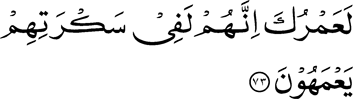
The social order of  Sodom and Gomorrah was blinding and intoxicating. The verse uses the term  لفي to denote the intensity of this condition. 

It is very difficult for those affected by such conditions to see the reality of their existence. 

Prophets and Scripture comes forth in order to open up the eyes and to have foundations for proper thinking. I see the Prophet Muhammad's   صلى الله عليه وسلم   supplication as particularly relevant here in the sense that one not only invokes Allah but it also provides a philosophical foundation for acting in the real world.


His prayer is "O Allah, show us truth as truth, and give us the ability to follow it, and show us falsehood [Baatil] as falsehood, and give us the ability to abstain therefrom." 

[ 15: 73-74]


Sayhah is also translated as "scream", and seems to denote a general overturning of the social order.


[15:75]


The translator Muhammad Asad, quoting Imam Razi and the famed grammarian and commentator Zamakhshari, points out in his note that Mutawassim means " One who applies his mind to the study of the outward appearance of a thing with the view to understand it's real nature and inner characterstics".

This is a deeply important verse here. When connected to 15:72, we can see that the argument is that a society of blinded, drunken (in their thinking and actions) human beings brings forth their own destruction. God says here that such societies should be studied, and this is precisely what social scientists, archaeologists, and related fields do. This also occurs with intelligent figures interested in the betterment of their own societies. One need only look at the libraries of such figures as Dr Martin Luther King, Jr and Malcolm X.  The latter, in his autobiography, mentions the many books he studied, they include histories, political theory, philiosophy, and more. 

The Qur'an is not a book that encourages blind faith. In fact, it points to the sciences, to certain fields and disciplines that would be deemed by many today as non religious! The guidance of God tells us that we should take lessons from the mistakes of past societies. It has been my observation that those who are deeply influenced by the Qur'an, personalities whom I know personally and others whom I have not interacted with, are people who are not limited to the Qur'an. Their interests are expansive, usually to include history, the physical world, science,  and the fate of civilizations. This does not mean that they all reach the same conclusions on all subjects, or that their conclusions are always correct. However, it does indicate that they are pondering deeply upon the words of Allah, which makes them look at the other important subjects. 

I would dare take this further to say that those who claim to study the Qur'an and yet have no interest in these [and other related] subjects, have in fact not studied the Qur'an properly! Perhaps a better way of saying that is that their "studies" are actually superficial at best. The need to study these other important fields is particularly acute in our Imams, scholars and speakers, especially the famous ones or those up and coming! 

There is no need for us to become like many who are referred to as Biblical fundamentalists, people who read and study only  the [translations of] Bible. Such reading may be a nice pious exercise, however the results can be very problematic, and we don't want to follow in the same mistakes.


[15: 76]


The location of Sodom and Gommorah is well known, as was known at the time of the revelation. God lets such remmants exist in order to be a lesson for future generations. Yet. today, at the site, it is not taken seriously. Indeed, it is now a swimming attraction today.


[15: 77]


Believers do take the warnings and signs of past civilizational failures seriously.

[15: 78-80] 


Madyan is in NorthWest Arabia, to whom a Prophet named Shu'ayb      عليه السلام   was sent.

Hijr is said to be between the Hijaz [Western Arabia, where Makkah and Madinah are located] and Syria. To them, a Prophet named Saaleh  عليه السلام         was sent forth.

Zamakhshari [as quoted by Muhammad Asad] suggests that the term "Messengers" here means Saaleh and his followers. This would suggest that the followers of Prophets likewise have a Prophetic mission.


These observations are not meant to be dogmatic, but rather to point out that the Quranic treatment of subjects are very nuanced. Indeed, even with the Sodom and Gomorrah story, we should be able to see that the prevalence of sexual relations outside of the norm is only a sympton of a deeper illness. We should also be able to see that the Qur'an advocates a serious study and search for solutions to the issues we face in today's world.

Wallaahu A'laam

Wa Billaahit Tawfeeq


Sunday, September 3, 2017

Eid Ul Ad-haa Khutbah: Toledo 2017

[Note: The following is an edited version of my Khutbah (sermon) delivered at the United Eid prayers held Friday, September 1st, 2017. An article on this year's prayer service can be found at https://www.toledoblade.com/Religion/2017/09/01/Area-Muslims-gather-in-unified-prayer-for-Eid-al-Adha]

 Praise belongs to Allah, who has directed us towards repentance, which we could never have obtained, except by his bounty. O servants of Allah, I advise you as myself, to have reverence for God, indeed, it is those with reverence [Taqwaaa] who attain felicity. الحمد لله الذي دلنا على التوبة التي لم نفد ها الا من فضله
اصيكم و نفسي بتقوى الله فقد فاز المتقون

Why are we here?


We are here today, in recollection of an important series of events and teachings, teachings that have had a global impact. These teachings and events center around the person of Abraham [Ibrahim, 'alayhis salaam] . He is a man of God, and the Quranic narrative [Q 6:74-79] tells us of his search to understand the reality that is God. The narrative is given in stages. He sees a heavenly body [Kawkaab] and says "This is My Lord", but it disappears. He sees the moon and proclaims "This is My Lord" but it disappears. He sees the sun and says "This is My Lord, [in fact] This is the greatest", yet, once again, it disappears. 

Abraham then says " Indeed, I turn my entire being to Him who is the origin of the heavens and the Earth, and I do not worship any others besides Allah"

Understanding that God is not captured within the physical, that He is beyond the physical and is actually the source of the physical, this understanding allows him to become connected to Allah.

That connection allows him to keep firm throughout the challenges that he would find  in life.

The Sacrifice

The Qur'an tells us that he had a vision, and within this vision, he understands it as a command to sacrifice his son. The Qur'an says [37:103] that both father and son submitted to that and that when the sacrifice was near happening, God calls out to Abraham "Indeed, you have fulfilled your vision" [Q 37:104]. The willingness to sacrifice for God's will, that is why we are here today. To learn from the patriarch, from that personality rightly called in the Judeo-Christian tradition as "father of many nations". As people who seek to follow the Divine ethos, as exemplified through Prophets, ending with the final Prophet [Sall Allahu 'alayhi wa sallam], we need to learn not only to sacrifice an animal for the benefit of the poor, we need to be willing to sacrifice our time, resources, for the right causes.

The Qur'an ( Q 22:37) reminds us that the blood of sacrifice does not reach God, nor the meat, rather, it is your collective reverence. Yanaaluhut Taqwaaa minkum. Thus, we return to the sentence in which we began this Khutbah, "I advise you and myself, to have Taqwaaa of Allah, Indeed, it is those with Taqwaaa who attain felicity". May we be closer to Him who is The Most High, may He accept our prayers, fasting and any good that we do.


Second part

This gathering also coincides with the Hajj, pilgrimage to the site associated with Abraham and his family.  At Hajj, we find unity in a tapestry of diverse colors, languages, backrounds and religious orientations. They gather together in obedience to Allah. We pray for them and likewise always ask any pilgrims we know to offer prayers on our behalf. The key point is that despite their differences, they join together in expression of their love of Allah. The Qur'an says "And whosoever obeys Allah and His Messenger achieve a mighty achievement".

We pray that the pilgrims today find their Hajj to be acceptable and successful, and that any future pilgrimages we do are acceptable in God's sight as well. May we take the most valuable lessons from the Hajj and the Ka'bah, in what these things represent. The lesson of replacing wrong concepts for proper thinking, abandoning vice and embracing that which God wants us to embrace, dropping trends as our models, but rather taking for role models Prophets such as Abraham, Moses, Jesus, and Muhammad the seal of the Prophets ['alayhimus salaam], taking them as models to do what they did, to become like them in their obedience and nearness to Allah.

Monday, September 19, 2016

Organized Spirituality: lessons from Abraham post-Eid

[ Note: The following is an edited version of a Friday Khutbah 9/16/16 at Toledo Masjid. The opening Hamd has been omitted, as has much of the Quranic and hadeeth quotes in Arabic.]


Building, not destroying

During the 'Eid ul Ad-haa, which just passed, our speakers usually focus on the willingness of Abraham [Ibrahim, 'alayhis salaam] to sacrifice his son because he saw that as being God's command. Indeed, the entire holiday centers around that premise.

However, there is yet another aspect we should ponder upon.

"And when Abraham raised the foundations of the House, and Ishmael as well [they prayed]: Our Lord, accept from us, surely, You are the All-Hearing, All-Knowing." [Q 2:127].

Abraham and his son [Ismaa'il, 'alayhis salaam] are associated here with building, and not destroying! They built [or re-built] the Ka'bah. That place is described as Baytul 'Ateeq or the ancient house, Baytun Naas which means the house for all people, and the Qur'an describes it as "a blessing and a guidance for all nations" [Q 3:96].

So Abraham and his son built something, and building something takes planning, thinking, mapping out appropriate strategies,

For a home, we have to plan our finances, and all of this takes time, patience. This is what Abraham [upon whom be peace] and his son did! This 'house' outlived them.

At every moment, thousands and often millions are circling the Ka'bah, reciting the Talbiyah, calling upon Allah, often in the very words used by Abraham himself "Our Lord, accept from us, Surely, You are the All-Hearing, All-Knowing."Rabbana Taqqabbal Minna, Innaka Antas Samee'ul 'Aleem.

So being organized and strategic in our religious priorities, indeed within all aspects of our lives, is arguably the most important lesson for us to take.

Going for job interview requires having prepared a resume', appropriate clothes and language.

So what about prayer [Du'aa]? When you make du'aa, you should think about who and what to make du'aa for.Ahadeeth. Take lessons from Soorah al Faatihah and from the other obligatory aspects of the Salaah as to what or who we should pray for. When we offer salaah, particularly alone, think about the meanings of what is to be recited.
Take some lessons from the supplications present in the Qur'an and Sunnah.

What can we do or how can we benefit in our lives from what we are to recite in prayer, and how can we build upon that to create something wonderful and lasting as Abraham did?

The Ka'bah and Abraham's station

About the Ka'bah, Allah says "In it are clear signs and Abraham's station." [Q 3:96]. This teaches us that the Ka'bah is a blessed symbol and is itself a testimony to Abraham's position [Maqaam Ibrahim] with Allah. It is a symbol or a goal we can work to, and the important term here is "work". Work wisely, work sincerely, for Allah, not for ego or fame or wealth. To go against the philosophy of Abraham is actually to show foolishness [Q 3:109]. May Allah accept from us.


The Ka'bah as Qiblah and at Hajj

The great symbol called the Ka'bah becomes the focus during Hajj. In addition to this, it is the Qiblah, the direction we are to face during worship.

Allah says to the Prophet: " We [Allah] see you [O Muhammad] turning your face to the sky,,," [Q 2:144].

Before the revelation of the above statement, it is said that the Qiblah faced by the Muslims was that which was associated with the Prophets of old, i.e. Jerusalem. Here, we are told the Prophet [Sall Allahu 'alayhi wa sallam] was facing the sky. The exact meaning of this is a debated point among the Mufassiroon.

Let us consider this as a possible meaning: after years of persecution in Makkah itself [the enemy capital] - The Prophet is now in stable Madinah, and he sees the need to become better focused, to be oriented correctly and to be organized spiritually.
God answers that concern by directing him not towards the sky, but rather to that symbol constructed by the great Patriarch, Abraham. 

So the Ka'bah is our Qiblah because it focuses us. It's very existence encourages us to build, to build or to fortify our hearts, to fill our minds with useful information, to build in this world, to add, not to destroy!

The Prophet Muhammad [upon whom be peace and blessings] said that if you see the world ending around you while your planting a tree, continue to plant that tree!

So let us be intelligent in our lives, and intelligent in our Islam. Let us be like Abraham, willing to  obey Allah even in the most difficult of circumstances.

Saturday, July 23, 2016

Is being a full-time Muslim easier said than done?

[ Note: The following is an edited version of a  Friday Khutbah given July 22, 2016 at The Islamic Center of Greater Toledo[ICGT] in Perrysburg, Ohio. The opening Hamd has been omitted.]

Introduction


This week I gave a lecture entitled "Towards becoming Full time Muslims" [url] https://www.youtube.com/watch?v=6V_aAxmp0J0[/url] . As the title suggests, we explored some practical ways to become stronger in our submission to Allah Almighty. One of the reactions to this presentation was, in essence, that it is easier said than done.

Events both here and overseas have influenced me to ponder upon that response. In particular, the political discourse we are seeing in recent days is very concerning. Thus, it is understandable that there would be difficulty to become "full time Muslims".

Observing the reports on the attack in the French city of Nice', the attacker, a reported drinker and even consumer of Pork, was said to have been "radicalized". Evidence of this so called radicalization was his weeks worth of beard growth [url] https://www.theguardian.com/world/2016/jul/18/nice-attack-premeditated-mohamed-lahouaiej-bouhlel-beard-prosecutor[/url].

Politicians have in recent days called for Sharee'ah to be banned [not even knowing the meaning of this term] and its practitioners deported.

So the argument that these forces are making is that the stronger Muslim you become, the more dangerous to society you become.


Islam is not an identity

It is important to remember that Islam is mot an "identity". Rather it is the title or the summary of that guidance which came forth through all the Prophets and Messengers of God. We must remember that almost all of the Prophets experienced character assassination, jealous foes, scapegoating and other pressures, all designed to prevent a fuller manifestation of God's guidance in society.


So know that these pressures are going to be there, just as they were in the lives of the Prophets [upon whom be peace]. Yet, these pressures should only make us better qualified.

Pressure is character building

When you jog, lift weights, or play sports or do some other exercises, you will experience some level of discomfort. You will feel sore during and afterwards, perhaps for quite a bit of time, and look and smell bad. However, it is worth it.

So we look at the Prophets to give us guidance in terms of dealing with those pressures as well as predicting the future.

Ibrahim [The Prophet Abraham 'alayhis salaam] is a good example of this. He doesn't seek to be domineering, he only preaches Tauheed [recognizing that Allah is one and alone in deserving worship] and seeks to make his audience think. He says "Do you not use your minds?" [Afala Ta'qiloon]. His foes respond by saying "Burn him" [Harriquhu].

Opponents of Truth are intellectually bankrupt

The foes of Abraham were intellectually bankrupt. Abraham was a Prophet that embodies logic, wisdom and even research. His foes find this threatening. They cannot respond to his logic, so they respond by gaining up, rabble-rousing, violence.

Look at Allah's Divine Hand at work. "We Decreed: O Fire! Be cool and peaceful for Abraham"[ Q 21:70].

So Abraham as a person went from being a potential victim of lynching to a miraculous saving of his life, which also means that his message was saved. The fire of hate was put out.
The evidence is strengthened by the fact that the three monotheistic religions[Judaism, Christianity and Islam]  see themselves as connected to Abraham. They are all called "The Abrahamic religions" [Al Adyaan Al Ibrahimiyyah].

So don't let outside forces stop you from getting closer to Allah, from being better and more committed Muslims. We pray for Allah's mercy, guidance, forgiveness, and stronger hearts planted with Imaan.

Muslims who work with the wider public have greater responsibilities

Many of us are people who deal with the wider public in some fashion. It is upon such folks a bigger responsibility of being full-time Muslims in a way that is seen by the public.

Firstly, this means that Islamic ethics must be displayed, particularly in financial matters. That also means we cannot be shy as Muslims.

Look at Prophet Muhammad [Sall Allahu 'alayhi wa sallam]. There was a lady who used to harass him by dumping trash in places where she knew he would walk. When she fell ill, he took care of her. When he ['alayhis salaatu was salaam] left Makkah for Madinah, he made sure to give back wealth that had been entrusted to him to its rightful owners.

Those of us in public should also be prepared to answer queries at all times. Keep Islamic pamphlets or literature in your offices, suitcase, bag, purse and car. Invite them to the Mosque. Have more open houses and be welcoming and invite the hard questions.

We have to be like Abraham. A mob wanted to burn him, yet Allah gave him immunity from that- and now-thousands of years later, the majority of humans see themselves as connected to him.

Indeed, in the Judeo-Christian tradition his name is known to mean "father of many nations" or "father of all nation", depending on which Bible translation [in English] you read.

 We have to be strong, confident and closer to Allah.

God is not an intellectual point. God is real, and is active in the world of man. Allah be with you all, [Allah Ma'kum Jamee'an].


Tuesday, November 3, 2015

Dealing with change: Friday Khutbah

[ This is an edited version of a recent Friday Khutbah]

The Prophet     صلى الله عليه وسلم          taught us that we are supposed to say "Praise belongs to Allah in every circumstance" [Alhamdulillaahi 'alaa Kulli haal]. Another version  adds  "Or during blessing too" [Aw Ni'mat]. This statement has many levels, the least of which is that whatever situation we are in, it could always be worse. Even if we are unaware of the hadeeth from which this teaching derives, all of us, by necessity, know the statement Alhamdulilllaahi Rabbil 'aal ameen- praise belongs to Allah, the Caretaker of the Universe. After all, we recite this daily in our Salaah. This is an integral line in Soorat Al Faatihah.


When we combine the two expressions of Hamd,[from the Qur'an and the Hadeeth here]  we are presented with a wonderful result. Allahسُبْحَانَهُ وَتَعَالَىٰ ‎ is the source of all things, what we perceive as "good" as well as "bad". Allah runs all things, and he does so, not in some vicious or random way. Nor does He do so in a way that would imply playing with our lives as a game. Allah runs things in a deliberate, organized, elaborate fashion. Thus, recognizing that he is Rabbul 'Aal ameen [Caretaker of the Universe], when we encounter that which we are unfamiliar or uncomfortable, we are to still give him praise!


We also proclaim Hamd because we are acknowledging that a change is coming [or is already here]! Change is hard, we have to admit. After all, humans naturally crave stability, but that in itself can create it's own problems, such as stagnation, boredom, etc. Consider what Allah says. He says that he created death and life. In this particular verse, he mentions Death before he mentions Life! Both death and life are created by God. In a similar way, heath and sickness, wealth and poverty, all are created by Allah and are under the direction of Allah.  These are examples of unavoidable changes, and when they do come, often we cannot see the wisdom behind them. Change can also be a frightening experience,yet, as believers we are to seek to ultimately connect ourselves to the thread of thinking that seeks to consciously submit to the Divine Will!

Jews and Christians are sometimes criticized in the Qur'an, even though they share with the Muslims similar beliefs regarding God, Prophets, scriptures, etc..So why are they criticized? Because they were unable [at least the Western Christians, as the overwhelming majority of Christians in Arabia and surrounding lands did eventually accept ] to accept the Qur'an and the Prophet. The Qur'an itself says "Those given the scripture recognize him [Muhammad] just as they did their own sons." الَّذِينَ آتَيْنَاهُمُ الْكِتَابَ يَعْرِفُونَهُ كَمَا يَعْرِفُونَ أَبْنَاءهُمُ

 Their educated people of religion could see that the Qur'an and Prophetصلى الله عليه وسلم were the genuine article, but recognition was not enough. Thus, the verse ends "They bring loss to their own souls, in that they don't have Imaan." [Q 6:20]

الَّذِينَ خَسِرُواْ أَنفُسَهُمْ فَهُمْ لاَ يُؤْمِنُونَ
The Prophet, because he was an Arab, a people whose ancestor [Ishmael] is dismissed in the Bible as a "wild donkey of a man", was rejected by them because of bloodline alone. So the change, the change of Prophethood [to now go to an Arab figure], the change of Qiblah [Jerusalem to Makkah], these were changes they found unacceptable. Yet, change is a part of existence. Change is necessary. So, our situation[s] change, yet we still say Alhamdulillaah and keep on going.

Our Prophet- upon whom be peace and blessings, is the embodiment of change, but that change was never capricious. The changes were not a part of some "Divine Comedy" [to borrow an expression from Dante'] . Allahسُبْحَانَهُ وَتَعَالَىٰ ‎ says that our Prophet was nothing more than a Mercy to all nations.
وَمَا أَرْسَلْنَاكَ إِلَّا رَحْمَةً لِّلْعَالَمِينَ

So, our Prophet- an example of change- was a Mercy to all- sent forth by Allah. That means that God cares. God has compassion. His Messenger [peace be upon him] was the same way. He lived from many life changing experiences such as marriages, place of residence, dealing with foes, yet the caring, merciful aspects of his character never left him! He issued amnesty for his foes when we overcame them in Makkah. He said "None of you have Imaan until he loves for his brother what he loves for himself." He also said "A person who sleeps full while his neighbor is hungry is not a believer."  So this quality of mercy was a constant.

Mercy, although a natural quality, is enhanced or sustained by thinking, by conscious behavior. Of course that means that there has to be a bit of struggle, to maintain that awareness. A struggle is needed, to maintain the attitude of mercy over that of wrath. In today's world, we have much wrath, violence, jealousy, and egotism, but little mercy!  

A welcome change in today's world would be the change of this trend- from wrath to mercy, and that would also demonstrate our attempt to follow the Prophet, the best model.

So wherever you are, wherever you find yourself, still praise Allah and seek him, because he is real! Have confidence in what Allah has given you, in that any "bad situation" you find yourself in now- it may turn out to be simply a doorway to a better thing.

Tuesday, February 11, 2014

Eid ul ad-haa Khutbah video

This is from Oct 15, 2013, Eid ul adhaa speech [Khutbah] at Toledo Masjid.

Eid ul adhaa Khutbah

Tuesday, February 9, 2010

New Releases from Arifin Imports


Arifin Imports & Publications is proud to release on sale two of our newest items.

[1] [DVD] "Trees and Oceans, Allah's words". Beautiful, quality recording of a Khutbah that basically explains the awesome message, or philosophy, behind the Qur'anic verse "Say: if the oceans were ink, the oceans would be exhausted, but the words of my Lord would not be finished, even if another ocean were added for its assistance." [18:109]

This DVD also begins with a beautiful recitation from the Qur'an, and is highly suggested as a gift to a New-Muslim, Non Muslim, or just about anyone with an interest in religion, Qur'anic exegesis [Tafseer]. Sale price is $9.95 plus shipping and handling.


[2] Millat Ibrahim

Khutbah at Masjid Al-Islam Toledo Ohio, discusses the position of Abraham in the monotheistic religions, Pilgrimage, importance of traveling to attain spiritual growth and development, and a host of other issues. A clip of this lecture is available on YOUTUBE, at our channel Arifin publications.http://www.youtube.com/watch?v=EIx0Bmeffng

This is also available for $9.95 plus shipping and handling. To order, please contact

Arifin Imports & Publications
P O Box 70617
Toledo, Ohio 43607
419-246-9697

Friday, November 27, 2009

Abraham: father of all nations, a goodly model


There is for you an excellent example (to follow) in Abraham and those with him..[Qur'an 60:4]

'Eid Ul-Ad-haa, Imams and orators worldwide undoubtedly mentioned the story of the sacrifice, as given in scripture, wherein Abraham was ready to take the life of his son in response to a vision interpreted to have been from God. Another theme usually explored is when he left his son and Hagar [Hajar] in the desert to fend for themselves. This particular narrative has it that during the process of searching for water for her infant son, Hagar ran bath and forth seven times, and at the end, almost in a miracle fashion, the well appears. Indeed, Muslims re enact this event during the Hajj [Pilgrimage] at the Safa and Marwa trails [which has now been included in the complex of the Masjid Al-Haraam], the well itself still giving water, known as ZamZam water.[Ft.1]

Yet, there is something to be said of other aspects of the life of Abraham, who is called in the scripture of the Jews and the Christians "father of all nations" [ Genesis 17:5].

Origins of Abraham

Called Ibrahim in Arabic, tradition has it that he was born in Southern Iraq, although there does exist other places, in Northern Iraq, Turkey and even Sicily. Regardless of where he was born, eventually he found his ways to such diverse places as Egypt, Palestine, and Arabia. Sites in all those places, not the least of which is the Ka'bah at Makkah, are associated with him.

Is there a lesson in these sites?

The Qur'an tells us a very interesting observation, one which should be associated with Abraham, but also with seekers of truth and guidance in all times, places and among all peoples.

"Have they not traveled in the land so that their hearts will come to understand, or that their ears will come to hear?"[ Qur'an 22:46]


Travel is very important, for the sake of religious or spiritual knowledge. This is something that seems to have been universally recognized, when we notice adherents of Hinduism, Christianity, Islam, going forth from country to country to study with respected spiritual figures. Reading books, or even studying at a local university, are all wonderful acts, acts which can produce blessings and appropriate information, but nothing can beat leaving the comforts of one's home and family for the sake of attaining knowledge.

The journey itself is a learning experience, be it meeting interesting people at airports, or having some time in isolation while in transit to deeply contemplate the pressing concerns of the body, soul and mind.

Whatever one thinks of Abraham, the towering figure in the three monotheistic traditions, this aspect of his existence cannot be denied. This is, of course, especially true for the Muslim, the reader of the Qur'an.

This author has done, and continues to, much traveling, and the above mentioned Quranic verse is very true. Many times we cannot process the information or insight someone gives us [or that we read in a book, magazine or website] until we have the same, or a similar experience, or a set of experiences.

So, on this occasion of 'Eid ul-Ad-haa[ft.2], let us try to emulate the goodly model present in Ibrahim ['Alayhis salaam]. Attain whatever knowledge we can from our scholars, books and websites. But always be prepared to learn something from one's one experiences, or the experiences of other people. There is much insight to be gained from travels of this nature.

Role of the Qur'an

The word Qur'an itself means a reading, a recital. It has the sense of "something put together piece by piece, part by part." This is a very appropriate name, as it was revealed to the Prophet Muhammad [Sall-Allahu 'alayhi wa sallam] slowly, over a period of twenty-three years.

The Qur'an serves many roles, but for the sake of this article, we want to emphasis that it serves as a guide to make its reader a bit more sophisticated, well-rounded, knowledgeable. It is an undeniable fact that it can be speaking of theology for several verses, and then turn to a completely different subject such as war or marriage.

Those with broad knowledge in various fields, who have lived and traveled in many places, learning languages and cultures alien to their native backround, can appreciate such a guide as the Qur'an.

In issues not addressed in the Qur'an, God allows us to figure it out on our own, we can access some guidance or precedent in the reliable sources about the Prophet Muhammad [the last Prophet, and universal messenger], we can access guidance [or perhaps assistance is a better word] from our collectives experiences present in our culture, our personal reading of the situation [as well as our reading of the goal of religion] to ascertain the proper way to proceed.

In any case, all of that comes from having a broad experience, an open mind, open ears and open heart.

The Qur'an is very suitable for our guidance because we, like the last book of Allah itself, have been put together piece by piece, part by part. We are born as babies and absorb everything while growing up. Our parents and societies give us the foundation and much assistance, but there are times when we will have to learn lessons on our own, because our own mistakes will teach us how to act in the future. Our own actions will be suitable to serve as precedent, and each time that occurs, as far as the Qur'an goes, we can come to appreciate, nay, understand, texts better. It will grow in meaning for us.


Endnotes

[1] This author has examined in great detail the Qur'anic presentation of Abraham's story of the sacrifice in the work The Languuge of Revelation [pg. 237 "Abraham"]. To obtain, go to www.arifinimports.com

[2] The significance of the 'Eid-Ul Ad-haa occasion has been addressed in a lecture and Q & A session called "The story and sacrifice", available for free at www.esnips.com/web/shamsuddinwsStuff.