Showing posts with label Soorah Al Hijr. Show all posts

Monday, September 11, 2017

Study Notes: Accepting God's will: Refections upon Soorah Al Hijr ( 15: 80-90)

( Note: The following is an edited version of my reflections on a handful of Quranic verses. Previously, we have looked at vv. 70-80, which can be found here . The English translation has not been included, unless otherwise stated. This allows the reader to consult the translation of their choice. The Arabic text has been included, and, as always, discussion is welcome.]


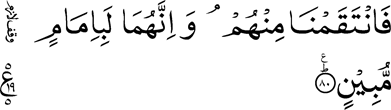
[ Q 15:80]

As found in the previous article, we have a brief gloss of the regions Madyan and Hijr. The famed Zamakhshari has suggested ( as quoted by Muhammad Asad) that "Messengers" is a reference to not only the Prophet Saaleh, but rather to his followers, suggesting that the followers of the Prophet Saaleh [and perhaps, by the followers of all Prophets] have a Prophetic mission themselves.


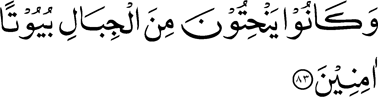
[ Q 15: 81-84]



It is generally imagined that Prophets are figures speaking to primitive societies, however the words of the Qur'an point towards the opposite conclusion. We are talking about highly advanced, materially rich, cultures. We should also consider connecting these verses to the Sodom and Gommorah situation, in the sense that both had the same issues of moral decay.

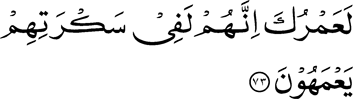
Q 15:72 states that Sodom and Gomorrah existed in a drunken condition, blindly wandering. Now, in v.82, we see that these groups would ignore Allah's signs and exist "feeling secure" because their homes were built in seemingly solid places such as mountains. However, that did not save them!

This is a lesson that we in the developed world need to learn. As we compose these words, the USA is facing Hurricanes in our southern regions. Indeed, it has to be admitted that those of us living in the USA and in other highly developed nations perceive ourselves as largely immune to the disasters, both natural and man-made, that other societies face on a regular basis. The feeling of complacency, in the face of eventualities as well as in the face of social and moral injustices, can very well be the seeds that plant our eventual destruction.

We are not advocating a negative view on everything, only that we keep our eyes open, and our hearts firmly planted within Allah's guidance.


[Q 15:85]
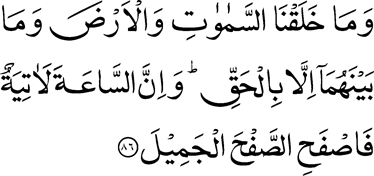
Haqq has a plethora of meanings and implications, here, it is best to render it as "Purpose". In another verse, Allah says "And We ( i.e. Allah) have not created the sky and the earth and what is between them for play" [Q 21:16].

The One who created the universe for Haqq, will, likewise, end it all in Haqq. The ending is the "hour" of Judgement. That day is also called The Last Day [Yawm Al Aakhir]. Because the beginning and ending all exists within God's purposes, we are told "So forgive with gracious forgiveness" (Saheeh International translation).

This last sentence in the verse is clear enough, yet Tafseer Al Jalalayn asserts that it is abrogated by "The verse of the sword", which reads, as translated by Saheeh International  : "And when the inviolable months have passed, then kill the polytheists whereever you find them and beseige them and sit in wait for them at every place of ambush.." ( Q 9:5)

We find this assertion to be unsupported by the context, moreover, the assertion is a violation of well known principles. Q 9:5 is clearly in a certain war context at a certain place and time. Indeed, all one really needs to do is read the contex [Starting from 9:1 and ending in 9:10]. In other words, verses regarding war are at a particular place and moment, specific to that, whereas the principle of graciousness, humility, forgiveness and kindness are general and timeless.

The general principle, when and where general situations are applicable, have nothing to do with war and fimness during periods of imposed conflict.

Throughout the Qur'an, we read statements such as "and when the ignorant address you, say "peace"" [Q 25:63].

Therefore, we cannot agree with the claim that this text has been abrogated. We question the entire basis for the claim that any verse of the Qur'an has been abrogated(ft.1)


[Q 15:86]



Al Khallaq means the ever-Creating. It is different from Al-Khaaliq {The Creator}. The former shows us that God is constantly at work in creating!

This is an important nuance because as scripture readers, we tend to think of Allah as only acting in the past, whereas the fact of the matter is is that Allah is still and will always be at work in the universe He runs.  The importance of Ayatul Kursiyy  ( Q 2:255) is highlighted in such a discussion. If God is simply a historical figure, a being who worked in the past, the presence of Ayatul Kursiyy in the Qur'an would be pointless, as would the numberous Prophetic traditions encouraging us to regularly recite that text!


[Q 15:87]
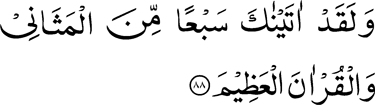


"Seven oft repeated" is universally understood to refer to Soorah Al-Faatihah. That chapter, the Qur'an's opening words, is recited several times daily in Muslim prayers.

It is signifigant to this writer that all Muslim demoninations without exception agree that Al-Faatihah is necessary for the daily prayers, even though there is no verse which directly says that one must recite it in the prayers.(Ft.2)


[ Q 15:88-90]
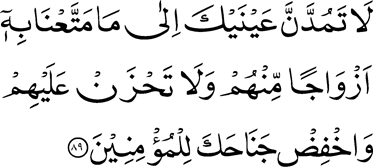


This is directed to Prophet Muhammad, upon whom be peace and blessings, moreso than anyone else. In essence, it says to him to never be tempted to give up your faith and the company of those sincere in their faith, because God has already given you so much. The material or worldly trappings in the hands of the disbelievers should not dissuade you.

Other Quranic texts tell the Prophet, Sall Allahu 'alayhi wa sallam, the same message. In particular, many of the texts in the Juz 'Amma section . I would recommend reading some of those Soorahs, such as Ad Duhaa ( chapter 93), Inshiraah ( chapter 94) and Al Kawthar (chapter 108).

Verse 90 is more difficult to grapple, and that difficulty is reflected in the different interpretations found in the books of Tafseer.

If connected with vv.91-92, the context seems to be a warning, just as warning is found in general in the story of Lot's people and the Madyan and Hijr above, to not pick and choose what one accepts of Divine Revelation.

The Qur'an states "..and those firmly grounded in knowledge assert 'We believe in it, all of what is from the presence of our Lord.." ( Q 3:7).

In today's world, we have trends which attempt to carve up the scripture, both figuratevly and literally. We have writers and lecturers, of Muslim family backround, asserting that Muhammad made up parts of the Qur'an in order to justify genocide and to have women!

We have "Muslims" who esentially reject what the Qur'an says on race relations, who attempt to use the Scripture to justify racism, hatred, misogny, and immoral behaviour.

The Qur'an can never have textual corruption (called Tahreef in the literature) but it can have distortions based upon a copy/paste approach. This is done by extremist groups all the time among Muslim ranks, but it is also done diverse groups as Islamophobes ( folks with an irrational fear of Islam and Muslims) and liberal voices in the Muslim community.

I think it is better for people to admit that they have weaknesses rather than to justify the unjustifiable in Islam. It would be more honest.

In any case, there are other interpretations of verse 90 [and the verses following it] that could be the correct understanding. For now, we share our views above and conclude with the reminder that at the end, only Allah knows best.


Conclusion

The world and life therein can be a confusing place. The diversity of personalities, cultures, egos and agendas can bring people to a state of loss, of feeling lost. The Qur'an comes along to help us on life's journey, but in order for it to really be effective, one must reflect on it in a continous manner, regularly studying it, reciting it, and acting upon it.

This should not be done in a superficial way, nor should it be dogmatic, in the sense that the text gets manipulated to suit our whims.

In our previous article, we looked at the story of Lot, how the people there were "wandering about blindly, in a drunken state". In this article here, we read how Allah says that another group felt that they were secure from any catastrophe because their homes were built within mountains.

We should consider taking the above sentiments further, not just in social analysis, but within our own circles or existence of life. Are we walking blindly or acting drunk in our lives and in our thinking? Are we oblivious to realities? Are we painting the doors while the house is on fire?

May Allah show us truth as truth, and give us the ability to follow it, and falsehood as falsehood, and give us the ability to abstain therefrom.


Footnotes

[1] For more on the question of abrogation [known as Naskh] go to this link .

[2] We have a number of Prophetic Ahadeeth which tell us that Al-Faatihah is to be included in prayers. All the groupings, despite their many theological and methodological differences, accept that Al-Faatihah is needed to be included in their prayers. The necessity for Al-Faatihah in worship is also accepted by most of those who reject Hadeeth as a source of Islamic understanding, known widely as Quranites or "Quran alone". Thus, one can find the writings and videos of Rashad Khalifa, one of the most well-known proponents of a hadeeth-free understanding of Islam, advocating that Al-Faatihah be recited in prayers.

Al-Faatihah is known as Umm Al Qur'an, the essence of the Qur'an. It is the perfect text for worship, and logically we should be able to see why the Prophet Muhammad said that any prayer in which that Soorah was not included was "Incomplete" ghayr Tamaam. The source of this hadeeth is Saheeh Muslim.


Monday, September 4, 2017

Study Notes: Soorah Al Hijr [ 15: 70-80]. The implications of the story of Lot [Luut عليه السلام]

[ Note: The following is an edited version of some reflections on ten verses from the Qur'an. Originally, these notes were prepared for a weekly Quranic discussion I participate in, however I have decided to share them here, with the hopes of generating discussion and thinking. Also please note that unless otherwise seen in the text, the English translation has not been included. This will influence the reader to check the translation of their choice. The Arabic text is included.]


Some backround

This particular section deals with the story of Prophet Lot, known as Luutعليه السلام  in Arabic. The immediate context preceding the verses in question tell us that Lot's own household contained contrasting elements therein, as do all families. While Lot is connected to Allah, his wife is counted as being among the 'criminal class' [15:58-60]. Eventually, God's angelic messengers conveys notice to Abrahamعليه السلام ,  Lot's uncle,  that Sodom and Gommorah will be destroyed. The Qur'an says elsewhere ( Q 7:80-81 among other places) that the society engaged in intimate activity that cannot be deemed natural .

This particular issue is a deeply sensitive and potentially divisive one in today's world. I think it is important to see all of this in connection to what is repeatedly stated in these verses, and that is the title "The Family of Lot " [Aal Luut]. Lot is the family patriarch, the caring, wise and loving father and perhaps grandfather that we all have in our family units, seeking to preserve the morals of those under his care. Lot recognizes that wild behavior is something which leads to disastorous consequences ( Q 15: 61-64).

Lot advocates that the thinking of his family and followers be upon correct or healthy boundaries. He tells them to neither long for the social ties with those engaged in destructive behavior, nor even be in their company. In our age, the wise parent may instruct his child to stay away from certain other children because of their behavior, and the same parent may put restrictions [or even remove] the television or the cell phone when such devices of entertainment are found to be detrimental to the oveall development of his child [15: 65-66].

The society, probably more in particular the elites in power [called Al Mala' throughout the Quranic narrations], had places restrictions on Lot. In a sense, he seemed to have been a character that they wanted to silence, to be under house arrest. Lot  has some "guests" [who are actually these angelic messengers mentioned earlier] . These guests were threatened with attack, and the text implies that they were even threatened with rape! Lot makes a final appeal to any Taqwaaa [reverence for God Almighty] as well as any sense of social propriety, but alas, his pleas fall upon deaf ears. [Q 15: 67-69]

But as we come to know, attempts to restrict or suppress the truth eventually come to naught! Truth cannot be defeated( 15:70) . The Qur'an says "And say: Truth has come, and falsehood vanishes. Indeed, falsehood is, by it's nature, a vanishing [thing]' [Q 17:81]

[15:71]


In his comments, the translator Yusuf Ali righly points out that this language is the language of a family patriarch, an older man trying to push atleast a little bit in a different direction.
Thus, "My daughters" are not literal, nor is he seeking to sacrifice the women in his society to be raped, as sometimes thought by some critical readers. Perhaps marriage between men and women was a dying institute, as it is in our society today, and sought, out of desperation, to revive it.

[15:72]


The social order of  Sodom and Gomorrah was blinding and intoxicating. The verse uses the term  لفي to denote the intensity of this condition. 

It is very difficult for those affected by such conditions to see the reality of their existence. 

Prophets and Scripture comes forth in order to open up the eyes and to have foundations for proper thinking. I see the Prophet Muhammad's   صلى الله عليه وسلم   supplication as particularly relevant here in the sense that one not only invokes Allah but it also provides a philosophical foundation for acting in the real world.


His prayer is "O Allah, show us truth as truth, and give us the ability to follow it, and show us falsehood [Baatil] as falsehood, and give us the ability to abstain therefrom." 

[ 15: 73-74]


Sayhah is also translated as "scream", and seems to denote a general overturning of the social order.


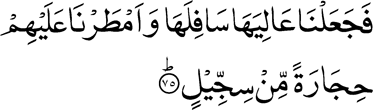
[15:75]


The translator Muhammad Asad, quoting Imam Razi and the famed grammarian and commentator Zamakhshari, points out in his note that Mutawassim means " One who applies his mind to the study of the outward appearance of a thing with the view to understand it's real nature and inner characterstics".

This is a deeply important verse here. When connected to 15:72, we can see that the argument is that a society of blinded, drunken (in their thinking and actions) human beings brings forth their own destruction. God says here that such societies should be studied, and this is precisely what social scientists, archaeologists, and related fields do. This also occurs with intelligent figures interested in the betterment of their own societies. One need only look at the libraries of such figures as Dr Martin Luther King, Jr and Malcolm X.  The latter, in his autobiography, mentions the many books he studied, they include histories, political theory, philiosophy, and more. 

The Qur'an is not a book that encourages blind faith. In fact, it points to the sciences, to certain fields and disciplines that would be deemed by many today as non religious! The guidance of God tells us that we should take lessons from the mistakes of past societies. It has been my observation that those who are deeply influenced by the Qur'an, personalities whom I know personally and others whom I have not interacted with, are people who are not limited to the Qur'an. Their interests are expansive, usually to include history, the physical world, science,  and the fate of civilizations. This does not mean that they all reach the same conclusions on all subjects, or that their conclusions are always correct. However, it does indicate that they are pondering deeply upon the words of Allah, which makes them look at the other important subjects. 

I would dare take this further to say that those who claim to study the Qur'an and yet have no interest in these [and other related] subjects, have in fact not studied the Qur'an properly! Perhaps a better way of saying that is that their "studies" are actually superficial at best. The need to study these other important fields is particularly acute in our Imams, scholars and speakers, especially the famous ones or those up and coming! 

There is no need for us to become like many who are referred to as Biblical fundamentalists, people who read and study only  the [translations of] Bible. Such reading may be a nice pious exercise, however the results can be very problematic, and we don't want to follow in the same mistakes.


[15: 76]


The location of Sodom and Gommorah is well known, as was known at the time of the revelation. God lets such remmants exist in order to be a lesson for future generations. Yet. today, at the site, it is not taken seriously. Indeed, it is now a swimming attraction today.


[15: 77]


Believers do take the warnings and signs of past civilizational failures seriously.

[15: 78-80] 


Madyan is in NorthWest Arabia, to whom a Prophet named Shu'ayb      عليه السلام   was sent.

Hijr is said to be between the Hijaz [Western Arabia, where Makkah and Madinah are located] and Syria. To them, a Prophet named Saaleh  عليه السلام         was sent forth.

Zamakhshari [as quoted by Muhammad Asad] suggests that the term "Messengers" here means Saaleh and his followers. This would suggest that the followers of Prophets likewise have a Prophetic mission.


These observations are not meant to be dogmatic, but rather to point out that the Quranic treatment of subjects are very nuanced. Indeed, even with the Sodom and Gomorrah story, we should be able to see that the prevalence of sexual relations outside of the norm is only a sympton of a deeper illness. We should also be able to see that the Qur'an advocates a serious study and search for solutions to the issues we face in today's world.

Wallaahu A'laam

Wa Billaahit Tawfeeq


Monday, July 17, 2017

Study notes : Soorah Al Hijr [Qur'an 15:10-30]

[ Note: The following are some reflections on texts from the fifteenth Soorah of the Qur'an. We have examined the first ten verses, available at http://shamsuddinwaheed.blogspot.com/2017/07/study-notes-brief-thoughts-on-quranic.html. The English translation has not been given, unless otherwise stated, allowing the reader to look up the translation of their choice.]


[15:10]


وَلَقَدْ أَرْسَلْنَا مِن قَبْلِكَ فِي شِيَعِ الأَوَّلِينَ

As stated in our previous article, just as God's message has been ever consistent, the response of the leadership of rejection [A-immah al Kufr] has, likewise, been consistent. Ever demanding of what amounts to little more than magic tricks, diminishing the real import of the Divine imperative.


[15: 11-15]

وَمَا يَأْتِيهِم مِّن رَّسُولٍ إِلاَّ كَانُواْ بِهِ يَسْتَهْزِؤُونَ
كَذَلِكَ نَسْلُكُهُ فِي قُلُوبِ الْمُجْرِمِينَ
لاَ يُؤْمِنُونَ بِهِ وَقَدْ خَلَتْ سُنَّةُ الأَوَّلِينَ
وَلَوْ فَتَحْنَا عَلَيْهِم بَابًا مِّنَ السَّمَاء فَظَلُّواْ فِيهِ يَعْرُجُونَ
لَقَالُواْ إِنَّمَا سُكِّرَتْ أَبْصَارُنَا بَلْ نَحْنُ قَوْمٌ مَّسْحُورُونَ

If one were to read other places within the Qur'an or even the Christian Bible ( Matthew 16:1, Luke 11:16], this basic pattern is the same.

Notice here in verse 12 that the "hearts of the criminals" is said to have been corrupted, so that they cannot and will not change. This assertion has been given repeatedly in the Qur'an [see 2: 7-17 for a clear series of examples]. It is important to remember that "Mujrimeen" [Criminals] and Kaafireen [Rejectors] are terms referring to the same reality. In other words, these are synonymous expressions, and are referring to the A-immah al Kufr. They reject the signs of Allah with all sorts of excuses.

[15:16-18]

وَلَقَدْ جَعَلْنَا فِي السَّمَاء بُرُوجًا وَزَيَّنَّاهَا لِلنَّاظِرِينَ
وَحَفِظْنَاهَا مِن كُلِّ شَيْطَانٍ رَّجِيمٍ

إِلاَّ مَنِ اسْتَرَقَ السَّمْعَ فَأَتْبَعَهُ شِهَابٌ مُّبِينٌ
There are similar passages in the Qur'an. One example reads: " The Adorned Sky, adorned with heavenly bodies [Kawaakib]...rebellious devils  being unable to get a full hearing of Al Mala' Al A'laa ( high assembly), chased away by a burning flame." ( Q 37:6-10).

It is popularly imagined that these verses are referring to Shayateen being chased away from the gathering of angels in an heavenly assembly by a comet.

Looking at context, and after many years of pondering upon these set of Ayaat, this writer is of the view that the text is not talking about the sky, but rather, about the Qur'an itself!

In other words, criminally minded folks, be they with a "Muslim" name or a "Non Muslim" name, with wrong-headed interpretations of the Qur'an eventually gets discovered, and any success they have will be short lived.

It does not matter if those engaged in wrongful or deliberate misrepresentations are from the Khawaarij( ft.1) of old or their modern day manifestations in the form of ISIS, or if they are from the Right-wing bigots posting video commentary, they eventually become discovered and their misrepresentation will not hold long term traction.

It is interesting to note here that The Prophet Muhammad Sall Allahu 'alayhi wa sallam is reported to have said "My Ummah will not agree upon that which is misguidance". [Tirmidhee]

In other words, while elements of deviance and disagreement will always be in the Muslim community, as with any community, the core principles and teachings are all agreed upon. For Muslims, that agreement is manifested in things from the same prayer, same scripture, same pillars, and so forth.

If the vast majority are saying, for example, that the sex slavery reportedly practiced by ISIS is incorrect, and that terrorism is contrary to religious ethics, that should be an evidence that it is the vast majority got it right!

[15:19-20]


وَالأَرْضَ مَدَدْنَاهَا وَأَلْقَيْنَا فِيهَا رَوَاسِيَ وَأَنبَتْنَا فِيهَا مِن كُلِّ شَيْءٍ مَّوْزُونٍ

وَجَعَلْنَا لَكُمْ فِيهَا مَعَايِشَ وَمَن لَّسْتُمْ لَهُ بِرَازِقِينَ


The Qur'an is from the one who has made the Earth, and provides for all. Allah's provision reaches all things. We invite a reader to go to a zoo, or to a community garden, and have the custodians explain the processes of farming and gardening, the reader will reach the conclusion that God provides for all.

Revelation is often connected to the natural world.

"The Merciful [God], Teacher of the Qur'an, He created humanity, He taught man articulate expression. The Sun and The Moon operate on a course predetermined." [Q 55:1-5]

"Read! In the name of your Lord who created, created man from a clot, Read, and your Lord is the Most Generous, Who teaches by means of the Pen, teaches man what he did not know." [Q 96:1-5]

[15:21-24]

وَإِن مِّن شَيْءٍ إِلاَّ عِندَنَا خَزَائِنُهُ وَمَا نُنَزِّلُهُ إِلاَّ بِقَدَرٍ مَّعْلُومٍ
وَأَرْسَلْنَا الرِّيَاحَ لَوَاقِحَ فَأَنزَلْنَا مِنَ السَّمَاء مَاء فَأَسْقَيْنَاكُمُوهُ وَمَا أَنتُمْ لَهُ 
بِخَازِنِينَ
وَإنَّا لَنَحْنُ نُحْيِي وَنُمِيتُ وَنَحْنُ الْوَارِثُونَ
وَلَقَدْ عَلِمْنَا الْمُسْتَقْدِمِينَ مِنكُمْ وَلَقَدْ عَلِمْنَا الْمُسْتَأْخِرِينَ 


The source of the Qur'an, as well as for provison of all, is God, The All-Knowing.

The Qur'an functions as a clarifier [See Q 27:76 for example] and does so particularly on issues relating to God concept [see Q 2:255, 24:35, and 112:1-4], contrasting to the views of some religions, which depict God in language suggesting 'resting' [Genesis 2:2] or that God is the knower of headlines, not small details [ such as in the Hindu sect Brahman Kumaris]

[!5:25]

وَإِنَّ رَبَّكَ هُوَ يَحْشُرُهُمْ إِنَّهُ حَكِيمٌ عَلِيمٌ

An obvious reference to the day of Judgement. It is important to note here that this is a fundamental Islamic teaching. If one denies that there will be a time in which one is held accountable before Allah, that person has a defective understanding of the faith.

[15:26-27]

وَلَقَدْ خَلَقْنَا الإِنسَانَ مِن صَلْصَالٍ مِّنْ حَمَإٍ مَّسْنُونٍ
وَالْجَآنَّ خَلَقْنَاهُ مِن قَبْلُ مِن نَّارِ السَّمُومِ

The Nation of Islam [NOI] uses these verses, as well as some other texts [although they tend to use Biblical allusions more] to support a racist interpretation.

Their belief system includes a story that Whites were created by an evil Black Scientist named Yacub. In essence, according to them, Whites are actually Non Human!(Ft.2)

"And Indeed, We [Allah] have created humanity from Salsaal, from Hamaa-in Masnoon."

Salsaal: "Dried clay that emits a sound when struck". The Qur'an translator and commentator Muhammad Asad takes this to mean "an allusion to articulate speech..as well as the brittleness of his existence." [The Message of the Qur'an, 1980, Gibraltar]

Hamaa: "dark or black clay". This is found in Tafseer Al Jalalayn(ft.3]  as well as other Tafaseer.

Masnoon: "Shaped into human form, hollowed out"(ft.4)

Here, we have some matter-of-fact descriptions of human creation. Other verses highlight other items, such as blood and water.

These verses should not be read in a racial or racist way! Indeed, the Qur'an (Q 30:22) says that the different colors and languages exist by God's will, as evidence of his power and artistry, and Q 49:13, the most famous Quranic passage on issues involving race and tribe, says that his making people as different groupings allow for learning!

In other words, the interaction between the different human societies or sub-societies benefit all involved. Be it in food, music, clothing, any field.

It is also important to share the observation that those who seek racial division and advocate hatred based on color, language and the like, are people who have been influenced by devilish influences. It is the view and experience of this writer that such voices are power seeking, power hungry, irrational beings at their core, not in need of hatred, but of spiritual reformation.

Verse 27 tells us briefly about the creation of the Jinn, in contrast to that of humankind. It is imagined that Jinn are equal to Genies, made famous by legends and of course Disney movies. It is impossible to verify one way or the other most of those tales, so it is important to stick as much as possible to what is contained in the Qur'an and authentic Sunnah.

"Jinn" basically means "hidden". It is a life form or force whose reality we cannot fully grasp. It's nature is fiery, in contrast to the "pottery type" of nature humans have!

[15:28-30]
وَإِذْ قَالَ رَبُّكَ لِلْمَلاَئِكَةِ إِنِّي خَالِقٌ بَشَرًا مِّن صَلْصَالٍ مِّنْ حَمَإٍ مَّسْنُونٍ
فَإِذَا سَوَّيْتُهُ وَنَفَخْتُ فِيهِ مِن رُّوحِي فَقَعُواْ لَهُ سَاجِدِينَ
فَسَجَدَ الْمَلآئِكَةُ كُلُّهُمْ أَجْمَعُونَ

Iblees is made from the fire, he is a Jinn creature. He saw himself as superior to Adam, which is why he refuses to prostrate to Adam even though ordered by God to do so [15:30].

Iblees is not an angel, he was in angelic company, but he was a Jinn. Verse 29 tells us Allah breathed into Adam "My spirit", a referece to the breath of life.

Iblees-in a sense- is the first racist. The Quranic narrative is so strong, and here, looking at vv.26-27 before, it seems an even stronger evidence is being provided to show that those playing racial or nationalistic politics are actually playing from Satan's own playbook!

It is important not to fall into those traps. The Prophet said that among the signs of the nearing of Judgement day, one would find "Knowledge in low estimation, and an abundance of ignorance." (Yaqillul 'ilmu wa yaktharul Jahl].

The "Ignorance" spoken of in the Qur'an and Ahadeeth has many aspects. A good way to begin to understand what the texts speak of is to consider the age that preceded the Prophet's emergence on the Arabian peninsula. Idolatry and tribal wars, but also racism and tribalism [which Muslims call traditionally 'Asabiyyah].

The presence of the Prophet -upon whom be peace and blessings- as well as the Quranic revelation-did much to remove those diseases from the hearts of the Arabians of that time. "Muslims" should not have those issues anymore, but unfortunately we do!

Racism of all types exists, and is manifested in varying ways. Sometimes it is those proclaiming to be victims of racism that are, in fact, the biggest promoters of it!

If such folks claim an allegience to Islam, it is important for them to look inward rather than always playing the victim card. It is important to have one's faith and confidence in Allah and in Allah's words, above the calls of others. Islam is a faith that requires not only outward submission, but internal conformity to the Divine Imperatives!


Footnotes

[1] The Kharijies were an early extremist trend which emerged in Southern Iraq, roughly the same location ISIS as a movement came from. They were famous for their views that they alone possessed religious truth, and launched a bloody campaign for power. One of their members even killed the Prophet's own cousin, 'Ali ibn Abi Taalib, while the latter was praying in a Kufa, Iraq  Mosque [661 CE].

[2] It is possible that Elijah Muhammad [who records the Yacub account in his Message to the Blackman] meant for the account to be a dramatized social commentary, nonetheless, it has become a doctrinal teaching that still finds expression in today's NOI led by Minister Louis Farrakhan.

While it seems to this writer that Farrakhan has tried to distance himself from that rhetoric of the past, nonetheless commentaries on it still appears from time to time, composed by such persons as the late Tynetta Muhammad and Jabril Muhammad,  in his weekly publication, The Final Call. 

[3] Tafseer Al Jalalayn is a brief classical commentary, by two scholars carrying the same first name {Jalaluddin Al Mahalli in 1459 and his student Jalaluddin As Suyooti, his student, completing it is 1505}. The edition we have consulted is 2007, Damasus, Darul Kalam At-Teeb.

[4] Tafseer wa Bayaanu Kalimaat Al Qur'an, by the famed Egyptian scholar, Shaikh Hasanayn Muhammad Makhlouf (d. 1990]. The edition consulted is 2006, Amman, Daar Usaama.

Wednesday, July 5, 2017

Study notes: Brief thoughts on Quranic texts [Soorah Al Hijr 15:1-10]


Note: Below is a summary of some thoughts generated upon study of verses from the Qur'an's fifteenth chapter, known as Soorah Al Hijr. The Arabic text is given below, and we have not included translation, except where noted within the article. This encourages the English language reader-if necessary- to read the translation of their choice for themselves. This article is not intended to be an authoritative Tafseer [commentary or explanation], but rather, an example of Tafheem [attempt at understanding] and Tadabbur, pondering upon the Quranic text. This also functions as an edited version  of our 7/2/17  presentation at our weekly Quranic discussion in the Mosque.


[15:1]

الَرَ تِلْكَ آيَاتُ الْكِتَابِ وَقُرْآنٍ مُّبِينٍ

As in many Soowar, we find rather odd letter combinations starting out the verse. Anyone acquainted with the Qur'an and the traditional Tafseer literature will know that there has been many theories expressed as to what these letter combinations [known as Al Muqata'aat] mean, as well as explanations that have been given in unorthodox writings [such as Rashad Khalifa's view that they are actually letters with numerical value [in the Abjad system], with a code that points to the world ending in the year 2280! (ft.1)

The more authoritative Tafaseer will usually have the expression "God knows best the meaning" in connection with Al Muqata'aat. It is the view of this writer that the meaning is actually rather simple and summarized as follows: [1] With only the exception of Soorah Maryam [19:1], the letter combinations [or "initals" if you wish] always precede a mention of something regading the Qur'an itself, and here is no different. "Alif-Laam, Raa, These are the signs of the Scripture, and a reading that is perfectly clear [Qur'aanin Mubeen]" . (2) Therefore, the Muqata'aat are Attention getters, taking our attention to that which follows it, in this case, to the value of the Qur'an itself!

This is not a new speculation, Ibn Katheer in his commentary [Tafseer Al Qur'aan Al 'Adheem] mentions this was an explanation advanced by some scholars in his own time [he died in 1373 CE]. While it is true that he does not appear to endorse this view, the fact that he encountered it does tell us that this is not a novel opinion! In our own times, organiztions of importance are better known by their initials, it is the initials in their name which generate the most and quickest attention. FBI, rather than "Federal Bureau of Investigation", CIA, rather than "Central Intelligence Agency" and so forth.


[15:2-4]

رُّبَمَا يَوَدُّ الَّذِينَ كَفَرُواْ لَوْ كَانُواْ مُسْلِمِينَ
ذَرْهُمْ يَأْكُلُواْ وَيَتَمَتَّعُواْ وَيُلْهِهِمُ الأَمَلُ فَسَوْفَ يَعْلَمُونَ
وَمَا أَهْلَكْنَا مِن قَرْيَةٍ إِلاَّ وَلَهَا كِتَابٌ مَّعْلُومٌ


As in many places within this scripture, the term Kuffar [or here Alladheena Kafaroo] does not speak to each and every single Non Muslim, but rather, to what the Qur'an calls "elites" [Al Mala'a] or "The leadership of Kufr" [A-immat al Kufr] [Q 9:12].

The winds of change always, atleast eventually, change in the favor of truth and justice. "Probably, those who reject wish they had been submissive, so let them consume ( Ya'kulu) and enjoy.."

The mission of the Prophets, with almost no exception, is always filled with persecution, slander, killlings, etc, in its initial stages. The Prophets are victims of all the above terrible things, but the tides change over time, in favor of the Prophets.

The term "Known decree" [Kitaabin Ma'loom] shows that when Allah does, in fact, punish a social order, He [Jalla wa 'Alaaa] does so because their crimes are so well known and established that their guilt is beyond doubt.


[15:5]

مَّا تَسْبِقُ مِنْ أُمَّةٍ أَجَلَهَا وَمَا يَسْتَأْخِرُونَ


The Qur'an almost always looks at the big picture. No power can remain longer than God has permitted. This is something shown repeatedly in the Qur'an, and should be an axiomatic truth to a person familiar with the Quranic texts. It is worth noting that the term Ummah, used here, is also used in the Qur'an elsewhere as referring to a single person [as opposed to an entire group. The example of Abraham is in Q 16:120] and even to a time period ( Q 12:45).(FT,2)

[15:6-9]

وَقَالُواْ يَا أَيُّهَا الَّذِي نُزِّلَ عَلَيْهِ الذِّكْرُ إِنَّكَ لَمَجْنُونٌ
لَّوْ مَا تَأْتِينَا بِالْمَلائِكَةِ إِن كُنتَ مِنَ الصَّادِقِينَ
مَا نُنَزِّلُ الْمَلائِكَةَ إِلاَّ بِالحَقِّ وَمَا كَانُواْ إِذًا مُّنظَرِينَ
إِنَّا نَحْنُ نَزَّلْنَا الذِّكْرَ وَإِنَّا لَهُ لَحَافِظُونَ

The Leaders of Rejection//Tyranny [A-Immat al Kufr] are always demanding magic tricks from the Prophets and Messengers of Allah.

The most important issue to remember in this discussion is that the mission and the message of the Prophets are not limited to "religion", but rather, they have social and political implications, Asking for magic tricks is simply a demeaning of the Divine message.

15:8 teaches us that if-in fact- angels would come down, they would not come for the whims of the rejectors, rather, they would come as God's agents of punishment.

15:9 is perhaps the most famous verse in this Soorah. "Indeed, it is We [i.e. Allah] who has sent the Reminder [Adh-Dhikr], and it is We [i.e. Allah] who guard it". It is the most famous ayah in this chapter because it speaks on the status of the Qur'an, and Muslims always quote it to show the textual preservation of the Qur'an.

The context [in particular with verse 6, which also has the word Adh-dhikr] seems to suggest an even deeper meaning, and that is that God's Message has been ever-consistent. The manifestation of God's message may have had differing emphasis depending on time, place and audience, nonethelss it has been consistent in overall point and overall philosophy.

Thus, universally, people of faith find muder to be repulsive, theft to be a criminal act, and have the same overall attitudes on issues relating to social and political order.(ft.3)

This goes along with other Quranic verses, such as "There is no change in the words of Allah" ( Q 6:34).

[15:10]

وَلَقَدْ أَرْسَلْنَا مِن قَبْلِكَ فِي شِيَعِ الأَوَّلِينَ

The thoughts expressed in connection with verse 9 above provides a basis for which to understand this verse, as well as vv 11-15. Just as God's message has been consistent, the response of the leadership of Rejection has, likewise, been consistent. It has consisted of ridicule, slander, and eventually violence at some levels. Yet, God protects His overall message, and has especially done so with the Last of the Scriptures, given to the Last of the Prophets, the Universal Messenger, Muhammad ibn 'Abdullah, Sall Allahu 'alayhi wa sallam.

Notes

(1) Rashad Khalifa (1935-1990), an Egyptian Biochemist, advanced an idea that the entire Quranic corpus was all based on multiples of the number 19, thus, in his view, proving the Divine origin of the Qur'an. However, the text on which he derives his notion (Q 74:30) clearly speaks of Hell, and not the Qur'an. Moreover, it uses feminine pronoun ['Alayhaa] whereas "Qur'an" and words relating to it are masculine pronoun. Khalifa eventually declared himself as a Messenger of God [even signing his letters with the Farsi  term Rasool-e Khuda]. His views on the letter combinations in the Qur'an are to be found in his translation Quran: The Final Testament [1989, Tuscon, Arizona, Islamic Productions, pp613-625].

(2) Shaikh Akram Nadwi explains that the term in Q 12:45, ad-dakara, should be tadhakkara, but here has been changed in addakara because it has the meaning "to make effort to remember". In this case, Joseph's cell-mate, released, took a long time to recall his promise to Joseph to tell the ruler of his status. For more information, see Qur'an 12:42-46.

(3) As an example to prove this assertion, see the Qur'an 17:23-39. The basic moral code of life is given in those verses, a code that-broadly speaking- can be agreed upon by followers of every religion.