[ Q 15:80]

As found in the previous article, we have a brief gloss of the regions Madyan and Hijr. The famed Zamakhshari has suggested ( as quoted by Muhammad Asad) that "Messengers" is a reference to not only the Prophet Saaleh, but rather to his followers, suggesting that the followers of the Prophet Saaleh [and perhaps, by the followers of all Prophets] have a Prophetic mission themselves.
[ Q 15: 81-84]

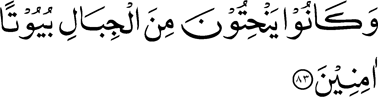


It is generally imagined that Prophets are figures speaking to primitive societies, however the words of the Qur'an point towards the opposite conclusion. We are talking about highly advanced, materially rich, cultures. We should also consider connecting these verses to the Sodom and Gommorah situation, in the sense that both had the same issues of moral decay.
Q 15:72 states that Sodom and Gomorrah existed in a drunken condition, blindly wandering. Now, in v.82, we see that these groups would ignore Allah's signs and exist "feeling secure" because their homes were built in seemingly solid places such as mountains. However, that did not save them!
This is a lesson that we in the developed world need to learn. As we compose these words, the USA is facing Hurricanes in our southern regions. Indeed, it has to be admitted that those of us living in the USA and in other highly developed nations perceive ourselves as largely immune to the disasters, both natural and man-made, that other societies face on a regular basis. The feeling of complacency, in the face of eventualities as well as in the face of social and moral injustices, can very well be the seeds that plant our eventual destruction.
We are not advocating a negative view on everything, only that we keep our eyes open, and our hearts firmly planted within Allah's guidance.
[Q 15:85]
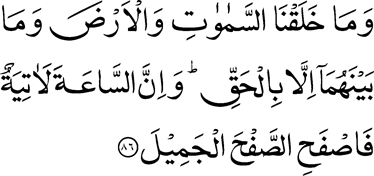
Haqq has a plethora of meanings and implications, here, it is best to render it as "Purpose". In another verse, Allah says "And We ( i.e. Allah) have not created the sky and the earth and what is between them for play" [Q 21:16].
The One who created the universe for Haqq, will, likewise, end it all in Haqq. The ending is the "hour" of Judgement. That day is also called The Last Day [Yawm Al Aakhir]. Because the beginning and ending all exists within God's purposes, we are told "So forgive with gracious forgiveness" (Saheeh International translation).
This last sentence in the verse is clear enough, yet Tafseer Al Jalalayn asserts that it is abrogated by "The verse of the sword", which reads, as translated by Saheeh International : "And when the inviolable months have passed, then kill the polytheists whereever you find them and beseige them and sit in wait for them at every place of ambush.." ( Q 9:5)
We find this assertion to be unsupported by the context, moreover, the assertion is a violation of well known principles. Q 9:5 is clearly in a certain war context at a certain place and time. Indeed, all one really needs to do is read the contex [Starting from 9:1 and ending in 9:10]. In other words, verses regarding war are at a particular place and moment, specific to that, whereas the principle of graciousness, humility, forgiveness and kindness are general and timeless.
The general principle, when and where general situations are applicable, have nothing to do with war and fimness during periods of imposed conflict.
Throughout the Qur'an, we read statements such as "and when the ignorant address you, say "peace"" [Q 25:63].
Therefore, we cannot agree with the claim that this text has been abrogated. We question the entire basis for the claim that any verse of the Qur'an has been abrogated(ft.1)
[Q 15:86]

Al Khallaq means the ever-Creating. It is different from Al-Khaaliq {The Creator}. The former shows us that God is constantly at work in creating!
This is an important nuance because as scripture readers, we tend to think of Allah as only acting in the past, whereas the fact of the matter is is that Allah is still and will always be at work in the universe He runs. The importance of Ayatul Kursiyy ( Q 2:255) is highlighted in such a discussion. If God is simply a historical figure, a being who worked in the past, the presence of Ayatul Kursiyy in the Qur'an would be pointless, as would the numberous Prophetic traditions encouraging us to regularly recite that text!
[Q 15:87]
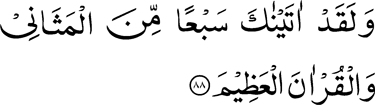
"Seven oft repeated" is universally understood to refer to Soorah Al-Faatihah. That chapter, the Qur'an's opening words, is recited several times daily in Muslim prayers.
It is signifigant to this writer that all Muslim demoninations without exception agree that Al-Faatihah is necessary for the daily prayers, even though there is no verse which directly says that one must recite it in the prayers.(Ft.2)
[ Q 15:88-90]
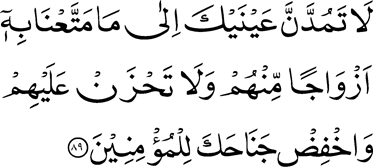


This is directed to Prophet Muhammad, upon whom be peace and blessings, moreso than anyone else. In essence, it says to him to never be tempted to give up your faith and the company of those sincere in their faith, because God has already given you so much. The material or worldly trappings in the hands of the disbelievers should not dissuade you.
Other Quranic texts tell the Prophet, Sall Allahu 'alayhi wa sallam, the same message. In particular, many of the texts in the Juz 'Amma section . I would recommend reading some of those Soorahs, such as Ad Duhaa ( chapter 93), Inshiraah ( chapter 94) and Al Kawthar (chapter 108).
Verse 90 is more difficult to grapple, and that difficulty is reflected in the different interpretations found in the books of Tafseer.
If connected with vv.91-92, the context seems to be a warning, just as warning is found in general in the story of Lot's people and the Madyan and Hijr above, to not pick and choose what one accepts of Divine Revelation.
The Qur'an states "..and those firmly grounded in knowledge assert 'We believe in it, all of what is from the presence of our Lord.." ( Q 3:7).
In today's world, we have trends which attempt to carve up the scripture, both figuratevly and literally. We have writers and lecturers, of Muslim family backround, asserting that Muhammad made up parts of the Qur'an in order to justify genocide and to have women!
We have "Muslims" who esentially reject what the Qur'an says on race relations, who attempt to use the Scripture to justify racism, hatred, misogny, and immoral behaviour.
The Qur'an can never have textual corruption (called Tahreef in the literature) but it can have distortions based upon a copy/paste approach. This is done by extremist groups all the time among Muslim ranks, but it is also done diverse groups as Islamophobes ( folks with an irrational fear of Islam and Muslims) and liberal voices in the Muslim community.
I think it is better for people to admit that they have weaknesses rather than to justify the unjustifiable in Islam. It would be more honest.
In any case, there are other interpretations of verse 90 [and the verses following it] that could be the correct understanding. For now, we share our views above and conclude with the reminder that at the end, only Allah knows best.
Conclusion
The world and life therein can be a confusing place. The diversity of personalities, cultures, egos and agendas can bring people to a state of loss, of feeling lost. The Qur'an comes along to help us on life's journey, but in order for it to really be effective, one must reflect on it in a continous manner, regularly studying it, reciting it, and acting upon it.
This should not be done in a superficial way, nor should it be dogmatic, in the sense that the text gets manipulated to suit our whims.
In our previous article, we looked at the story of Lot, how the people there were "wandering about blindly, in a drunken state". In this article here, we read how Allah says that another group felt that they were secure from any catastrophe because their homes were built within mountains.
We should consider taking the above sentiments further, not just in social analysis, but within our own circles or existence of life. Are we walking blindly or acting drunk in our lives and in our thinking? Are we oblivious to realities? Are we painting the doors while the house is on fire?
May Allah show us truth as truth, and give us the ability to follow it, and falsehood as falsehood, and give us the ability to abstain therefrom.
Footnotes
[1] For more on the question of abrogation [known as Naskh] go to this link .
[2] We have a number of Prophetic Ahadeeth which tell us that Al-Faatihah is to be included in prayers. All the groupings, despite their many theological and methodological differences, accept that Al-Faatihah is needed to be included in their prayers. The necessity for Al-Faatihah in worship is also accepted by most of those who reject Hadeeth as a source of Islamic understanding, known widely as Quranites or "Quran alone". Thus, one can find the writings and videos of Rashad Khalifa, one of the most well-known proponents of a hadeeth-free understanding of Islam, advocating that Al-Faatihah be recited in prayers.
Al-Faatihah is known as Umm Al Qur'an, the essence of the Qur'an. It is the perfect text for worship, and logically we should be able to see why the Prophet Muhammad said that any prayer in which that Soorah was not included was "Incomplete" ghayr Tamaam. The source of this hadeeth is Saheeh Muslim.

