Showing posts with label reflections. Show all posts

Monday, March 2, 2026

Gas lighting, Moving the goal posts, arrogance and stupidity- thoughts on the newest war

 To the surprise of no one, Israel and the United States launched attacks on Iran in an open manner, bombing a number of cities, generating casualties, the most significant being the assassination  of Supreme leader Ayatullah Ali Khameini.  Iran has retaliated by launching missiles and drones at various places within the Middle East which play host to United States bases, and of course on Israel itself.  How the military side of things plays out in the immediate future is impossible to predict with precision, but it should be noted that the mechanisms of how we have arrived at this point be studied from various angles, with as much fairness as possible.


In short, we have arrived at this stage for a number of reasons, summarized as follows.


(1) In the very recent situation, protests against skyrocketing inflation (itself a byproduct of U.S. economic sanctions) were infiltrated with what can be politely referred to as rioters, burning everything from police stations, mosques, homes and much more, leading to thousands of deaths. 


(2) The Iranian authorities described such persons as agents of the United States and Israel, with an agenda of creating enough social chaos to collapse the Iranian government. The Internet was temporarily shut down in Iran in order to limit the abilities of the rioters to coordinate, a move which seems to have worked. Both The US and Israel, in various official and unofficial public communications, acknowledged their hand in these things, attempted to circumvent the Iranian move (by the use of smuggled Starlink terminals). Indeed, US president Donald Trump directly called for Iranians to move against the government and stated "help is on the way." Thus, another pretext was used in an attempt to justify military attacks on Iran by the United States. 


(3) When this failed (although it did lead to the deaths of thousands), The Trump administration changed tactics, threatening attacks to disable Iran's "ambitions " to possess Nuclear weapons. For those who have kept up with these issues over the years, this was laughable. Not only was the nuclear sites attacked by the United States in the so called 12-day war, Iran has for decades maintained that they are against nuclear weapons, but only want to utilize Nuclear technology for domestic purposes. More importantly, a treaty was already in place by  The Joint Comprehensive Plan Of Action (JCPOA) an agreement which the United States unilaterally withdrew from upon Trump's second term. See Here New York Times perspective


(4) In any case, peace talks took place, albeit in unusual circumstances, mediated by the government of Oman. It is in this context, while talks are still under way, that Israel and the United States simply launched attacks anyway. Recent behavior of the Israelis show that war still occurs, in the most treacherous ways, and that at core neither agreement, morality or common sense would be utilized. This is demonstrated by the Israeli attack on Doha, Qatar itself, targeting Hamas leaders while in peace talks with them In September 2025.  The fact that the United States did NOT defend Qatar from an attack (despite the presence of their air force as well as defense technology) shows that at core, neither the US nor Israel can be trusted at all! 


(5) The peace talks mediated by Oman was on the nuclear question, which even Iranian officials were saying that progress was being made. Then, the Trump administration demands it be on missile technology. The goalposts keep moving because the claims to want diplomacy and peace was all subterfuge. The desire is NOT peace, but rather the total overthrow of the Iranian authorities. 


(6) Common sense demonstrates that the Iranians would respond, and have done so by launching attacks on U.S. bases and other military targets that are based in the region,  such as Kuwait, Saudi Arabia, Qatar, Jordan, The United Arab Emirates, and of course Israel itself. The long-term impact of such actions have yet to reveal themselves, but it is obvious that the world economic system will be devastated should Iran choose to close the Straits of Hormuz, through which 20% of the world's oil travels.


The above is simply common sense, a straightforward analysis that can be easily understood. Indeed, we can say that even the Trump administration has -by and large- been open with stating its overall agenda of death and destruction, using only thinly disguised excuses as  pretext to present justifications. 


Gaslighting


The false justifications mirror past accusations which led to other conflicts, such as the assertions that Iraq had to be invaded  by the United States in order to remove "weapons of mass destruction" (WMD) in 2003. This is an example of gaslighting in the sense that we have been expected to have forgotten this pattern in recent history. False pretexts exist throughout the history of wars, especially conflicts directed against Muslim nations. 


The false justifications in the current conflict have been built up particularly in social media, with the most ridiculous accusations directed towards Iran, such as sanctioning pedophilia, hatred against local Christians and Jews, and much more. As a student of history, theology and related topics, I have been particularly annoyed at these assertions, which are obviously mostly directed towards American politicians and public which is mostly uneducated in these fields. 


Arrogance

The American push against Iran-directed by Israel- is a reflection of a bigger attitude of "Might Makes Right" as well as White privilege. That class in power, the same with deep connection to the late Jeffrey Epstein, sees themselves as better than everyone else, that any actions they initiate are for the benefit of the planet. This class has become emboldened in recent years, to the extent that U.S. defense secretary Pete Hegseth directly said that the United States is not obligated, nor will follow "stupid rules of engagement" or engage in "politically correct wars."


Recently, the United States Ambassador to Israel-Mike Huckabee- in an interview asserted that Israel has a God-given right to "take" the entire Middle East. Although the Trump administration publicly distanced itself from that statement, it simply is a reflection of already held views in that circle.


Ultimately, these actions and attitudes are poorly thought out, leading to nothing except  continued wars that bring no benefit. It is the average people who will suffer the most. I believe that the recent trends in American society to present minorities such as the Somalis (in Minnesota and Ohio) as villains has been initiated in order to provide easy scapegoats, to distract average citizens by directing their anger towards visible minorities. Indeed, it would seem that ICE actions, even President Trump's own comments in his recent State Of The Union address, are meant to facilitate this nonsense. 


An Islamic take on these issues


Firstly, the Qur'an has told us that when those who are guilty of flagrant violation of the rules of conduct give us information, that information needs to be subjected to scrutiny before believing and acting on it (Q 49:6). Similarly, the Qur'an has described these forces as those who will proclaim with the loudest voices that they are a class which only wants the best for mankind, rejects any reasonable pleas to reasonable behavior, but rather attempt to manipulate the public via all the media mechanisms at their command (Q 2:9-16).


For average apolitical audiences, it is necessary to exercise a healthy skepticism, stay informed, but perhaps most importantly to not allow the toxic thinking patterns of the Epstein-type class to infiltrate our hearts and minds. Tyranny will not last forever. Eventually, the system of oppression, hatred, racism and arrogance will collapse, and it will collapse largely as a result of its own actions. In the meantime, never believe what this class of abusers say, at least not without verification. Be safe, be active, and develop the tools needed for as much independence as possible.  In a broader sense, Muslims-in particular powerful Muslim nations- need these reminders as well, especially in light of sectarian and ethnic conflicts, as we have seen between the brother nations of Afghanistan and Pakistan.  Disunity only benefits the Epstein types who have been widely reported to have engaged in sexual abuse, murders, political and social manipulation, and even some levels of child sacrifice See here


Wa Billaahit Tawfeeq.

Tuesday, August 6, 2024

The fragility of life

 On both macro and micro levels, we are reminded of the fragility of life, that what we take for granted now will be out of our hands at any moment. People die every day, from both natural and unnatural causes, at times when it is expected as well as sudden (and seemingly) random. 


Seeing certain things on the macro and micro levels recently have made me think about this, even my own particular life circumstances, and on top of this an unexpected death of a longtime friend occurred, and by the time I learned of it, it was too late to make arrangements to attend the janazah (funeral prayers).


The local press had published details of his death, and surprisingly very little biographical information. His work in the religious realm, even translating classical and modern texts from Arabic to English, as either head or worker in various organizations that dealt with the serious issues of society, was unmentioned. Only his age and a handful of comments showing his generosity was shared. 


Perhaps in recent years he has not emphasized his past accomplishments, or there were limitations to what can and can't be published in a death notice.  We would often speak on books, theological points, politics and a host of other topics. Hè was a very intelligent and articulate believer in Allah and in Muhammad (peace be upon him) as the messenger of Allah. 


There are some lessons I have derived from this news (of his death), lessons that are applicable to everyone. It should be noted that death is NEVER an accident, at least in the sense of Allah's power. In other words, death happens when God has meant or willed for it to happen. Qur'an asserts that None can delay it or advance it, it happens as God wills it to happen ( Q 16:61).


(1) Do not delay in keeping up with loved ones


Tomorrow is not guaranteed. All of us can easily depart from this world. Thus, it is important to keep up with your loved ones. There will be so much regret when those persons are gone. This world is very busy and stressful, but nonetheless we have to make time to maintain good ties with them. It could be something as simple as a weekly phone call or text message.  The friend in question sent me a text message the day before he died, but because of my own neglect I didn't reply, and now feel a bit of guilt. Thus. the lesson! 


(2) Drop the grudges


There are families broken apart over largely inconsequential items. This way of operating is quite unhealthy and leads to a stagnation whose impact can be felt for centuries. Some issues are necessary to "hold a grudge", but most are not. For those things which are not that weighty, a by-product of human error and the like, we should at least try to resolve them. One of the interesting teachings in Islam is that in Paradise, disputes, "vain talk" and the like are not present. (Q 19:62). In other words, the conflicts of the dunya should not (and actually will not) be transferred to the Akhirah


(3) Live your life


Enjoy life while you have it. This does not mean to be hedonistic, but rather to have wholesome life, in which you need not be a slave to the past. Many of us have been so burdened by trauma that we think we cannot escape it. We create excuses and even can engage (unknowingly) in self-sabotage, creating (illogical) excuses not to go forward with life. The famous Arab poet and philosopher Khalil Gibran has articulated this lesson succinctly: "Travel, and don't inform anyone. Live a real love story, and don't inform anyone, because people (tend to) ruin beautiful things".


There are always changes of failure in particular endeavors, however fear from doing anything makes failure a guaranteed outcome! 


Indeed, with the recently deceased friend, this was something he was very much doing in the months preceding his death. 

(4) Keep up with your spiritual life


The main avenue for spiritual maintenance is of course the five daily prayers as observed by Muslims. This activity is the main vehicle by which we connect to Allah. Avoid the prohibited actions as articulated in the Islamic sources, and keep with other practices such as reciting "None deserves worship except Allah" (Laa elaaha ill Allah) before sleeping. After all, if we do indeed pass away in sleep, having our last words be the words of testimony of faith is actually a blessing. 


(5) Goodly company


Death is guaranteed, and as believers we believe in the power, existence and authority of God. Thus, while here, we should have in our circle those who help in the development of our souls, our character and morals. This is particularly important in the romantic realm. 


This article concludes with a prayer that Allah grant our friend (whose name I will omit), the Shaikh, paradise, forgiveness for any faults, Divine Mercy and provision. Indeed, we pray this same wish reaches all believers, men and women, old and young, who depart from this world. Ameen. 


Wednesday, December 13, 2023

Looking Over The Horizon: a glimpse at the methodology we use to explain and apply Islamic teachings


Introduction


Life is a journey, wherein the traveler has happiness as well as pain, where he or she learns and benefits from the experiences of others. The longer we live, the more opportunities we have to grow, to mature in outlook, and to use that as a means for benefit for self and others. 


From a religious perspective, the primary purpose of existence is to function in the matter decreed by God, and that function itself delivers benefit to the wider whole. Fossil fuels are the remains of lifeforms long gone, yet our planet is literally powered by the presence of those dead organisms. The Qur'an phrases it in the following manner "And I (Allah) have not created the Jinn nor humanity (for any purpose) except that they worship Me." (Q 51:56).


This term "worship" is not restricted to rituals conducted in an assigned spot at specific times, rather, worship is to function as useful and productive in much the same way as the fossil fuels have done, and we all should invoke Allah to be those who prove to be useful and productive in this world.


The purpose of this article is to highlight the building blocks of the methodology we employ to explain and how to apply Islamic teachings. This composition is by no means exhaustive, nor does this writer claim immunity from mistakes or faulty conclusions. After all, "perfection is with God alone" (Al Kamaalu lillaahi wahdah), as the expression goes.  In short, what we are sharing, and always share (insofar as understanding the faith and its application) is what we see looking over the horizon.


It should be noted that the summary below has more relation to application (fiqh) purposes than to theological constructs. 


[1] The Qur'an


The Qur'an is the primary text, seen as the uncorrupted word of God, the final scripture, delivered to the figure referred to as "the seal of the Prophets", Muhammad ibn 'Abdullah, Sall Allahu 'alayhi wa sallam

. It's place in Muslim life is beyond question, its value as the preserved scripture with historical validation is similarly above reproach. All Muslims, regardless of cultural or sectarian label, affirm these aforementioned assertions. Moreover, the Qur'anic content is surprisingly general, allowing for application in just about any environment.  Regarding its own status, we are told "Say: it is, for those who have faith, a guide, and a healing (source)" " (Q 41:44).  

Allah (Subhaanahu wa ta'alaa) has also told the Prophet Muhammad (peace be upon him) " And We (Allah) have been sending down consistently (Nazzalnaa) upon you the scripture as a clarification of all things, a guide. a mercy, and good news for those who submit." (Q 16:89).


Thus, in our methodology, a careful examination of the Quranic text on any given issue is required, particularly social issues. 


(2) The Prophetic Sunnah


We would be remiss without consultation with the tradition of the Prophet. Indeed, to him the Qur'an was revealed, and it was he who taught not only the text but the way by which the text was to be applied. The reports of his statements, actions, even tacit approvals, are recorded in hadeeth literature. The hadeeth literature is vast, it is comparable to bits of data, entered into files, placed under analysis, categorized and referenced as needed. 


 Because the hadeeth literature is so vast, traditionally the investigation and referencing of that genre has been limited to specialists in this particular field. We agree with this approach, and advocate that the general body of Muslims own books such as The Forty Hadeeth (An-Nawawi) or Riyaadhus Saaleheen (Gardens of the Righteous), as works like this have largely useful and non-controversial narrations, however the vaster works should be read by specialists.  To use an analogy, the Medical Doctor has the right to own and research complicated medical texts because of their training, whereas a novice would consult the same works and become confused. 

In answering queries, we do refer to the reported words of the Prophet when needed, and we keep in mind that the words and actions recorded have a context often unique to the Prophet's time and place, as well as the principle that the most important tradition of his to follow is that which provides guidance, particularly in worship and ethics, known as Sunnat al Hudaa


We keep in mind that the words and actions recorded in the hadeeth literature are to be in conjunction with the Qur'an, either in word or spirit, that those words must not overthrow well-established Islamic principles, must not contradict known historical facts or scientific data. While this is not the place to get into a discussion on the traditional methods of hadeeth verification ('Ilmul hadeeth, 'Ilm ar-rijaal etc), understand that it is consulted and referenced in addressing queries. 


(3) The schools of thought (Madhaahib)


We do address specific questions with reference to the schools of thought when applicable. After all, most Muslims have grown up in a family or society, so it makes sense to use this as a source, and comparison or deriving rulings from other schools when needed. 


(4) Local or personal needs/dynamics


In a Western context, this reality cannot be ignored, and it is the strongly held view of this writer that often the answers given by the scholars are lacking cultural or situational awareness. Convert sisters' marriages with non-Muslim husbands get broken up because they have been told "it's now haraam," without even a chance to address the issue, families become disturbed because the Muslims are told by the scholars not to have thanksgiving or Christmas dinners with non-Muslims, leading to a host of other negative consequences. 


The social sciences, personal and societal history and overall needs all must be kept in mind when giving advice on the methods of practicing and applying Islam. 


(5) Liberal Or Conservative Islam ?


Our approach towards the application of Islam is often described as "liberal". While I understand the reasons behind this perception (ft.1), I attempt to follow the model of Prophet Muhammad-peace and blessings of God be upon him- who was described by his companions as "a teacher that makes things easy "(Mu'alliman Muyassira) when addressing the religious needs of those who consult with me. 


Thus, I see myself as a Muslim, trying my best to understand and apply Islam in the world circumstances we face. I try to give advice based on the Qur'an, Sunnah, and the overall needs of people. 


I believe that Islam is Allah's guidance for all mankind, at least for those who are willing and able to embrace it, and I believe further that the deen is not as hard as people think it is. I do not water down the faith, and I share what I believe is authentic, true and beneficial. May Allah give us all guidance and a firm stance on what is correct, may He correct our faults. Ameen.


Footnote

(1) The main reason behind this perception (I assume) is that my Islamic academic background has been associated with other teachers deemed "liberal", as well as a look of a "normal guy". 


Thursday, June 16, 2022

Reflections on Istikhaarah: the priorities of life


Muslims have a tradition that when facing options in which there is no clarity, to make the above supplication. As a ritual, the basic procedure is to offer a two-unit (rak'ahs) prayer and make the above supplication. 


A full examination of the Istikhaarah rite                                                                                                                                  
The tradition is based on the following report " On the authority of Jaabir b.'Abdullah, Radee Allahu 'anhu: The Prophet (Muhammad) Sall Allahu 'alayhi wa sallam would instruct us to pray for guidance in all of our concerns, just as he would teach us a chapter of the Qur'an! He, Sall Allahu 'alayhi wa sallam, would say "if any of you intends to undertake a matter, let him pray two -units of voluntary prayer, and afterwards supplicate (the istikhaarah supplication)."

There are some interesting elements of the practice that are present in the above hadeeth, which are addressed below

Pray for guidance in all concerns. 

 The Muslims are instructed to offer five daily prayers, give in charity, and fast as necessary elements in our attempts to be close to the Creator.   The rite of offering two- unit salaah, in which Soorah Al-Faatihah (Ft.1) is recited, as well as the other normative worship texts (Tasbeeh, Tahmeed, Tashahhud, Salaat 'alan nabi etc) shows us that there is to be an attitude of submission, and acceptance to the Divine plan! We don't always know what that plan is, but we are expected to integrate ourselves to it.

The Qur'anic revelation states: " So, where will you go?  It (Qur'an itself) is none except a reminder to all nations, for whosoever amongst you that wants to go straight, and you are not to will, except as Allah has willed, (he is) the caretaker of the universe." (Q 81:26-29)

This supplication (du'aa) was taught just as the Qur'an was taught


This is very telling. The Prophet Muhammad, upon whom be peace and blessings, made the teaching of this supplication a priority, in the same fashion that Quranic education was a priority! The Qur'an itself teaches that God hears all supplications (Q 2:186), while also asserting that He knows the contents of one's heart (Q 3:154, 5:7, 8:43, 67:13-14 and many other texts). 

So, what is the purpose of reciting a specific supplication? Why recite a supplication at all, if God already knows what we are in need of in the first place? 

The answer is that the Istikhaarah supplication is done, primarily, as an act of worship (ta'abudi), and worship itself has a way of addressing one's concerns by its very nature. A person develops a closer tie to the Almighty through worship and supplication, the stronger that tie is, the weaker the particular problem will be, until that problem gets resolved.

Translation of the supplication

O Allah, I seek your guidance by your knowledge. strength by your power, I ask from your magnificent bounty, you have power, while I don't have power. You know, and I do not know, and you are the full knower of the hidden ('allaamal Ghuyoob). 

O Allah, if you know this issue (and mention the issue) to be best for me in my faith (deeni), my life (ma'aashi), my ending ('aaqibati amri), then decree it for me, make it easy for me, then bless me in it.

And if you know this issue (haadhal Amr) is harmful for me (sharrun li) in my faith, life and ending, then remove it from me and me from it, decree for me what is best (khayr) wherever it is and make me satisfied with it." 

The supplication teaches bullet points of priorities

The supplication texts of both the Qur'an and Prophetic tradition serve as more than ritualized recitations, rather, they serve as items conveying lessons. In this case, after telling us repeatedly about the Divine power and knowledge, this du'aa teaches that what we are to look for, when trying to make a decision that has long term consequences, is if that issue for which we are indecisive, if it will be the vehicle for religious/spiritual growth, enhance one's worldly life/happiness, and be a source of peace when the end of life comes.


What happens after Istikhaarah?

This can be followed up with seeking advice on the matter from trusted sources, as well as writing out a list of pros and cons on the matter. Ultimately, the supplicant has to live with their choices, but the supplication gives us core things to look for. Many people limit the Istikhaarah supplication to marriage, however it can be offered when facing other choices as well, such as career, moving, business, etc. 

Many depend on "a good feeling", intuitive understanding, afterwards, or seeking out a dream or a miracle as a sign from God in favor or against. While we cannot say for certain what Allah will do, we can be assured that the supplication helps us to make the decision on our own. 

After all, God has given us minds, hearts, arms and legs by which to make decisions and to be able to make those decisions come into reality.

Footnotes 

(1) Soorah Al-Faatihah, the opening chapter of the Qur'an, is the necessary text for every unit of prayer. There is consensus (Ijmaa') on this. It is a text of both worship and supplication. 

Wednesday, May 4, 2022

Zakaat: Reflections on its application in the Western world

(1)  Zakaat as inescapable religious obligation


The payment of Zakaat, often rendered as " poor dues" certainly is a religious obligation. It is placed as among the five pillars of Islam. The reason for this is apparent only by glancing the opening pages of the Qur'an, which reads " A.L.M. This is the scripture, about which there is no doubt, a guide for those who possess taqwaa, who have faith in the Unseen realities, establish prayers, and spend out of what WE (i.e., God) has provided for them." (Q 2:1-3).


Similarly, we have hundreds of places throughout the Qur'an which places the obligation of daily prayers alongside payment of Zakaat. Denial of its primary presence in Islam is deemed sufficient by many scholars as a rejection of the Islamic faith in totality, and a number of Quranic verses have expressed condemnation for those who do not pay it (Q 3:180, 41:6-7, 9:34-35 among others).


(2) How is it usually paid?


The schools of jurisprudence are in agreement that a minimum of 2.5 % of yearly wealth is to be given in Zakaat. Traditionally, most prefer to pay this in the month of Ramadan. This is different from the charity mandated by the Sunnah to be paid before the 'Eid prayers, which is known as sadaqatul Fitr or Zakaatul Fitr.


(3) To whom it is given?

In many Muslim countries, it is collected as a tax from one's pay, or deducted yearly from one's savings account. The government then distributes those funds to those it finds eligible. Still, other Muslim nations do not regulate or exercise control over Zakaat funds, leaving it to the discretion of individual believers or mosques/religious organizations.


While there are small discussions as to who is eligible to receive it, the following texts provide the general recipient list:


 Zakah expenditures are only for the poor and for the needy and for those employed to collect [zakah] and for bringing hearts together [for Islam] and for freeing captives [or slaves] and for those in debt and for the cause of Allah and for the [stranded] traveler - an obligation [imposed] by Allah. And Allah is Knowing and Wise." (Q 9:60 Saheeh International translation)


 "It is not righteousness that ye turn your faces Towards east or West; but it is righteousness- to believe in Allah and the Last Day, and the Angels, and the Book, and the Messengers; to spend of your substance, out of love for Him, for your kin, for orphans, for the needy, for the wayfarer, for those who ask, and for the ransom of slaves; to be steadfast in prayer, and practice regular charity; to fulfil the contracts which ye have made; and to be firm and patient, in pain (or suffering) and adversity, and throughout all periods of panic. Such are the people of truth, the Allah-fearing." ( Q 2:177 Yusuf Ali translation)


The inspiration to help others, as integrated into the Muslim faith and culture, has won praise from friend and foe alike. It has functioned as a live saving institution.

There are a number of points raised in these two Quranic verses, insofar as their applicability in today's world, particularly in a Western context, which we will address in due course. We hope to show that the religion of Islam is indeed versatile, having the ingredients necessary to give concrete guidance that reflects our current realities. It is necessary to deal with the following questions.


(4) Can Non -Muslims receive zakaat funds?

Generally, the scholars assert that Non-Muslims are ineligible to receive Zakaat, but rather, the non obligatory, discretionary charity (sadaqa). This understanding makes sense in a context of supporting local needs first, a concept that is globally understood. After all, U.S. citizens pay taxes to the United States government, not to Canada.


However, a literal and careful reading of the Qur'an does not specify a religious identity of recipients. Moreover, the term rendered as "bringing hearts together" (Al-Mu'allaf al Quluubuhum) above has been understood, even in the Prophet's time, as either giving funds to those who would be persecuted as a result of accepting the religion (who would otherwise not accept it because of those fears) or at least for generating good will within the non-Muslim community. 


Thus, it is our view that any on the above list of zakat recipients are eligible, regardless of religious label.


(5) Can Mosques and institutions receive zakaat


It is the view of the majority of scholars and schools of jurisprudence that Mosques and religious institutions are not eligible to receive zakaat. The Hanafi school is particularly vocal in these regards. (ft.#1)


This ruling makes sense in a Muslim world context, where the mosques are funded either by the government, rich individuals, or religious institutions.


In the West, the mosques function as not only the places of worship, but of learning, government, social, political and propagation sites. Thus, it is our view that mosques and religious institutions are eligible to receive zakaat.


This argument has a plethora of evidence, summarized as follows.  (1) The Quranic verse 9:60 clearly states that those "employed to collect" are eligible to receive, and in a Western context it is the mosques who collect zakaat and distribute it to those individuals in need. (2)  Q 2:195, among other verses, commands to "spend in the cause of Allah", which has been understood as struggle and even propagation. Mosques function as both centers of propagation and struggle to uphold Islamic values. (3) The Qur'an (Q 9:17) also commands the believers to maintain the mosques(ft.#2).  In a Western environment, governments do not support places of worship, therefore the local Muslim community-out of necessity- should support the mosque they worship in financially.


(6) Can charity of any kind be given to a mosque or religious organization not our own?


Both online and in person, we have seen this scenario, in both the Muslim world and the West. A real- life example, which I read on a fatwa website, can be summarized as follows:  A Sunni gets a job in Iraq, being a majority Shiite country. He prays in the Shiite mosques, and encounters charitable organizations set up to support the poor, widows and orphans, people suffering as a result of the constant warfare Iraq has faced. The Sunni posits the question if it is legitimate to support those charitable organizations. The website responds that it is not legitimate, because they are Shiites, and it is not permissible to give strength to incorrect theology ('Aqeedah).


Similarly, we have seen those who will pray in a mosque that does not necessarily subscribe to their particular understanding of the faith, they will frequent that mosque on a regular basis, yet proclaim it is forbidden to give financial support to that institution.

We find this reasoning to be deeply flawed. Simple logic would dictate that if a place is good enough to pray in on a regular basis, and its facilities such as parking lot, restrooms and prayer halls are utilized, that even a token payment is necessary. 


(7) The emancipation of those help captive (Ar Riqaab)


Both Quranic verses cited above in #3 uses the term Riqaab, referring to those who are slaves. Slavery no longer exists as a legally and socially recognized institution, so how should we understand this today? How can the Quranic assertion to free Ar Riqaab be applied in today's world?

It is our view that it is best applied to pay for education, for minor children as well as university students in nations where fees are prohibitive or where students end up in exploitative, ribaa based loan programs.    


(8) Who are the Yataamaa (sing.Yateem)?

Obviously, this term is typically used to refer to children with no parents, i.e. orphans. It certainly has this application, yet in the West we find that there are -by and large- organizations created, both public and private, to take care of such children, there is the foster care system and adoptions available.

While the pros and cons of these initiatives can be disputed, we are looking at the meaning of the term "Yateem", which also appears in Arabic, Urdu and Bahasa Melayu. In Arabic, the basic meaning is "one who is alone, without support".


Therefore, it is our view that Zakaat should be given to adults and minors alike who find themselves, in the West, isolated, struggling both financially and spiritually, until more permanent solutions are found for such individuals.


(9) When to pay Zakaat?

Traditionally, the obligatory zakaat (called Zakaat al maal) was paid once a year, usually in the month of Ramadan. It is our view that a more efficient way to meet the obligation is to pay it more often. Those organizations, mosques and the like entrusted to distribute those funds would then be empowered to do much more in terms of supporting those in need within the community. 


The Qur'an gives us a clue when it says that the due is due on the day of harvest (Q 6:141).  Therefore, it is our suggestion that 2 .5 percent be given, for example, on a monthly basis, via automatic deduction from one's bank account, in much the same way that the majority of our bills are now paid. Another idea could be to simply take the cash once a month, the first Friday of the month, to the mosque and pay it then. A reminder can be made in one's cell phone calendar to make such a payment. One could simply pay with cash or a check.


This is more efficient, even in small amounts, because it allows the mosque or organization to be able to rely on those funds, rather than a random occurrence. Islam promotes stability in all aspects of life and religious practice.


(10) How to pay Zakaat?


The above deals with this question somewhat. The monthly suggestion is based off of the trend in today's financial culture, yet we are also aware of salaries usually being dispersed on a weekly or 15 day basis. There is also the self-employed, who may earn profit on a daily basis.


Applications (apps) are now widely available to help in calculating zakaat amounts. In addition, one need not pay it to an organization. If you know those who are struggling and fit the categories mentioned above, you can give directly to such persons. 


However one does it, it needs to be done, and done on a consistent basis.


Footnote

(1) In many mosques, including my own, funds meant for maintenance and those meant for the needy are kept separately, in keeping not only with Hanafi Fiqh but transparency as well. It is our argument above that Zakaat can be used for mosque maintenance as well. 


(2) On my first visit to Saudi Arabia I was struck by the fact that this Quranic text decorated most mosque entrances. Subsequent visits to the Kingdom have revealed that this is no longer the case, nonetheless it is a good reminder of our obligations, and perhaps should be adopted globally as a necessary text to decorate the mosques.


Sunday, May 30, 2021

Issac and Ishmael: Some thoughts

 The latest round of violence which has occurred in the Middle East has prompted much discussion on the origins of the tensions. There is a great deal of disinformation regarding both the contemporary problems, as well as their origins, deliberate and outright evil attempts to control the narrative, to brainwash the next generation of human beings to be in favor of a system that is inherently unjust.


One of the theories that is often cited, especially in the last two weeks, is that the "Middle East conflict" is simply an extension of an old family feud, a feud between two brothers, themselves, while having different mothers, bear the same father. Indeed, Islam itself is claimed by those who hold that view to be a creation born from that feud!


Abraham 

According to the scriptures, Abraham ("father of many nations") was blessed by God to received guidance, delivery from idol-worship, and was given a covenant. Broadly speaking, this is agreed upon by the adherents of Judaism, Christianity and Islam. Indeed, these faiths are referred to as the Abrahamic religions, as they see themselves as having their roots in  Abraham's experiences.


The Bible (Gen. 16:1-9) asserts that a wife of Abraham, by the name of Sarai (also known as Sarah) unable to give birth on her own, encouraged him to have a relationship with her "maidservant" (known as Hagar), conceive with her, so that the family line would go on. However, problems developed between the two women, causing the latter to leave.(#1)


The two sons from the Bible


Hagar gives birth to Ishmael, who is seen as the progenitor of the Arabs, whereas years later, Sarai gives birth to Isaac, viewed as the progenitor of the Hebrew group. 


The problems between their mothers were visited upon the sons, as the story goes. The Bible, while acknowledging that Hagar has not done anything wrong, nonetheless asserts  that Hagar was told that her son, who is the progenitor of the Arabs, would be "a wild donkey of a man".(Gen.16:12).


Isaac, although younger, is said to embody the covenant. Ishmael is disinherited from that. It is interesting that throughout the Bible, expressions such as "The Lord God of the house of Israel" and "The Lord God of Abraham, Issac and Jacob" are common.


The two sons from the Qur'an


The Qur'an does not entertain any problems between the two sons. They are both mentioned with respect (Q 6:84, 14:39-41, 2:136 and other places), and it is common practice to say "peace be upon him" when referencing both. 


There is never a disrespectful passage in the Qur'an about Issac, even though he is viewed as the progenitor of the Jews. Indeed, Isaac  is viewed as a recipient of Divine guidance.


It is important here to note that the Qur'an contrasts from the Biblical style in that it NEVER uses racist or nationalistic language. It refers to God as the "Caretaker of the universe" (Q 1:2), and never as being restricted or exclusively connected to Arabs.


Religious rhetoric has certainly been exploited throughout the "Middle East conflict". Arabs are routinely portrayed as savages, and antisemitism is a charge regularly made by the supporters of the state of Israel, as a means to disarm criticism. Indeed, the ghosts of the holocaust are routinely resurrected to accomplish this, even though the Arabs and Muslim world had no relation to the Nazi-led holocaust that occurred (in Christian Europe) during the days of the second world war. 


Evangelical figure John Hagee, in almost all of his speeches and writing, has exemplified this pattern, as well as stated in no uncertain terms that he expects a time in the near future when "Israel will own an control all of present-day Israel, including Jerusalem, Lebanon, The West Bank of Jordan, and most of Syria, Iraq and Saudi Arabia".(#2)


Such rhetoric cannot be ignored, especially when it is backed by financial and political drive. One need only conduct a google search to see the reach this figure and this trend has.


If there ever was conflict between Isaac and Ishmael, or between  Hagar and Sarah, that conflict is no excuse to perpetuate oppression. Moreover, in the spiritual realm, it is Islam, which has been conveyed via the Qur'an to Muhammad, which has stated clearly that blood ties has no bearing on one's ties to God. It is Islam which has clearly stated that respect and love be had not only for one son of Abraham, but the other one as well. 


This post has only been some brief thoughts, meant to convey that the Islamic position is actually very reasonable, for any who use reason, when it comes to issues surrounding the descendants of Abraham(#3).In conclusion, we pray "Glorified is Your Lord, the Lord of honor and glory, he is above what is wrongly attributed to him, peace be upon the messengers, and praise belongs to God, the caretaker of the universe." ( Q 37:180-182).


Endnotes

 (1) Robert Alter, in his Torah translation THE FIVE BOOKS OF MOSES ( New York, Norton& Company Limited, 2004) pg.78 uses the word "harassed" to describe Sarah's attitude towards Hagar.

 (2) This quotation is taken from John Hagee's book CAN AMERICA SURVIVE? 10 PROPHETIC SIGNS THAT WE ARE THE TERMINAL GENERATION ( New York, Howard Books, 2010) pg.109. 

(3) The following article has a thorough explanation of the Muslim understanding of issue such as the covenant, sacrifice, etc.. associated with Abraham. http://www.why-christians-convert-to-islam.com/nice201.htm


Tuesday, December 24, 2019

An Ear Of Benefit: thoughts on the role of faith in the modern world

Last week I received a telephone call at my office. The caller expressed their gratitude for "all the efforts" I did which- according to them- changed their life for the better. The sentiments expressed by the caller was obviously heart-felt, and influenced me to think about the countless times such sentiments have been expressed by those who have been positively impacted by us in one sense or another. On a personal level, there is undoubtedly a sense of gratification, a sense of accomplishment, that our efforts achieve positive results, but it also made me recall a rather profound, if undervalued, statement in the Qur'an.


Among them are men who molest the Prophet and say, "He is (all) ear." Say, "He listens to what is best for you: he believes in Allah, has faith in the Believers, and is a Mercy to those of you who believe." But those who molest the Messenger will have a grievous penalty.


The above is from Soorah 9:61, Abdullah Yusuf Ali translation. The Tafseer literature states that the hypocrites are those whom the Quranic verse above is mentioning, they used the expression "He is an ear" (Huwa Udhunun) to assert that Prophet Muhammad          صَلَّى اللّٰهُ عَلَيْهِ وَسَلَّمَ           did not have the ability to distinguish between those who are telling the truth and those who are lying to him.(ft.1).

In other words, they saw him as naive, as-at best- a useful fool. The Prophet's congenial and helpful nature was well known, even by those who would become his foes. He was known as someone who was very honest and trustworthy (As Saadiq and Al Amin), and was involved in activities designed to take care of the downtrodden(ft.2).

To the assertion that he is naive , the Qur'an says "Say: He is an ear, an ear of benefit to you" (Qul:Udhunu khayril lakum).  This is an extremly profound assertion. It is profound because it expresses the fact that there are people out there, blessed by God to function as blessings to others. Similarly, there are institutions out there, which function as a vehicle for the channeling of those blessings.

Long Term Benefit

People of faith want to be connected to those which will help them in developing their faith and to channel their positive impulses to that which is wholesome. Those who lack faith, or are simply oppurtunistic in nature, can only go after short term benefits, and only for selfish reasons. They cannot think in an alturistic manner. Such thinking is- according to the Qur'an, a consequence of having a diseased heart!

The nature of Prophet Muhammad is a nature that has so much love, goodness and mercy therein, even for those who may not necessarily agree with his prophetic claims, that the benefits from his teachings actually outlived him as a person.

I think the same thing can be said of other messengers of God, as well as Non Prophetic figures, men and women who have been blessed with so much internal goodness that it shines forth and benefits others long after the death of those initial personalities.

Conclusion

Strive to do what is right, avoid the company and influence of those who are insincere, have diseased hearts, whose baggage is extremly destructive, and BE the blessing. Allah will in turn bless you. The blessings will be passed around, benefitiing all they touch at some level.

Have faith in this path, have faith in the ONE who created all of us, try to be positive even in the midst of the temptations to give in to negative emotions and naysayer detractors, and take as a model of success the human model, universal messnger and seal of the Prophet, Muhammad ibn 'Abdullah, upon whom be Allah's peace and blessings.

Footnotes

[1] This explanation is given by Imam Ash-Shawkanee(d.1839 CE)  in his Commentary Fat-h ul Qadeer. Similar explanations are found in other tafaseer as well.

[2] The Hilful Fudool is the association that is said to have been created after an internal conflict in Arabian society. It is said that the Prophet (before the Prophethood) was twenty years old when this association was created.

Saturday, August 24, 2019

Towards creating a balanced personality: brief reflections on the role of Prophet Muhammad)

( Note: the following is an article that is based on reflections shared in our Friday Khutbah 8/23/19. Both that khutbah and this article  should be viewed as a follow up on our Khutbah entitled " The Islamic Formula for Happiness: A Quranic perspective", which can be found part 1 as well as Part 2 . We recommend, in the interest of viewing the whole context, that  the above referenced Khutbah be viewed.)


Why Prophet Muhammad?

لَقَدۡ کَانَ لَکُمۡ فِیۡ رَسُوۡلِ اللّٰہِ اُسۡوَۃٌ حَسَنَۃٌ لِّمَنۡ کَانَ یَرۡجُوا اللّٰہَ وَ الۡیَوۡمَ الۡاٰخِرَ وَ ذَکَرَ اللّٰہَ کَثِیۡرًا

" Indeed, you have in the Messenger of Allah, a goodly model, for any who has hope in Allah, the final day, and who recall Allah abundantly." ( Q 33:21)

While the above quotation is often viewed superficially(ft.1), this Quranic verse tells us to look at the Prophet as an example of real success. He functions as an example for those who have hope in the future, hope in God's designs and plan.

While the Qur'an does tell us ( Q 9:129) that the core characteristics of the Prophet was that of kindness and compassion, there is another side that is present.

Another characteristic of the Prophet

"Muhammad is the Messenger of Allah, and those with him display strength(ashidda) with those who reject, yet display mercy with each other. You see them, in rukoo' (bowing), in sajdah (prostration), seeking bounty from Allah and His pleasure, in their faces ( i.e. the core of their being) are the traces of that submission ( min atharis sujood)" ( Q 48:29).
 
 مُحَمَّدٌ رَّسُوۡلُ اللّٰہِ ؕ وَ الَّذِیۡنَ مَعَہٗۤ اَشِدَّآءُ عَلَی الۡکُفَّارِ رُحَمَآءُ بَیۡنَہُمۡ تَرٰٮہُمۡ رُکَّعًا سُجَّدًا یَّبۡتَغُوۡنَ فَضۡلًا مِّنَ اللّٰہِ وَ رِضۡوَانًا ۫ سِیۡمَاہُمۡ فِیۡ وُجُوۡہِہِمۡ مِّنۡ اَثَرِ السُّجُوۡدِ ؕ
The above verse highlights the characteristics of strength and resolve. That requires working hard to accomplish necessary goals. The Prophet was not so "merciful" as to be passive!

The idea of passivity, of surrendering to tyranny (of whatever form) in the name of "surrender to God's will" exists within every religious community in some form or another, but what we learn from the Prophet Muhammad is that he had to face those who sought to destroy him, his followers and his community, and he faced those challenges by being proactive.

Both texts (33:21 and 48:29) have connecting to God in common. In Soorah 9:128-129 we see not only that the Prophet was kindly and compassionate, we  read therein a formula that he was to recite, to seek out God's presence and protection.

Some people believe that a passive, weak personality, is necessary for a healthy spirituality and even assert that such have moral superiority over Prophet Muhammad. Christian apologists cite Jesus's supposed passivity in the face of opposition as an example of his moral superiority over Muhammad.(ft.2).

When a personality is both spiritual and displaying strength, it can breed jealousy, opposition as well as slander. Worldly motivations are projected unto the Prophet, as well as the creation of stories of atrocities.

This happens to Prophets as well as Non Prophets. Good people, who want to see good within themselves and their societies, become targets by those opponents with jealousy within their hearts, or by those who themselves derive some power or benefit from an evil status quo.  It can be disheartening to those trying to do good.

When feeling like this, the Qur'an says to look to the Prophet Muhammad, upon whom be peace.  The Qur'an says, in essence, to the modern reader, "Look at what the Prophet was able to accomplish."

Arabian society had so much serious baggage in those days, well known social and religious ills, and the Prophet was largely successful in removing those bad elements, turning rough people into brave, yet contemplative, personalities, such as 'Umar b.Al-Khattab. His followers became people who looked inward, who worked hard on themselves. They did so by following the Prophet's example, by prayers, contemplation upon Allah (ft.3), discipline, and cultivation of the self.

Thus, the Prophet Muhammad is a model of success, not simply in the religious realm, but in the worldly life as well. The teaching that he conveyed-from Allah-has within it things which we could all use to create happiness and security in life. It is true that not all that he conveyed ("allowed" is perhaps a better term) is always to our pleasing, being as we all come with our own personal and cultural baggage, nonetheless those options are there.

More importantly, the personality of the Prophet is that of a balanced human being. He can be strong when fighting is necessary, but he can likewise be calm, kind and compassionate at those other times when strive is not present.

There are exaggerations and outright slanders against him. These things are brought up as attempts to indicate that the Prophet was a vicious and petty criminal. If such accusations were valid, Islam would have never went anywhere! It would have died out or become of marginal affect.

Yet, the contrast is the reality. Islam is here to stay. It is here to benefit all humanity. It is not here to be imposed by force, but it functions as a blessing.


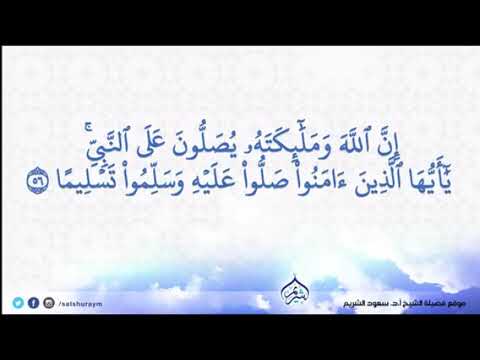
 Image result for quran 33:56

Footnotes

(1)  It is to our dismay that Muslims tend to quote this verse as evidence of a superficial following of the Prophet, taking only things such as dress and eating style from him. Muslim scholarship has wisely stated that there are things we follow of the Prophet when it has religious impact, but that there are things of the Prophet that exist only due to his place and time, such as the dressing style and other things common to all Arabs.  A superficial reading of the Quranic verse does a disservice to the Prophet.

(2) Other assertions made by Christian critics assert that the Prophet's married life was governed by sensual concerns, whereas Jesus was a higher moral code due to being celibate. These type of accusations have been addressed elsewhere by this writer See Here .

(3) The Hadeeth literature is full of examples of individuals coming to the Prophet, seeking out advice on making themselves better. There are even accounts of a self-accusatory nature, wherein people would even embarrass themselves in public by sharing their shortcomings, yet the Prophet would generally find ways to make them feel better about themselves. One example is found in both Al-Bukhari and Muslim, summarized thusly: A man wanted to confess to an indiscretion, the Prophet kept pretending not to hear him. After prayers, the man repeated the confession, the Prophet asked him if he had just prayed with him, the man replies in the affirmative. The Prophet replies that God had already forgiven him (i.e. the questioner).


Monday, September 11, 2017

Study Notes: Accepting God's will: Refections upon Soorah Al Hijr ( 15: 80-90)

( Note: The following is an edited version of my reflections on a handful of Quranic verses. Previously, we have looked at vv. 70-80, which can be found here . The English translation has not been included, unless otherwise stated. This allows the reader to consult the translation of their choice. The Arabic text has been included, and, as always, discussion is welcome.]


[ Q 15:80]

As found in the previous article, we have a brief gloss of the regions Madyan and Hijr. The famed Zamakhshari has suggested ( as quoted by Muhammad Asad) that "Messengers" is a reference to not only the Prophet Saaleh, but rather to his followers, suggesting that the followers of the Prophet Saaleh [and perhaps, by the followers of all Prophets] have a Prophetic mission themselves.


[ Q 15: 81-84]


It is generally imagined that Prophets are figures speaking to primitive societies, however the words of the Qur'an point towards the opposite conclusion. We are talking about highly advanced, materially rich, cultures. We should also consider connecting these verses to the Sodom and Gommorah situation, in the sense that both had the same issues of moral decay.

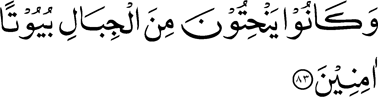
Q 15:72 states that Sodom and Gomorrah existed in a drunken condition, blindly wandering. Now, in v.82, we see that these groups would ignore Allah's signs and exist "feeling secure" because their homes were built in seemingly solid places such as mountains. However, that did not save them!

This is a lesson that we in the developed world need to learn. As we compose these words, the USA is facing Hurricanes in our southern regions. Indeed, it has to be admitted that those of us living in the USA and in other highly developed nations perceive ourselves as largely immune to the disasters, both natural and man-made, that other societies face on a regular basis. The feeling of complacency, in the face of eventualities as well as in the face of social and moral injustices, can very well be the seeds that plant our eventual destruction.

We are not advocating a negative view on everything, only that we keep our eyes open, and our hearts firmly planted within Allah's guidance.


[Q 15:85]

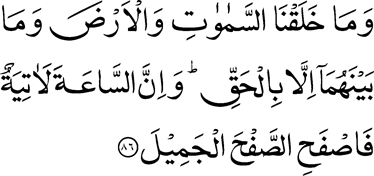
Haqq has a plethora of meanings and implications, here, it is best to render it as "Purpose". In another verse, Allah says "And We ( i.e. Allah) have not created the sky and the earth and what is between them for play" [Q 21:16].

The One who created the universe for Haqq, will, likewise, end it all in Haqq. The ending is the "hour" of Judgement. That day is also called The Last Day [Yawm Al Aakhir]. Because the beginning and ending all exists within God's purposes, we are told "So forgive with gracious forgiveness" (Saheeh International translation).

This last sentence in the verse is clear enough, yet Tafseer Al Jalalayn asserts that it is abrogated by "The verse of the sword", which reads, as translated by Saheeh International  : "And when the inviolable months have passed, then kill the polytheists whereever you find them and beseige them and sit in wait for them at every place of ambush.." ( Q 9:5)

We find this assertion to be unsupported by the context, moreover, the assertion is a violation of well known principles. Q 9:5 is clearly in a certain war context at a certain place and time. Indeed, all one really needs to do is read the contex [Starting from 9:1 and ending in 9:10]. In other words, verses regarding war are at a particular place and moment, specific to that, whereas the principle of graciousness, humility, forgiveness and kindness are general and timeless.

The general principle, when and where general situations are applicable, have nothing to do with war and fimness during periods of imposed conflict.

Throughout the Qur'an, we read statements such as "and when the ignorant address you, say "peace"" [Q 25:63].

Therefore, we cannot agree with the claim that this text has been abrogated. We question the entire basis for the claim that any verse of the Qur'an has been abrogated(ft.1)


[Q 15:86]


Al Khallaq means the ever-Creating. It is different from Al-Khaaliq {The Creator}. The former shows us that God is constantly at work in creating!

This is an important nuance because as scripture readers, we tend to think of Allah as only acting in the past, whereas the fact of the matter is is that Allah is still and will always be at work in the universe He runs.  The importance of Ayatul Kursiyy  ( Q 2:255) is highlighted in such a discussion. If God is simply a historical figure, a being who worked in the past, the presence of Ayatul Kursiyy in the Qur'an would be pointless, as would the numberous Prophetic traditions encouraging us to regularly recite that text!


[Q 15:87]


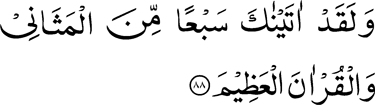
"Seven oft repeated" is universally understood to refer to Soorah Al-Faatihah. That chapter, the Qur'an's opening words, is recited several times daily in Muslim prayers.

It is signifigant to this writer that all Muslim demoninations without exception agree that Al-Faatihah is necessary for the daily prayers, even though there is no verse which directly says that one must recite it in the prayers.(Ft.2)


[ Q 15:88-90]


This is directed to Prophet Muhammad, upon whom be peace and blessings, moreso than anyone else. In essence, it says to him to never be tempted to give up your faith and the company of those sincere in their faith, because God has already given you so much. The material or worldly trappings in the hands of the disbelievers should not dissuade you.

Other Quranic texts tell the Prophet, Sall Allahu 'alayhi wa sallam, the same message. In particular, many of the texts in the Juz 'Amma section . I would recommend reading some of those Soorahs, such as Ad Duhaa ( chapter 93), Inshiraah ( chapter 94) and Al Kawthar (chapter 108).

Verse 90 is more difficult to grapple, and that difficulty is reflected in the different interpretations found in the books of Tafseer.

If connected with vv.91-92, the context seems to be a warning, just as warning is found in general in the story of Lot's people and the Madyan and Hijr above, to not pick and choose what one accepts of Divine Revelation.

The Qur'an states "..and those firmly grounded in knowledge assert 'We believe in it, all of what is from the presence of our Lord.." ( Q 3:7).

In today's world, we have trends which attempt to carve up the scripture, both figuratevly and literally. We have writers and lecturers, of Muslim family backround, asserting that Muhammad made up parts of the Qur'an in order to justify genocide and to have women!

We have "Muslims" who esentially reject what the Qur'an says on race relations, who attempt to use the Scripture to justify racism, hatred, misogny, and immoral behaviour.

The Qur'an can never have textual corruption (called Tahreef in the literature) but it can have distortions based upon a copy/paste approach. This is done by extremist groups all the time among Muslim ranks, but it is also done diverse groups as Islamophobes ( folks with an irrational fear of Islam and Muslims) and liberal voices in the Muslim community.

I think it is better for people to admit that they have weaknesses rather than to justify the unjustifiable in Islam. It would be more honest.

In any case, there are other interpretations of verse 90 [and the verses following it] that could be the correct understanding. For now, we share our views above and conclude with the reminder that at the end, only Allah knows best.


Conclusion

The world and life therein can be a confusing place. The diversity of personalities, cultures, egos and agendas can bring people to a state of loss, of feeling lost. The Qur'an comes along to help us on life's journey, but in order for it to really be effective, one must reflect on it in a continous manner, regularly studying it, reciting it, and acting upon it.

This should not be done in a superficial way, nor should it be dogmatic, in the sense that the text gets manipulated to suit our whims.

In our previous article, we looked at the story of Lot, how the people there were "wandering about blindly, in a drunken state". In this article here, we read how Allah says that another group felt that they were secure from any catastrophe because their homes were built within mountains.

We should consider taking the above sentiments further, not just in social analysis, but within our own circles or existence of life. Are we walking blindly or acting drunk in our lives and in our thinking? Are we oblivious to realities? Are we painting the doors while the house is on fire?

May Allah show us truth as truth, and give us the ability to follow it, and falsehood as falsehood, and give us the ability to abstain therefrom.


Footnotes

[1] For more on the question of abrogation [known as Naskh] go to this link .

[2] We have a number of Prophetic Ahadeeth which tell us that Al-Faatihah is to be included in prayers. All the groupings, despite their many theological and methodological differences, accept that Al-Faatihah is needed to be included in their prayers. The necessity for Al-Faatihah in worship is also accepted by most of those who reject Hadeeth as a source of Islamic understanding, known widely as Quranites or "Quran alone". Thus, one can find the writings and videos of Rashad Khalifa, one of the most well-known proponents of a hadeeth-free understanding of Islam, advocating that Al-Faatihah be recited in prayers.

Al-Faatihah is known as Umm Al Qur'an, the essence of the Qur'an. It is the perfect text for worship, and logically we should be able to see why the Prophet Muhammad said that any prayer in which that Soorah was not included was "Incomplete" ghayr Tamaam. The source of this hadeeth is Saheeh Muslim.

Tuesday, September 6, 2016

Qur'an: serious business for believers and a challenge to those who reject [part two] Q 11:13-20

[ Note: The following is a continuation of some reflections on the eleventh chapter of the Qur'an, beginning here from verse 13 and ending with 20. For part one see http://shamsuddinwaheed.blogspot.com/2016/09/quran-serious-business-for-believers.html]

[Q 11:13] As previously noted, the nature of the Qur'an is so sublime that none can match it or overtake it. There have been attempts ever since the Quranic revelation came to answer its challenges but all have failed to gain any traction. Indeed, the Quranic revelation is the foundation upon which Arabic language sciences formed and flourished. One Arabic Christian poet write:

" I drank from the Nile [river] water, the Shaykh of rivers, it is comparable to tasting the water of Paradise [Maa al Kawthar], a river blessed since ancient times that is [still] sweet, however, it is not comparable to the water of my country." [Eliya Abu al Maadi] [Ft.#1]

The language and style of the poet's composition is clearly Quranic, but also it's motifs. Al Kawthar is a chapter title of the Qur'an, and the traditions say that it is the name of a pond in Paradise, that Prophet Muhammad himself offers such drink from it, that those who drink it will never be thirsty again.[ft.2]

In any case, here- as elsewhere- the Qur'an confidently proclaims that if the opponents can produce something like it [in order to prove that Qur'an is not from Allah], go ahead and try.

In recent years there has been a couple of attempts to answer the Quranic challenge by missionaries. They published a particular book, in Arabic, however they have attempted to market it in the Non Arabic speaking Muslim world.

Why have they done that? Because there is obviously a language gap which they try to take advantage of. However even then, the work, called Al Kitaab al Furqaan, is rightly and widely seen as a foolish production which takes some Islamic  sentences , mixes it up with insulting insinuations and awkwardly composed arguments.[ft.3]

The Qur'an, sent to an illiterate society, memorized and recited daily by millions, stands the tests of time.

[14-15] They have challenged the Qur'an because they seek worldly benefit. In another ayah, we read of such people when Allah says "Do you make your wealth by lying about it?" [Q 56:79]. Their challenge will take them no where.

[16] Except, of course, Hell.

[17] Qur'an is serious business. It is not a game. It is a guidance for those with Taqwaaa, and to play with it is to invite trouble.

[18-20] Those who play with the Qur'an and with the Divine message are not the average Joe-Blow walking down the street. Rather, they are the powers that be, forces that have financial and political interests.

It is important to note that when the Qur'an uses terms such as Kufr, they are synonymous with oppression, the usurpation of the rights of others, with having a destructive mindset.


Conclusion

The historical accounts, the morals, and the emphatic aspects of the Qur'an need to be examined, particularly in today's world. The Quranic discourse needs to be a force of influence, calling us to God and to being able to properly identify what is wholesome and what is it's opposite.

Don't take our word for it. Have a look at it for yourself. Think about what you read, and do so deeply. This Book only benefits those who have a healthy or a sincere mindset. It is for the hard worker, not the intellectually lazy.

[Ft.1] The Arabic text of this quotation is given here.

و شربت ما ء النيل شيخ الانهر فكانني قد ذقت ماء الكوثر نهر .تبارك من قديم العصر عذب ، و ولكن لا كماء بلادي ( ايليا ابو الماضي )


[Ft.2] For more on Soorat al Kawthar, see http://shamsuddinwaheed.blogspot.com/2008/04/al-kauthar-legacy-of-prophet_03.html [Al Kauthar: Legacy of the Prophet].

[3] The Furqaan work was allegedly written by two anonymous writers and 'translated' by Anis Shoroosh. The latter, a Christian of Palestinian extraction, has for many years engaged in polemics with Muslims, the most famous examples being his debates with the late Ahmed Deedat and Dr. Shabbir Ally of Canada. In recent years he has lost credibility in Evangelical circles, least of all due to an arrest for fraud and arson in Florida in 2008.


 .    

Saturday, June 25, 2016

Forgiveness of Ramadan: Reflections on the second part of the fasting month


[Note: The following is an edited version of the Friday Khutbah at Toledo Masjid Al-Islam on July 17th, 2016 at Toledo Masjid Al-Islam. The opening Hamd has been omitted.]

Ramadan quickly ending

As hard as it is to imagine, we are nearly half-way finished with Ramadan. There is a hadeeth of the Prophet, in which he divides the month into three parts, each part consisting of ten days. The first ten days are mercy, the second forgiveness, and the third emancipation from Hell-fire. The initial entry into Ramadan itself, for a believer, is in itself a mercy from God. The second part [forgiveness] is where we want to focus. All religions teach their adherents to seek out Allah's forgiveness, and indeed, the Qur'an and the Sunnah are filled with such pleas. Another approach to take in this regards  is ourselves being forgiving towards each other.

This is also found throughout the Qur'an, Ahadeeth, and the teachings of other faith traditions. Thus, while Ramadan is certainly a personal journey, it is experienced in a wide community of fellow travelers. The travelers all share a bus, a train or an airplane, but upon leaving that mode of transport will go to different places and varied interests.

Forgiveness of others is important because holding onto anger, bitterness and resentfulness can be quite damaging. Most importantly, these things can become ever-consuming and limits spiritual growth, even if knowledge is present.

Look at the Prophet Muhammad, Sall Allahu 'alayhi wa sallam. He entered Makkah, the enemy capital, after years of persecution, war, slander, assassination attempts and the murder of his family members and followers. One would imagine that he would at least have some individuals executed. However, he declared an amnesty, one which even extended to those responsible for the death and mutilation of his uncle, Hamza. The Prophet did not hold on to that bitterness.

How can we apply this Sunnah today? It's easy to apply the Sunnah associated with things such as dress and beard, and even the Sunan associated with worship, but how can we repeat the actions of the Prophet here? By avoiding being overly judgemental, critical and argumentative. Be more accepting, forgiving and tolerant.

Self-Forgiveness

Another aspect worth exploring is self-forgiveness. We can be very hard on ourselves. Well, we all have baggage in life, and the past cannot be changed.  We can only hope to do better in the future.

Many of us take a very wrong approach. We declare ourselves absolved of sins and dedicate ourselves to be judges over other people's sins and issues. Yet we have to look at the Prophet's statement. He says : "Among the pleasant aspects of Islam is to leave that which has no meaning for him.


This is shorthand for the American expression "mind your own business". This is not simply for protecting an individual's right to privacy, even though we admit that such teaching is found throughout the Qur'an and Sunnah [ Soorat an Noor and Soorat al Hujuraat for example] , it is a teaching useful for our own spiritual state. We need to address our own issues and conditions. May this month be a period wherein we can accomplish that.

Demons are locked away yet their mouths are still at work

The demons [Shayateen], we are told, are locked up in the month of Ramadan.  While it is understood that their bodies are locked up, yet their voices are still heard.  Indeed, Allah says in the Qur'an that the Kuffar seek to blow out God's light with their mouths.

So this Ramadan, we have to recognize that there are voices out there who seek to call us, distract us away from Allah, from self-reflection and improvement. They want us to be stagnant, weak and always on the defensive. The strong among us will only be slightly affected by these voices. There are those among us who are affected in a great way by these voices, and these are the weak among us. If we are affected, we have to ask why, we have to ask where our weaknesses are. Ramadan should be the time when we are asking these tough questions. We need more prayer, more reflection [Tadabbur] on the Qur'anic verses. We need to be serious in finding the spiritual truths that are relevant to us, and learn to act upon those truths, as taught by the Prophet [peace and blessings be upon him]


Speaking without knowledge

Many people today speak on subjects without having even an elementary knowledge of that subject. Among them are the majority of our media pundits and politicians. Speaking without knowledge is very dangerous. Thus, the Qur'an repeatedly says "And do not speak about Allah what you do not know" as well as "So ask the people of knowledge if you don't know."


If we really don't know, there is no shame in being silent or asking those who do have information on that subject. We live in a culture that asserts that all opinions are equal and valued, but this is simply a Cultural lie!

We cannot take scientific opinions from a factory worker, simply because they have not studied or mastered this branch of knowledge. Common sense would tell us that we would trust a scientist when teaching on his field, rather than someone who has not taken the time to even a minimum of information. Let this Ramadan be a time of the removal of all self-delusions, when we can become, by hard work, a people that deserve Allah's paradise.