These days it is very common to see aspects of "Islamic law" [Sharee'ah] brought up in media outlets and discussions with anti-Muslim elements [indeed, even among some Muslims on occasion], as a way to embarrass or ridicule the overall message of Islam itself, while at the same time maintain the "superiority" of the "Western' way of doing things.
Islam as religious practice and as a Political ideology are both seen as inherently inflexible, unable to function in modern society.Our intransigence has made us hateful, we are told, of the physical accomplishments of the Non-Muslim world, and manifests itself in "our" women wearing various "Islamic clothing" [everything from the Khimaar to the Niqaab], by 'fanatically' clinging onto five daily prayers, by having 'distinctive' architecture [ take for example the minarets traditionally attached to the Mosques, now made illegal in Switzerland] and eventually this intransigence leads to violence against some innocent third parties.
It is our intention here to present in a condensed form some thoughts on these issues, as well as what we perceive to be the genesis of the above.
Islamic Law vs. "Western" law [democracy/secularism]
Obviously, "law" to a Muslim encompasses a great number of things. It can refer to the prayer format [i.e. Qur'an recitation, prostrations, etc...] to the prohibition of Alcohol and Pork, all the way to the penalties for murder.
We acknowledge that the "democratic" legal tradition can be argued to be lacking when compared to the Islamic law in some respects, after all, with the exception of Murder mentioned above, there are no laws in any Western nation regulating prayer methods and dietary practices yet we have to also admit that the Qur'an does not give direct rulings on every single legal issue. Certainly, it contains prohibitions and punishments regarding theft, murder, embezzlement, etc... and does give some punishments that would be deemed unacceptable in a multicultural, modern world as ours. Cutting the hand of the [perpetual] thief, execution of rapists, a physical penalty for Zinaa are some examples.
The message of the Qur'an, the practice and the spirituality that emanates from the Qur'an, should not be misinterpreted or summarized just in the presence of exemplary punishments. That would be over simplistic. Every legal tradition evolved in a unique set of circumstances, and the presence of exemplary [or 'harsh'] punishments in the legal texts [for Muslims, the ultimate source is the Qur'an itself] only shows that there has to be some remedy available for extreme circumstances. Indeed, this has been historically recognized, in that theft [for example] was only to be punished by cutting the hand when a certain amount was taken, all of which depending on the particular case itself. This is the Muslim scholars approach. Even in the early days, during the reign of the Khalifah 'Umar ibn Al-khattab [d. 644 C.E.], famine swept the Arabian peninsula, so he [the Khalifah] deemed it unjust to punish theft, especially of food items, knowing full well the citizenry was in dire straits. May God be pleased with him, one of the wisest and most fair rulers of all time. The point being the Islamic message need not be seen as "rigid" and inflexible.
Besides, any legal system imposes limitations on what is allowed and what is not. If there were no such limitations in place, the system would be meaningless. So why is it that only the Muslims or their religion is seen as 'rigid'?
Muslims and Islam are sometimes two different things
This author has a "Muslim look" [beard, olive skin complexion], and a while back I was asked by some random guy on the street "why do you kill your women?' He also asked me "why do you force your women to wear all black?" It is true the guy was looking for an argument, but even in such circumstances I tried to be reasonable. Some women wear black as part of their cultural expression, but such choices are not mandated by the Qur'an at all. There is nothing inherently Islamic or Un-Islamic by wearing black. It is a neutral issue, a moot point, as far as the Islamic texts are concerned. This is the answer I provided for the guy, and also for you, our noble reader.
To outsiders, and sometimes even among us, cultural or personal choices are mistaken for Islamic! This has always been the case, and will continue to be the case, as long as humans remain human. Fortunately, we have access to the Qur'an, and in the modern world even access to the canonical works of Hadeeth, Fiqh, etc.. [thanks to the internet, book companies, otherwise such works would only be available to the scholars and specialists], so we can find out rather easily what is authentic according to Islam and what is spurious.
It is commonly assumed that 'honor killings" is sanctioned by Islam. Now, while segments of both Muslim and Non-Muslim societies accept it [ one only need to look at Egyptian Christians who engage in the same], no where in the Qur'an or Hadeeth literature can there be found any justification.
Sexual relationships are a sensitive issue, and the Qur'an advocates that such can be engaged in only within certain confines. It also tells us a legal punishment for those who violate that restriction, but it is apparent that the punishment is only in some extreme circumstances. This is because [A] To even make the charge in an Islamic judicial system, a minimum of four witnesses are required. If such are unavailable [and unless the act is taking place in public, they are never available anyways] then the one who makes the charge will be deemed unreliable as a witness for any future cases, and is open to punishment themselves. Please see Qur'an 24:4 [Ft.1].
[B] The Qur'anic punishment is suppose to be for both parties [provided of course the requirements are met as mentioned above]. The wording of the verse is Az-Zaaniyatu waz Zaaniy 'The woman and the man who has done Zinaa..'[Q 24:2], yet it is often imagined [and indeed, when 'honor killings' take place] that the female alone is to be punished. Besides all of this, there is no death penalty given for this.
So, even when there is guilt, when no evidence is available, legally nothing can be done about it. This is God's wisdom, which allows all the parties/families involved to address the issue internally, one way or the other. There is no need for putting all the dirty laundry out there. This wisdom is applicable anywhere, any place and any time. Alhamdulillaah!
Applying Islamic laws in the West?
There is a great fear that the Muslims in the West are a third column, ready to march on capitals, cutting off heads, whipping and amputating. This fear led the Swiss voters to recently ban minarets on Mosques in their country, even though its purpose is only for architecture. Some posters distributed by the supporters of the law asserted that minarets are ''symbols of Islamic fascism". The specter of fear was waved so much that people actually thought the Muslims in Switzerland were ready to take over and impose Islamic laws, even though the Muslims there are a minority.
Well, despite their fears, Muslims are already conducting themselves on the basis of Islamic laws. Our Marriages, funerals, rituals, fasting, etc.. are all done according to Islam, not according to the whims of voters. But as for the laws mentioned earlier in this post, i.e. for theft, Zinaa, etc.. no Muslim in his or her right mind would dream of such a thing in a Western context, for many, many reasons. The least of those reasons is that even in the traditional sense, Non-Muslims were exempted from Islamic laws anyways. Moreover, there are reasons that Muslims living in the West participate in the legal system prevalent.[ft.2]
Concluding thoughts
There are many elements out there, seeking to publish their views and push their agendas. In a world with so much information readily available, it is important that all people remain informed, educated and well-rounded. Such a position can actually reduce tensions, hatred and violence. Mutual understanding and wisdom in dealing with things are needed more so than armies, intelligence agencies and law enforcement. As the Qur'an says "Do not let hatred of a people towards you swerve you away from justice" [ Q 5:8].
Footnotes
[1] It should be noted that the Quranic verse actually says "and those who throw[Yarmoona] [the public accusation of Zinaa] against Al-Muhsanaat.."[Q 24:4] the latter word means "the goodly women", translated as "The chaste women" by both A.Yusuf 'Ali and the Saheeh international translations, shows that the principle here is 'innocent until proved guilty'.
[2] Please see our "Voting for the first time" at http://shamsuddinwaheed.blogspot.com/2008/11/voting-for-first-time-muslims-thoughts.html. Also of interest is this discussion at the Islaminviewforum site, called "Islam and Corporal punishment" http://islaminviewforum.com/index.php?showtopic=1040. This discussion is still open, to contribute to it, become a member of the forum.
Wednesday, January 13, 2010

Thursday, December 31, 2009
Spreading Islam efficiently: thoughts on Da’wah work
The Arabic word we use to describe efforts at propagating Islam is called “Da’wah”, it is a verbal noun that basically means “Call”. The word Du’aa, in which we invoke Allah, comes from the same root. We can make Du’aa in the usual manner, with outward palms raised, in the direction of our faces, reciting a particular invocation from the Qur’an and Sunnah, yet we can say that a good wish, such as “I hope so and so will be okay” is a Du’aa, because Allah hears the Du’aa, and can know our intentions and thoughts even when others cannot see them. Basically, in Du’aa we can offer it actively [as described above] or passively [as described in the latter portion of the above paragraph.]. Spreading Islam can also fall under these two categories.
Active Da’wah
By viewing Da’wah as a public relations or marketing campaign, there can be so much more potential for success. This would obviously entail organization, indeed, employing or utilizing the talents of professionals. Any business, political or cultural association will have only certain members out there as the ‘media face’, the folks who appear at press conferences, who will compose opinions for newspapers, speak at events. In this age of instant communications and visual stimulation, these sorts of actions are very important. So, to act in an efficient manner, Da’wah workers should have the following qualities. [A] Dedication to Islam. [B] Dress and speak well. With the latter, it may be prudent to practice or compose what will be said before going out to work. [C] Knowledge of the Islamic sources, as well as the local culture, politics, religions, and the like.
Now, it must be admitted that many times, our Imams do not fit these descriptions. They may have piety and have committed to memory many texts of the Qur’an and Hadeeth, but they have these ‘issues’ that are best not aired to new people. Therefore, it is prudent that the Imam-in many cases, depending on the local situation- stick to leading prayers and teaching, and not have such a public role. After all, as good as someone is, we all have talents and weaknesses. Such is life, and there is nothing to be ashamed of here.
If Da’wah workers are actually ‘going to the streets’ then they are to be armed with quality, but easy to read, Islamic materials that they are prepared to give away. Please don’t expect to give some regular Joe-Blow a copy of Saheeh Al-Bukhari on the first encounter.
Passive Da’wah
This is the sort of ‘calling’ that can be done by everyone, regardless of knowledge level, speaking abilities and the like. This “passive Da’wah” was often times exactly what attracted interest in Islam. From the Prophet’s character [as given in many reports] to the scruples exercised by Muslim traders in such diverse places as West Africa, India and Indonesia, ‘passive’ propagation of Islam left a lasting impression, which changed the lives of millions for generations to come. If our personalities are shaped by Islam, our actions regulated by Islam, that will go a long way. As an Imam, I have heard countless stories from people as to how interactions with Muslim co workers, students, business partners or relatives influenced their own decision to investigate the Deen. In “passive Da’wah”, every Muslim should have the ability to answer some basic questions about the fundamentals of Islam, preferably by answering with “The Qur’an says such and such” or “The Prophet said such and such”. Every Muslim should also have on his or her person some literature, just in case someone asks. Keep in mind that Allah gives guidance to who he wants, not who we want. Nonetheless, efforts on our parts will gain some blessing.
Active Da’wah
By viewing Da’wah as a public relations or marketing campaign, there can be so much more potential for success. This would obviously entail organization, indeed, employing or utilizing the talents of professionals. Any business, political or cultural association will have only certain members out there as the ‘media face’, the folks who appear at press conferences, who will compose opinions for newspapers, speak at events. In this age of instant communications and visual stimulation, these sorts of actions are very important. So, to act in an efficient manner, Da’wah workers should have the following qualities. [A] Dedication to Islam. [B] Dress and speak well. With the latter, it may be prudent to practice or compose what will be said before going out to work. [C] Knowledge of the Islamic sources, as well as the local culture, politics, religions, and the like.
Now, it must be admitted that many times, our Imams do not fit these descriptions. They may have piety and have committed to memory many texts of the Qur’an and Hadeeth, but they have these ‘issues’ that are best not aired to new people. Therefore, it is prudent that the Imam-in many cases, depending on the local situation- stick to leading prayers and teaching, and not have such a public role. After all, as good as someone is, we all have talents and weaknesses. Such is life, and there is nothing to be ashamed of here.
If Da’wah workers are actually ‘going to the streets’ then they are to be armed with quality, but easy to read, Islamic materials that they are prepared to give away. Please don’t expect to give some regular Joe-Blow a copy of Saheeh Al-Bukhari on the first encounter.
Passive Da’wah
This is the sort of ‘calling’ that can be done by everyone, regardless of knowledge level, speaking abilities and the like. This “passive Da’wah” was often times exactly what attracted interest in Islam. From the Prophet’s character [as given in many reports] to the scruples exercised by Muslim traders in such diverse places as West Africa, India and Indonesia, ‘passive’ propagation of Islam left a lasting impression, which changed the lives of millions for generations to come. If our personalities are shaped by Islam, our actions regulated by Islam, that will go a long way. As an Imam, I have heard countless stories from people as to how interactions with Muslim co workers, students, business partners or relatives influenced their own decision to investigate the Deen. In “passive Da’wah”, every Muslim should have the ability to answer some basic questions about the fundamentals of Islam, preferably by answering with “The Qur’an says such and such” or “The Prophet said such and such”. Every Muslim should also have on his or her person some literature, just in case someone asks. Keep in mind that Allah gives guidance to who he wants, not who we want. Nonetheless, efforts on our parts will gain some blessing.
Friday, November 27, 2009
Abraham: father of all nations, a goodly model

There is for you an excellent example (to follow) in Abraham and those with him..[Qur'an 60:4]
'Eid Ul-Ad-haa, Imams and orators worldwide undoubtedly mentioned the story of the sacrifice, as given in scripture, wherein Abraham was ready to take the life of his son in response to a vision interpreted to have been from God. Another theme usually explored is when he left his son and Hagar [Hajar] in the desert to fend for themselves. This particular narrative has it that during the process of searching for water for her infant son, Hagar ran bath and forth seven times, and at the end, almost in a miracle fashion, the well appears. Indeed, Muslims re enact this event during the Hajj [Pilgrimage] at the Safa and Marwa trails [which has now been included in the complex of the Masjid Al-Haraam], the well itself still giving water, known as ZamZam water.[Ft.1]
Yet, there is something to be said of other aspects of the life of Abraham, who is called in the scripture of the Jews and the Christians "father of all nations" [ Genesis 17:5].
Origins of Abraham
Called Ibrahim in Arabic, tradition has it that he was born in Southern Iraq, although there does exist other places, in Northern Iraq, Turkey and even Sicily. Regardless of where he was born, eventually he found his ways to such diverse places as Egypt, Palestine, and Arabia. Sites in all those places, not the least of which is the Ka'bah at Makkah, are associated with him.
Is there a lesson in these sites?
The Qur'an tells us a very interesting observation, one which should be associated with Abraham, but also with seekers of truth and guidance in all times, places and among all peoples."Have they not traveled in the land so that their hearts will come to understand, or that their ears will come to hear?"[ Qur'an 22:46]
Travel is very important, for the sake of religious or spiritual knowledge. This is something that seems to have been universally recognized, when we notice adherents of Hinduism, Christianity, Islam, going forth from country to country to study with respected spiritual figures. Reading books, or even studying at a local university, are all wonderful acts, acts which can produce blessings and appropriate information, but nothing can beat leaving the comforts of one's home and family for the sake of attaining knowledge.
The journey itself is a learning experience, be it meeting interesting people at airports, or having some time in isolation while in transit to deeply contemplate the pressing concerns of the body, soul and mind.
Whatever one thinks of Abraham, the towering figure in the three monotheistic traditions, this aspect of his existence cannot be denied. This is, of course, especially true for the Muslim, the reader of the Qur'an.
This author has done, and continues to, much traveling, and the above mentioned Quranic verse is very true. Many times we cannot process the information or insight someone gives us [or that we read in a book, magazine or website] until we have the same, or a similar experience, or a set of experiences.
So, on this occasion of 'Eid ul-Ad-haa[ft.2], let us try to emulate the goodly model present in Ibrahim ['Alayhis salaam]. Attain whatever knowledge we can from our scholars, books and websites. But always be prepared to learn something from one's one experiences, or the experiences of other people. There is much insight to be gained from travels of this nature.
Role of the Qur'an
The word Qur'an itself means a reading, a recital. It has the sense of "something put together piece by piece, part by part." This is a very appropriate name, as it was revealed to the Prophet Muhammad [Sall-Allahu 'alayhi wa sallam] slowly, over a period of twenty-three years.
The Qur'an serves many roles, but for the sake of this article, we want to emphasis that it serves as a guide to make its reader a bit more sophisticated, well-rounded, knowledgeable. It is an undeniable fact that it can be speaking of theology for several verses, and then turn to a completely different subject such as war or marriage.
Those with broad knowledge in various fields, who have lived and traveled in many places, learning languages and cultures alien to their native backround, can appreciate such a guide as the Qur'an.
In issues not addressed in the Qur'an, God allows us to figure it out on our own, we can access some guidance or precedent in the reliable sources about the Prophet Muhammad [the last Prophet, and universal messenger], we can access guidance [or perhaps assistance is a better word] from our collectives experiences present in our culture, our personal reading of the situation [as well as our reading of the goal of religion] to ascertain the proper way to proceed.
In any case, all of that comes from having a broad experience, an open mind, open ears and open heart.
The Qur'an is very suitable for our guidance because we, like the last book of Allah itself, have been put together piece by piece, part by part. We are born as babies and absorb everything while growing up. Our parents and societies give us the foundation and much assistance, but there are times when we will have to learn lessons on our own, because our own mistakes will teach us how to act in the future. Our own actions will be suitable to serve as precedent, and each time that occurs, as far as the Qur'an goes, we can come to appreciate, nay, understand, texts better. It will grow in meaning for us.
Endnotes
[1] This author has examined in great detail the Qur'anic presentation of Abraham's story of the sacrifice in the work The Languuge of Revelation [pg. 237 "Abraham"]. To obtain, go to www.arifinimports.com
[2] The significance of the 'Eid-Ul Ad-haa occasion has been addressed in a lecture and Q & A session called "The story and sacrifice", available for free at www.esnips.com/web/shamsuddinwsStuff.
Wednesday, November 4, 2009
Enhancement: the goal of Islam
"The best of you in [the days of] Islam is also the best of you in the days of ignorance" [Hadeeth, related in Bukhari, Al Adab al Mufrad 7: 71:129]
 Offered a minimum of five times daily [dawn, noon, mid-afternoon, sunset and evening], it is described by the Qur'an itself as having the ability to "restrain from hateful, shameful activity" [Q 29:45]. Apparently, a person who offers the Salaah with full awareness and consciousness will be less likely to enter into activities that are illicit, immoral or otherwise harmful. There is no coercion involved here. No fear of the police or of vigilantes. The person's awareness of God is enhanced by connecting with the Divine reality by the method of Salaah, a connection or awareness not easily dismissed or forgotten. In addition to this, there are some other benefits as well;
[A] Discipline: Salaah is to be observed at stated times, if offered at other times, it is considered "late" and not having the same merit or blessing as when performed at the stated times. If a Muslim can have the discipline to offer prayers five times daily, which also involves physical preparations [i.e. being in a clean state and making Wudoo' [ablution] beforehand], then he or she can have the discipline for any secular pursuit in life as well. A Muslim conscious of praying "on time" will also be "on time" for work, completing study/work tasks in a timely manner.
[B] Education: In Salaah, we mainly recite the Qur'an. This is very powerful, especially in congregation [Jamaa'ah][ft.1], when the prayer leader [Imam] recites texts that may be unfamiliar to the ones praying behind him. The Qur'an speaks to many subjects, and actually integrates seemingly unrelated subjects, so the prayers act as a sort of learning session, making the Musalli [the one praying] learn, become more well rounded. This is especially true of the Taraweeh prayers, offered in the evenings during Ramadan, wherein the entire Qur'an is often recited.[ft.2]
[C] Feeling of brotherhood
Much like the Hajj, Salaah is an equalizer. Rich and poor, black and White, all standing shoulder to shoulder, performing the same actions, reciting the same texts, the same rituals in the same language. In fact, there are several narrations in the Hadeeth literature which has the Prophet Muhammad instructing that there should be no gap between the praying people, because Satan can take advantage of that. Meaning, it's something that brings people close, whereas Satan seeks to divide.
Zakaah
The spiritual an societal benefits of paying 2 1/2% of one's wealth are obvious.
In an Islamic society, this can be collected as a tax and distributed according to he guidelines of the above Qur'anic text. In a Non-Muslim society, the Zakaah is usually given to Mosques or organizations who then distribute it according to the guidelines of the above verse. I believe it's especially meaningful to pay Zakaat while living in a Non-Muslim environment, because it makes the Muslim think, contemplate on who and what is most deserving of these funds.
Zakaah has the meaning of purification. Islam teaches that all personal wealth, even when legally and morally acquired, has a societal due. Hoarding is something not looked on favorably in the spiritual realm. The Bible reports Jesus, upon whom be peace, as saying
The distribution of Zakaah goes a long way in combating starvation, famine and the like. In addition to this, Zakaah funds can be used to address societal needs as well, such as education. Resources dedicated to this purpose are generally given the name Sadaqah Jareeyah [perpetual charity].
Funds that exceed the minimum requirements, called Sadaqah, are also given during times not generally considered. The Qur'an gives a "remedy" to personal transgressions by engaging one's wealth in Sadaqah. Below is a verse speaking about Dhihaar, a divorce practice observed by the Pre-Islamic Arabs in which a woman was denied both marital rights as well as the right to seek another marriage, leaving her in a limbo. Now, the Qur'an outlawed this practice, and gives the following guidelines to those Muslims who had done this.
Thus, Islam joins personal salvation with societal development and assistance.
Siyaam-Fasting
The Qur'an [2:183-185] tells Muslims to fast in the daylight hours of the lunar month of Ramadan. Fasting encourages us to be more conscious of the struggles others face to even eat once a day, thus, encouraging us to be charitable and distribute food to the needy.
Fasting is also a discipline building exercise. It should teach us to give up excess waste, junk food, cigarettes, vain talk, and strengthen personal morals. All of this and more can be found in the Quranic statement regarding the purpose of fasting, given in the words La'allakum Tattaqoon [So that perhaps you will gain Taqwa. Q 2:185]. The word La'alla shows us that there is a possibility of failure in accomplishing this goal, which is why we are to fast again and again. The Qur'an mandates the Ramadan fast, but we can also engage in voluntary fasting, to build up our morals, and above all the main thrust of Taqwa, to become closer to God.
Hajj
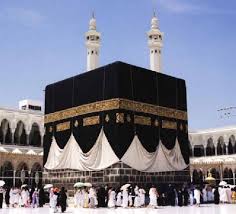
This is the last, and arguably a conditional pillar of Islamic practice, in the sense that one is obligated to make the pilgrimage to the site of the Ka'bah, built by Abraham and his son for the purpose of worshiping God, when financial and physical means are available. The Ka'bah is located in Makkah, in the Kingdom of Saudi Arabia.
During Hajj, we are once again made equals. The White seamless wraps, called the Ihram, does not allow that one's financial or education status be recognized. The King and the pauper both endure the same struggles, performing the same rituals, and each learning something, be it about others and their needs, or of a personal nature, that they were suppose to learn. This is why we have a tradition in Islam, attributed to no greater a figure than the Prophet Muhammad himself, upon whom be peace and blessings, that a successful Hajj [pilgrimage] wipes out prior sins, a person is renewed, pure as if a new born baby.
A recent study shows that returning pilgrims are 22% more likely to see Non-Muslims as equals, twice as likely to condemn terrorism, and 8% more likely to hope their daughters would adopt professional careers. [ "Muslim pilgrimage; a journey towards Tolerance?" Think; the magazine of Case Western Reserve University, Fall/Winter 2009 edition, page 18]
Conclusion
The foundation of Islamic practice is one that places emphasis on personal development, enlightenment, charity, sobriety and every other good characteristic. Islam is wrongly associated with violence and criminal activity. The recent death of a Detroit Imam, Luqman Abdullah, and the arrest of several of his supporters has once again brought the idea that Islam and criminality are linked to the public. One charge alleges that Abdullah gave legitimacy to theft, on the grounds that as long as they prayed and the thefts "benefits Islam", it was legitimate. Given the public works and reputation of the deceased Abdullah, the charges are very suspect, but nonetheless in terms of what Islam teaches, it's pillars hold up people's hearts and minds to always be conscious of Allah, of one's personal responsibilities and societal responsibilities.
Islam is a tool from God that can enlighten all who wish it, who actively seek it. This does not mean we will become monks, nor does it require that we give up enjoyment in life or comforts. It simply means that we train, that we refine the goodness that is present in the hearts of all humanity, utilize that goodness, apply it in both a systematic and random manner. Random acts of violence can become random acts of kindness.
Footnotes
[1] Congregational prayers are highly preferred, especially the obligatory ones, which can be done in a Mosque or with a group anywhere. One Hadeeth describes it as being "twenty-seven times greater than prayer alone." [ Bukhari, 10:30]
[2] The Shi'ah Muslims do not follow this practice, instead, their tradition places emphasis on individual prayer at night [in contrast to communal]. They do, however, gather together in Mosques to read the Qur'an together in the nights of the Ramadan month.
There is a great emphasis on change in today's world. It's a powerful word that everyone uses. The winning slogan in [then] Presidential candidate Barack Obama's campaign was his assertion "Don't tell me we can't change."
For those who have a distrust of Islam and Muslims, change is something to fear. They assert that when people accept Islam, they "change" into candidates for violence. At the very least, when dietary practices, dress and even names are altered by Muslim converts, these folks express fears even about those changes. I can recall reading online a statement that all who accept Islam freely "must have mental problems."
Muslim writers and leaders often adopt quite the opposite approach. They are quick to say "Actions must change." This or that "must change"!
Certainly all of this is in the eye of the beholder. We hope to examine a bit the foundation of Islamic practice, as found in four of the five pillars [ the first pillar will not be examined in this post, however we do recommend reading Shamsuddinwaheed.blogspot.com/2008/10/only-one-god-forgotten-aspects-of.html]
The best of you in Islam was also the best during the period without Islam
The Hadeeth quoted at the beginning of this post shows us that Islam is not [by necessity, anyways] about change. It is about enhancement. Its distinguishing characteristics are the pillars of Islamic practice, and it will be seen that all of them serve to emphasis- in some fashion or another- various morals, ethics and practical benefit, they are not without meaning.
Salaah
For those who have a distrust of Islam and Muslims, change is something to fear. They assert that when people accept Islam, they "change" into candidates for violence. At the very least, when dietary practices, dress and even names are altered by Muslim converts, these folks express fears even about those changes. I can recall reading online a statement that all who accept Islam freely "must have mental problems."
Muslim writers and leaders often adopt quite the opposite approach. They are quick to say "Actions must change." This or that "must change"!
Certainly all of this is in the eye of the beholder. We hope to examine a bit the foundation of Islamic practice, as found in four of the five pillars [ the first pillar will not be examined in this post, however we do recommend reading Shamsuddinwaheed.blogspot.com/2008/10/only-one-god-forgotten-aspects-of.html]
The best of you in Islam was also the best during the period without Islam
The Hadeeth quoted at the beginning of this post shows us that Islam is not [by necessity, anyways] about change. It is about enhancement. Its distinguishing characteristics are the pillars of Islamic practice, and it will be seen that all of them serve to emphasis- in some fashion or another- various morals, ethics and practical benefit, they are not without meaning.
Salaah
Offered a minimum of five times daily [dawn, noon, mid-afternoon, sunset and evening], it is described by the Qur'an itself as having the ability to "restrain from hateful, shameful activity" [Q 29:45]. Apparently, a person who offers the Salaah with full awareness and consciousness will be less likely to enter into activities that are illicit, immoral or otherwise harmful. There is no coercion involved here. No fear of the police or of vigilantes. The person's awareness of God is enhanced by connecting with the Divine reality by the method of Salaah, a connection or awareness not easily dismissed or forgotten. In addition to this, there are some other benefits as well;[A] Discipline: Salaah is to be observed at stated times, if offered at other times, it is considered "late" and not having the same merit or blessing as when performed at the stated times. If a Muslim can have the discipline to offer prayers five times daily, which also involves physical preparations [i.e. being in a clean state and making Wudoo' [ablution] beforehand], then he or she can have the discipline for any secular pursuit in life as well. A Muslim conscious of praying "on time" will also be "on time" for work, completing study/work tasks in a timely manner.
[B] Education: In Salaah, we mainly recite the Qur'an. This is very powerful, especially in congregation [Jamaa'ah][ft.1], when the prayer leader [Imam] recites texts that may be unfamiliar to the ones praying behind him. The Qur'an speaks to many subjects, and actually integrates seemingly unrelated subjects, so the prayers act as a sort of learning session, making the Musalli [the one praying] learn, become more well rounded. This is especially true of the Taraweeh prayers, offered in the evenings during Ramadan, wherein the entire Qur'an is often recited.[ft.2]
[C] Feeling of brotherhood
Much like the Hajj, Salaah is an equalizer. Rich and poor, black and White, all standing shoulder to shoulder, performing the same actions, reciting the same texts, the same rituals in the same language. In fact, there are several narrations in the Hadeeth literature which has the Prophet Muhammad instructing that there should be no gap between the praying people, because Satan can take advantage of that. Meaning, it's something that brings people close, whereas Satan seeks to divide.
Zakaah
The spiritual an societal benefits of paying 2 1/2% of one's wealth are obvious.
The offerings given for the sake of God are [meant] only for the poor and the needy, and those who are in charge thereof, and those whose hearts are to be won over, and for the freeing of human beings from bondage, and [for] those who are over burdened with debts, and [for every struggle] in God's cause, and [for] the wayfarer: [this is] an ordinance from God - and God is all-knowing, wise.[ Q 9:60, Muhammad Asad translation]
In an Islamic society, this can be collected as a tax and distributed according to he guidelines of the above Qur'anic text. In a Non-Muslim society, the Zakaah is usually given to Mosques or organizations who then distribute it according to the guidelines of the above verse. I believe it's especially meaningful to pay Zakaat while living in a Non-Muslim environment, because it makes the Muslim think, contemplate on who and what is most deserving of these funds.
Zakaah has the meaning of purification. Islam teaches that all personal wealth, even when legally and morally acquired, has a societal due. Hoarding is something not looked on favorably in the spiritual realm. The Bible reports Jesus, upon whom be peace, as saying
Sell your posessions and give to the poor…For where your treasure is, there your heart will be also.“ Luke 12:22-34.
The distribution of Zakaah goes a long way in combating starvation, famine and the like. In addition to this, Zakaah funds can be used to address societal needs as well, such as education. Resources dedicated to this purpose are generally given the name Sadaqah Jareeyah [perpetual charity].
Funds that exceed the minimum requirements, called Sadaqah, are also given during times not generally considered. The Qur'an gives a "remedy" to personal transgressions by engaging one's wealth in Sadaqah. Below is a verse speaking about Dhihaar, a divorce practice observed by the Pre-Islamic Arabs in which a woman was denied both marital rights as well as the right to seek another marriage, leaving her in a limbo. Now, the Qur'an outlawed this practice, and gives the following guidelines to those Muslims who had done this.
And those [men] who pronounced Dhihaar to their wives and recant their declaration, they must [A] Free a captive before touching each other. This is what you are admonished to do, and Allah is aware of your actions. So, those who do not find [the means to free a captive] should [B] Fast two months before touching each other. Those unable to do that should [C] feed sixty poor people [Sitteena Miskeena]..."{ Q 58:3-4}
Thus, Islam joins personal salvation with societal development and assistance.
Siyaam-Fasting
The Qur'an [2:183-185] tells Muslims to fast in the daylight hours of the lunar month of Ramadan. Fasting encourages us to be more conscious of the struggles others face to even eat once a day, thus, encouraging us to be charitable and distribute food to the needy.
Fasting is also a discipline building exercise. It should teach us to give up excess waste, junk food, cigarettes, vain talk, and strengthen personal morals. All of this and more can be found in the Quranic statement regarding the purpose of fasting, given in the words La'allakum Tattaqoon [So that perhaps you will gain Taqwa. Q 2:185]. The word La'alla shows us that there is a possibility of failure in accomplishing this goal, which is why we are to fast again and again. The Qur'an mandates the Ramadan fast, but we can also engage in voluntary fasting, to build up our morals, and above all the main thrust of Taqwa, to become closer to God.
Hajj
This is the last, and arguably a conditional pillar of Islamic practice, in the sense that one is obligated to make the pilgrimage to the site of the Ka'bah, built by Abraham and his son for the purpose of worshiping God, when financial and physical means are available. The Ka'bah is located in Makkah, in the Kingdom of Saudi Arabia.
During Hajj, we are once again made equals. The White seamless wraps, called the Ihram, does not allow that one's financial or education status be recognized. The King and the pauper both endure the same struggles, performing the same rituals, and each learning something, be it about others and their needs, or of a personal nature, that they were suppose to learn. This is why we have a tradition in Islam, attributed to no greater a figure than the Prophet Muhammad himself, upon whom be peace and blessings, that a successful Hajj [pilgrimage] wipes out prior sins, a person is renewed, pure as if a new born baby.
A recent study shows that returning pilgrims are 22% more likely to see Non-Muslims as equals, twice as likely to condemn terrorism, and 8% more likely to hope their daughters would adopt professional careers. [ "Muslim pilgrimage; a journey towards Tolerance?" Think; the magazine of Case Western Reserve University, Fall/Winter 2009 edition, page 18]
Conclusion
The foundation of Islamic practice is one that places emphasis on personal development, enlightenment, charity, sobriety and every other good characteristic. Islam is wrongly associated with violence and criminal activity. The recent death of a Detroit Imam, Luqman Abdullah, and the arrest of several of his supporters has once again brought the idea that Islam and criminality are linked to the public. One charge alleges that Abdullah gave legitimacy to theft, on the grounds that as long as they prayed and the thefts "benefits Islam", it was legitimate. Given the public works and reputation of the deceased Abdullah, the charges are very suspect, but nonetheless in terms of what Islam teaches, it's pillars hold up people's hearts and minds to always be conscious of Allah, of one's personal responsibilities and societal responsibilities.
Islam is a tool from God that can enlighten all who wish it, who actively seek it. This does not mean we will become monks, nor does it require that we give up enjoyment in life or comforts. It simply means that we train, that we refine the goodness that is present in the hearts of all humanity, utilize that goodness, apply it in both a systematic and random manner. Random acts of violence can become random acts of kindness.
Footnotes
[1] Congregational prayers are highly preferred, especially the obligatory ones, which can be done in a Mosque or with a group anywhere. One Hadeeth describes it as being "twenty-seven times greater than prayer alone." [ Bukhari, 10:30]
[2] The Shi'ah Muslims do not follow this practice, instead, their tradition places emphasis on individual prayer at night [in contrast to communal]. They do, however, gather together in Mosques to read the Qur'an together in the nights of the Ramadan month.
Saturday, October 3, 2009
Arifin Imports and Publications

It is my pleasure to formally announce the opening of Arifin Imports & Publications. Our mission is to provide quality items relating to the teachings of Islam, Muslim culture and history, while being faithful to the text of the Qur'an and Sunnah and addressing realities in a Non-Muslim or Western environment.
To that end, our products include lectures available on CD and DVD, as well as books. Our library is continuously expanding. We will endeavor to provide only quality items, which will quench the intellectual and spiritual thirst. Wholesale orders are also accepted. To be added to our mailing list or for a physical list of products, please send a request to admin@arifinimports.com.
Prices are very reasonable, payments are accepted through both credit cards, Pay Pal, as well as check/ money order for your convenience. The link to the site is below:
http://www.arifinimports.com
In addition to this, we also have a You Tube channel, Arifin Publications, with several free lectures and clips from presentations/lectures:
Our mailing address is below:
Arifin Imports & Publications
P O Box 70617
Toledo, Ohio 43607
419-246-9697
Thursday, September 10, 2009
The guidance of religion vs. personal whims

Islam is a faith that asserts itself, in very clear and strong language, to be a faith that is completely detailed [Qur'an 6:114]. The last verse revealed to the Prophet Muhammad himself, Sall-Allahu 'alayhi wa sallam, asserts that Islam has been chosen, perfected, and completed by God himself, in the time of his final Prophet [Q 5:3]. This completion becomes evident even in the midst of the existence of Muslim sects, in the sense that despite our [minor] differences, our essentials are identical, as well as having the same book, prayers, charity, pilgrimage, etc.
Since Islam was perfected in the time of the Final Prophet, essentially it means that if we really believe, then we have to accept as Halaal [lawful] what is given in clear terms as Halaal in the Qur'an and Prophetic example [Usawtun Hasana] and to avoid that which is clearly given as Haraam[unlawful] according to the Qur'an and Prophetic model.
In this regards, it is important to remember Allah's statements;
''And obey Allah, and the messenger, so that perhaps you will receive mercy." [Q 3:132]
Whosoever obeys the messenger [Muhammad], obeys Allah. Therefore, if any turn back, We [Allah] have not sent you as a watcher over them." [Q 4:80]
To call one's self a Muslim, one is to have confidence in all the contents of Divine revelation as useful, beneficial and blessed. To replace something that is clearly supported or endorsed by the Qur'an and the Prophet for a tradition or idea whose roots lie in another faith or thinking pattern is almost tantamount to rejecting Islam itself,as if to say that particular idea is superior to the contents of the Qur'an and Prophetic model! We seek God's protection from that!
Islam: a realistic faith
In a world where individuality is the name of the game, religion has been reduced, in many ways, to the following forms.[A] Ethnic or racial identifier. [B] A series of personal rituals and beliefs designed to bring about personal satisfaction, a contentment that is comparable to the euphoric feelings brought about by drug use.
In addition to this, we must mention "interpreting for one's self." Often this slogan, which has its roots in Western religious culture from the times the Bible was not allowed to be translated, so that when it became available people wanted to 'understand' for themselves, which in itself is not a problem at all. However, it does become a problem to interpret in such a way that clarity is replaced with ambiguity, leaving the doors open for all sorts of vices as well as incorporating foreign concepts into one's practice and understanding of Islam.
Take for example the Quranic allowance for physical fighting. Many verses from the Qur'an speak to this, but for the sake of space only one will be quoted here;
Fighting is ordered for you, and you dislike it. But it is possible that you dislike a thing which is good for you, and that you love a thing which is bad for you. Allah knows, and you do not know .[ Q 2:216)
Other verses that speak to this reality, and the conditions for it, can be found in 22:39,40, 2:190,9:41,61:11-14 and many other references.
We fear that some Muslims are actually embarrassed by these verses, perhaps due to inferiority complexes, brought about by arguments of the Christian missionaries, who continually assert that Jesus Christ was passive, even in the face of great opposition, and that such a position is better in the sights of God[Ft.1]. Another reason for such a view is that contemporary figures who avoided a response by the hand have been touted in the Modern world as having made their particular causes successful. This argument is weak at best, as it can be argued that their successes are perceived and not real. The Dalai Lama comes to mind here.
If something as clear as fighting [when necessary]as given in the Qur'an can be rejected by interpretative gymnastics, where do we stop? Will the Qur'an be used to give legitimacy to the idea that Jesus is God? Will we have to hear, all of the sudden, that there are in fact many gods?
These examples are actually becoming real in our times! One example is that of Alcohol. The Qur'an calls it " a product of Satan's work"[ Q 5:90], that it has benefit, but "its sin outweighs its benefits."[ Q 2:219]. We are also told " so, abstain from it [alcohol and gambling] so that perhaps you will be successful." [latter part of Q 5:90]! Yet, believe it or not, many "Muslims" today actually assert that Alcoholic consumption is Halaal because the word Haraam is not used in the above referenced Qur'anic Ayaat!!!
Allah's Deen is serious business. It should not be interpreted by whims. Meaning, if a person drinks, well, that's a weakness that has to be addressed. But that does not require that one engage in dishonesty by claiming the text says "yes" when it clearly says "No".
We don't call for violence or extremism. Nay, we are calling for intellectual honesty. If Islam says such and such is legitimate, then that's the way it is. If Islam says that such and such is immoral, is wrong, well, that's what that is!
No one is perfect, all of us have faults and weaknesses. Why try to change the guidance of Allah, rather than looking at ourselves and changing in accordance with the guidance of Allah?
"And who is worse than one who has as a god his passions." Q 45:23.
Footnotes
#1= The following polemical article was composed by a Christian missionary, as a means to show their view that Islam is inherently violent, while Christianity is inherently peaceful. http://www.answering-islam.org/Authors/Arlandson/sword.htm. In any case, while the Gospels portray Jesus as passive, it also portrays him as taking rather drastic actions, such as overturning the money changers tables in the temple [ Matthew 12:12-13] and asserting that he has "come with a sword" [Matthew 10:34].
Tuesday, August 18, 2009
Problems in your Masjid? thoughts on the Mosque in Islam and Western society
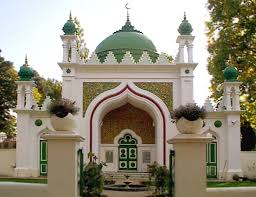
The Mosque in the West
It should be noted, first and foremost, that the role of the Masjid [Mosque] in the Western context is very different from that in the Muslim world. In the Muslim world, the mosque is simply a place of prayer.Some Mosques will have funeral services, and of course students may take it as a quiet refuge to study, but essentially it ends at that.
In the United states, the Mosque has these roles and much more. It serves as a symbol of Muslim presence and culture, as the picture above shows. It is of the Shah Jahan Masjid in Woking [Surrey], United Kingdom. Marriages are performed, as well as various social gatherings, dinners, counseling, community work, political organizing, and so much more.
In short, the role of the Mosque in the West is the same as that of the Church. The Imam gives advice, marriage counseling, plays a role in local politics, in the same manner as the Pastor of the local Church. It's not an issue of right or wrong, this is just a reality.
Problems in the Masjid
In the Muslim world, the Mosque is basically on every corner. Generally speaking, it is also maintained and controlled by Government ministries, so the 'average' person has no role or responsibility in the Mosque. He [and almost never 'she'] will attend Friday prayers, and perhaps some of the daily prayers, in Jama'ah at the local mosque, and leave it at that.
Sectarianism in Mosques does exist, however it's very limited and varies from nation to nation. In places such as Pakistan, where the Sunni/Shi'ah divide is multiplied by sub-divisions, political and personality issues, attending the Mosque can be actually dangerous, as repeated bombings of Mosques, prayer gatherings and funerals show.
In places such as the United states, sectarianism is further complicated by class and ethnic divisions, which is dealt with two broad solutions..
[A] In small towns, Muslims of all sects and ethnic backgrounds will worship in the same mosque.They will offer friday prayers at the most convenient location.
[B] Muslims of the same sect or group, such as Shi'ah, Salafi, upon having sufficient numbers, will form their own mosques. Now, while Muslims outside of these groups are welcome, it is understood that this particular mosque is dominated by one school or ethnic group.
What next?
In the two 'solutions' given above, at some point problems, both on an individual and communal level, develop. It is unavoidable. When people of various thinking patterns, understanding of religion, as well as having different personalities, are enclosed in small spaces, feelings get hurt. Resentments form. Sometimes there are power struggles. Such problems are almost unheard of in the Muslim world, but they are an unfortunate reality in the Western context. Such problems exist even among followers of the same sect or same ethnic group. All of us think 'our way' is the correct model of Islamic practice and theology!
At some point, it becomes necessary for us as individuals to figure out what is beneficial to us in terms of our Islamic practice and spirituality. If we go to places where we don't feel comfortable for reasons, such as those mentioned in this text, we can easily find another Mosque. Another solution can be to limit one's participation to friday prayers only [after all, Friday prayers are obligatory according to the Qur'an 62:9] and avoid the politics. Sometimes, our boards and Imams need some perspective. Give them advice.
Religion is sincere advice [or sincerity, Naseehah in Arabic], [for the cause of] Allah, to the messenger, to the leaders of the Muslims and to the general public. [Sahih Al-Bukhari, 2:42]
Remember that the entire Earth is a Mosque [Sahih Al-Bukhari,8:56], prayers can be conducted anywhere that is clean and reasonable. We living in the West, especially having children, use our Mosques not only for prayers, but as cultural hubs, as sanctuaries and the like. So, just leaving it is not easy. Deep contemplation is required, as well as knowing the situation of other Mosques, before making such decisions. Seek Allah's guidance, and he will give you direction.Consider all options.
Subscribe to:
Comments (Atom)