Showing posts with label society. Show all posts

Thursday, August 14, 2025

Thoughts on random topics

                            In the name of God, The Compassionate, The Ever-Merciful


It has been a few months since I have composed a full article for this blog. This is largely because of a very busy schedule, which includes a publishing project (which is in the final stages now). In any case, I want to share below some thoughts on subjects which are very important, challenges that are facing not only the United States or even the Muslim Ummah, but also mankind, regardless of religious or national affiliation. Keep in mind that below are thoughts expressed rather quickly. Thus, this post is not structured with references, notes and links.


(1) Palestine


The crisis with the victimization of Palestinians by Israel is not a new situation. The current onslaught in Gaza is simply a continuation of policies that have been in place since 1947. It is perhaps "new"  in the sense that with mass communications and social media, the horrific images cannot be hidden from the world. 


The system of apartheid and colonialism (which also has ideological components ) is unsustainable, and it is my view that we are witnessing desperate attempts to keep it going. That desperation leads to open violence, disdain of international opinion and legal bodies. I think that while the Palestinians continue to suffer, there is light at the end of the tunnel. 


Indeed, God himself states that He does not allow success to be experienced by those who are oppressive (Innahu Laa Yuflihudh Dhaalimoon) (Qur'an 6:135 etc). This means that oppression is not a permanent condition. It will eventually be lifted. It's just a matter of time. 


A few months back. I was invited to teach on Middle East Affairs, and I outlined in an academic environment both the foundations for the conflict as well as for peace. Two of those class presentations are available. See (From the Land of Canaan )


As well as 

(Exploring paths to peace in the Middle East)


(2) Muslim-Christian relations


I am a strong believer in Islam, it is the summary of Divine guidance as given through all of the messengers of Allah ('alayhim as salaam) ending with the coming of the Final Prophet (Muhammad, Sall Allahu 'alayhi wa sallam). I believe inviting Christians to accept Islam is an important task, and have been active in that field for many years. 


Yet, I believe that the religious environment has been poisoned in recent times, particularly in online content. While it is common for Christian  apologists to make outrageous, even stupid claims, against Islam and Muslims, I am also increasingly concerned with Muslim behavior towards Christians. I find that Muslim videos (and keep in mind, typically the creators of these videos are not Imams of any type) are unnecessarily antagonistic, filled not only with superficial arguments, but creating tensions and conflict.


There will always be believers and disbelievers. Christians, Jews, Muslims, Hindus,  and others, will always exist, as long as the world exists. Frankly, I am unbothered by Christians (or Muslims for that matter) who think I am destined for Hell. Da'wah is fine, but we have to do it in the best fashion. We invite using cogent arguments, wisdom and also with our good character. We need maturity, calm discussions, and we also need to accept that others will have religious beliefs that do not align with our own, and that is fine. After all, Allah could make everyone think the same, but He did not do that. 


So yes, we should do da'wah, but in a professional fashion, and avoid emotional arguments, gas-lighting and stay away from creating environments of conflict. The actions of many of our active Da'ees (callers to Islam, mostly online) are reactions to the belligerent and often insane moves of Christian missionaries (which includes disrupting prayers at a mosque to even chewing pages of Qur'an online), however, these so called Christians are not our teachers. Our primary, practical teacher is the Prophet Muhammad, the one who is called "a mercy to all nations" (Q 21:107). His ethics were that of engaging in a holistic manner with the followers of other religions. His style was discussion and sharing the content of the Qur'an. 


While I can confess to engaging sometimes in religious arguments, in general it is not the best way for long-term goals.  On areas of shared interest, especially in a Western environment, Muslims and Christians can work together. Addressing poverty, immorality, political disenfranchisement, etc.. we should be able to do that. But that requires maturity on both sides of the aisle. Moreover, there are elements out here, both within religious discourse -and their financiers behind the scenes- who desire to poison any attempts to do good things. It suits their political interests to keep us divided. This is something our leaders have to be cognizant of.


(3) American society (Homelessness, immigration, family, economy, racism, xenophobia)


In the second term of President Donald Trump's reign, I am increasingly alarmed at not only his foreign policy actions of late, but also the exercise of authoritarianism on domestic levels. I cannot help but sound an alarm at his announced plans to employ the National guard to have a Federal takeover of Washington, D.C. claiming it is a move to fight crime and homelessness. He has expressed a desire to do something similar to Chicago, Illinois.


Regarding homelessness, in the West coast of the United States we see it on the rise. However, using police tactics-simply to move them from one place to another- is a temporary fix at best. The solution-I think- is a reform of the culture, as well as shifting of spending priorities on the county, state and national levels. After all, how much money is spent on our military budget? How much is spent to support Israel? Or to Ukraine, which only provokes Russia?  Those funds are better spent dealing with the social issues of this country.


Immigration has been another hot topic, in which even some Non-White immigrants express support for the Trump administration crackdown on illegal immigrant. I think the support of some voices from immigrants is a desire for proximity to power, but also stems from class differences.  The Trump supporters (of all stripes) view themselves as elites, and cannot see the other side. 


Racism and Xenophobia have also been on the rise, with both official and unofficial expression. It is difficult and seemingly almost impossible to change the mindset of those who have embraced these views. As such, those with a more sane vision of existence need to hope for the best and also become prepared. Everyone should have items such as a passport, second streams of income, practice careful spending/investing, and become better educated (both formally and informally).  Those with the ability to enter into politics, media and the like should do so, and at the least, try to slow down the rise of dangerous ideas.


The Prophet Muhammad, upon whom be peace, has remarked that end times are indicated by "the diminishing of knowledge and the popularization of ignorance" (Yaqillul 'ilmu wa yakthurul jahl). I firmly believe that this can equally be applied to the era of the fall of a society. It is up to people of 'Ilm (knowledge) and Hilm  ( mental controls) to put something out there that has a positive impact on these situations. They cannot stay silent.


The preservation of the family (and even redefining it in order to create stronger networks of support) is very important. The concepts of excessive individualism and materialism are not only destructive, they are contrary to Divine guidelines. Thus, the social trends of encouraging conflict between the sexes and the like should be thrown into the trash.


I have no doubt that this post is short on details. It can be made better. These are simply some thoughts on just a sample of the most important issues we face today. As always, I welcome reactions, reflections, be it in agreement or disagreement. Thank you. 

Saturday, July 26, 2025

"None touch it except those who are purified" ( Friday Khutbah recording at Masjid As Sabur)

 As salaamu alaikum


Below is a recording of a recent Khutbah delivered at Masjid As Sabur, mostly around the Quranic verse "None touch it except those who are purified"


Click here

Monday, December 14, 2020

Lessons from Sacred History: Some reflections on Soorah An Noor

 Introduction


Islam portrays itself as a faith that is not only for the benefit of all humanity, but as a logical, practical and healthy way of life. The more life experiences emerge, the more this portrayal is found to be true. 


Ultimately, what Islam seeks for its adherents is a foundation for moral and spiritual development,  tools to accomplish this. This is a life-long process for most of us, and it is our belief that this is precisely why the Qur'an contains stories, be it in detailed or truncated form. One chapter which illustrates this is is the twenty-forth Soorah, called simply An Noor or "The Light". 


Positive conjecture is the healthy, default position to be held by people of faith 

 The Soorah makes allusions to a particular incident in the time of revelation. In brief, the Prophet Muhammad (Sall Allahu 'alayhi wa sallam) and a number of others went on an expedition. Among the party was his wife 'Aa'ishaa. There was a point when the Muslim party had left, accidentally leaving her behind. She was discovered by a man (Safwan), the latter, with respect and intelligence, places her on his camel, walks it back to Madinah.


This caused gossip to emerge, a scandal, voiced in whispers, alleging an affair between the wife of the Prophet (referred to traditionally as "Mother of the believers") and Safwan. This Soorah speaks on this in the following words:

لَوۡ لَاۤ اِذۡ سَمِعۡتُمُوۡہُ ظَنَّ الۡمُؤۡمِنُوۡنَ وَ الۡمُؤۡمِنٰتُ بِاَنۡفُسِہِمۡ خَیۡرًا ۙ وَّ قَالُوۡا ہٰذَاۤ اِفۡکٌ مُّبِیۡنٌ

"Why didn't the people of  Imaan (faith), men and women (alike), when they heard it, not have a good thought of their own selves, and assert; "this is clearly false." (Q 24:12).


One of the principles we should learn from this is a principal called Husnudh dhann, or positive conjecture. Essentially, it means to assume the best before assuming the worst. When positive thinking is not present, it is an unstable foundation. Negative assumptions (soo'adh-dhann) as default is a dangerous foundation for a community as well as a family. 

Sooratun Noor has interwoven much spirituality in the discussion about an accusation of that nature, as well as laws and social etiquette.  It goes on to say:

یَعِظُکُمُ اللّٰہُ اَنۡ تَعُوۡدُوۡا لِمِثۡلِہٖۤ اَبَدًا اِنۡ کُنۡتُمۡ مُّؤۡمِنِیۡنَ

 وَ یُبَیِّنُ اللّٰہُ لَکُمُ الۡاٰیٰتِ ؕ وَ اللّٰہُ عَلِیۡمٌ حَکِیۡمٌ

" Allah gives you admonition never to return to this (type of scandalizing), if you have faith, and Allah makes clear for you the signs, Allah is the One who knows, the wise." ( Q 24:17-18)


Prejudice as a reason behind negative assumptions

Muhammad Husayn Haykal's book The Life of Muhammad (    1995, Indianapolis, pp.334-335)              has pointed out two basic reasons behind the spread of the rumor regarding the Prophet's wife and Safwan. The first involves internal family dynamics, whereas the second was political.  Haykal points out the details, in which old tribal conflicts were once again agitated as a result of this, some taking on a sort of cause in order to solve old rivalries. 

The Qur'an focuses upon the political motivations wherein it states " Indeed, those who spread about the lie, are a powerful element ('Usbah) from your midst." (Q 24:11).

اِنَّ الَّذِیۡنَ جَآءُوۡ بِالۡاِفۡکِ عُصۡبَۃٌ مِّنۡکُمۡ

Prejudice entered into the picture, and this is something we can learn from today! Prejudices ( to "prejudge") are not only based on skin color, ethnicity or language. Indeed, most countries have communities therein which has biases towards others in the same country, sharing the same items listed above. 


Prejudices can come in the same community. The Non-Hijabi sees the Hijabi as fanatical, the latter seeing the former as immoral, the clean shaven views the bearded man as a zealot, the bearded Muslim looks at his clean-shaven counterpart as lacking religious commitment. The Salafi judges the Shiite, etc. 

We are quick to judge those who have even the slightest difference, even in the same community, to make negative assumptions. 


We have to learn to judge on merits and evidence, and avoid jumping to conclusions based on our prejudices. Essentially, Islam asks us to remove prejudices. 


More benefits of the Soorah

The Soorah gives guidance on a  number of issues. 

(1) In terms of accusations of adultery, an entire legal process is placed. Four witnesses (vv.4-8)(ft.1) are required before even an accusation can be made in a legal setting. Otherwise, a person bringing that to the court without this evidence is deemed unreliable and actually to face punishment (v.4). 

(2) It gives us some guidance as to marriage.(vv.32-34)

(3) It gives us some social etiquette, dress code.(vv.27-32)

(4) It gives us the beautiful "Verse of light" (Q 24:35). (ft.2)

Perhaps this is why , when the incident is spoken of, Allah says "Do not think of it as evil for you, nay, it benefits you." (Q 24:11)

 لَا تَحۡسَبُوۡہُ شَرًّا لَّکُمۡ ؕ بَلۡ ہُوَ خَیۡرٌ لَّکُمۡ

May we learn from our sacred history. That is why it is there.

Footnotes

(1)  The scholars have added, based upon Prophetic narrations, that Zinaa (adultery) must be proven via four people witnessing penetration (and no other act). This is a nearly impossible condition. This is necessary to both protect the privacy of people as well as public morals. 


(2) Ayatun Noor has fascinated readers since the Quranic revelation. I have shared some reflections on it at the following link. http://shamsuddinwaheed.blogspot.com/2008/01/divine-illumination-examination-of-ayah.html

Monday, September 4, 2017

Study Notes: Soorah Al Hijr [ 15: 70-80]. The implications of the story of Lot [Luut عليه السلام]

[ Note: The following is an edited version of some reflections on ten verses from the Qur'an. Originally, these notes were prepared for a weekly Quranic discussion I participate in, however I have decided to share them here, with the hopes of generating discussion and thinking. Also please note that unless otherwise seen in the text, the English translation has not been included. This will influence the reader to check the translation of their choice. The Arabic text is included.]


Some backround

This particular section deals with the story of Prophet Lot, known as Luutعليه السلام  in Arabic. The immediate context preceding the verses in question tell us that Lot's own household contained contrasting elements therein, as do all families. While Lot is connected to Allah, his wife is counted as being among the 'criminal class' [15:58-60]. Eventually, God's angelic messengers conveys notice to Abrahamعليه السلام ,  Lot's uncle,  that Sodom and Gommorah will be destroyed. The Qur'an says elsewhere ( Q 7:80-81 among other places) that the society engaged in intimate activity that cannot be deemed natural .

This particular issue is a deeply sensitive and potentially divisive one in today's world. I think it is important to see all of this in connection to what is repeatedly stated in these verses, and that is the title "The Family of Lot " [Aal Luut]. Lot is the family patriarch, the caring, wise and loving father and perhaps grandfather that we all have in our family units, seeking to preserve the morals of those under his care. Lot recognizes that wild behavior is something which leads to disastorous consequences ( Q 15: 61-64).

Lot advocates that the thinking of his family and followers be upon correct or healthy boundaries. He tells them to neither long for the social ties with those engaged in destructive behavior, nor even be in their company. In our age, the wise parent may instruct his child to stay away from certain other children because of their behavior, and the same parent may put restrictions [or even remove] the television or the cell phone when such devices of entertainment are found to be detrimental to the oveall development of his child [15: 65-66].

The society, probably more in particular the elites in power [called Al Mala' throughout the Quranic narrations], had places restrictions on Lot. In a sense, he seemed to have been a character that they wanted to silence, to be under house arrest. Lot  has some "guests" [who are actually these angelic messengers mentioned earlier] . These guests were threatened with attack, and the text implies that they were even threatened with rape! Lot makes a final appeal to any Taqwaaa [reverence for God Almighty] as well as any sense of social propriety, but alas, his pleas fall upon deaf ears. [Q 15: 67-69]

But as we come to know, attempts to restrict or suppress the truth eventually come to naught! Truth cannot be defeated( 15:70) . The Qur'an says "And say: Truth has come, and falsehood vanishes. Indeed, falsehood is, by it's nature, a vanishing [thing]' [Q 17:81]

[15:71]


In his comments, the translator Yusuf Ali righly points out that this language is the language of a family patriarch, an older man trying to push atleast a little bit in a different direction.
Thus, "My daughters" are not literal, nor is he seeking to sacrifice the women in his society to be raped, as sometimes thought by some critical readers. Perhaps marriage between men and women was a dying institute, as it is in our society today, and sought, out of desperation, to revive it.

[15:72]


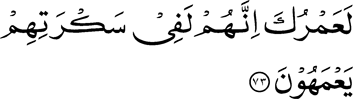
The social order of  Sodom and Gomorrah was blinding and intoxicating. The verse uses the term  لفي to denote the intensity of this condition. 

It is very difficult for those affected by such conditions to see the reality of their existence. 

Prophets and Scripture comes forth in order to open up the eyes and to have foundations for proper thinking. I see the Prophet Muhammad's   صلى الله عليه وسلم   supplication as particularly relevant here in the sense that one not only invokes Allah but it also provides a philosophical foundation for acting in the real world.


His prayer is "O Allah, show us truth as truth, and give us the ability to follow it, and show us falsehood [Baatil] as falsehood, and give us the ability to abstain therefrom." 

[ 15: 73-74]


Sayhah is also translated as "scream", and seems to denote a general overturning of the social order.


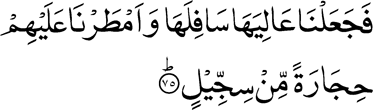
[15:75]


The translator Muhammad Asad, quoting Imam Razi and the famed grammarian and commentator Zamakhshari, points out in his note that Mutawassim means " One who applies his mind to the study of the outward appearance of a thing with the view to understand it's real nature and inner characterstics".

This is a deeply important verse here. When connected to 15:72, we can see that the argument is that a society of blinded, drunken (in their thinking and actions) human beings brings forth their own destruction. God says here that such societies should be studied, and this is precisely what social scientists, archaeologists, and related fields do. This also occurs with intelligent figures interested in the betterment of their own societies. One need only look at the libraries of such figures as Dr Martin Luther King, Jr and Malcolm X.  The latter, in his autobiography, mentions the many books he studied, they include histories, political theory, philiosophy, and more. 

The Qur'an is not a book that encourages blind faith. In fact, it points to the sciences, to certain fields and disciplines that would be deemed by many today as non religious! The guidance of God tells us that we should take lessons from the mistakes of past societies. It has been my observation that those who are deeply influenced by the Qur'an, personalities whom I know personally and others whom I have not interacted with, are people who are not limited to the Qur'an. Their interests are expansive, usually to include history, the physical world, science,  and the fate of civilizations. This does not mean that they all reach the same conclusions on all subjects, or that their conclusions are always correct. However, it does indicate that they are pondering deeply upon the words of Allah, which makes them look at the other important subjects. 

I would dare take this further to say that those who claim to study the Qur'an and yet have no interest in these [and other related] subjects, have in fact not studied the Qur'an properly! Perhaps a better way of saying that is that their "studies" are actually superficial at best. The need to study these other important fields is particularly acute in our Imams, scholars and speakers, especially the famous ones or those up and coming! 

There is no need for us to become like many who are referred to as Biblical fundamentalists, people who read and study only  the [translations of] Bible. Such reading may be a nice pious exercise, however the results can be very problematic, and we don't want to follow in the same mistakes.


[15: 76]


The location of Sodom and Gommorah is well known, as was known at the time of the revelation. God lets such remmants exist in order to be a lesson for future generations. Yet. today, at the site, it is not taken seriously. Indeed, it is now a swimming attraction today.


[15: 77]


Believers do take the warnings and signs of past civilizational failures seriously.

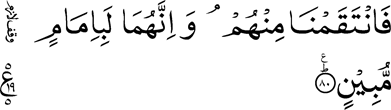
[15: 78-80] 


Madyan is in NorthWest Arabia, to whom a Prophet named Shu'ayb      عليه السلام   was sent.

Hijr is said to be between the Hijaz [Western Arabia, where Makkah and Madinah are located] and Syria. To them, a Prophet named Saaleh  عليه السلام         was sent forth.

Zamakhshari [as quoted by Muhammad Asad] suggests that the term "Messengers" here means Saaleh and his followers. This would suggest that the followers of Prophets likewise have a Prophetic mission.


These observations are not meant to be dogmatic, but rather to point out that the Quranic treatment of subjects are very nuanced. Indeed, even with the Sodom and Gomorrah story, we should be able to see that the prevalence of sexual relations outside of the norm is only a sympton of a deeper illness. We should also be able to see that the Qur'an advocates a serious study and search for solutions to the issues we face in today's world.

Wallaahu A'laam

Wa Billaahit Tawfeeq


Thursday, November 10, 2016

Trump presidency: thoughts on the immediate and distant future

We begin this composition with a confession, and that is-simply put- that we never imagined that the Trump campaign was little more than a bad joke that had no chance of success due to the numerous accusations, outright racism and clear personality problems that are displayed in his recorded statements and behavior.

The success of the Trump campaign has essentially blindsided all of us, it has negated all the predictions of the pundits and it feels like we are now living in a parallel universe that Science Fiction programs such as Star Trek and Fringe have displayed, a world that is very similar to the world we know and are accustomed to, yet filled with glaring examples of differences, enough to make one panic and desire a quick escape.


Why is Donald Trump so troubling?


His entire platform has been one insult after another. However, our focus is not simply on this. His campaign has been one which tells the voters what they want to hear, however upon close examination there is actually no substance at all behind his rhetoric.


Whether it is call for  building a wall between Mexico and the Southern United States [which he asserts that he will make Mexico pay for], threatening Muslims, insulting African Americans, or an unclear plan to strengthen the US economy, any of these things, which are well documented, should be sufficient enough to find his election to this nation's highest office to be a frightening turn of events.

The following link has a good summary of why this is a terrible development. http://reverbpress.com/politics/seven-reasons-donald-trump-make-terrible-president/

If he's so bad, then why was he elected to the highest office?

The answer to this is even more troubling. Despite Trump's many issues in terms of not having any substantive plans and his crass statements regarding women, the handicapped, immigrants, minorities and the like, he has been successful. Those things did not work against him, rather, they worked for him.

I recall an interview I heard on NPR, the one being interviewed was a Gay Latino from New York. He thought of Donald Trump as a personal success story, narrating about the latter's homes, wealth and all the trappings of success he already displayed.

A succinct article in The Guardian [ Anti-Intellectualism taking over the US] explains this very well. This is increasingly becoming a culture that places no value on education [except of course in the practical fields such as Engineering].

Education is more than a piece of paper or the ability to count numbers and decipher symbols . Education is meant to instill respect for certain values and to nurture- at the least- a foundation for understanding the world around the student.

Yet, despite the presence of universities and the Internet, ignorance of even basic facts still is the prevalent situation. An economics professor doing work while taking a flight was pulled off a plane and interrogated by authorities. Apparently, he was mistaken for an Arab and his work notebook's contents "strange writings" was simply math equations. [ https://www.rawstory.com/2016/05/penn-professor-booted-from-plane-after-passenger-identified-him-as-a-terrorist-for-doing-math/#.Vy6cfuYVTDw.facebook].

This utter ignorance and dismay for personal and communal growth breeds irrational fear and unsubstantiated beliefs, particularly for the "other". African Americans have long been the victims of this thread of thinking, and are thus generally more understanding of this side of America!


The other unspoken reason that Mr. Trump has now become our president is that the demographics  are rapidly changing from the White Anglo Saxon Protestant equation. There is a great deal of growth of Non-White communities, and this of course translates into political and economic changes, not to even mention the social impact.

Indeed, the demographer William H.Frey in his book Diversity Explosion predicts that after 2040, whites will no longer be the majority population in this country. This is a future that is not pleasant to think about for many Americans.

We have ignored Mrs. Hillary Rodham-Clinton up to this point. Many analysts have explained her failure to win the Oval office due to the E-mail scandal or a frustration with the system in general. It is the view of this writer that those issues are only a minor part of it. In other words, it would not have even mattered if Jesus Christ himself was the candidate of the Democratic party, the chance to stem the social changes and to express deeply-held sentiments was simply too much to pass up.

What should Muslim do?

Since the issue of Muslims' religion and presence in this country was a campaign issue for President-elect Trump, it seems prudent to direct this to Muslims, however, this is equally valid for all Americans who feel that we have now entered seriously dangerous political territory and fear for the future of this nation!

Our response to this should include, but not be limited to:

[1] Coalition building: This means more than an occasional dinner. Muslims-particularly the leadership, have to become better involved in their local communities and become stewards of universal justice, which is itself a Quranic command [Q 4: 135]. This means that -for example- when a person is unjustly killed by law enforcement, Muslims have to be there standing for what is right. This means greater civil involvement.

[2] Become deeply involved in other parties: Currently this nation is dominated by a two party system. While other parties do exist, they have little to no influence at all. We have to join the voices of those seeking real change, and not simply hope our few dollars to entrenched politicians will produce results on our limited interests. Our interests must be bigger than Palestine, Hijaab and holidays.

As a whole, disaffected Americans can take a lesson from other nations such as India [the most populous Democratic nation as it likes to call itself]. It has about eight big active parties such as AITC and INC, but arguable hundreds of smaller ones.

We don't have to limit ourselves to this two party system. We have to think bigger and in longer terms.

[3] For Muslims, to do more to  have  our voices heard. Write to the local newspaper when stories are published. Become educated enough to answer questions on Islam. Share the Qur'an or Islamic materials with people, refer them to the mosque or to accurate websites.

[4] Americans, both Muslim and Non Muslim alike, should be encouraged to travel, in order to broaden their horizons and perspectives. This is also a Quranic teaching [ Q 29:20 is just one example]. Keep a valid passport at all times.

I hope this brief article generates much discussion and deep thinking. After all, this is the time to be rational and calm. Actions born out of frustrations and anger almost never produce a positive outcome.

Sunday, November 30, 2014

Towards applying the Qur'an: examining Soorah al Hujuraat in lighty of contemporary problems

Introduction

What initially began as a Friday Khutbah [speech] at the Mosque, delivered in the wake of the Ferguson Grand Jury decision {Ft.1} has now turned into an examination of An important Quranic chapter. Can it give some light as to how we see things and how our reactions should be? Can it speak on the American social climate that produces these sort of problems? Please note that this post does not proclaim to uncover the truth regarding this particular tragedy, but I do acknowledge that one thing which is painfully obvious is that feelings of marginalization and outright oppression are widely felt by people of color. {ft.2]

The Qur'an, as a field of intellectual examination, is fascinating. It is comparable to a puzzle, the pieces have to be put together in order for the full picture to be seen. Moreover, understanding can change, or at least deepen, when confronted with new knowledge or sets of life-experiences {Ft.3]. With regards to this particular Soorah, our literature states that it was revealed initially to respond to a rather minor incident that displayed crass, inconsiderate behavior, on the part of a people the Qur'an says were "not thinking" [Ft.4]. This text goes on to weave a compelling tapestry, connecting several issues that may seem unrelated, but upon contemplation, those connections become real and important. [Ft.5]

Having a correct foundation

O Believers! Do not place yourselves before Allah and his messenger, rather, have Taqwaa of Allah, Surely, Allah is Hearer, knower.[ Q 49:1]. O believers! Do not elevate your voices above the voice of the Prophet, do not be loud with him in speech, nor treat his speech as the speech of others, lest your deeds become nullified while you are not perceptive.[Q 49:2]
As humans, we are to surrender to the Divine decrees. The Divine arrangements are to be superior to other thoughts. To go against the Divine Order, especially in public, can render good deeds null and void. So having a sense of being cautious about God's decrees [i.e. Taqwaa] is a quality that should be present in public and private. A system based on real justice, should be on display and felt by all, regardless of the racial, religious, economic or educational level of the public. In short, a correct foundation.

Processing information

  O believers! When a "Faasiq" [an immoral person who breaks the normal rules of behavior] comes with any information, investigate it, lest you bring harm to a people unknowingly and become regretful afterwards." [Al-Qur'an 49:6]

We are not told to reject information, we are told to investigate, to find out by the means at our disposal what is true and what is false, especially during times of strive. Responses to situations should be based on facts, not fiction.


That information may be based on misconceptions

O ye who believe! Let not a folk deride a folk who may be better than they (are), nor let women (deride) women who may be better than they are; neither defame one another, nor insult one another by nicknames. Bad is the name of lewdness after faith. And whoso turneth not in repentance, such are evil-doers. [ Q 49:11, Muhammad Pickthall translation]

Putting it into modern language, we are to not stereotype, nor dehumanize people. Popular media, especially the entertainment industry, have been doing this to people of color for decades. If we read this in connection with 49:6 mentioned above, we find that those who perpetuate stereotypes do so for political gains, and are themselves criminals of sorts. We should not fall for their deceptions. Each and every single human has unique qualities and to label them or dismiss them in an over-simplistic fashion is to ignore the nuances, thus committing injustices. 

How are falsehoods spread?

 
O believers, [1] Do not engage in much conjecture, verily, conjecture is sometimes sinful. [2] Do not spy on one another,[3] Do not backbite on one another, would you like to eat the meat of your dead brother? Nay, you would hate this. Have Taqwaa of Allah, verily, Allah is Oft-Returning, Compassionate.[ Q 49:12]

These commands have societal applications, and should not be restricted to personal ethics. Conjecture, speculation, usually spread by backbiting, is dangerous. In addition to this, we are told not to spy. That is an issue with several different implications, but our point here is that even in civil strife, there should be some limits that are not crossed. "Spying" in this sense goes beyond reasonable discourse. Look at the Ferguson case. The criminal activities of  Police officer Darren \Wilson's deceased mother has now been brought into the public debate. [ see  http://financialjuneteenth.com/officer-darren-wilsons-mother-robbed-people-out-of-hundreds-of-thousands-of-dollars/] . What does that have to do with the case at all?  Indeed, in Cleveland, Ohio we saw a similar situation. 12 yr old Tamir Rice was killed by police, yet some media brought out that his father has a criminal record! What does that have to do with the fact that a twelve year old boy was killed by police? [ see http://www.huffingtonpost.com/2014/11/26/tamir-rice-father_n_6227312.html].

So falsehoods and conjectures are spread about by spying, dirt digging, in an attempt to paint a particular image, bent on, essentially, destruction. That sort of action should never enter the public discourse.

Do not stereotype, because God made us all to carry and embody differences

"O Humanity! Verily We [God] have created you from a single male and female, made you into peoples and groupings for the purpose of learning from one another. Verily, in Allah's sight the most honorable are those with the highest amount of Taqwaa in your midst. Verily, Allah is the Knowing, the Aware." [Q 49:13]

Tall, short, dark, pale skin complexion, and all in between, have been made by God. To stereotype, spread false impressions in order to benefit politically, is immoral. It is rebellion against the Divine Imperatives.

Stereotyping even occurs within the same community. In a Muslim context, Non-Hijabis stereotype Hijabis. A brother with a beard sees his beardless counterpart as shameful, the beardless one sees his bearded friend as a radical, someone not wearing a tie is uneducated, and on and on. God says he made us all different, and those differences exist for a reason. In truth there is great benefit in having differences. A style of dressing gets embellished and transformed by others, same with music, food, philosophy, etc. This is the Divine plan!

To any who thinks that there is something wrong with this, We are told a response.

"Say: will you teach God your Deen?" [ Q 49:16]. Are you going to tell God or teach God how to improve on the creation? The verse continues "...Yet, God knows what is in the heavens and the Earth, and is knowledgeable of all things." [ 49:16]

If all humans were to live by this one Soorah, there would truly be peace and harmony on this Earth. Let us work towards creating that world, where false stereotypes are eliminated by human interactions, discussion, education and travel. Those who perpetuate false stereotyping and fear mongering should be seen as the criminals they truly are, and not heeded in the least.

Footnotes

[1] On Nov. 24, 2014, a Ferguson Grand Jury declined to press charges against Police officer Darren Wilson in the death of 18 yr old Michael Brown. The decision led to protests and some rioting.

[2] Protests were seen not only in Ferguson, Missouri, but nationwide.

[3] See, for example, The Bible, The Qur'an and Science, The Holy Scriptures examined in the light of Modern Knowledge by Maurice Bucaille [2009, A.S. Noordeen, Kuala Lumpur, Malaysia]

[4] Qur'an 49:4. For the story said to surround the revelation of this Soorah, see  http://shamsuddinwaheed.blogspot.com/2013/07/towards-healthy-spiritual-life.html]

[5] There are many examples of this. One example I recommend reading is the whole of Soorah An Noor [Chapter 24], it discusses subjects such as manners, dress, marriage and more, and connects all of it with the Divine light, as given in 24:35.

Wednesday, November 26, 2014

Thoughts on "Post-Racial" American society

As I write these few words, the entire nation is debating. The Grand jury in Ferguson, Missouri decision not to press charges in the death of Michael Brown, who was killed in an encounter [the details of which are highly disputed, but the outcome obviously undeniable] with a local police officer named Darren Wilson  has ignited not only protests, but it has even come down to rioting and looting. Certainly criminal elements always emerge in these type of situations, taking advantage of the atmosphere to create anarchy and steal [after all, the Brown's family church as well as places such as an  AUTOZONE store  were destroyed [ see http://www.dailymail.co.uk/news/article-2849736/Church-attended-Michael-Brown-s-family-destroyed-Monday-night-s-protests.html ].

Yet, this has been felt nationwide. Protests are taking place all across the USA. President Obama has made comments on it. On the INTERNET, we can find solidarity rallies and tweets from people worldwide. If we are such a 'post-racial' society, why is it that these things are happening?

While it is quite encouraging to see Non Blacks protesting alongside African-Americans nationwide, it's obvious that problems still exist. Quite frankly, it goes beyond this one man's death. As I see it, these problems can be summarized in the following fashion [1] A perception that Blacks and other minorities are simply criminals at nature, an image that has been sustained for decades by the entertainment industry.  [2] An increasingly alarming trend nationwide on the part of Law enforcement to use deadly force and ask questions later. [3] Community and family ties are not as strong as in the past.

This brief post cannot cover everything. In essence, this is simply a rant. But it's a rant that searches for solutions. While protests certainly generate media attention, what happens when the media goes to another story? It's certainly true that burning stores in one's own community will not bring any healthy solutions, but what can be done, practically, to prevent things like this from happening again?

I tend to think solutions include, but are not limited to [1] Deeper and stronger community ties. These ties have to cut across racial, religious, and class ties. Poverty is not some moral disease, thus poor people should not be ignored. The type of society that used to exist must be revived, wherein people know each other, neighbors look out for each other, who will address crime in their own neighborhoods and families. How can that be done? By family involvement in the lives of the youth. This should not be taken as blaming the victim [in this case, Michael Brown], but in addition to cleaning up our own neighborhoods, it would also limit our contact with situations in which police would potentially get involved. [2] There has to be a removal of stereotypes. This is easier said than done, but in all honesty, because of how we have been socialized, Blacks are quicker to be seen as dangerous than Whites! [3] On the part of law enforcement, obviously in the Ferguson context, there will have to be seen more and more Blacks and other minorities added to the police force.


Just some thoughts..


Wednesday, May 25, 2011

Gender identity: thoughts on a Canadian couple's parenting style

Admittedly, this composition is hard to write, and I have even wondered if it was necessary to even write about this issue. In the end, however, it seems necessary to speak on this. A reader sent me the following link: [url] http://www.parentcentral.ca/parent/babiespregnancy/babies/article/995112--parents-keep-child-s-gender-secret[/url]which interviews a Canadian couple who have decided to raise a "genderless baby" named Storm! The reasoning behind such a move is given in the following excerpt from the article
“When the baby comes out, even the people who love you the most and know you so intimately, the first question they ask is, ‘Is it a girl or a boy?’” says Witterick, bouncing Storm, dressed in a red-fleece jumper, on her lap at the kitchen table.

“If you really want to get to know someone, you don’t ask what’s between their legs,” says Stocker.

When Storm was born, the couple sent an email to friends and family: “We've decided not to share Storm's sex for now — a tribute to freedom and choice in place of limitation, a stand up to what the world could become in Storm's lifetime (a more progressive place? ...).”


The article goes on to say that the "liberal" couple's two sons have been raised in a similar fashion, they pick out clothes from both boys and girls sections of the stores, and seem to have been nurtured in such a fashion wherein its acceptable to wear hair styles and colors generally associated with females.

It's certainly true that gender roles and identifying markers are largely subjective, in the sense that cultures have varying norms and styles associated with males and females respectively. In the Middle East, men wear the Jalabiyyah. It's a long [to the feet], one piece tunic. The traditional depictions of Jesus has him wearing a white Jalabiyyah-type cloth. Yet, in an American context, it may be seen by many unfamiliar with other cultures as a woman's dress!

Yet, as the article itself points out, there is no mistaking the genitalia of a person. As a baby grows, their gender will be apparent, and this is certainly true in the onset of puberty.

Rebellion against nature


While we admit that gender identifying clothes/habits/tastes vary according to cultural norm, the whole premise of "not identifying the gender, allowing the child to choose their gender" is a form of rebellion against nature! In the modern world, where we see ourselves as having control over every aspect of life, we have a deficit in terms of our connection with what's real.


What happened to the days when kids loved to play outside? These days, everyone wants to have their children [or more accurately, the children themselves desire] to play video games, music and games on their phone, chatting and using twitter, rather than engaging on a social level. We depend on electronic media and seemingly isolate ourselves from the natural world.

Of course, we have to admit that, from a religious standpoint, this is one of our objections to homosexuality. Procreation cannot take place between two men or between two women, it can only happen in a relationship between a man and a woman. Homosexuality is inherently against nature. Yet, what we are talking about, the complete elimination [or at least marginalization] of gender from identity, especially of a child, is a whole other ballgame. It's worse than simply having a sexual preference that's unnatural! These parents, what are they setting their children, especially the baby named Storm, up for? How will the children themselves have healthy lives when they are living in a situation wherein they are raised with a thought that keeping secret one's gender is a virtue?

It is our hope that the parents will see that their choice to use their children to preach an agenda of gender elimination from society will have devastating emotional and psychological consequences, and correct the situation before its too late. It is also our hope that in general, humankind will return to having natural, healthy relationships, both with each other and with the planet in general.

Monday, August 11, 2008

Human excellence

The above title is taken from a theme of a program which I was invited to address last winter. The organizers had in mind a multi-religious, multi-ethnic response to issues facing the urban centers such as drug use, street violence, the message to the youth to stay in school, etc....

The program itself was nice, and attracted mainly young people, Non-Muslims as well as a few Muslim activists. Although it took place in the wintertime {Feb. 2008}, nonetheless I wanted to share some of my thoughts on the issue of 'human excellence'. I would appreciate any feedback.

It seems to me that the word 'excellence' has different meanings to different people. Too many of us have been fooled into thinking that having a stereo system is the meaning and goal of life. We have seen too many times people who are willing to waste their lives and the lives of others, including their loved ones, in the pursuit of transitory things by committing robbery, selling drugs, prostitution, and so forth.


Because of the vagueness of the theme name, I have opted to address human dignity. This is more to my understanding of the intent of the organizers. In the end, dignity is not in material things, or in the 'party life'. It is in the single mother, who despite hardships, continues to support her family. She does so without help or complaint. She elevates herself and her family through hard work, patience and consistency. She becomes an example to others, even if she does not wish this.


Education is very important, it is very difficult to operate in this world today without it. I am not just talking about formal education, but also self-education and consistent improvement. Take every oppurtunity to learn something, take advantage of the Libraries, read more. For an inspirational example, read the autobiography of Malcolm X.


There was much more that I told the audience, and occasionally I made Biblical and Quranic references. I am interested in knowing the readers views; how can we become better? What more can we do about the problems in the urban centers? What does dignity imply to you>

Sunday, June 22, 2008

Al-Qur'an: a liberal scripture?


Introduction

It is often imagined that Islam is a religion of extremism, rigidity and inflexible traditions. This picture of Islam is promoted in an effective manner by the mainstream media, and it is perhaps a Western misunderstanding of the many obligations that Muslims are indeed to fulfill, such as daily prayers, dietary restrictions, dress code and the like. Such actions stand out as unique and sometimes strange in a Western, secular-minded society that has succeeded in restricting religion, to a great extent, to Church services and personal theological convictions.

Perhaps taking the bait, many of us Muslims have bought the media's assessment as the correct one, indeed becoming extremely rigid in our approach. Of course, this is not really the right way at all, even from the point of view of the Ahadeeth. The Prophet Muhammad, upon whom be God's blessings and peace, is said to have always taken the path of moderation, of choosing the easier of any two choices 1. Examples of this rigid approach include a story I read about four years ago in a Muslim publication, discussing a similar theme, about a Muslim who actually, upon believing that music is Haraam [unlawful], would place cotton in his ears to avoid hearing elevator music 2!

Other, more well-known examples, include the very strict rules that governed the lives of Afghani women under the Taleban rule.

The Balanced community

The Qur'an teaches that Muslims are to constitute a middle nation, or a community of balance [2:143], one that is neither too far-right nor to the extreme left. Extremism, in any fashion, has been criticized by Allah himself. The practice of not marrying and living as a monk, we are told, was not ordained by God[ Q 57:27], thus was an unnecessary innovation, that does more harm than good. To have a balanced religion, it is necessary to approach it from a holistic sense. To have balance, one must examine one's one needs, realistic needs, be it personal or societal, by obtaining real knowledge of the religious texts, of the message of Allah as given in his final book, the Qur'an. Ignoring the current physical realities in pursuit of the idealistic may be commendable, but in the end a disservice. A good example of this is Interest. It is clearly unlawful, from the Islamic point of view [Q 2;275 and many other verses], yet, we live in a society where we need our loans, our mortgages, car notes etc..

As a balanced community, our scholars, Imams, leaders need to get together and offer alternatives, affordable ones, to the community. Alhamdulillah, there is indeed such efforts taking place, but perhaps the average Muslim living in the USA or Europe may not see the results anytime soon. But in the meantime we need to bite the bullet and attempt to take the lesser of two evils when we can.

A Balanced ideology

The Qur'an, the scripture revealed to the Prophet Muhammad over fourteen centuries ago, provides the essential doctrines that Muslims are to hold. Anything else appearing outside the Qur'an may be correct [or incorrect], but with Quranic beliefs, we can never go wrong. If the teachings given in the Qur'an are accepted by a person, then they are Muslims that deserve our recognition. Look at the following example:
The Messenger[Muhammad] believes in what hath been revealed to him from his Lord, as do the believers.. Each one (of them) believes in God, , His angels, His books, and His messengers. "We make no distinction (they say) between one and another of His apostles. [2:285]

Other Quranic examples of what Muslims are to accept theologically are given in 2:1-5 and 2:177. The actions that display this belief system are also given throughout the Qur'an, examples include 23:1-11, 17:23-39 and 98:5.


Qur'an, a source for liberalism?

A thought has been occurring to me, which has been difficult to express in words. I have realized that whenever a Muslim scholar, leader or activist [or just about any body] attempts to focus on the Qur'an for their guidance, more so that any other source, other Muslims will dismiss that person as a "liberal" or "Modernistic". This has made me wonder aloud if indeed the Qur'an teaches "liberalism" or "modern values"?

It is certainly true that these titles are vague in themselves, but nonetheless they seem to be legitimate queries. It does seem to me that while the Qur'an is very clear on certain issues, especially those of theology, it is deliberately silent on others. For example, in terms of governing, there is only one Quranic guideline , that of consultive and representative bodies Shuraa Baynahum, Qur'an, 42:38.If these bodies are set up, then by the Quranic viewpoint they are legitimate. In this regard, Iran, which is a republic, as well as Saudi Arabia, ruled by monarchy, have compelling claims to legitimacy under Islamic law [and indeed, both make this claim], despite their obvious differences in style of governing.

Allah has not forgotten to place something in the Qur'an at all. It is clear that God intends for humans to use our minds and creative genius, our collective gifts, to solve our own problems and create our own unique styles to deal with our lives, here, the example of government. "Democracy" itself is practiced differently, as between Western examples and that of Japan 3.


In other words, by not placing certain information or guidelines in the Qur'an, God wants us to use our own Ijtihaad. If we as humans [looking at a broad view] or as Muslims [looking at a focused perspective and interest] come to different conclusions and styles, this is still acceptable to God, and should be acceptable to each other. God has given humans varying colors, languages, cultures and mindsets, so we may learn from each other, copy each other if need be, so there is no basis for Muslims to dismiss other Muslims for disagreements on small issues as "innovators" "disbelievers" etc...! There is little "dogmatism" within Islam, either in its theology or its practice.

That does not mean that there are no guidelines at all. We are to accept God as one and alone, Muhammad as God's messenger and final Prophet, and offer our prayers in the way prescribed through Muhammad, etc..but in general, we have little "absolutes" within Islam.

The Qur'an acts as a constitution, a basis for theological belief and worldly practice, and all other sources. Ahadeeth, Fiqh, Seerah, Tareekh, etc. serve only as commentary and helpful aids in following the constitution that is the Qur'an. Nothing can be equal to the words of God Almighty.

Returning to the main theme, it indeed seems the Qur'an, fourteen centuries ago, taught what we now see as "modern values", freedom of religion,racial equality, the promotion of morals for the protection of society, are all Quranic principles. Of course, that does not mean that the Western values and Islamic teachings are in complete agreement, as Alcohol and gambling, for example,are forbidden to Muslims 4 .


Conclusion

The Qur'an is a book that deserves more of our attention. It contains much more than we give it credit for. It should not just decorate our homes and be on our lips at prayer time, weddings and funerals. It should be constantly read and pondered upon.

It is our hope that our non-Muslim reader would take the opportunity to investigate these claims, and if they are found to be true, to join the one billion strong Muslim community and fully gain from the word of God. But even if the reader disagrees, it cannot be argued that the Islamic principles, propagated in the Qur'an before Western political philosophers grabbed a hold of them, shines forth in influence nonetheless, that its light outshines all other lights, by its own sheer power [Qur'an, 9:33].

Footnotes

1. Sahih Al-Bukhari, Kitaab al-adab 73:147.

2. There are many traditions attributed to the Prophet which speak negatively about music. That is another issue altogether, beyond the scope of this post. We simply illustrated the example to show an extreme response.

3. See http://www.crf-usa.org/election_central/japan_democracy.htm

4. In Muslim lands, Non-Muslims have always had access to alcohol and whatever else they wanted, but for Muslims, such is clearly not allowed.

Saturday, May 24, 2008

West/East dichotomy present in Cairo Hyatt controversy?


The recent decision by the owner of the Grand Hyatt hotel in Cairo, a hotel which enjoys five-star status, to cease immediately the sale of alcohol has infuriated many, the bogeyman of Saudi "radicalism" in an otherwise "moderate" Egyptian Muslim society has been invoked, seemingly by both Muslim and Non-Muslim commentators. What has been even more disturbing is that some of the responses to this decision has brought to light many of the illogical fallacies and outright racist and ethnocentric views that are held by many whenever it comes to Muslims, Islam, and specifically the desire to live in accordance to certain values of religious origin. Our prior article about Polygamy emphasized the hypocrisy of seizing children allegedly from Polygamous unions, while at the same time having no problems with the "hook-up" culture that leaves far more problems, social, emotional, STDS, burden on the American taxpayer's etc..

First, I should clarify that I have no problem with a Non-Muslim wanting to consume alcohol. This is their business. Many strands of Christian practice use Wine in their religious ceremonies to represent the blood of Christ, whom they believe died for mankind's sins. I am not in a position, especially in such a post as this, to address the legitimacy or lack of it with regards to their tradition. That is the job of their scholars and intellectuals. As a Muslims, I must remember what the Qur'an has taught in its own declaration of religious freedom when it has asserted that "There is no compulsion in religion..'' [Q 2:256]. Therefore, I cannot force my own religious choice on a reluctant population.

That being said, it should also be acknowledged that when in someone else's house, the wishes of the owner should be respected. If I ask my visitors to remove their shoes when they come to my house, then out of respect the visitors should. They should not even ask me for an explanation. They will do so because I have asked them to. The owner of the hotel, a Muslim, operating in a Muslim-majority nation, has decided to ban alcohol from his place of business. He chooses not to have that as part of his business. He should be commended for this action, as so many of us are driven by financial considerations alone, unwilling to act upon our better selves, the part of our soul that pushes us to what is right.


An example of the thinking pattern that I take very strong exception to is the following quote. I found it to be very racist and arrogant. I ask the reader if this makes sense to you:

"But critics say just as Muslims expect to be served Halal food on international flights, they should be prepared to respect the desires of their Western guests." [ http://news.bbc.co.uk/2/hi/middle_east/7415495.stm]

I have been on international flights in the Muslim world many times, as well as in other regions. I have never asked for Halal meat. On flights in Muslim areas, it only makes sense that the airline would have available Halal meat, but to compare that to alcohol? Besides, if a Muslim does not wish to consume Non-Halal meat, he or she can easily eat fruits or seafood, etc.. that is available on the flight. Moreover, do "Western guests" consider Halal meats to be immoral? To be against their religious values? The Qur'an has clearly stated that alcohol is a distraction from spiritual pursuits, that it is harmful, and that it is actually a tool of Satan to bring forth inappropriate behavior [ Q 2:219, 5:90-91].

To compare Halal foods to alcohol is to also bring into question drugs such as crack cocaine, etc...! Should I serve my guests these simply because they may like it? Should I have such available in my home? It would be foolish for me to do this, because it is against my own values, the laws of my state and nation, and would bring many more problems to my doorstep. In other words, it is best for my own interests to keep these items at distance. That is exactly what the Cairo Hyatt has done.

The argument that it would harm the Egyptian tourist industry also seems illogical to me. Egypt is one big museum, with artifacts from many culture and civilizations. The reader already accepts this as an axiomatic truth. I need not provide evidence for this. Can not the tourist, if they really want alcohol, either wait for their trip to conclude or find their desired drink outside their hotel?

I wonder aloud here, in this brief post, if the Egyptians cited in the BBC article as having concerns about this recent move by the Cairo Hyatt have internalized a view that their values, influenced by Islam, are antiquated and useless, while those of fun-loving tourists are "civilized" and "modern"? I also wonder if the Non-Muslims on the international scene see themselves as the ultimate judges of what is right and wrong, if they have adopted, knowingly or otherwise, a paternalistic attitude towards the "third world"?

In any case, what has been shown is that even in business, there has to be morals, ethics, and standing for one's conscious, even if it hurts politically or financially. This does not naturally equate confrontation or conflict, but nonetheless it is my honest view that the owner, Sheikh 'Abdul 'Aziz Ibrahim bin Ibrahim, should be congratulated by all people of conscious, Muslim and non-Muslim. He should be seen as an example of standing up for what is right and true.
I also recommend reading this perspective http://modernmuslimwoman.com/2008/05/cairo-hyatt-no-longer-sells-alcoholthis.html