Showing posts with label Judaism. Show all posts

Thursday, December 2, 2021

A deep dive into false ideas regarding Islam: with a focus on the Abrahamic ties


Introduction


Public discourse on any subject will always be subject to misunderstandings and intentional distortions, but   when it comes to religious affairs, this is even more problematic, because religion can be intertwined with identity and culture, thus, sensitivities and emotions become involved, without the benefit of patience and deep thought.


The Qur'an (39:3)   teaches that religion is supposed to be specifically for God. It also teaches that faith should be backed by rational arguments and evidence (22:46, 46:26, 12:1, et al).


It is with those teachings in mind that we present A deep dive into false ideas regarding Islam: with a focus on the Abrahamic ties, to function as a clarification and a reference to those in particular that are associated with the Abrahamic faiths, to address wrong and often ignorant assertions made from such quarters about the religion of Islam, some of those notions having existed for centuries, but with the advent of mass communication, made much easier with the internet and social media, have the capacity to spread further and be taken as credible, simply because of marketing.  


Below, we take a look at some of the leading false ideas that are to be found in the public discourse:


Islam is for Arabs (only)


This particular assertion is made by those who can concede that Muhammad (peace be upon him) was indeed a Prophet of God yet find his message (risaalah) relevant only to the Arabs. Such an idea comes from the assertion that Muhammad was the "founder" of Islam, and that because the scripture (Qur'an) is in Arabic, it is therefore Arab-centric with no value to the wider world.
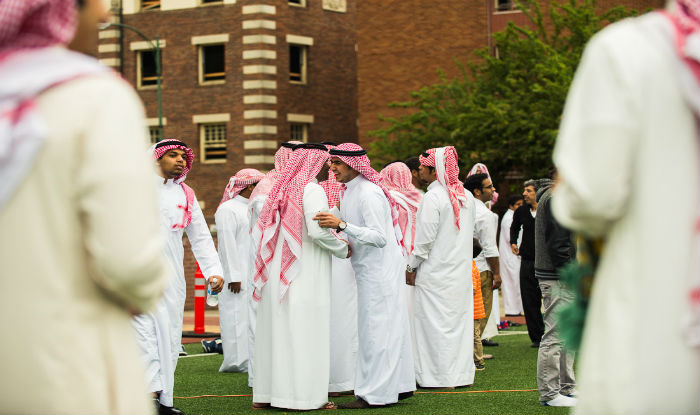


Such a view contradicts the religious teachings   as well as historical realities regarding the Muslim community globally. (ft.1)

The Qur'an refers to Muhammad as "The seal of the Prophets" (33:40), a "mercy to all nations" (21:107) as well as a Messenger "sufficient for all people" (34:28). These references should suffice in terms of how the Prophet is portrayed insofar as his potential audience. 


Moreover, the Islamic scripture speaks very eloquently on humanity's diversity as evidence of Divine power, wisdom, and as a means for mutual growth (Q 30:22, 49:13), and the Prophet to whom it was given has himself shown clearly that racism and "chosen people" concept have no place in faith. Although there are many statements made by him recorded, his words in his famous final speech (khutbat al widaa') provide a powerful message. He has stated " An Arab carries no virtue over a non-Arab, nor does a non-Arab over an Arab, nor a white over a black, (the only criterion being) piety."


What about Ishmael and Isaac?


Another notion widespread, in particular among Jews and Christians, is that Islam functions as a religious rebellion, generated by the feud between the sons of Abraham, itself being an extension of the feud between their respective mothers (Sarah and Hagar).

This notion is further given fuel by the fact that while Judaism (and by extension Christianity) asserts that the identity of the sacrificed son is Isaac (the progenitor of the Jews) while Islam teaches that the son here would be none other than Ishmael (the progenitor of the Arabs).


While it is true that there is a difference in the identification of the particular son (ft.2), as well as the fact that the Bible (Gen.16:12) uses disrespectful language regarding Ishmael, it should be noted that the Qur'an never does the same thing to Isaac!


Isaac is viewed with reverence by Muslims, he is given in the Qur'an as one of the carriers of the Divine message (37:112 among other places), and the invocation of peace is recited by Muslims when he is referenced. 


This is also strong proof that Islam is not a tribalistic faith, nor is it centered in Arab nationalism.


Qur'an vis-a vis Bible


Seven Quranic texts are often cited by missionaries of various denominations as proof that the Qur'an is relatively useless when it comes to matters spoken of in the Judeo-Christian dispensation. Islam does teach that God has sent forth communication and even scriptures before the advent of the Qur'an to Prophet Muhammad (see the Qur'an 2:1-5, 3:1-3, among other places), however it also teaches that the Qur'an itself functions as a clarification of matters that are present in the Judeo-Christian discourse (Q 27:76).  It also sees itself as a "guardian" insofar as preserving essential truths as conveyed in the past (Q 5:48).  It portrays itself as the "best narration" (Q 39:23) and the ultimate criteria for judgement (Q 25:1).


A summary of the cited texts is given below, along with a thorough yet succinct explanation.


[1] Q 5:43. This verse requires a simple reading of verses 41-42 which precede it. The context shows the insincerity of the party approaching Prophet Muhammad for a legal ruling. It is here a bit of sarcasm when it reads " And how do they come to you (O Muhammad) for judgement, while they possess the law, therein being God's judgement, then, they turn away after a while, and they are not of those who possess faith."


[2] Q 5:44. The "Law" possessed light and guidance. Remember that the particular aspect of "law" (here being "Taurah") that is referred to is the law of retribution, mentioned in Q 5:45 as something which appears not only in the Qur'an, but in the "law" which came before. 


[3] Q 5:46-47: "Injeel" means "Good news", being the Arabic rendering of what is called in English "Gospel". It does NOT reference an actual book, let alone the largely anonymous collections of "Gospels" that came into circulation after the time of Jesus. Jesus did not carry a book with him called "The Gospel", on the contrary, he represented and embodied that "good news". Therefore, his "followers" should conduct themselves in that light. In any case, the very next verse (5:48) tells us that now we have a scripture of Divine Origin, given to the global messenger, that safeguards the core truths that were conveyed before. It is worth mentioning here that Islam teaches that God's guidance was conveyed to peoples all over the world, not limited to a semitic context, and that we have limited information currently on the history (and even identities) of them. (Q 13:7, 40:78).


[4] Q 5:66-68. They did not, in fact, stick to Divine guidance, however, with the Qur'anic revelation to Muhammad, the chance for that guidance emerges once again. 


Modern scholarship has confirmed what has been hinted at in the Qur'an (2:79) regarding the editing process of the Bible, not only in theological points, but even in texts which seemingly are innocuous. (ft.3)


Some important examples of differences 


One must keep in mind that the Qur'an is for the benefit of all God-aware human beings (Q 2:1), and a thorough reading of its contents and language will show that its general message and application can fit in any time, place and cultural context. We have chosen below some examples to illustrate the Quranic logic vis a vis the rituals and laws that are associated with the Bible or with the faiths tied to it.


[1] Sabbath: The Bible gives two different reasons for its observance: that God "rested" after the creation of the universe (Gen.2:2) and as an act of gratitude to God for liberation (of the Jews) from Egypt (Deut.5:15). (ft.4). 


In Islam, there is no concept of God having to "rest", even as a metaphorical expression! The Qur'an says directly "God, none deserves worship except him, the self-subsisting, the eternal, slumber does not overtake him, nor does sleep." (Q 2:255). 


Thus, the theological assumptions present in the Biblical language have no equivalent in the Qur'an, thus, that assumption is rejected, and no need for Muslims to observe the Sabbath. Moreover, the other reason given, as an act of gratitude, at best, is for that immediate audience, not for all of humanity.


[2] Divorce: Allowed in the Mosaic dispensation (Deut.24:1), it is said to have been forbidden by Jesus, allowed only in cases of adultery (Matthew 19:9). If the Biblical text can be taken as authoritative, it becomes apparent that divorce was too easy and too lax in Jesus' time and insofar as his audience, so he seeks to stop the abuse of the Mosaic allowance.  


Islam, as a faith for all mankind, not only allows divorce, but it also gives us regulations on it. There's an entire chapter called "Divorce" (Soorah at Talaq, 65). This is logical, in that the bulk of mankind would not necessarily face the same issues as faced by the audience of Jesus in his time.


[3] Alcoholic Consumption:  While the Bible writers have expressed language ranging from praise of it (Psalm 104:15, Ecclesiastes 9:7) to condemnation of drunken behavior (Proverbs 20:1), nonetheless it has been generally allowed in most strands of Judaism and Christianity. 


The Qur'an, given to humanity as a guide to safety and maximum benefit, has decreed that it is totally forbidden. The Qur'an simply states that the harms of alcohol outweigh its benefit (2:219. also see 5:90)


Footnotes


(1) The Arab world only constitutes 20 % of Muslims globally. They are a minority in the Muslim world, the largest nation of Muslims being Indonesia, as well as half of the African continent. Moreover, "Islam" is an Arabic word which means "surrender to God", and according to the Qur'an, submission to God has been taught by the authentic prophets and teachers of the past, in both semitic and non-semitic societies. As for faith as presented in the Bible and Qur'an, refer to the paragraph "Islam: The path of Jesus and Muhammad" in the following article. Click here


(2) There are several issues present that need to be looked at. {I} The older son of Abraham, Ishmael-the progenitor of the Arabs- would be the logical son for the sacrifice. {II} While the Bible (Gen.22) certainly names Isaac (the younger son) as to be the sacrifice, it incorrectly calls him "Your only son", which, at no time, was ever the case! The Biblical wording absolutely suggests the motivations of tribal prestige, which is totally absent from the Qur'an. It is also relevant here to mention that the covenant, often spoken of by missionaries with Biblical citations, has a totally different expression than the Quranic language. In Q 2:124, we read that God tells Abraham that he will make him a leader of global impact ("Imaaman"), Abraham asks if this extends to his descendants, to which he is told "My covenant extends not to the oppressive". Thus, Islam teaches that neither tribe or bloodlines (real or imagined) carry any weight insofar as ties with God are concerned.


(3) It has been convincingly argued, for example, that Mark's Gospel was written in Rome (and not Palestine) by citing Mark 10:12, which allows a woman to seek out divorce. Such an allowance occurred under Roman law, but not in Jewish law, which is exclusively with the man! See Barton, John A HISTORY OF THE BIBLE: THE BOOK & ITS FAITHS, Penguin books, 2019, pg.297. Many authorities, similarly, have been able to detect that the famous story of the adulteress spared by Jesus with the words "let he who is sinless cast the first stone" to be a later interpolation. See Bart D.Ehram, MISQUOTING JESUS: THE STORY BEHIND WHO CHANGED THE BIBLE AND WHY, HarperSanFrancisco, New York, 2005, pp.63-66. Even the famous "Lord's prayer", the most recited supplication in Christendom, has been dismissed as wrongly attributed to Jesus later on. See John Shelby Spong BIBLICAL LITERALISM: A GENTILE HERESY. Harper One, New York, 2016, pp.135-137. This is just the tip of the iceberg. 


(4)  Genesis 2:2 is rendered as "ceased" in the JPS translation ( TANAKH THE HOLY SCRIPTURES, pg.4, New York, 1988) but has a note that allows for "rested". Robert Alter has also used the same word in his translation (THE FIVE BOOKS OF MOSES, New York, W.W.Norton &  Company, 2004, pg.20).  While this text has different understandings among Jews and Christians respectively, Islam does not allow for even this sort of language to be used. Thus, the theological importance of the Quranic text 2:255. which is famously called the verse of the throne (Ayatul Kursiyy). A brief examination of that text can be found here


Saturday, February 11, 2017

Common misconceptions about Islam

Introduction

Islam is the religious choice of a fifth of humanity, it is the dominant faith in areas of the world rich in resources and strategic importance. It has influenced countless trends in philosophy, culture, theology, and the practical sciences. It has not only given us 'Umar ibn Al-Khattab(1), it has given us figures as diverse as Rumi (2) and Muhammad Ali.

Despite these presence of these undeniable facts, there persists a number of myths and misconceptions in the minds of people, Some of these myths have their origins during the time of the Crusades(3) while others are of a more recent creation,

While misconceptions may be held and perpetuated out of simple ignorance, we have to admit that outright distortions of the Islamic message are spread via mass media, movies and the like, out of political interests. In short, the religion of Islam and Muslims are a convenient scapegoat.

This brief article seeks to address the leading misconceptions on Islam. Comments/questions are welcome, and as time allows this writer will seek to address them all.

Who or what is 'Allah'?


Allah is the Arabic name for 'God'. Literally, it is a contraction of two words,"Al" and "Ilah", "The" "Object of worship". It refers to the One and Only God!

It may come as a surprise that Arabic translations of the Bible have God referred to as "Allah"!

The concept of the Divine as given in Islam can be found in well known Quranic references "Say: He is God alone, God the Absolute, He has not given birth to any, nor was he born to any, and there is nothing like him." ( Q 112:1-4)

"He is God {Allah}, besides whom there is none deserving worship but him. (The one who) knows the hidden and the apparent, He is the Merciful, The Compassionate. He is God, besides whom none deserves worship but Him, The Sovereign, The Sacred, The Source of Peace, The Guardian (4) of faith, the Protector, The Mighty, The Powerful, The Great. Glory belongs to God, he is exalted above what is [wrongly] attributed to Him. He is God, The Creator, The Maker, The Creator of Form, To Him belongs the most beautiful of names. To him belongs glory, in the heavens and the earth, and He is The Mighty, The Wise." {Q 59:22-24}


Is Allah a moon god?

This particular assertion has been made in recent years by a handful of Christian polemicists in books and, more popularly, comic-book leaflets. The gist of their argument is that a pantheon of deities were deemed worthy of worship by the Arabs of Muhammad's time, and he simply picked one, a deity associated with the moon!  This, the argument continues, is why the traditional calendar is lunar, mosque domes often have a crescent moon adorning it, and the reason why many Muslim nations have a crescent on their flags!

There is a plethora of evidence to refute this notion and this has been addressed succinctly by others(5), however, this Quranic evidence should be sufficient for an honest reader.

"Do you not see that verily, to God is submissive who is in the heavens, the earth, the sun, the moon, the stars, the mountains, the trees, animal life as well as a goodly number of humans..?{ Q 22:18}

In another Quranic verse, we read that the pagans were asked "If you ask them 'who created the heavens and the Earth and subjected the sun and the moon, they will reply 'God".." [Q 29:61].

The Qur'an repeatedly speaks of both the moon and the sun as being used to measure time [6:96, 10:5, 55:5] and under the control of God. The Qur'an has never given legitimacy to a view that the Moon has Divine properties, or that "Allah" was synonymous with a moon deity!

Allah cannot be seen physically by human beings, because, ultimately, we would not be able to grasp Him in a full and complete manner, This is why God is never depicted in human form [or any physical form for that matter] and no pictures are present in prayer halls. Indeed, we find that if any decorations adorn the Mosques, it would be quotations from the Qur'an itself, designed to remind the visitor of the greatness of God.

"And the mosques are for God, therefore do not supplicate any other than him."[Q72:18]


Islam as the teaching of Prophets preceding Muhammad and coming through Muhammad

Islam is an Arabic word meaning "submission to God". The one who does the act of submission is called a "Muslim". If one were to read about the characters of old, particularly in the Jude-Christian dispensation, we find that indeed, they taught their followers submission to God. It is true that there are some differences in emphasis and rituals, however the core of submission remains.

As Muslims see it, this thread of teachers, scriptures and Prophets ended with the coming of Muhammad. He comes, according to Islamic teachings, as a Mercy from God to be felt universally [Q 21:107], as the Last of the Prophets with the final scriptural revelation { Q 33:40}, and with teachings that correct certain important misconceptions and that will act as an ultimate criterion for judgement between what is authentic and what is spurious, { Q 27:76 and 25:1].

As part of the Muslim practice, we are to pray for peace and blessings to be bestowed on all the Prophets and do not allow any disrespectful language about them.

Islam's relation with Jews and Christians 

The modern discourse has placed the three monotheistic religions alongside each other as reflective of the shared roots in Abraham, thus, the term Abrahamic religions.

While it is true that Islam has strong theological disagreements with the other two faiths, the Qur'an repeatedly calls them as "People of Scripture" and allows both marital and other social ties [Q 5:5].


Terrorism/Violence to spread religion

This is perhaps the greatest myth perpetuated by forces with political interests. It is imagined that Islam has taught its followers to spread the faith at the point of a sword, however, this is far from the truth. The Qur'an itself says "There is no compulsion in religious affairs, as truth stands clear from error.."[Q 2:256].

It says further "And say; Truth is from your Lord, so he who will accept, let him accept, and he who will reject, let him reject..[Q 18:29].

The Qur'an tells us that Noah says to his interlocutors "Shall we compel you to accept while you are hateful of it?" [ Q 11:28]

So we should be able to see clearly that using violence as a means to spread religion is not correct as far as Islam is concerned. In today's world, forces both inside and outside the Muslim community seem to believe otherwise, but all of that is connected to political causes and often are simply masks to disguise other agendas!

Islam is a missionary religion, it does seek to call people to investigate it and accept it. However, it does so by telling the "caller" to use "wisdom and articulate expressions" { Q 16:125}. The Qur'an refers to itself as a scripture given in order to influence people to think [Q 12:4, among other texts], so it is clearly against a blind faith.

Jesus

Depicted as a Prophet and great teacher, Jesus is mentioned by name twenty five times in the Qur'an. Muslims affirm his virginal birth and view him as the Messiah, although the understanding we have on the meaning of that differs from mainline Christianity.

This article does not seek to enter into details on that(6), nonetheless what we should convey is that belief in Jesus as Messiah is part and parcel of Islam. He is loved and respected by Muslims, even though our understanding of his significance differs from Christians,

Women

Increasingly in the West the issue of how women are treated and viewed in Islam has been raised. The most visible Muslim women are of course those who wear Hijaab or other well-recognized dress associated with Islam.

It can be said that certain parochial cultures have a negative attitude towards women, but that reflects their own views, not necessarily the teachings of the Qur'an and Prophet Muhammad. In the time before Arabia accepted Islam, the Arabian custom was to view females with little regards, even practicing female infanticide! The Qur'an, in one of its earliest texts, addressed this horrific practice [Q 81:8-9]. Islam as taught by Muhammad himself gave inheritance rights, leadership roles, rights in choice of marriage and freedom with their own incomes. Indeed, we have an entire Quranic chapter entitled "The Women" [An Nisaa'].

There are guidelines for dress for women, but what is often ignored is that there is a dress code for both men and women. The Qur'an does directly speak on how women should dress [Q 24:31 and 33:59] but what is often ignored is that the context of these regulations, particularly in the Qur'an's chapter 24 as referred to above, speaks on men and women abstaining from inappropriate staring, and behavior in general. In other words, the dress code is connected to a wider set of behavioral guidelines.

How those guidelines are carried out will vary from culture to culture. Nigerian clothing styles differ from those in the Arab world, but so long as modesty and appropriate respectful guidelines are observed, they are all equally Islamic or allowable in Islam!

For women, the dress code includes the covering of the whole body, including hair. This actually seeks to create an environment of respect and appropriateness. It has no relation to oppression of women.


Endnotes

(1) 'Umar ibn Al-Khattab {d.644 C.E.} was initially a foe of Islam, even wanting to kill Prophet Muhammad, but his heart was touched by the Quranic message and he went on to become a strong defender of the faith, even at one point becoming the leader of the Muslim community after the Prophet's death. He is well known for his modesty and sense of justice for all.

(2) Jalaluddin Ar-Rumi [d. 1273 C.E.] was a great poet, philosopher and spiritualist. The Western world absorbs his poetry and often he is seen as having been divorced from Islam. While there is admittedly some controversy surrounding him in Muslim discourse, nonetheless he saw himself as totally in line with Islam. One quote attributed to him says "Be in the community of those who receive Divine Mercy, don't abandon the Sunnah of Ahmad [i.e. Prophet Muhammad], rather, be commanded by it." A book has recently been published, which I have yet to obtain, that speaks on this attempt to divorce Rumi from Islam. The book is called Rumi's Secret by Brad Gooch. A review of it, as well as a very pleasant overview of Rumi's reach, is to be found at [url] http://www.newyorker.com/books/page-turner/the-erasure-of-islam-from-the-poetry-of-rumi[/url] .

(3) Some of these myths are described well in the book Holy Wars: The Crusades And Their Impact On Today's World by Karen Armstrong [New York, 2001].

(4) Al Mu'min is rendered here as "The Guardian", but it has been variously interpreted. Tafseer Al-Jalalayn has it as informing us about God who is "The truthful, who conveys the truth of miraculous creation". I'raab Al Qur'an  mentions three different interpretations, which include God's "Protecting of his servants from danger." " The Protector of his closest ones [Awliyaaa'] from his own wrath." and "That the believers will testify on judgement day and their testimony will be truthful, verified as true by God.."  This work, by the 10th century Egyptian scholar Abu Ja'far Ahmad bin Muhammad Isma'il An-Nahhas, is a wonderful reference source for examining the grammatical possibilities of Quranic words. The edition we have is published by Dar Al Ma'rifah, Beirut, Lebanon.

(5) The famed Muslim debater and academic Dr. Shabbir Ally has published a thorough refutation of the moon god theory. It can be found at [url]http://www.beautifulislam.net/christianity/robert_moreys_moon_god_myth.htm[/url].

(6) The Islamic understanding of the role of Jesus is explained by this writer at [url] http://shamsuddinwaheed.blogspot.com/2008/01/jesus-in-islam.html[/url].


Thursday, April 16, 2015

Finding Guidance in a world of Confusion


[Note: This is an edited version of our presentation at the monthly spirituality session at Toledo Masjid Al-Islam. Initially this was to be shared on video, but the recording failed half way into the presentation.]

When looking at life today, we find that almost everything is in a state of chaos, instability is the new normal. Attitudes, morals, public policies, all of them are up for grabs. "Facts" or values upheld as recently as fifty years ago are not under review worldwide.  In the religious world, this is also a problem, and confusion abounds. It can be argued that this is a greater problem for Christians than for any other religious community. Thus, under the slogans of Love, Forgiveness and Acceptance, support for everything under the sun is given, and religion ends up becoming nothing more than a label, a uniform  put on during the holidays, making religion a thing that has lost all value. Thus, we have here the basic foundation of confusion, translating into becoming lost, misguided and easily manipulated.

Allah [God, the most high] says in the Qur'an


If you obey most of those in the land, they will mislead you from the path of Allah. They [themselves] follow conjecture [Dhann], and are themselves nothing but a presumptuous lot." [Q 6:116]
6:116

We have two important phrases in this ayah. Dhann [conjecture] and yakhrusoon [root being kharasa], the latter carries, among its meanings, to have or to follow opinions without proof. It can also mean lying. So, giving obedience to lies.

Therefore, to be prepared to receive guidance, there has to be a willingness to pursue what is right. That means thinking deeply. Pondering, study, research. Guidance is NOT dictated by emotions, nor by the whims of the majority. Sociologists have long warned us of a mob mentality. The mob mentality manifests itself in obvious terms when a group of people assault or even kill a single person, but having or following the mob mentality is something preached to us on a daily basis through Television, Music, Movies, Politicians and even Social Media.  We have to be willing to accept that guidance may not always be seen or recognized by a majority.

Indeed, the Qur'an often tells us that those rejecting the Prophets of God would do so under the banner of following family or societal traditions [ among some examples, see Q 5:104 and 2:170].

Returning to conjecture, Dhann in Arabic, we also read in the Qur'an
يَا أَيُّهَا الَّذِينَ آمَنُوا اجْتَنِبُوا كَثِيرًا مِّنَ الظَّنِّ إِنَّ بَعْضَ الظَّنِّ إِثْمٌ
O Believers. avoid much conjecture, verily, sometimes conjecture is sinful. [Q 49:12].So we learn from this statement that conjecture, be it about religion or even other human beings, can be harmful. Islamophobes have fears based on conjecture. Thus, to many, a women wearing a head scarf is automatically oppressed, even if she's college educated. 

So strive hard to find truth, rather than having assumptions, because that is the gateway to receiving correct information.


Some other practical steps


Don't be lazy Muslims. Be connected to the Qur'an, consult it often. Use its verses in your prayers, have a stronger tie to it than you have to your favorite Television shows, Football teams and the like.


Be connected to people of knowledge, and to the Muslim community.


Don't let egos, jealousy, get in the way of your spiritual progression. A good practice is the regular recitation of the last two Quranic chapters [Al Falaq and An-Naas] because it can serve as a sort of spiritual protection, from other's bad intentions but also from developing those bad characteristics in one's own self.


In Islam, when we pray in congregation [Jamaa'ah] we do so standing closely to one another. The Imam is reciting texts [from  the Qur'an] that are universally accessible. The praying with others can create bonds that will overcome those bad characteristics, and it creates humility. 


In prayer, we say with every movement Allahu Akbar, God is the greatest, meaning God is bigger or more important than anything else. We proclaim his might and power in the bowing and prostrations. The Black and the White, the rich or poor, all are taught to proclaim the Divine power and thus, the fact we cannot be compared to him. We belong to God, to him is our return, and even our religion is to be for him! 


What about the actions of others?


If we are capable, we should always share whatever the truth is, especially on religious matters, but we can't force it on people. 


وَمَا جَعَلْنَاكَ عَلَيْهِمْ حَفِيظًا وَمَا أَنتَ عَلَيْهِم بِوَكِيلٍ

"And We have not made you [O Muhammad] a keeper over them, nor have you been made in charge of their affairs. [6:107]

So if we have tools for others to use in their search for guidance, we do share them freely. The doctor can write the prescription, but in the end, it is the patient's responsibility to take the medicine as prescribed.

Guidance does not require force.

Personal guidance vs communal enlightenment

For me, I am a Muslim who is firmly convinced that Islam is the perfected manifestation of the Divine Truth. I am willing to share its teachings on God-concept, spirituality, prophetic history and narrative.

But there's more to this. As a species, humans need guidance too, and that guidance is present within Islam.Guidance that all humans can benefit from, even disbelievers. Islamic teachings on economy, on race, on nationalism, ethical code, family, all of these [ and more] are required for life in today's world. These teachings need to be studied and applied in a comprehensive way. That application will be the best type of propagating, and will provide a worldly salvation for mankind.


Tuesday, January 8, 2013

Comparing the scriptures: a glance at Biblical and Quranic texts

Introduction


This article is not designed to antagonize nor offend readers of any faith. Nor is it a polemical device. Rather, it is an educational and discussion tool, on a subject we have been long asked to address. The reader is encouraged to verify the quotations for themselves. The Biblical references are from the NIV [NIV study Bible, Zondervan, Grand Rapids, Michigan 2002 edition] unless otherwise stated, and the Quranic texts are translated by the author, unless otherwise stated.


God concept

The basic idea or understanding of how to conceptualize the Almighty is the same as between the Bible and the Qur'an.

"I am the Lord your God, who teaches you what is best for you, who directs you in the ways you should go.." [Isaiah 48:18]

"God is not a man that he should lie, nor a son of man that he should change his mind." [Numbers 23:19]

"Hear, O Israel: The Lord our God, the Lord is one." [Deuteronomy 6:4]

"Say: He is Allah alone! Allah the eternal. He does not give birth, nor was he given birth to, and nothing exists like him. "[Qur'an 112:1-4]

 "And place your trust in the Living One [Al-Hayy] who does not die, and celebrate his praise, and he is sufficient as aware of the sins of his servants" [Qur'an 25:58]

 “Allah![1]  Nothing deserves worship except He, the Self-Subsisting, Eternal. Slumber does not overtake him, neither does sleep. To Him belongs what is in the Heavens and what is in the Earth. Who possesses abilities of intercession, except by His permission? He knows what is between them, and what is behind them. None grasp of his knowledge, except by his will. His throne encompasses the Heavens and the Earth, He does not tire in protecting them both, and He is the Most High, the Magnificent” [Q 2:255]

Ethics

 “Honor your father and your mother, as the Lord your God has commanded you, so that you may live long and that it may go well with you in the land the Lord your God is giving you.
 “You shall not murder.
 “You shall not commit adultery.
 “You shall not steal.
 “You shall not give false testimony against your neighbor.
“You shall not covet your neighbor’s wife. You shall not set your desire on your neighbor’s house or land, his male or female servant, his ox or donkey, or anything that belongs to your neighbor.”[Deuteronomy 5:16-21]


 "Hence, do not kill your children for fear of poverty : it is We[#2] who shall provide sustenance for them as well as for you. Verily, killing them is a great sin.And do not commit adultery  -for, behold, it is an abomination and an evil way.And do not take any human being's life -[the life] which God has willed to be, sacred-otherwise than in [the pursuit of] justice.  Hence, if anyone has been slain wrongfully, We have empowered the defender of his rights [to exact a just retribution] ;  but even so, let him not exceed the bounds of equity in [retributive] killing.  [And as for him who has been slain wrongfully -] behold, he is indeed succoured [by God] !And do not touch the substance of an orphan, save to improve it, before he comes of age.  And be true to every promise - for, verily, [on Judgment Day] you will be called to account for every promise which you have made !
" [ 17:31-34 Muhammad Asad translation, The Message of the Qur'an]


Broadly speaking, these two topics are arguably the most important. The two scriptures share the same vision here. While differences do exist between the two, it is the similarities that outweigh the differences.


Notes
[1] "Allah" is the name of God in Arabic, just as Dios is in Spanish and  Khuda in Farsi and Urdu. It refers to the One and Only God.

[2] "WE" refers to God himself. The plural used is a royal plural, given to denote grandeur and authority. The Bible repeatedly uses this, such as in Genesis 1:1, "In the beginning, God [Elohim] created the heavens and the Earth." Elohim is plural of Eloh!


Friday, November 27, 2009

Abraham: father of all nations, a goodly model


There is for you an excellent example (to follow) in Abraham and those with him..[Qur'an 60:4]

'Eid Ul-Ad-haa, Imams and orators worldwide undoubtedly mentioned the story of the sacrifice, as given in scripture, wherein Abraham was ready to take the life of his son in response to a vision interpreted to have been from God. Another theme usually explored is when he left his son and Hagar [Hajar] in the desert to fend for themselves. This particular narrative has it that during the process of searching for water for her infant son, Hagar ran bath and forth seven times, and at the end, almost in a miracle fashion, the well appears. Indeed, Muslims re enact this event during the Hajj [Pilgrimage] at the Safa and Marwa trails [which has now been included in the complex of the Masjid Al-Haraam], the well itself still giving water, known as ZamZam water.[Ft.1]

Yet, there is something to be said of other aspects of the life of Abraham, who is called in the scripture of the Jews and the Christians "father of all nations" [ Genesis 17:5].

Origins of Abraham

Called Ibrahim in Arabic, tradition has it that he was born in Southern Iraq, although there does exist other places, in Northern Iraq, Turkey and even Sicily. Regardless of where he was born, eventually he found his ways to such diverse places as Egypt, Palestine, and Arabia. Sites in all those places, not the least of which is the Ka'bah at Makkah, are associated with him.

Is there a lesson in these sites?

The Qur'an tells us a very interesting observation, one which should be associated with Abraham, but also with seekers of truth and guidance in all times, places and among all peoples.

"Have they not traveled in the land so that their hearts will come to understand, or that their ears will come to hear?"[ Qur'an 22:46]


Travel is very important, for the sake of religious or spiritual knowledge. This is something that seems to have been universally recognized, when we notice adherents of Hinduism, Christianity, Islam, going forth from country to country to study with respected spiritual figures. Reading books, or even studying at a local university, are all wonderful acts, acts which can produce blessings and appropriate information, but nothing can beat leaving the comforts of one's home and family for the sake of attaining knowledge.

The journey itself is a learning experience, be it meeting interesting people at airports, or having some time in isolation while in transit to deeply contemplate the pressing concerns of the body, soul and mind.

Whatever one thinks of Abraham, the towering figure in the three monotheistic traditions, this aspect of his existence cannot be denied. This is, of course, especially true for the Muslim, the reader of the Qur'an.

This author has done, and continues to, much traveling, and the above mentioned Quranic verse is very true. Many times we cannot process the information or insight someone gives us [or that we read in a book, magazine or website] until we have the same, or a similar experience, or a set of experiences.

So, on this occasion of 'Eid ul-Ad-haa[ft.2], let us try to emulate the goodly model present in Ibrahim ['Alayhis salaam]. Attain whatever knowledge we can from our scholars, books and websites. But always be prepared to learn something from one's one experiences, or the experiences of other people. There is much insight to be gained from travels of this nature.

Role of the Qur'an

The word Qur'an itself means a reading, a recital. It has the sense of "something put together piece by piece, part by part." This is a very appropriate name, as it was revealed to the Prophet Muhammad [Sall-Allahu 'alayhi wa sallam] slowly, over a period of twenty-three years.

The Qur'an serves many roles, but for the sake of this article, we want to emphasis that it serves as a guide to make its reader a bit more sophisticated, well-rounded, knowledgeable. It is an undeniable fact that it can be speaking of theology for several verses, and then turn to a completely different subject such as war or marriage.

Those with broad knowledge in various fields, who have lived and traveled in many places, learning languages and cultures alien to their native backround, can appreciate such a guide as the Qur'an.

In issues not addressed in the Qur'an, God allows us to figure it out on our own, we can access some guidance or precedent in the reliable sources about the Prophet Muhammad [the last Prophet, and universal messenger], we can access guidance [or perhaps assistance is a better word] from our collectives experiences present in our culture, our personal reading of the situation [as well as our reading of the goal of religion] to ascertain the proper way to proceed.

In any case, all of that comes from having a broad experience, an open mind, open ears and open heart.

The Qur'an is very suitable for our guidance because we, like the last book of Allah itself, have been put together piece by piece, part by part. We are born as babies and absorb everything while growing up. Our parents and societies give us the foundation and much assistance, but there are times when we will have to learn lessons on our own, because our own mistakes will teach us how to act in the future. Our own actions will be suitable to serve as precedent, and each time that occurs, as far as the Qur'an goes, we can come to appreciate, nay, understand, texts better. It will grow in meaning for us.


Endnotes

[1] This author has examined in great detail the Qur'anic presentation of Abraham's story of the sacrifice in the work The Languuge of Revelation [pg. 237 "Abraham"]. To obtain, go to www.arifinimports.com

[2] The significance of the 'Eid-Ul Ad-haa occasion has been addressed in a lecture and Q & A session called "The story and sacrifice", available for free at www.esnips.com/web/shamsuddinwsStuff.
