Showing posts with label alcohol. Show all posts

Thursday, December 2, 2021

A deep dive into false ideas regarding Islam: with a focus on the Abrahamic ties


Introduction


Public discourse on any subject will always be subject to misunderstandings and intentional distortions, but   when it comes to religious affairs, this is even more problematic, because religion can be intertwined with identity and culture, thus, sensitivities and emotions become involved, without the benefit of patience and deep thought.


The Qur'an (39:3)   teaches that religion is supposed to be specifically for God. It also teaches that faith should be backed by rational arguments and evidence (22:46, 46:26, 12:1, et al).


It is with those teachings in mind that we present A deep dive into false ideas regarding Islam: with a focus on the Abrahamic ties, to function as a clarification and a reference to those in particular that are associated with the Abrahamic faiths, to address wrong and often ignorant assertions made from such quarters about the religion of Islam, some of those notions having existed for centuries, but with the advent of mass communication, made much easier with the internet and social media, have the capacity to spread further and be taken as credible, simply because of marketing.  


Below, we take a look at some of the leading false ideas that are to be found in the public discourse:


Islam is for Arabs (only)


This particular assertion is made by those who can concede that Muhammad (peace be upon him) was indeed a Prophet of God yet find his message (risaalah) relevant only to the Arabs. Such an idea comes from the assertion that Muhammad was the "founder" of Islam, and that because the scripture (Qur'an) is in Arabic, it is therefore Arab-centric with no value to the wider world.
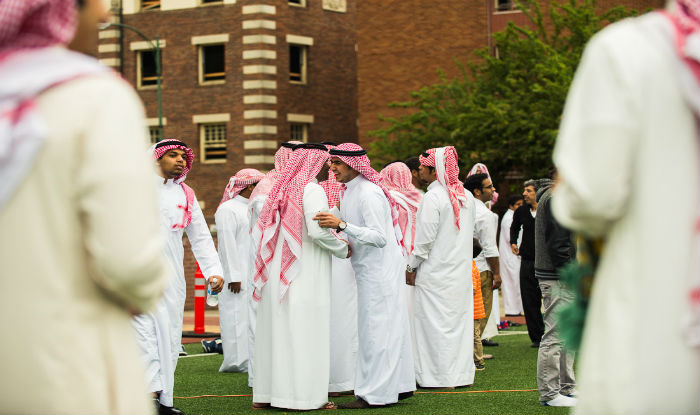


Such a view contradicts the religious teachings   as well as historical realities regarding the Muslim community globally. (ft.1)

The Qur'an refers to Muhammad as "The seal of the Prophets" (33:40), a "mercy to all nations" (21:107) as well as a Messenger "sufficient for all people" (34:28). These references should suffice in terms of how the Prophet is portrayed insofar as his potential audience. 


Moreover, the Islamic scripture speaks very eloquently on humanity's diversity as evidence of Divine power, wisdom, and as a means for mutual growth (Q 30:22, 49:13), and the Prophet to whom it was given has himself shown clearly that racism and "chosen people" concept have no place in faith. Although there are many statements made by him recorded, his words in his famous final speech (khutbat al widaa') provide a powerful message. He has stated " An Arab carries no virtue over a non-Arab, nor does a non-Arab over an Arab, nor a white over a black, (the only criterion being) piety."


What about Ishmael and Isaac?


Another notion widespread, in particular among Jews and Christians, is that Islam functions as a religious rebellion, generated by the feud between the sons of Abraham, itself being an extension of the feud between their respective mothers (Sarah and Hagar).

This notion is further given fuel by the fact that while Judaism (and by extension Christianity) asserts that the identity of the sacrificed son is Isaac (the progenitor of the Jews) while Islam teaches that the son here would be none other than Ishmael (the progenitor of the Arabs).


While it is true that there is a difference in the identification of the particular son (ft.2), as well as the fact that the Bible (Gen.16:12) uses disrespectful language regarding Ishmael, it should be noted that the Qur'an never does the same thing to Isaac!


Isaac is viewed with reverence by Muslims, he is given in the Qur'an as one of the carriers of the Divine message (37:112 among other places), and the invocation of peace is recited by Muslims when he is referenced. 


This is also strong proof that Islam is not a tribalistic faith, nor is it centered in Arab nationalism.


Qur'an vis-a vis Bible


Seven Quranic texts are often cited by missionaries of various denominations as proof that the Qur'an is relatively useless when it comes to matters spoken of in the Judeo-Christian dispensation. Islam does teach that God has sent forth communication and even scriptures before the advent of the Qur'an to Prophet Muhammad (see the Qur'an 2:1-5, 3:1-3, among other places), however it also teaches that the Qur'an itself functions as a clarification of matters that are present in the Judeo-Christian discourse (Q 27:76).  It also sees itself as a "guardian" insofar as preserving essential truths as conveyed in the past (Q 5:48).  It portrays itself as the "best narration" (Q 39:23) and the ultimate criteria for judgement (Q 25:1).


A summary of the cited texts is given below, along with a thorough yet succinct explanation.


[1] Q 5:43. This verse requires a simple reading of verses 41-42 which precede it. The context shows the insincerity of the party approaching Prophet Muhammad for a legal ruling. It is here a bit of sarcasm when it reads " And how do they come to you (O Muhammad) for judgement, while they possess the law, therein being God's judgement, then, they turn away after a while, and they are not of those who possess faith."


[2] Q 5:44. The "Law" possessed light and guidance. Remember that the particular aspect of "law" (here being "Taurah") that is referred to is the law of retribution, mentioned in Q 5:45 as something which appears not only in the Qur'an, but in the "law" which came before. 


[3] Q 5:46-47: "Injeel" means "Good news", being the Arabic rendering of what is called in English "Gospel". It does NOT reference an actual book, let alone the largely anonymous collections of "Gospels" that came into circulation after the time of Jesus. Jesus did not carry a book with him called "The Gospel", on the contrary, he represented and embodied that "good news". Therefore, his "followers" should conduct themselves in that light. In any case, the very next verse (5:48) tells us that now we have a scripture of Divine Origin, given to the global messenger, that safeguards the core truths that were conveyed before. It is worth mentioning here that Islam teaches that God's guidance was conveyed to peoples all over the world, not limited to a semitic context, and that we have limited information currently on the history (and even identities) of them. (Q 13:7, 40:78).


[4] Q 5:66-68. They did not, in fact, stick to Divine guidance, however, with the Qur'anic revelation to Muhammad, the chance for that guidance emerges once again. 


Modern scholarship has confirmed what has been hinted at in the Qur'an (2:79) regarding the editing process of the Bible, not only in theological points, but even in texts which seemingly are innocuous. (ft.3)


Some important examples of differences 


One must keep in mind that the Qur'an is for the benefit of all God-aware human beings (Q 2:1), and a thorough reading of its contents and language will show that its general message and application can fit in any time, place and cultural context. We have chosen below some examples to illustrate the Quranic logic vis a vis the rituals and laws that are associated with the Bible or with the faiths tied to it.


[1] Sabbath: The Bible gives two different reasons for its observance: that God "rested" after the creation of the universe (Gen.2:2) and as an act of gratitude to God for liberation (of the Jews) from Egypt (Deut.5:15). (ft.4). 


In Islam, there is no concept of God having to "rest", even as a metaphorical expression! The Qur'an says directly "God, none deserves worship except him, the self-subsisting, the eternal, slumber does not overtake him, nor does sleep." (Q 2:255). 


Thus, the theological assumptions present in the Biblical language have no equivalent in the Qur'an, thus, that assumption is rejected, and no need for Muslims to observe the Sabbath. Moreover, the other reason given, as an act of gratitude, at best, is for that immediate audience, not for all of humanity.


[2] Divorce: Allowed in the Mosaic dispensation (Deut.24:1), it is said to have been forbidden by Jesus, allowed only in cases of adultery (Matthew 19:9). If the Biblical text can be taken as authoritative, it becomes apparent that divorce was too easy and too lax in Jesus' time and insofar as his audience, so he seeks to stop the abuse of the Mosaic allowance.  


Islam, as a faith for all mankind, not only allows divorce, but it also gives us regulations on it. There's an entire chapter called "Divorce" (Soorah at Talaq, 65). This is logical, in that the bulk of mankind would not necessarily face the same issues as faced by the audience of Jesus in his time.


[3] Alcoholic Consumption:  While the Bible writers have expressed language ranging from praise of it (Psalm 104:15, Ecclesiastes 9:7) to condemnation of drunken behavior (Proverbs 20:1), nonetheless it has been generally allowed in most strands of Judaism and Christianity. 


The Qur'an, given to humanity as a guide to safety and maximum benefit, has decreed that it is totally forbidden. The Qur'an simply states that the harms of alcohol outweigh its benefit (2:219. also see 5:90)


Footnotes


(1) The Arab world only constitutes 20 % of Muslims globally. They are a minority in the Muslim world, the largest nation of Muslims being Indonesia, as well as half of the African continent. Moreover, "Islam" is an Arabic word which means "surrender to God", and according to the Qur'an, submission to God has been taught by the authentic prophets and teachers of the past, in both semitic and non-semitic societies. As for faith as presented in the Bible and Qur'an, refer to the paragraph "Islam: The path of Jesus and Muhammad" in the following article. Click here


(2) There are several issues present that need to be looked at. {I} The older son of Abraham, Ishmael-the progenitor of the Arabs- would be the logical son for the sacrifice. {II} While the Bible (Gen.22) certainly names Isaac (the younger son) as to be the sacrifice, it incorrectly calls him "Your only son", which, at no time, was ever the case! The Biblical wording absolutely suggests the motivations of tribal prestige, which is totally absent from the Qur'an. It is also relevant here to mention that the covenant, often spoken of by missionaries with Biblical citations, has a totally different expression than the Quranic language. In Q 2:124, we read that God tells Abraham that he will make him a leader of global impact ("Imaaman"), Abraham asks if this extends to his descendants, to which he is told "My covenant extends not to the oppressive". Thus, Islam teaches that neither tribe or bloodlines (real or imagined) carry any weight insofar as ties with God are concerned.


(3) It has been convincingly argued, for example, that Mark's Gospel was written in Rome (and not Palestine) by citing Mark 10:12, which allows a woman to seek out divorce. Such an allowance occurred under Roman law, but not in Jewish law, which is exclusively with the man! See Barton, John A HISTORY OF THE BIBLE: THE BOOK & ITS FAITHS, Penguin books, 2019, pg.297. Many authorities, similarly, have been able to detect that the famous story of the adulteress spared by Jesus with the words "let he who is sinless cast the first stone" to be a later interpolation. See Bart D.Ehram, MISQUOTING JESUS: THE STORY BEHIND WHO CHANGED THE BIBLE AND WHY, HarperSanFrancisco, New York, 2005, pp.63-66. Even the famous "Lord's prayer", the most recited supplication in Christendom, has been dismissed as wrongly attributed to Jesus later on. See John Shelby Spong BIBLICAL LITERALISM: A GENTILE HERESY. Harper One, New York, 2016, pp.135-137. This is just the tip of the iceberg. 


(4)  Genesis 2:2 is rendered as "ceased" in the JPS translation ( TANAKH THE HOLY SCRIPTURES, pg.4, New York, 1988) but has a note that allows for "rested". Robert Alter has also used the same word in his translation (THE FIVE BOOKS OF MOSES, New York, W.W.Norton &  Company, 2004, pg.20).  While this text has different understandings among Jews and Christians respectively, Islam does not allow for even this sort of language to be used. Thus, the theological importance of the Quranic text 2:255. which is famously called the verse of the throne (Ayatul Kursiyy). A brief examination of that text can be found here


Monday, April 12, 2021

Lecture notes: Building Character in Islam


(Introduction: The following is an edited  version of a presentation recently given on the subject Character Building in Islam.)

Creation


The Qur'an uses the passive  verb Khuliqa ("He was created") in connection to humanity, in carrying certain seemingly negative built-in aspects, such as" anxiety/impatience" (Q  70:19),"haste" (Q 21:37) and twice as "weak" (Q 4:28, 30:54).


In Arabic grammar, the presence of a passive verb would also require that the one who carried out the verb (faa'il) goes unmentioned. The doer would be assumed, or simply be unknown. Q 30:54 does not fit the above pattern, but rather the past tense verb, with the doer mentioned ("God is the one who created you all with some weakness.").


Some words of interest for this subject which stem from the same root include Akhlaaq ("character" or "manners") and "Akhlaq" ("Most appropriate" "Most natural"). 

The four seemingly negative tendencies mentioned above, "created" in us by God, are items that all of us have to deal with, and it is our dealing with those things which actually benefits us, as individuals as well as a species. Our dealing with those characteristics builds us up, it is on the job training, to allow us to do our job as stewards on the earth better

There are general behavioral codes which are globally accepted, i.e. don't kill, don't steal, etc, but those are external manifestations, yet the above-mentioned Quranic verses are speaking to internal conditions.


Ramadan and Character building


The month of Ramadan is the perfect opportunity to faithful people to engage in character building. Some examples of this are summarized below:

* Anxiety/impatience (Haloo'a). Listening to Quranic recitation, reading the text during the fasting period, helps to sooth anxiety.

*Hastiness. The desire for immediate satisfaction, as opposed to delayed gratification, is addressed by the discipline building of fasting, of holding back from the satisfaction of hunger and needs during the daylight hours of the month. 


* Weakness, be it physical or mental, is addressed through exercise, diet, and conscientious behavior. We often emphasis the Quranic prohibitions of gambling and alcohol. Those items are clearly forbidden in Islam, and is agreed upon in the Muslim community. There are other addictions which are worth asking about, such as tobacco, sugar, pornography, salt, and food addictions. Indeed, there are even those of us who are unable to function without a mobile phone!

Obviously the Qur'an and Sunnah don't directly speak on those items, the benefit vs.harms aspects are widely discussed, and on the above items Muslims reach different conclusions. 

We are not, for the purpose of this presentation, addressing their legal status in Islam, we are only saying that the Ramadan experience forces us to evaluate those items in our lives, to examine questions such as figuring out what is positive for us, and what is toxic for us, in light of Divine guidance.


The Prophet Muhammad (peace be upon him) is reported to have said that he has come to perfect morals. He does this by teaching "Scripture and Wisdom" (Q 62:2), which, when integrated into the mind and hearts of believers, gives them the tools needed for the perfections of morals.


Thursday, September 10, 2009

The guidance of religion vs. personal whims


Islam is a faith that asserts itself, in very clear and strong language, to be a faith that is completely detailed [Qur'an 6:114]. The last verse revealed to the Prophet Muhammad himself, Sall-Allahu 'alayhi wa sallam, asserts that Islam has been chosen, perfected, and completed by God himself, in the time of his final Prophet [Q 5:3]. This completion becomes evident even in the midst of the existence of Muslim sects, in the sense that despite our [minor] differences, our essentials are identical, as well as having the same book, prayers, charity, pilgrimage, etc.

Since Islam was perfected in the time of the Final Prophet, essentially it means that if we really believe, then we have to accept as Halaal [lawful] what is given in clear terms as Halaal in the Qur'an and Prophetic example [Usawtun Hasana] and to avoid that which is clearly given as Haraam[unlawful] according to the Qur'an and Prophetic model.


In this regards, it is important to remember Allah's statements;

''And obey Allah, and the messenger, so that perhaps you will receive mercy." [Q 3:132]


Whosoever obeys the messenger [Muhammad], obeys Allah. Therefore, if any turn back, We [Allah] have not sent you as a watcher over them." [Q 4:80]


To call one's self a Muslim, one is to have confidence in all the contents of Divine revelation as useful, beneficial and blessed. To replace something that is clearly supported or endorsed by the Qur'an and the Prophet for a tradition or idea whose roots lie in another faith or thinking pattern is almost tantamount to rejecting Islam itself,as if to say that particular idea is superior to the contents of the Qur'an and Prophetic model! We seek God's protection from that!

Islam: a realistic faith


In a world where individuality is the name of the game, religion has been reduced, in many ways, to the following forms.[A] Ethnic or racial identifier. [B] A series of personal rituals and beliefs designed to bring about personal satisfaction, a contentment that is comparable to the euphoric feelings brought about by drug use.

In addition to this, we must mention "interpreting for one's self." Often this slogan, which has its roots in Western religious culture from the times the Bible was not allowed to be translated, so that when it became available people wanted to 'understand' for themselves, which in itself is not a problem at all. However, it does become a problem to interpret in such a way that clarity is replaced with ambiguity, leaving the doors open for all sorts of vices as well as incorporating foreign concepts into one's practice and understanding of Islam.

Take for example the Quranic allowance for physical fighting. Many verses from the Qur'an speak to this, but for the sake of space only one will be quoted here;

Fighting is ordered for you, and you dislike it. But it is possible that you dislike a thing which is good for you, and that you love a thing which is bad for you. Allah knows, and you do not know .[ Q 2:216)

Other verses that speak to this reality, and the conditions for it, can be found in 22:39,40, 2:190,9:41,61:11-14 and many other references.

We fear that some Muslims are actually embarrassed by these verses, perhaps due to inferiority complexes, brought about by arguments of the Christian missionaries, who continually assert that Jesus Christ was passive, even in the face of great opposition, and that such a position is better in the sights of God[Ft.1]. Another reason for such a view is that contemporary figures who avoided a response by the hand have been touted in the Modern world as having made their particular causes successful. This argument is weak at best, as it can be argued that their successes are perceived and not real. The Dalai Lama comes to mind here.

If something as clear as fighting [when necessary]as given in the Qur'an can be rejected by interpretative gymnastics, where do we stop? Will the Qur'an be used to give legitimacy to the idea that Jesus is God? Will we have to hear, all of the sudden, that there are in fact many gods?

These examples are actually becoming real in our times! One example is that of Alcohol. The Qur'an calls it " a product of Satan's work"[ Q 5:90], that it has benefit, but "its sin outweighs its benefits."[ Q 2:219]. We are also told " so, abstain from it [alcohol and gambling] so that perhaps you will be successful." [latter part of Q 5:90]! Yet, believe it or not, many "Muslims" today actually assert that Alcoholic consumption is Halaal because the word Haraam is not used in the above referenced Qur'anic Ayaat!!!


Allah's Deen is serious business. It should not be interpreted by whims. Meaning, if a person drinks, well, that's a weakness that has to be addressed. But that does not require that one engage in dishonesty by claiming the text says "yes" when it clearly says "No".

We don't call for violence or extremism. Nay, we are calling for intellectual honesty. If Islam says such and such is legitimate, then that's the way it is. If Islam says that such and such is immoral, is wrong, well, that's what that is!

No one is perfect, all of us have faults and weaknesses. Why try to change the guidance of Allah, rather than looking at ourselves and changing in accordance with the guidance of Allah?

"And who is worse than one who has as a god his passions." Q 45:23.


Footnotes

#1= The following polemical article was composed by a Christian missionary, as a means to show their view that Islam is inherently violent, while Christianity is inherently peaceful. http://www.answering-islam.org/Authors/Arlandson/sword.htm. In any case, while the Gospels portray Jesus as passive, it also portrays him as taking rather drastic actions, such as overturning the money changers tables in the temple [ Matthew 12:12-13] and asserting that he has "come with a sword" [Matthew 10:34].

Saturday, May 24, 2008

West/East dichotomy present in Cairo Hyatt controversy?


The recent decision by the owner of the Grand Hyatt hotel in Cairo, a hotel which enjoys five-star status, to cease immediately the sale of alcohol has infuriated many, the bogeyman of Saudi "radicalism" in an otherwise "moderate" Egyptian Muslim society has been invoked, seemingly by both Muslim and Non-Muslim commentators. What has been even more disturbing is that some of the responses to this decision has brought to light many of the illogical fallacies and outright racist and ethnocentric views that are held by many whenever it comes to Muslims, Islam, and specifically the desire to live in accordance to certain values of religious origin. Our prior article about Polygamy emphasized the hypocrisy of seizing children allegedly from Polygamous unions, while at the same time having no problems with the "hook-up" culture that leaves far more problems, social, emotional, STDS, burden on the American taxpayer's etc..

First, I should clarify that I have no problem with a Non-Muslim wanting to consume alcohol. This is their business. Many strands of Christian practice use Wine in their religious ceremonies to represent the blood of Christ, whom they believe died for mankind's sins. I am not in a position, especially in such a post as this, to address the legitimacy or lack of it with regards to their tradition. That is the job of their scholars and intellectuals. As a Muslims, I must remember what the Qur'an has taught in its own declaration of religious freedom when it has asserted that "There is no compulsion in religion..'' [Q 2:256]. Therefore, I cannot force my own religious choice on a reluctant population.

That being said, it should also be acknowledged that when in someone else's house, the wishes of the owner should be respected. If I ask my visitors to remove their shoes when they come to my house, then out of respect the visitors should. They should not even ask me for an explanation. They will do so because I have asked them to. The owner of the hotel, a Muslim, operating in a Muslim-majority nation, has decided to ban alcohol from his place of business. He chooses not to have that as part of his business. He should be commended for this action, as so many of us are driven by financial considerations alone, unwilling to act upon our better selves, the part of our soul that pushes us to what is right.


An example of the thinking pattern that I take very strong exception to is the following quote. I found it to be very racist and arrogant. I ask the reader if this makes sense to you:

"But critics say just as Muslims expect to be served Halal food on international flights, they should be prepared to respect the desires of their Western guests." [ http://news.bbc.co.uk/2/hi/middle_east/7415495.stm]

I have been on international flights in the Muslim world many times, as well as in other regions. I have never asked for Halal meat. On flights in Muslim areas, it only makes sense that the airline would have available Halal meat, but to compare that to alcohol? Besides, if a Muslim does not wish to consume Non-Halal meat, he or she can easily eat fruits or seafood, etc.. that is available on the flight. Moreover, do "Western guests" consider Halal meats to be immoral? To be against their religious values? The Qur'an has clearly stated that alcohol is a distraction from spiritual pursuits, that it is harmful, and that it is actually a tool of Satan to bring forth inappropriate behavior [ Q 2:219, 5:90-91].

To compare Halal foods to alcohol is to also bring into question drugs such as crack cocaine, etc...! Should I serve my guests these simply because they may like it? Should I have such available in my home? It would be foolish for me to do this, because it is against my own values, the laws of my state and nation, and would bring many more problems to my doorstep. In other words, it is best for my own interests to keep these items at distance. That is exactly what the Cairo Hyatt has done.

The argument that it would harm the Egyptian tourist industry also seems illogical to me. Egypt is one big museum, with artifacts from many culture and civilizations. The reader already accepts this as an axiomatic truth. I need not provide evidence for this. Can not the tourist, if they really want alcohol, either wait for their trip to conclude or find their desired drink outside their hotel?

I wonder aloud here, in this brief post, if the Egyptians cited in the BBC article as having concerns about this recent move by the Cairo Hyatt have internalized a view that their values, influenced by Islam, are antiquated and useless, while those of fun-loving tourists are "civilized" and "modern"? I also wonder if the Non-Muslims on the international scene see themselves as the ultimate judges of what is right and wrong, if they have adopted, knowingly or otherwise, a paternalistic attitude towards the "third world"?

In any case, what has been shown is that even in business, there has to be morals, ethics, and standing for one's conscious, even if it hurts politically or financially. This does not naturally equate confrontation or conflict, but nonetheless it is my honest view that the owner, Sheikh 'Abdul 'Aziz Ibrahim bin Ibrahim, should be congratulated by all people of conscious, Muslim and non-Muslim. He should be seen as an example of standing up for what is right and true.
I also recommend reading this perspective http://modernmuslimwoman.com/2008/05/cairo-hyatt-no-longer-sells-alcoholthis.html