An oft-repeated assertion in the Qur'an is that it is "guidance" [Hudan Lil Muttaqeen]. An even stronger expression found in the text tells us that it is "that which gives clarity to all things" [ Tibyaanan likulli shay'] ( Q 16:89) .
A sceptical reader may treat these assertions with caution or even ridicule, but for this writer, the more I engage with the Quranic scripture, the more I find these statements to be accurate.Indeed, one of the interesting things is that it is the only text I have ever engaged with and not had a moment of boredom. It gives us things to think about, to consider, even in the midst of some historical account.(ft.1)
The Qur'an is an ever-relevant Book, however it has to be read slowly, it has to be studied, we have to have patience with it. It cannot be treated in the way we treat other materials. It takes much work, particularly when one is not fluent enough to engage it in it's original language(ft.2).
For this post, we have not, unless otherwise stated, provided the English translation, only the references and the Arabic text. This will allow the reader to consult the translation of their choice.
Thinking about the first few verses of Soorah Al-Baqarah

[Q 2:1-5]
The Soorah, the longest of the Qur'an, begins with some mysterious letters, known as Al-Muqata'aat. Other chapters have the same formula or similar headings, and while some have advanced explanations, the general consensus is that God alone knows (in fact) the real meaning of these three letter initials. Ibn Katheer quotes in his Tafseer different views, among them is that these are attention getters. In other words, the fact that we don't automatically known or recognize what these three letters [Alif-Laam-Meem] signify or mean, it forces us to think about it. It grabs our attention because of it's novelty!
Although Ibn Katheer does not seem to accept that view, it is the view that is most convincing to me. The fact that it does begin with something not immediately knowable or recognizable does flow with the message which carries forth in the chapter, particularly in the opening words.
The qualities of those who are deemed aware of God [Muttaqeen], who benefit from this Scripture, is that they accept that there are realities that they cannot immediately see or know. This is called the Ghayb. They pray regularly, they pay in charity regularly, but all of that is prefaced by Alladheena yu'minoona bil Ghayb [Those who have faith in the unseen realities].
There are things we cannot immediately see or know, but that does not mean that they don't exist. It only means that our understanding is not at the level wherein we can see them. A scientist may analyse a micro-oganism, a cell, under a micrscope, yet such cannot be see with the naked eye. A tool or tools are required to see them.
It is under this premise that we have to accept some things which we cannot see. God cannot be physically seen. In addition to this, forces of good and evil, known as angels and demons respectively, cannot typically be seen, even though there existence is almost universally acknowledged.
This is the reality that we are to form a basis upon. The human mind has limitations, and should never be elevated to some divine status. Yes, we should think, ponder and even question, however we should, if we proclaim that we believe in Allah, be careful not to take it too far. Indeed, the Qur'an itself asserts: "Have you not observed the one who takes his whims [Hawaa] as his object of worship?Allah has made such most astray, upon his own knowledge [of that character's inner realities], placed a seal on his hearing, his heart, and has made on his vision a veil. So who will deliver him guidance after Allah? Will you not recollect?" ( Q 45:23)
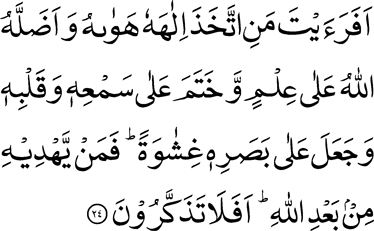
The Qur'an is for those who accept as axiomatic truth that God has sent forth scriptures and Prophets, who are assured of deeper realities(ft.3], and are consquently, the objects of guidance and success.
Those who elevate their wrong thinking are the ones responsible for chaos
[Q 2:6-10]
It is important to read words in their context, because context often provides the proper or intended meaning. Here is a perfect example. The words Innal ladheena Kafarooo are usually translated as "Indeed, those who are disbelievers". The term "disbeliever" does not capture the full reality of Kufr. In these regards, Kaafir as presented in the Qur'an is something different than Kaafir as expressed in popular culture or even in the writings of the Fuqahaa.
The word Kaafir has to do with rejection, with hiding or denying, and even is connected with ingratitude. It is a deeply nuanced word, as well as the words which stem from Kufr. Notice here that they [Alladheena Kafaroo] don't accept God's message because they are blinded to those realities!
They are blinded because of their actions. They are blinded and- as the verses suggest- destined for hell, because they have waged war on what is right. They are driven by ambition and hubris, usually filled with hatred and envy, and produce nothing but destruction upon whatever it is they possession of.
They may even pretend, out of political considerations, to be Muslims! They may have our names and terminology, but their hearts are not really with Islam.
In short, such folks don't accept that Ghayb exists. They seek only power, glory and wealth, and, even then, it seems they would not be satisfied.
Their self-awareness is non-existent. "They seek to deceive Allah, and those who have 'imaan', yet they deceive only themselves and realize it not." ( Q 2:9)
2:10 in particular seems to show us that because of their own internal conditions, which they themselves are largely for creating, only becomes worse as time goes on. God allows it to happen, not for ideological or "religious" reasons, but because of their destructive intentions and wrong thinking.
Characteristists of rejection
[Q 2:11-16]
These types not only have a theological rejection of Allah's guidance, they spread chaos while proclaiming their 'wonderful intentions'. The modern era has seen this repeatedly, and is known widely by terms such as "white man's burden". Invasions are staged in order to "spread democracy and freedom". Slavery was a wonderful institution because it "civilized Africans" or brought them to Christianity, etc.
These types have no self-awareness, they are arrogant, narcissistic, and view themselves as extremly clever. Sometimes they even pretend to be believers, and this actually seems to be a historical pattern. The Qur'an speaks of hypocrites in Prophet Muhammad's time, even in his presence (Q 63:1-3) proclaiming one thing and believing another.
They go whereever the wind of politics blow. They seemingly have no true or firm principles. They have devilish companionship (shayateenihim) and God promises that they don't get away with their evil deeds for long.
The sad thing is expressed in verses 16, 18 and 20 is that they had oppurtunities to be guided to God's light. They were exposed to it, they are exposed to it and to God's messenger, in this case Prophet Muhammad- The final Prophet- peace and blessings be upon him. Yet, they squander and continue to squander away those oppurtunities.
What should we get from these verses?
The first thing we should seek from these verses is to do serious introspection. Are we firm as to what we are to accept and what we are to reject as Muslims? While I do mean theologically, yet arguably more importantly in our perception of self and perception of life. Do we have proper thinking?
How are our characteristics? We should be working on the development of better characteristics.
One of the Prophet's supplications is "O Allah, I seek refuge with you from bad characteristics, deeds, passions and diseases"
اللهم جنبني منكرات الأخلاق و الاعمال و الاهواء والادواء
Another well known supplication from that era is "O Allah, show us truth as truth, and give us the ability to follow it, and show us falsehood as falsehood, and give us the ability to abstain therefrom"
للهم ارنا الحق حقاً و ارزقنا اتباعه وأرنا الباطل باطلاً وارزقنا اجتنابه
The characteristics of spreading destruction on a great and even global scale, arrogance, self-delusions and the like, are characteristics of those with spiritual diseases.
To put it another way, these verses have shown us that Kaafir as a Quranic term is synonymous with Mufsid [one who spreads destruction], Munaafiq [hypocrite], and a host of other negative attributes, and should not simply be read with the theologically loaded term "disbeliever".
If we have these diseases, we need to work on getting cure. If our surroundings, the people and environment around us, are filled with those with incorrect thinking and the propagators thereof, with toxic personalities and insincere elements, it is best to step back from such types.
"And when you see them, their exteriors please you. and when they speak, you listen to their speech, they are like pieces of wood, dressed up, reckoning that every call is against them. They are (in fact) your enemy, so avoid them..and when it is said to them 'come, God's Messenger will seek forgiveness/protection for you, they turn their heads, and you see them hindering (others from the path of Allah), and they are arrogant." ( Q 63:4-5)
Your peace of mind, conscious and sense of security, both physical and spiritual, are to take precedent. As believers we have to be conscious of these things and try as much as possible to stay as Muslims, conforming in mind, body and spirit, to the Qur'an and Sunnah.
May Allah protect us and may He guide us to do just that.
Footnotes
[1] One example of this is Soorah Yusuf. While telling us a story about the life of Joseph, it says that the story itself contains guidance for those who are seeking (12:7). In other words, there are morals and lessons behind the story, and not simply a narration of facts.
[2] This is not to say that nothing can be gained from reading a translation, or that someone understadning classical Arabic will get all there is to gain. There are a number of good translations of the Qur'an now available in English (and indeed, in many other tongues) and we encourage utilizing those resources. We are simply attempting to emphasis that the text in the original language contains much more than is able to be conveyed with a translation. The Quranic language in particular is very rich in meaning, nunances and subtleties.
[3] The text wa bil Aakhirati hum yuuqenoon. I have rendered "Al-Aakhirah" as "deeper realities" rather than "the hereafter" because [a] The hereafter belongs to the ghayb, which is already covered in the previous sentence, this is acknowledged universally by the Mufassireen. [b] In context, it suggests that Qur'anic emphasis on thinking properly and spiritual exercise allows the believer to see or judge beyond shallowness. In other words, Al-Aakirah here is speaking to the Baatini realities. This is more apparent in Q 30:7. There ( starting from 30:1 and ending with 30:10) it speaks of a quarrel between two superpowers, one seemingly defeated eternally, but it seemed so to those who judge on a superficial level. In 30:7, the word "Al-Aakhirah" clearly refers to those deeper realities, contrasting to superficialness.

