Showing posts with label tadabbur. Show all posts

Thursday, September 3, 2026

New Series: Life of the Prophet Muhammad (peace and blessings of Allah be upon him) lecture 1

 As salaamu 'alaikum! Below is a link to the 1st lecture in a  weekly series, hosted by Masjid As Sabur of Las Vegas, in which we are teaching the important details on the life of the Prophet Muhammad, Sall Allahu 'alayhi wa sallam .


It should be noted that around minute 7:50 of the recording, the presentation (which focuses on the first words of Quranic revelation received by the Prophet) has within it excerpts from our work "Engaging The Qur'an", which is available in hardback and E-book version. Information on that book is found below.


This series will take place every Wednesday after Maghrib prayers at Masjid As-Sabur of Las Vegas, Nevada. It will also be broadcast via Livestream and will be re-shared by my own Youtube channel. 

The link to the first session is found At this link 


Saturday, April 4, 2020

Can Judgement Day be mapped out?

In light of the current pandemic #Covid-19 sweeping the globe, the question about the end times keeps coming up in religious circles.

This Khutbah makes the argument that this is an issue that, while important as a doctrinal point, our focus is to be elsewhere.

We have made this  KHUTBAH available on YouTube as well as the mosque Facebook page. For the time being, our Friday sermons will be live-streamed every Friday at 1:00 P.M. (PST). Follow our page at https://www.facebook.com/TheMasjidIbrahim/ . 


The Khutbah video is below

From Facebook

If you are unable to view the Facebook, the same recording is available on YouTube.

Can Judgement day be mapped out (17 minute clip)

We recommend viewing from Facebook, as the YouTube recording is a bit short.

Discussion and feedback is always welcome.

Monday, September 11, 2017

Study Notes: Accepting God's will: Refections upon Soorah Al Hijr ( 15: 80-90)

( Note: The following is an edited version of my reflections on a handful of Quranic verses. Previously, we have looked at vv. 70-80, which can be found here . The English translation has not been included, unless otherwise stated. This allows the reader to consult the translation of their choice. The Arabic text has been included, and, as always, discussion is welcome.]


[ Q 15:80]

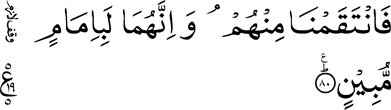
As found in the previous article, we have a brief gloss of the regions Madyan and Hijr. The famed Zamakhshari has suggested ( as quoted by Muhammad Asad) that "Messengers" is a reference to not only the Prophet Saaleh, but rather to his followers, suggesting that the followers of the Prophet Saaleh [and perhaps, by the followers of all Prophets] have a Prophetic mission themselves.


[ Q 15: 81-84]



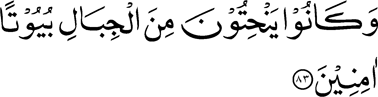
It is generally imagined that Prophets are figures speaking to primitive societies, however the words of the Qur'an point towards the opposite conclusion. We are talking about highly advanced, materially rich, cultures. We should also consider connecting these verses to the Sodom and Gommorah situation, in the sense that both had the same issues of moral decay.

Q 15:72 states that Sodom and Gomorrah existed in a drunken condition, blindly wandering. Now, in v.82, we see that these groups would ignore Allah's signs and exist "feeling secure" because their homes were built in seemingly solid places such as mountains. However, that did not save them!

This is a lesson that we in the developed world need to learn. As we compose these words, the USA is facing Hurricanes in our southern regions. Indeed, it has to be admitted that those of us living in the USA and in other highly developed nations perceive ourselves as largely immune to the disasters, both natural and man-made, that other societies face on a regular basis. The feeling of complacency, in the face of eventualities as well as in the face of social and moral injustices, can very well be the seeds that plant our eventual destruction.

We are not advocating a negative view on everything, only that we keep our eyes open, and our hearts firmly planted within Allah's guidance.


[Q 15:85]
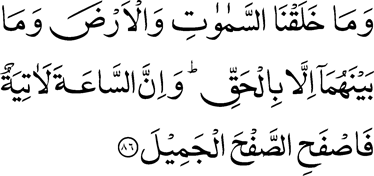
Haqq has a plethora of meanings and implications, here, it is best to render it as "Purpose". In another verse, Allah says "And We ( i.e. Allah) have not created the sky and the earth and what is between them for play" [Q 21:16].

The One who created the universe for Haqq, will, likewise, end it all in Haqq. The ending is the "hour" of Judgement. That day is also called The Last Day [Yawm Al Aakhir]. Because the beginning and ending all exists within God's purposes, we are told "So forgive with gracious forgiveness" (Saheeh International translation).

This last sentence in the verse is clear enough, yet Tafseer Al Jalalayn asserts that it is abrogated by "The verse of the sword", which reads, as translated by Saheeh International  : "And when the inviolable months have passed, then kill the polytheists whereever you find them and beseige them and sit in wait for them at every place of ambush.." ( Q 9:5)

We find this assertion to be unsupported by the context, moreover, the assertion is a violation of well known principles. Q 9:5 is clearly in a certain war context at a certain place and time. Indeed, all one really needs to do is read the contex [Starting from 9:1 and ending in 9:10]. In other words, verses regarding war are at a particular place and moment, specific to that, whereas the principle of graciousness, humility, forgiveness and kindness are general and timeless.

The general principle, when and where general situations are applicable, have nothing to do with war and fimness during periods of imposed conflict.

Throughout the Qur'an, we read statements such as "and when the ignorant address you, say "peace"" [Q 25:63].

Therefore, we cannot agree with the claim that this text has been abrogated. We question the entire basis for the claim that any verse of the Qur'an has been abrogated(ft.1)


[Q 15:86]



Al Khallaq means the ever-Creating. It is different from Al-Khaaliq {The Creator}. The former shows us that God is constantly at work in creating!

This is an important nuance because as scripture readers, we tend to think of Allah as only acting in the past, whereas the fact of the matter is is that Allah is still and will always be at work in the universe He runs.  The importance of Ayatul Kursiyy  ( Q 2:255) is highlighted in such a discussion. If God is simply a historical figure, a being who worked in the past, the presence of Ayatul Kursiyy in the Qur'an would be pointless, as would the numberous Prophetic traditions encouraging us to regularly recite that text!


[Q 15:87]
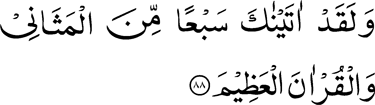


"Seven oft repeated" is universally understood to refer to Soorah Al-Faatihah. That chapter, the Qur'an's opening words, is recited several times daily in Muslim prayers.

It is signifigant to this writer that all Muslim demoninations without exception agree that Al-Faatihah is necessary for the daily prayers, even though there is no verse which directly says that one must recite it in the prayers.(Ft.2)


[ Q 15:88-90]
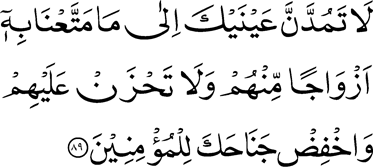


This is directed to Prophet Muhammad, upon whom be peace and blessings, moreso than anyone else. In essence, it says to him to never be tempted to give up your faith and the company of those sincere in their faith, because God has already given you so much. The material or worldly trappings in the hands of the disbelievers should not dissuade you.

Other Quranic texts tell the Prophet, Sall Allahu 'alayhi wa sallam, the same message. In particular, many of the texts in the Juz 'Amma section . I would recommend reading some of those Soorahs, such as Ad Duhaa ( chapter 93), Inshiraah ( chapter 94) and Al Kawthar (chapter 108).

Verse 90 is more difficult to grapple, and that difficulty is reflected in the different interpretations found in the books of Tafseer.

If connected with vv.91-92, the context seems to be a warning, just as warning is found in general in the story of Lot's people and the Madyan and Hijr above, to not pick and choose what one accepts of Divine Revelation.

The Qur'an states "..and those firmly grounded in knowledge assert 'We believe in it, all of what is from the presence of our Lord.." ( Q 3:7).

In today's world, we have trends which attempt to carve up the scripture, both figuratevly and literally. We have writers and lecturers, of Muslim family backround, asserting that Muhammad made up parts of the Qur'an in order to justify genocide and to have women!

We have "Muslims" who esentially reject what the Qur'an says on race relations, who attempt to use the Scripture to justify racism, hatred, misogny, and immoral behaviour.

The Qur'an can never have textual corruption (called Tahreef in the literature) but it can have distortions based upon a copy/paste approach. This is done by extremist groups all the time among Muslim ranks, but it is also done diverse groups as Islamophobes ( folks with an irrational fear of Islam and Muslims) and liberal voices in the Muslim community.

I think it is better for people to admit that they have weaknesses rather than to justify the unjustifiable in Islam. It would be more honest.

In any case, there are other interpretations of verse 90 [and the verses following it] that could be the correct understanding. For now, we share our views above and conclude with the reminder that at the end, only Allah knows best.


Conclusion

The world and life therein can be a confusing place. The diversity of personalities, cultures, egos and agendas can bring people to a state of loss, of feeling lost. The Qur'an comes along to help us on life's journey, but in order for it to really be effective, one must reflect on it in a continous manner, regularly studying it, reciting it, and acting upon it.

This should not be done in a superficial way, nor should it be dogmatic, in the sense that the text gets manipulated to suit our whims.

In our previous article, we looked at the story of Lot, how the people there were "wandering about blindly, in a drunken state". In this article here, we read how Allah says that another group felt that they were secure from any catastrophe because their homes were built within mountains.

We should consider taking the above sentiments further, not just in social analysis, but within our own circles or existence of life. Are we walking blindly or acting drunk in our lives and in our thinking? Are we oblivious to realities? Are we painting the doors while the house is on fire?

May Allah show us truth as truth, and give us the ability to follow it, and falsehood as falsehood, and give us the ability to abstain therefrom.


Footnotes

[1] For more on the question of abrogation [known as Naskh] go to this link .

[2] We have a number of Prophetic Ahadeeth which tell us that Al-Faatihah is to be included in prayers. All the groupings, despite their many theological and methodological differences, accept that Al-Faatihah is needed to be included in their prayers. The necessity for Al-Faatihah in worship is also accepted by most of those who reject Hadeeth as a source of Islamic understanding, known widely as Quranites or "Quran alone". Thus, one can find the writings and videos of Rashad Khalifa, one of the most well-known proponents of a hadeeth-free understanding of Islam, advocating that Al-Faatihah be recited in prayers.

Al-Faatihah is known as Umm Al Qur'an, the essence of the Qur'an. It is the perfect text for worship, and logically we should be able to see why the Prophet Muhammad said that any prayer in which that Soorah was not included was "Incomplete" ghayr Tamaam. The source of this hadeeth is Saheeh Muslim.

Monday, September 4, 2017

Study Notes: Soorah Al Hijr [ 15: 70-80]. The implications of the story of Lot [Luut عليه السلام]

[ Note: The following is an edited version of some reflections on ten verses from the Qur'an. Originally, these notes were prepared for a weekly Quranic discussion I participate in, however I have decided to share them here, with the hopes of generating discussion and thinking. Also please note that unless otherwise seen in the text, the English translation has not been included. This will influence the reader to check the translation of their choice. The Arabic text is included.]


Some backround

This particular section deals with the story of Prophet Lot, known as Luutعليه السلام  in Arabic. The immediate context preceding the verses in question tell us that Lot's own household contained contrasting elements therein, as do all families. While Lot is connected to Allah, his wife is counted as being among the 'criminal class' [15:58-60]. Eventually, God's angelic messengers conveys notice to Abrahamعليه السلام ,  Lot's uncle,  that Sodom and Gommorah will be destroyed. The Qur'an says elsewhere ( Q 7:80-81 among other places) that the society engaged in intimate activity that cannot be deemed natural .

This particular issue is a deeply sensitive and potentially divisive one in today's world. I think it is important to see all of this in connection to what is repeatedly stated in these verses, and that is the title "The Family of Lot " [Aal Luut]. Lot is the family patriarch, the caring, wise and loving father and perhaps grandfather that we all have in our family units, seeking to preserve the morals of those under his care. Lot recognizes that wild behavior is something which leads to disastorous consequences ( Q 15: 61-64).

Lot advocates that the thinking of his family and followers be upon correct or healthy boundaries. He tells them to neither long for the social ties with those engaged in destructive behavior, nor even be in their company. In our age, the wise parent may instruct his child to stay away from certain other children because of their behavior, and the same parent may put restrictions [or even remove] the television or the cell phone when such devices of entertainment are found to be detrimental to the oveall development of his child [15: 65-66].

The society, probably more in particular the elites in power [called Al Mala' throughout the Quranic narrations], had places restrictions on Lot. In a sense, he seemed to have been a character that they wanted to silence, to be under house arrest. Lot  has some "guests" [who are actually these angelic messengers mentioned earlier] . These guests were threatened with attack, and the text implies that they were even threatened with rape! Lot makes a final appeal to any Taqwaaa [reverence for God Almighty] as well as any sense of social propriety, but alas, his pleas fall upon deaf ears. [Q 15: 67-69]

But as we come to know, attempts to restrict or suppress the truth eventually come to naught! Truth cannot be defeated( 15:70) . The Qur'an says "And say: Truth has come, and falsehood vanishes. Indeed, falsehood is, by it's nature, a vanishing [thing]' [Q 17:81]

[15:71]


In his comments, the translator Yusuf Ali righly points out that this language is the language of a family patriarch, an older man trying to push atleast a little bit in a different direction.
Thus, "My daughters" are not literal, nor is he seeking to sacrifice the women in his society to be raped, as sometimes thought by some critical readers. Perhaps marriage between men and women was a dying institute, as it is in our society today, and sought, out of desperation, to revive it.

[15:72]


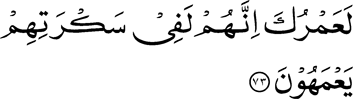
The social order of  Sodom and Gomorrah was blinding and intoxicating. The verse uses the term  لفي to denote the intensity of this condition. 

It is very difficult for those affected by such conditions to see the reality of their existence. 

Prophets and Scripture comes forth in order to open up the eyes and to have foundations for proper thinking. I see the Prophet Muhammad's   صلى الله عليه وسلم   supplication as particularly relevant here in the sense that one not only invokes Allah but it also provides a philosophical foundation for acting in the real world.


His prayer is "O Allah, show us truth as truth, and give us the ability to follow it, and show us falsehood [Baatil] as falsehood, and give us the ability to abstain therefrom." 

[ 15: 73-74]


Sayhah is also translated as "scream", and seems to denote a general overturning of the social order.


[15:75]


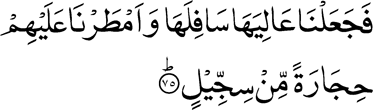
The translator Muhammad Asad, quoting Imam Razi and the famed grammarian and commentator Zamakhshari, points out in his note that Mutawassim means " One who applies his mind to the study of the outward appearance of a thing with the view to understand it's real nature and inner characterstics".

This is a deeply important verse here. When connected to 15:72, we can see that the argument is that a society of blinded, drunken (in their thinking and actions) human beings brings forth their own destruction. God says here that such societies should be studied, and this is precisely what social scientists, archaeologists, and related fields do. This also occurs with intelligent figures interested in the betterment of their own societies. One need only look at the libraries of such figures as Dr Martin Luther King, Jr and Malcolm X.  The latter, in his autobiography, mentions the many books he studied, they include histories, political theory, philiosophy, and more. 

The Qur'an is not a book that encourages blind faith. In fact, it points to the sciences, to certain fields and disciplines that would be deemed by many today as non religious! The guidance of God tells us that we should take lessons from the mistakes of past societies. It has been my observation that those who are deeply influenced by the Qur'an, personalities whom I know personally and others whom I have not interacted with, are people who are not limited to the Qur'an. Their interests are expansive, usually to include history, the physical world, science,  and the fate of civilizations. This does not mean that they all reach the same conclusions on all subjects, or that their conclusions are always correct. However, it does indicate that they are pondering deeply upon the words of Allah, which makes them look at the other important subjects. 

I would dare take this further to say that those who claim to study the Qur'an and yet have no interest in these [and other related] subjects, have in fact not studied the Qur'an properly! Perhaps a better way of saying that is that their "studies" are actually superficial at best. The need to study these other important fields is particularly acute in our Imams, scholars and speakers, especially the famous ones or those up and coming! 

There is no need for us to become like many who are referred to as Biblical fundamentalists, people who read and study only  the [translations of] Bible. Such reading may be a nice pious exercise, however the results can be very problematic, and we don't want to follow in the same mistakes.


[15: 76]


The location of Sodom and Gommorah is well known, as was known at the time of the revelation. God lets such remmants exist in order to be a lesson for future generations. Yet. today, at the site, it is not taken seriously. Indeed, it is now a swimming attraction today.


[15: 77]


Believers do take the warnings and signs of past civilizational failures seriously.

[15: 78-80] 


Madyan is in NorthWest Arabia, to whom a Prophet named Shu'ayb      عليه السلام   was sent.

Hijr is said to be between the Hijaz [Western Arabia, where Makkah and Madinah are located] and Syria. To them, a Prophet named Saaleh  عليه السلام         was sent forth.

Zamakhshari [as quoted by Muhammad Asad] suggests that the term "Messengers" here means Saaleh and his followers. This would suggest that the followers of Prophets likewise have a Prophetic mission.


These observations are not meant to be dogmatic, but rather to point out that the Quranic treatment of subjects are very nuanced. Indeed, even with the Sodom and Gomorrah story, we should be able to see that the prevalence of sexual relations outside of the norm is only a sympton of a deeper illness. We should also be able to see that the Qur'an advocates a serious study and search for solutions to the issues we face in today's world.

Wallaahu A'laam

Wa Billaahit Tawfeeq


Monday, September 19, 2016

Organized Spirituality: lessons from Abraham post-Eid

[ Note: The following is an edited version of a Friday Khutbah 9/16/16 at Toledo Masjid. The opening Hamd has been omitted, as has much of the Quranic and hadeeth quotes in Arabic.]


Building, not destroying

During the 'Eid ul Ad-haa, which just passed, our speakers usually focus on the willingness of Abraham [Ibrahim, 'alayhis salaam] to sacrifice his son because he saw that as being God's command. Indeed, the entire holiday centers around that premise.

However, there is yet another aspect we should ponder upon.

"And when Abraham raised the foundations of the House, and Ishmael as well [they prayed]: Our Lord, accept from us, surely, You are the All-Hearing, All-Knowing." [Q 2:127].

Abraham and his son [Ismaa'il, 'alayhis salaam] are associated here with building, and not destroying! They built [or re-built] the Ka'bah. That place is described as Baytul 'Ateeq or the ancient house, Baytun Naas which means the house for all people, and the Qur'an describes it as "a blessing and a guidance for all nations" [Q 3:96].

So Abraham and his son built something, and building something takes planning, thinking, mapping out appropriate strategies,

For a home, we have to plan our finances, and all of this takes time, patience. This is what Abraham [upon whom be peace] and his son did! This 'house' outlived them.

At every moment, thousands and often millions are circling the Ka'bah, reciting the Talbiyah, calling upon Allah, often in the very words used by Abraham himself "Our Lord, accept from us, Surely, You are the All-Hearing, All-Knowing."Rabbana Taqqabbal Minna, Innaka Antas Samee'ul 'Aleem.

So being organized and strategic in our religious priorities, indeed within all aspects of our lives, is arguably the most important lesson for us to take.

Going for job interview requires having prepared a resume', appropriate clothes and language.

So what about prayer [Du'aa]? When you make du'aa, you should think about who and what to make du'aa for.Ahadeeth. Take lessons from Soorah al Faatihah and from the other obligatory aspects of the Salaah as to what or who we should pray for. When we offer salaah, particularly alone, think about the meanings of what is to be recited.
Take some lessons from the supplications present in the Qur'an and Sunnah.

What can we do or how can we benefit in our lives from what we are to recite in prayer, and how can we build upon that to create something wonderful and lasting as Abraham did?

The Ka'bah and Abraham's station

About the Ka'bah, Allah says "In it are clear signs and Abraham's station." [Q 3:96]. This teaches us that the Ka'bah is a blessed symbol and is itself a testimony to Abraham's position [Maqaam Ibrahim] with Allah. It is a symbol or a goal we can work to, and the important term here is "work". Work wisely, work sincerely, for Allah, not for ego or fame or wealth. To go against the philosophy of Abraham is actually to show foolishness [Q 3:109]. May Allah accept from us.


The Ka'bah as Qiblah and at Hajj

The great symbol called the Ka'bah becomes the focus during Hajj. In addition to this, it is the Qiblah, the direction we are to face during worship.

Allah says to the Prophet: " We [Allah] see you [O Muhammad] turning your face to the sky,,," [Q 2:144].

Before the revelation of the above statement, it is said that the Qiblah faced by the Muslims was that which was associated with the Prophets of old, i.e. Jerusalem. Here, we are told the Prophet [Sall Allahu 'alayhi wa sallam] was facing the sky. The exact meaning of this is a debated point among the Mufassiroon.

Let us consider this as a possible meaning: after years of persecution in Makkah itself [the enemy capital] - The Prophet is now in stable Madinah, and he sees the need to become better focused, to be oriented correctly and to be organized spiritually.
God answers that concern by directing him not towards the sky, but rather to that symbol constructed by the great Patriarch, Abraham. 

So the Ka'bah is our Qiblah because it focuses us. It's very existence encourages us to build, to build or to fortify our hearts, to fill our minds with useful information, to build in this world, to add, not to destroy!

The Prophet Muhammad [upon whom be peace and blessings] said that if you see the world ending around you while your planting a tree, continue to plant that tree!

So let us be intelligent in our lives, and intelligent in our Islam. Let us be like Abraham, willing to  obey Allah even in the most difficult of circumstances.

Tuesday, September 6, 2016

Qur'an: serious business for believers and a challenge to those who reject [part two] Q 11:13-20

[ Note: The following is a continuation of some reflections on the eleventh chapter of the Qur'an, beginning here from verse 13 and ending with 20. For part one see http://shamsuddinwaheed.blogspot.com/2016/09/quran-serious-business-for-believers.html]

[Q 11:13] As previously noted, the nature of the Qur'an is so sublime that none can match it or overtake it. There have been attempts ever since the Quranic revelation came to answer its challenges but all have failed to gain any traction. Indeed, the Quranic revelation is the foundation upon which Arabic language sciences formed and flourished. One Arabic Christian poet write:

" I drank from the Nile [river] water, the Shaykh of rivers, it is comparable to tasting the water of Paradise [Maa al Kawthar], a river blessed since ancient times that is [still] sweet, however, it is not comparable to the water of my country." [Eliya Abu al Maadi] [Ft.#1]

The language and style of the poet's composition is clearly Quranic, but also it's motifs. Al Kawthar is a chapter title of the Qur'an, and the traditions say that it is the name of a pond in Paradise, that Prophet Muhammad himself offers such drink from it, that those who drink it will never be thirsty again.[ft.2]

In any case, here- as elsewhere- the Qur'an confidently proclaims that if the opponents can produce something like it [in order to prove that Qur'an is not from Allah], go ahead and try.

In recent years there has been a couple of attempts to answer the Quranic challenge by missionaries. They published a particular book, in Arabic, however they have attempted to market it in the Non Arabic speaking Muslim world.

Why have they done that? Because there is obviously a language gap which they try to take advantage of. However even then, the work, called Al Kitaab al Furqaan, is rightly and widely seen as a foolish production which takes some Islamic  sentences , mixes it up with insulting insinuations and awkwardly composed arguments.[ft.3]

The Qur'an, sent to an illiterate society, memorized and recited daily by millions, stands the tests of time.

[14-15] They have challenged the Qur'an because they seek worldly benefit. In another ayah, we read of such people when Allah says "Do you make your wealth by lying about it?" [Q 56:79]. Their challenge will take them no where.

[16] Except, of course, Hell.

[17] Qur'an is serious business. It is not a game. It is a guidance for those with Taqwaaa, and to play with it is to invite trouble.

[18-20] Those who play with the Qur'an and with the Divine message are not the average Joe-Blow walking down the street. Rather, they are the powers that be, forces that have financial and political interests.

It is important to note that when the Qur'an uses terms such as Kufr, they are synonymous with oppression, the usurpation of the rights of others, with having a destructive mindset.


Conclusion

The historical accounts, the morals, and the emphatic aspects of the Qur'an need to be examined, particularly in today's world. The Quranic discourse needs to be a force of influence, calling us to God and to being able to properly identify what is wholesome and what is it's opposite.

Don't take our word for it. Have a look at it for yourself. Think about what you read, and do so deeply. This Book only benefits those who have a healthy or a sincere mindset. It is for the hard worker, not the intellectually lazy.

[Ft.1] The Arabic text of this quotation is given here.

و شربت ما ء النيل شيخ الانهر فكانني قد ذقت ماء الكوثر نهر .تبارك من قديم العصر عذب ، و ولكن لا كماء بلادي ( ايليا ابو الماضي )


[Ft.2] For more on Soorat al Kawthar, see http://shamsuddinwaheed.blogspot.com/2008/04/al-kauthar-legacy-of-prophet_03.html [Al Kauthar: Legacy of the Prophet].

[3] The Furqaan work was allegedly written by two anonymous writers and 'translated' by Anis Shoroosh. The latter, a Christian of Palestinian extraction, has for many years engaged in polemics with Muslims, the most famous examples being his debates with the late Ahmed Deedat and Dr. Shabbir Ally of Canada. In recent years he has lost credibility in Evangelical circles, least of all due to an arrest for fraud and arson in Florida in 2008.


 .    

Saturday, June 25, 2016

Forgiveness of Ramadan: Reflections on the second part of the fasting month


[Note: The following is an edited version of the Friday Khutbah at Toledo Masjid Al-Islam on July 17th, 2016 at Toledo Masjid Al-Islam. The opening Hamd has been omitted.]

Ramadan quickly ending

As hard as it is to imagine, we are nearly half-way finished with Ramadan. There is a hadeeth of the Prophet, in which he divides the month into three parts, each part consisting of ten days. The first ten days are mercy, the second forgiveness, and the third emancipation from Hell-fire. The initial entry into Ramadan itself, for a believer, is in itself a mercy from God. The second part [forgiveness] is where we want to focus. All religions teach their adherents to seek out Allah's forgiveness, and indeed, the Qur'an and the Sunnah are filled with such pleas. Another approach to take in this regards  is ourselves being forgiving towards each other.

This is also found throughout the Qur'an, Ahadeeth, and the teachings of other faith traditions. Thus, while Ramadan is certainly a personal journey, it is experienced in a wide community of fellow travelers. The travelers all share a bus, a train or an airplane, but upon leaving that mode of transport will go to different places and varied interests.

Forgiveness of others is important because holding onto anger, bitterness and resentfulness can be quite damaging. Most importantly, these things can become ever-consuming and limits spiritual growth, even if knowledge is present.

Look at the Prophet Muhammad, Sall Allahu 'alayhi wa sallam. He entered Makkah, the enemy capital, after years of persecution, war, slander, assassination attempts and the murder of his family members and followers. One would imagine that he would at least have some individuals executed. However, he declared an amnesty, one which even extended to those responsible for the death and mutilation of his uncle, Hamza. The Prophet did not hold on to that bitterness.

How can we apply this Sunnah today? It's easy to apply the Sunnah associated with things such as dress and beard, and even the Sunan associated with worship, but how can we repeat the actions of the Prophet here? By avoiding being overly judgemental, critical and argumentative. Be more accepting, forgiving and tolerant.

Self-Forgiveness

Another aspect worth exploring is self-forgiveness. We can be very hard on ourselves. Well, we all have baggage in life, and the past cannot be changed.  We can only hope to do better in the future.

Many of us take a very wrong approach. We declare ourselves absolved of sins and dedicate ourselves to be judges over other people's sins and issues. Yet we have to look at the Prophet's statement. He says : "Among the pleasant aspects of Islam is to leave that which has no meaning for him.


This is shorthand for the American expression "mind your own business". This is not simply for protecting an individual's right to privacy, even though we admit that such teaching is found throughout the Qur'an and Sunnah [ Soorat an Noor and Soorat al Hujuraat for example] , it is a teaching useful for our own spiritual state. We need to address our own issues and conditions. May this month be a period wherein we can accomplish that.

Demons are locked away yet their mouths are still at work

The demons [Shayateen], we are told, are locked up in the month of Ramadan.  While it is understood that their bodies are locked up, yet their voices are still heard.  Indeed, Allah says in the Qur'an that the Kuffar seek to blow out God's light with their mouths.

So this Ramadan, we have to recognize that there are voices out there who seek to call us, distract us away from Allah, from self-reflection and improvement. They want us to be stagnant, weak and always on the defensive. The strong among us will only be slightly affected by these voices. There are those among us who are affected in a great way by these voices, and these are the weak among us. If we are affected, we have to ask why, we have to ask where our weaknesses are. Ramadan should be the time when we are asking these tough questions. We need more prayer, more reflection [Tadabbur] on the Qur'anic verses. We need to be serious in finding the spiritual truths that are relevant to us, and learn to act upon those truths, as taught by the Prophet [peace and blessings be upon him]


Speaking without knowledge

Many people today speak on subjects without having even an elementary knowledge of that subject. Among them are the majority of our media pundits and politicians. Speaking without knowledge is very dangerous. Thus, the Qur'an repeatedly says "And do not speak about Allah what you do not know" as well as "So ask the people of knowledge if you don't know."


If we really don't know, there is no shame in being silent or asking those who do have information on that subject. We live in a culture that asserts that all opinions are equal and valued, but this is simply a Cultural lie!

We cannot take scientific opinions from a factory worker, simply because they have not studied or mastered this branch of knowledge. Common sense would tell us that we would trust a scientist when teaching on his field, rather than someone who has not taken the time to even a minimum of information. Let this Ramadan be a time of the removal of all self-delusions, when we can become, by hard work, a people that deserve Allah's paradise.