In light of the current pandemic #Covid-19 sweeping the globe, the question about the end times keeps coming up in religious circles.
This Khutbah makes the argument that this is an issue that, while important as a doctrinal point, our focus is to be elsewhere.
We have made this KHUTBAH available on YouTube as well as the mosque Facebook page. For the time being, our Friday sermons will be live-streamed every Friday at 1:00 P.M. (PST). Follow our page at https://www.facebook.com/TheMasjidIbrahim/ .
The Khutbah video is below
From Facebook
If you are unable to view the Facebook, the same recording is available on YouTube.
Can Judgement day be mapped out (17 minute clip)
We recommend viewing from Facebook, as the YouTube recording is a bit short.
Discussion and feedback is always welcome.
Showing posts with label judgement day. Show all posts
Showing posts with label judgement day. Show all posts
Saturday, April 4, 2020

Friday, March 20, 2020
On the Wings of Angels: Reflections on Hadeeth Jibril
The following is a link to our March 2020 Hadeeth session, in which the famed narration known as "Hadeeth Jibril" is explored. The topics of Islam, Imaan (confidence), Ihsaan and the hour is explored.
There is also a robust Q and A.
On the Wings of Angels March 2020
There is also a robust Q and A.
On the Wings of Angels March 2020
Tuesday, July 2, 2019
Cultivation Of The Garden: An Islamic View
Note: The following is a video of our Friday Khutbah (sermon) which mainly deals with the implications of three Quranic supplications, as well as gives an explanation of the concepts of Paradise and Hell as being both initially created and experienced in this life by our own hands.
Comments are welcome.
CULTIVATION OF THE GARDEN: AN ISLAMIC PERSPECTIVE
Comments are welcome.
CULTIVATION OF THE GARDEN: AN ISLAMIC PERSPECTIVE
Tuesday, February 27, 2018
Being Successful In Life: A Quranic Perspective
Introduction
Today's world has largely accepted the notion that ''success" is determined by the amount of items and cash one has been able to acquire. In fact, most institutions of learning, sciences, and social building are built upon this premise. This has also infiltrated the realm of religion, the most relevant example being within the Christian community, which has a theological movement therein known as The Gospel Of Prosperity. (#1)
These assertions are not meant to convey an idea that mankind needs to become wandering ascetics, in the tradition of Buddhist monks in Thailand and other places. Indeed, if anything, the Qur'an teaches us a balanced perspective when it comes to the acquisition of material comforts. We need only quote two Quranic references:
"Say: Who has eternally forbidden (Harrama) God's pleasant (things) which He has produced for his servants, as well as that which is wholesome from His (own) provision? Say: They are for those who believe, in this life, as well as [being manifested ] specially on the Day of Resurrection. Thus, We (Allah) explain signs to a people of knowledge." ( Q 7:32)
Our Lord! Give on us that which is pleasant in this life, as well as that which is pleasant in the after-life, and protect us from the punishment of the fire ( Q 2:201).
The latter is a supplication (du'aa) to be made, invoking Allah. It also provides us with evidence of a balanced worldview advocated by Islamic teachings.
What constitutes success?
The Qur'an is very clear that there is this life as well as the life to come. They are related and- in a sense- codependent upon each other, and that connection can often create some misunderstandings in terms of how we approach and understand the Qur'an. One particular Soorah which is the victim of this is Soorah Al Qaari'ah [Chapter 101].
It does talk about the Judgement day, as does chapters which are in the same general location in the Quranic codex. Yet it also speaks of something else entirely, related yet different from the afterlife and from the day of Judgement.
Repeatedly, the Qur'an tells us of scales, by which actions will be weighed on the day of Judgement. However, it is also has impact here in this very life. Carefully read the following verses from Soorah Al-Qaari'ah.
"Therefore, those whose scale is heavy, for him is a happy existence" ( Q 101:6-7).


We understand that these scales are to be heavy with worship, charity and fasting, but we also should understand that the scales should be heavy with positive and productive initiatives. We are talking beyond simply political and economic power, rather, we are talking about things such as the cultivation of good character, deeds, knowledge, understanding, compassion and trustworthiness.
The only way the scale can be heavy is when these acts of cultivation are done on a regular basis. Allah says here in these verses that such who engage in this will be blessed with a sense of satisfaction in this life, as well as to be expected in the life to come.
This is summarized elsewhere in the Qur'an as "Alas, in the remembrance of Allah, hearts find contentment" ( Q 13:28).
In other words, recalling God's blessings to you, as well as his own attributes- in the here and now can bring forth the benefit of a happy life in the hear and now. That awareness and understanding translates practically in the cultivation of good personal ethics, actions and ultimately satisfaction.
Success's opposite
"And those whose scales are light, then his 'refuge' is whims " ( Q 101:8-9).These two verses have to be read alongside vv.6-7 as mentioned above. These verses here show us that satisfaction has not been achieved by such folks. They are discontented, so they seek to attain contentment/happiness by making their goal or their refuge in whims. This is captured very well in the expression Fa-Ummuhu Haawiyah.(#2)

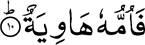
Haawiya is from Hawaa, which means whims, lusts, and the like. In other words, it is speaking to the narcissistic personalities, people whose only goals are the satisfaction of their egos [an eternal hunger, which is actually never satisfied] and the trappings of materialism and all that glitters.
"And what will teach you about [the reality of ] whims? It is [actually] a blazing fire" ( Q 101:10-11)
While it is clear that an afterlife exists, which has categories we know of as paradise ( Jannah) and Hell (Jahannam), it should also be clear that the foundations of that are manifested here in this life. The personality whose focus is only on ego and control is never secure. That personality hates and actually is likewise hated by others, yet does not care. That personality attains power and yields it in with destructive results.
The Qur'an phrases it in this fashion:
"Have you not observed the one who takes his whims [Hawaahu] as his object of worship? God has made such most astray, upon His own knowledge ( of that character's inner realities) placed a seal on his hearing, heart, and has veiled his vision..." ( Q 45:23).
In short, success is happiness, doing good, positive attitudes and inner-cultivation. If we can remember that and work on that, we will naturally fall out of the orbit of those who don't have that same interest, and, thus, be protected from their harm.
If we see the qualities of the hell-bound in our own thinking and actions, that should inspire us to BE BETTER, to aspire to change.
That can happen, with God's help as well as our own efforts ( Q 13: 11)
Endnotes
[1] The Gospel Of Prosperity is essentially a movement within American Christianity which places emphasis on material things as evidence that God has blessed you. This writer recalls attending a panel discussion at a University, in which a Pastor who follows this ideology spoke against charity! The historical development of this concept is too complex to explain in a footnote, but it is important to know that many of the famous Televangelists adhere to this thinking. For a summary of the historical development of this trend, see https://www.thegospelcoalition.org/article/prosperity-gospel-born-in-the-usa/.
[2] "Umm" can mean "mother", "source" as well as "refuge". In other words, here the Qur'an is telling us that the whole goal of those seemingly hell-bound is their Hawaa. The phraseology in Arabic is very profound, and admittedly I find it difficult to translate the same feeling into written English.
Wednesday, June 7, 2017
Are Muslims going crazy? An attempt to make sense of recent events
The last two weeks, despite it being the month of Ramadan, a time of prayer, fasting, introspection and charity, it seems that the Muslims worldwide has been set afire! The car and knife attacks in London last week are well known, as well as an incident in which a young man attacked a police officer in Paris, but also we have had the same sort of incidents in places within the Muslim world, such as Kabul, and today we are witnessing the aftermath of attacks on the Iranian Parliament and the shrine of Ayatullah Ruhullah Khomeini.
 The London attack brought to my mind nothing from Muslim history, or even civilization memories of long ago, but rather, a television show produced by FOX. Called simply THE FOLLOWING, it depicts a serial killer named Joe Carrol, a former university professor who focuses on classical literature [in particular the writings of Edgar Allen Poe] who manages, even after his initial capture, to gather, via the internet, numerous followers, hailing from diverse racial and economic backrounds. Throughout the series, any and all excuse was given to fulfill the bloodlust of this figure, and, of course, the series had also exposed in their story line different sets of villains, motivations, organizations, plots and twists.Copy cat killers and desperate personalities seeking fame and glory, as well as political intrigue, also played their parts. ISIS and its likes are precisely the same way, and it would not come as a surprise to this writer that ISIS members are found to have viewed this program and programs like it on a regular basis.
Is it really Islam which motivates killing sprees?
It's important to understand that anyone can make just about any claim as to their own motivations. The French writer Gabriel Meurier aptly observes: " He who excuses himself, accuses himself."
The human mind has great abilities to both see the truth and to hide it, to explain away and to justify, to rationalize bad decisions. Moreover, as individuals we are extremely complex, full of paradoxes which we are not always able to understand ourselves or to be adequately understood by others.
As a person who has been studying these subjects for many years, it is my view that it is wrong to simply say "Islam is the cause". The cause[s] vary from place to place and person to person. I think such actions, when taking place in clearly defined war contexts or on the battlefield, is universally understood, even if disliked by some and approved of by others.
However, how does that work in London, Paris, Orlando, and let us not forget, Charleston, South Carolina [where Dylann Roof shot to death nine people in an African American Church in the hopes of starting a race war]?
In those cases, one cannot simply look at the religion, race or even class of the perpetrator. One can and should look at his stated motivations, but also at what is hidden, what is behind the image. That is mainly the job of sociologists, psychologists and those in similar fields.
What does Islam say about violence?
The first source is, of course, The Qur'an, the Islamic scripture. It is seen as God's word and no other source is seen as superior to it. In it, we read a very long list of basic principles, similar to what Christians call the Ten Commandments (ft.1), and among the directives, we have "And do not kill the soul, which God has eternally forbidden [Harrama], except in justice. And whoso is killed unjustly, God has given his heirs authority, [yet even then], so do not be excessive in the retribution, as he [the heir] is assisted [legally]" [Q 17: 33]
In other words, killing is seen as forbidden, and if and when it does happen, from the perspective of Islamic laws, the family of the victim has the right to demand capital punishment, to have financial compensation. Moreover, when capital punishment is applied or sought after, it is not to become a free for all. This is particularly important in feudalistic societies, where cycles of revenge taking can last generations.
The above Quranic command is also alluded to in 2:178. There, it clearly states that regardless of the status of the victim or the killer, capital punishment remains an option if that is what the victim's family demands. It is worthy of emphasis that the victim's family has more say on the matter than the state in normative Islamic jurisprudence.
In another place within the scripture the principle has been given that is well known to the Judeo-Christian tradition, "...Whosoever kills a soul..it is like he has killed all of mankind, and if he saves a life, it is as if he has saved all of mankind." [Q 5:32].
In the same verse, as well as in 5:33, we have rather severe options given to deal with murder, as well as creating social chaos in general.
What about Jihad?
The term Jihad simply refers to struggle, and can be used in war and non war contexts. While we don't dispute that it has been used in war contexts, it is worth noting that Jihad as a war cannot be simply launched by anyone. Killing random people on the streets, innocents who have nothing to do with anything, cannot be justified in the name of Islam. Indeed, it seems to us that such actions fall under what is mentioned as "chaos" in 5:33, bringing forth a potential severe punishment from the authorities.
It is clear that the brains behind the acts in Paris, London, Kabul, Egypt, Syria, and other places have in mind spreading chaos. They want people to be afraid. They also seem to want Muslim minorities in Western nations to be in a state of fear, to be viewed with suspicion by the wider society.
It does not matter the religious or ethnic identity of the masterminds, I have no qualms in calling them out as evil, as people who are far away from religion, as folks who are master manipulators with desires for greatness, who serve their own egos rather than serving Allah, the Lord of creation.
Suicide bombings/attacks

This has been almost universally condemned in the Muslim world by Muslim scholars. Countless books, pamphlets, articles, position papers and speeches have been composed by scholars within every sect and orientation within Islam on this subject. In the modern age it is said that the ones who started this particular tactic was not Muslims, but rather Tamil Tiger rebels on the Indian subcontinent. Later, it was picked up by Muslim groups of various places and persuasions, in places such as Lebanon and Palestine.
In legitimate war contexts, all kinds of things can and do happen. Indeed, in the USA and other places we have what are called war movies, either fictionalized or depictions of real historical battles, in which soldiers sacrifice their lives.
Whatever one thinks of this, this is still not the same as what we are continually witnessing. Suicide bombings on Christian Church services in Egypt, or suicide attacks on Shiite worshipers offering prayers in Pakistani mosques, or at nightclubs and the like.
The Qur'an says "and do not take your own hands as to bring forth [your own] destruction.." (Q 2:195].
An even more clear sentence in the scripture says "And do not kill yourselves." [Q 4:29].
So if both murder and suicide have been condemned in the Qur'an, how about killing one's own self along with innocent others? The answer should be obvious, it is not allowed!
Looking at all of this from the perspective of belief in the texts of Islam
The hadeeth literature, texts which tell of of reports emanating from the Prophet Muhammad, relate to us that the Prophet, upon whom be Allah's peace and blessings, gave several signs as indicators of the coming day of Judgement. It is a day that, the Qur'an says, none should have any doubt about its eventual arrival [ Q 3: 9]. We have discussed many of them in the past (ft.2), but one of them is the emergence of what is called Maseeh id Dajjal, or simply"Dajjal".
Al Maseeh Ad Dajjal is translated usually as "The False Christ" or simply "Anti-Christ". The issues surrounding eschatology are complicated and highly debated, and while others focus on a particular personality to fit the description, this writer looks at it from the term Dajjal. In everyday Arabic, it is used for deceiver, and is often associated with a tyrannical ruler.
In other words, one of the signs of the age close to the Day of Judgement is that great deceptions will take place. Guidance will be lost, not just in religious affairs, but in the social and political arena. People, often damaged by the vices and soul crushing aspects of the modern world, will look for peace and meaning in all the wrong places. Another hadeeth words the situation as "Knowledge will be of low account, ignorance will be abundant" [Yaqillul 'ilmu, wa yaktharul Jahl]. Indeed, we even have a hadeeth which reports the Prophet as saying that killing would be so abundant that neither the killer nor the victim will understand why it is happening!
Dajjalic influences are not simply felt on Non Muslims! It is universally felt. The deceivers fool everyone in different ways and at different areas. The hadeeth literature speaks on social upheavals as well as violent confrontation between groups of powerful entities. The evil influences are widespread, so that today people can kill in the name of religion and in the name of race/ nation alike, as we saw recently with Jeremy Joseph Christian, in Portland, Oregon, expressed pride in killing two men who had come to the defense of Muslim women.(ft.3)
So what can do, if this is the age of great deception
A comprehensive answer cannot be given in this brief composition. The suggestions we have largely come from Islamic teachings themselves, but also from my own views, hopefully shaped in a correct way by Islam itself. These tips are also useful for Non Muslim readers.
[1] Be consistent in prayer: Strive to connect to God in a regular way and on a regular basis.
[2] Be studious: In this age, it is needed to stay informed and educated. Dedicate a part of your budget to the purchase of books [and not simply websites and news channels] on important social, economic and political subjects. If possible, learn another language in addition to your own native tongue. Don't be afraid to stand corrected on a topic you were previously misinformed on.
[3] Have good company and family ties: Spend time outside with your family, seek out mates and company of decent people.
[4] Avoid intoxicants and obsessions with vices: Weaknesses can be easily exploited and themselves be the foundation of becoming a victim.
[5] Be willing to travel: for your own health and sanity, it may become necessary to not only travel, but to move to another place.
This is by no means comprehensive, but nonetheless a good place to start.(ft.4)
Footnotes
[1] Robert Alter, in his Bible commentary and translation The Five Books of Moses ( 2004, New York, W.W. Norton & Company] gives a brief summary of the ten commandments not actually, in the original text, adding up to that number. Nonetheless, it has become a great part of Western thinking and legal foundations.
[2] Among the places we have addressed Judgement day, see "Considering the day of Judgement" at [url] http://shamsuddinwaheed.blogspot.com/2017/02/considering-day-of-judgement-is-it-close.html[/url] , "Judgement day: lessons from the Qur'an and Sunnah" [url] http://shamsuddinwaheed.blogspot.com/2017/04/judgement-day-lessons-from-quran-and.html[/url] and "Signs of Judgement day" at [url] https://www.youtube.com/watch?v=PMMq_mmjUXY[/url].
[3] On a Portland train, Christian was yelling at two women, one of whom was a Muslim. Three men came to the defense of the young ladies, and Christian reacted by repeatedly stabbing all three, two of whom died. Unfortunately, this event, which happened in May, has yet to get the wide attention that it deserves. In court, Christian yelled out, in part, "This is America, get out if you don't like free speech.". A little more information can be found at [url] http://www.independent.co.uk/news/world/americas/portland-us-murder-train-islamophobic-ramadan-racist-extremist-hate-crime-a7771231.html[/url]
[4] I am compelled here to mention that we must be careful in accepting claims at first glance. That is not only common sense, but it is a Quranic command [Q 49:6]. Many writers associate great deceptions with everything from terms such as the Illuminati to victims brainwashed to do certain actions in a Manchurian Candidate style event. We simply don't know which, if any, of those particular scenarios apply to the overall issues under discussion. We should simply exercise caution in accepting as truth anything that is presented to us, regardless of the source.
Wednesday, April 12, 2017
Judgement Day: Lessons From The Qur'an And Sunnah
( Note: The following is an edited version of our recent presentation at Toledo Masjid Al-Islam.)
Qiyaamah; a reality

The Day of Judgement is a frequent object of attention in the Qur'an, even a cursory glance at the text will reveal to the reader it's repeated appearance. One of the texts we find is "Our Lord, Indeed, You will gather people together on a day of which exists no doubt. Indeed, Allah does not fail in his promise." [Q 3:9]. Thus, a person claiming to be a Muslim must accept this core Quranic teaching.
Signs that precede Judgement day
The Qur'an does give some indicators, however it's focus is moreso on the event itself. Prophet Muhammad, Sall Allahu 'alayhi wa sallam, in one hadeeth does give us the following signs:
[1] We can understand this as higher education, out of reach for all but those at a social and financial status.
[2] The disappearance of authentic information, both religious and Non-religious, in that truth no longer matters.
[3] The rise of ignorance in both facts and in action. This can also refer to the ignorance as inspired by youthful attitudes, the rise of a culture that caters to the whims and wishes of the young, devoid of mature consideration. We also see this within the religious realm, in that people speak on Islam with no knowledge of what they are speaking on. We live in an age where ignorance is deemed praiseworthy and education is seen as, at best, odd, and, at worse, dangerous.
[4] Zinaa: Marriage will be seen, in the final age, as a pointless institution. This is increasinglty a global situation, [5] Khamr: This is not simply beer and wine, alcoholic drinks, but narcotics. Marijuana is socially and increasingly becoming legally acceptable.
The hadeeth highlights these things, and while other Prophetic narrations highlight other things, some of which are debated in terms of their strength and veracity, we are to seek lessons from the narration at hand,
Lessons
[1] Stay informed, particularly in Deeni affairs. We have to be connected to the Book of Allah, to Allah himself through righteous conduct. As the Qur'an says "Deen is to be specifically for Allah." [ Q 39:3]. A part of this is to recognize our status, to stay quiet, rather than speak, on issues that we have no knowledge of, The Qur'an says " So ask those who have knowledge, if you don't know." ( Q 16:43, 21:7). Having enough humility to be able to seek out knowledge from knowledgeable persons, as opposed to the do-it-yourself approach.
We have yet another hadeeth in which the Prophet said that in that age, close to thirty decievers will emerge claiming divine guidance, claiming to speak on behalf of God.(ft.1)
Such decievers [Dajjaloon] only gain traction in an environment devoid of knowledge and filled with ignorance.
The lesson here is particularly important with the Qur'an and the Prophet's Sunnah, in his manner of connecting with Allah.
[2] In the same hadeeth we have a statement that in that age "Women will be abundant, and men will be minimized" . It is our view that this does not simply refer to population, but rather, to a world where men are constantly under attack, where the responsibility of fathers will be taken away, be it in the name of fighting crime or of feminism. This is a widely held observation of the social condition of African Americans (ft.2). So the lesson is that men have to take responsibility, particularly as fathers, and not fall into the traps out there that seek to prevent this,
[3] Khamr, intoxicating agents, be it alcoholic drinks or recreational drugs, must be totally avoided, because these items cloud the rational thinking. We are to be awake, and not sleep-walk through life.
The Qur'an on the Day of Judgement itself
On that day, the bodily appendiges themselves will be made to testify ( Q 24:24, 36:63-65 among other verses) . It will be a day which will be initiated with a deafening noise, making people totally self-concerned. A frightening moment indeed [Q 80:33-37].
It is on that day that the veils are finally removed from the eyes of those who had rejected (Q 50:22). It is also the day that religious disputed will be solved or addressed directly by God ( Q 35:14 among other places). It is a day that records of one's life are actually read out, it is the day that the verdicts are announced.
While the Qur'an is very detailed on what happens on that day itself, we have yet another hadeeth (reported in Tirmidhee) which summarizes it all in which the Prophet said that a person will be questioned on how their time as a youth was spent, how they earned and disposed of their wealth, and how they acted upon the knowledge they possessed.
In addition to this, we have another well-known hadeeth, in which the Prophet [peace and blessings be on him] said that very first thing a person will be questioned about is worship ( Tirmidhee).
This hadeeth gives us a clue, it indicates that a life in which even the weak person, with all of his sins and imperfections, still sought out God, it is that seeking out that will be a source of salvation. So the more worship we do, the more aligned to Allah we become.
Predicting The Day Of Judgement
This is a situation more common with Christians than with Muslims(ft.3), an ironic reality because the Bible has Jesus say that God alone knows when it will happen [Mark 13:32]. The added aspect to this is an attempt to "move along" or to force God's hand (ft.4).
The Qur'an addresses this
This shows us that such people are guilty of shirk, because they have attempted to make God a push-over, a being that can be manipulated for their own interests. Allah's schedule is His own, how He sets about his business is his own affair. Our reasoning cannot go against the Divine Sunnah.
Protection from Dajjal
The hadeeth literature tells us that the Dajjal [deceiver] will gain near global domination in that age close to the Day of Judgement. Remember that Dajjal means "consistent deceiver". The text gives a description of that figure, but we should remember that this term is also a general concept.
The evidence for this is the already mentioned narration that close to thirty lying dajjals (dajjaloon kadhdhaboon qareebun min thalatheen) would emerge.
We are told in atleast two narrations that Soorah Al Kahf, the 18th chapter of the Qur'an, would serve as protection from Dajjal. This shows us that the power of Dajjal will simply be that of influence, suggestion and mental manipulation, and that such influence is countered by getting spiritually prepared for Qiyaamah, by being grounded in the Book of Allah, where Allah's guidance is stronger than other influences.
Tyrannical forces punished by God on the Day of Judgement
The focus of Allah's punishment is felt on the tryannical, those who attained power and sustained power on the backs of the oppressed.
So Judgement day will see the vindication of truth, but also ultimate justice.
Footnotes
[1] The Arabic text is text-align: right;">دجالون كذبون قريب من ثلاثين كلهم يزعم انه رسول الله
[2];There has been a wealth of publications made on this subject, approaching it from different angles. Among the more mature treatments of this, one can refer to The New Jim Crow by Michelle Alexander, or even Black Lies, White Lies (1995, New York) by Tony Brown.
[3] Christian history is replete with Messianic movements which have, at one point in their history, predicted Judgement day and the date of the return of Christ. In fact, a great many of the demoninations which currently exist trace their origin to such trends. American Christianity is particularly prone to these trends, and an entire industry exists in which figures of seemingly dubious intentions and questionable scholarship essentially cash in on these predictions. One such figure who clearly takes advantage of all this in order to gain political power is John Hagee, a southern mega-pastor. One of his publications which uses Biblical themes to support the Israeli policies is CAN AMERICA SURVIVE? 10 PROPHETIC SIGNS THAT WE ARE THE TERMINAL GENERATION [2010, New York]. The return of Christ is deemed contingent upon Christian support of Israel. If Israel does not exist, Christ cannot return. This is the essence of his argument.
[4] One interesting article on this is "Trying to force the Rapture"http://www.rense.com/general67/rap.htm.
[5] Ribaa is a hotly contested issue within Muslim scholarship. Modern Muslim thought seems to equate it with interest in its totality, loans with usurious rates, or something else entirely. It is worth noting here that Ribaa has the meaning of theft. Our point is that Ribaa can encompass all of the above mentioned examples as well as economic systems/philosophies which are destroying lives and land. It is worth noting that Ribaa can involve individuals as well, and that the Qur'an has taken the position that it is an immoral increase of wealth. The Qur'an seeks to touch the hearts and minds of goodly people to totally give up engaging in Ribaa.
Qiyaamah; a reality

The Day of Judgement is a frequent object of attention in the Qur'an, even a cursory glance at the text will reveal to the reader it's repeated appearance. One of the texts we find is "Our Lord, Indeed, You will gather people together on a day of which exists no doubt. Indeed, Allah does not fail in his promise." [Q 3:9]. Thus, a person claiming to be a Muslim must accept this core Quranic teaching.
Signs that precede Judgement day
The Qur'an does give some indicators, however it's focus is moreso on the event itself. Prophet Muhammad, Sall Allahu 'alayhi wa sallam, in one hadeeth does give us the following signs:
Anas reported that the Messenger of Allah [PBUH] said "The conditions of the hour will be [1] Knowledge will be elevated away (yurfa'ul 'Ilm)." Another wording that exists has it that The Prophet said "Knowledge will be diminished" (Yaqillul 'Ilm), meaning that the importance of knowledge will be made low. [2] Abundance of ignorance ( Jahl, in thinking and behaviour). (3) Abundance of Zinaa. (4) Abunance of the consumption of intoxicating agents ( Khamr)."
[1] We can understand this as higher education, out of reach for all but those at a social and financial status.
[2] The disappearance of authentic information, both religious and Non-religious, in that truth no longer matters.
[3] The rise of ignorance in both facts and in action. This can also refer to the ignorance as inspired by youthful attitudes, the rise of a culture that caters to the whims and wishes of the young, devoid of mature consideration. We also see this within the religious realm, in that people speak on Islam with no knowledge of what they are speaking on. We live in an age where ignorance is deemed praiseworthy and education is seen as, at best, odd, and, at worse, dangerous.
[4] Zinaa: Marriage will be seen, in the final age, as a pointless institution. This is increasinglty a global situation, [5] Khamr: This is not simply beer and wine, alcoholic drinks, but narcotics. Marijuana is socially and increasingly becoming legally acceptable.
The hadeeth highlights these things, and while other Prophetic narrations highlight other things, some of which are debated in terms of their strength and veracity, we are to seek lessons from the narration at hand,
Lessons
[1] Stay informed, particularly in Deeni affairs. We have to be connected to the Book of Allah, to Allah himself through righteous conduct. As the Qur'an says "Deen is to be specifically for Allah." [ Q 39:3]. A part of this is to recognize our status, to stay quiet, rather than speak, on issues that we have no knowledge of, The Qur'an says " So ask those who have knowledge, if you don't know." ( Q 16:43, 21:7). Having enough humility to be able to seek out knowledge from knowledgeable persons, as opposed to the do-it-yourself approach.
We have yet another hadeeth in which the Prophet said that in that age, close to thirty decievers will emerge claiming divine guidance, claiming to speak on behalf of God.(ft.1)
Such decievers [Dajjaloon] only gain traction in an environment devoid of knowledge and filled with ignorance.
The lesson here is particularly important with the Qur'an and the Prophet's Sunnah, in his manner of connecting with Allah.
[2] In the same hadeeth we have a statement that in that age "Women will be abundant, and men will be minimized" . It is our view that this does not simply refer to population, but rather, to a world where men are constantly under attack, where the responsibility of fathers will be taken away, be it in the name of fighting crime or of feminism. This is a widely held observation of the social condition of African Americans (ft.2). So the lesson is that men have to take responsibility, particularly as fathers, and not fall into the traps out there that seek to prevent this,
[3] Khamr, intoxicating agents, be it alcoholic drinks or recreational drugs, must be totally avoided, because these items cloud the rational thinking. We are to be awake, and not sleep-walk through life.
The Qur'an on the Day of Judgement itself
On that day, the bodily appendiges themselves will be made to testify ( Q 24:24, 36:63-65 among other verses) . It will be a day which will be initiated with a deafening noise, making people totally self-concerned. A frightening moment indeed [Q 80:33-37].
It is on that day that the veils are finally removed from the eyes of those who had rejected (Q 50:22). It is also the day that religious disputed will be solved or addressed directly by God ( Q 35:14 among other places). It is a day that records of one's life are actually read out, it is the day that the verdicts are announced.
While the Qur'an is very detailed on what happens on that day itself, we have yet another hadeeth (reported in Tirmidhee) which summarizes it all in which the Prophet said that a person will be questioned on how their time as a youth was spent, how they earned and disposed of their wealth, and how they acted upon the knowledge they possessed.
In addition to this, we have another well-known hadeeth, in which the Prophet [peace and blessings be on him] said that very first thing a person will be questioned about is worship ( Tirmidhee).
This hadeeth gives us a clue, it indicates that a life in which even the weak person, with all of his sins and imperfections, still sought out God, it is that seeking out that will be a source of salvation. So the more worship we do, the more aligned to Allah we become.
Predicting The Day Of Judgement
This is a situation more common with Christians than with Muslims(ft.3), an ironic reality because the Bible has Jesus say that God alone knows when it will happen [Mark 13:32]. The added aspect to this is an attempt to "move along" or to force God's hand (ft.4).
The Qur'an addresses this
"The affair of God is coming, so don't (even) imagine that you can speed it up. Glorified is He, and He is the Most High, above what they associate[yushrikoon] with him." ( Q 16:1)
This shows us that such people are guilty of shirk, because they have attempted to make God a push-over, a being that can be manipulated for their own interests. Allah's schedule is His own, how He sets about his business is his own affair. Our reasoning cannot go against the Divine Sunnah.
Protection from Dajjal
The hadeeth literature tells us that the Dajjal [deceiver] will gain near global domination in that age close to the Day of Judgement. Remember that Dajjal means "consistent deceiver". The text gives a description of that figure, but we should remember that this term is also a general concept.
The evidence for this is the already mentioned narration that close to thirty lying dajjals (dajjaloon kadhdhaboon qareebun min thalatheen) would emerge.
We are told in atleast two narrations that Soorah Al Kahf, the 18th chapter of the Qur'an, would serve as protection from Dajjal. This shows us that the power of Dajjal will simply be that of influence, suggestion and mental manipulation, and that such influence is countered by getting spiritually prepared for Qiyaamah, by being grounded in the Book of Allah, where Allah's guidance is stronger than other influences.
Tyrannical forces punished by God on the Day of Judgement
The focus of Allah's punishment is felt on the tryannical, those who attained power and sustained power on the backs of the oppressed.
Those who devored 'Ribaa'(ft.5) do not rise except as those confounded by the touch of Satan [Q 2:275]
Another Quranic text speaks of the oppressive class as "Nay! It [the punishment] will come to them, utterly stun them, with no ability to avert, nor are they given respite." [ Q 21:40]
So Judgement day will see the vindication of truth, but also ultimate justice.
Footnotes
[1] The Arabic text is text-align: right;">دجالون كذبون قريب من ثلاثين كلهم يزعم انه رسول الله
[2];There has been a wealth of publications made on this subject, approaching it from different angles. Among the more mature treatments of this, one can refer to The New Jim Crow by Michelle Alexander, or even Black Lies, White Lies (1995, New York) by Tony Brown.
[3] Christian history is replete with Messianic movements which have, at one point in their history, predicted Judgement day and the date of the return of Christ. In fact, a great many of the demoninations which currently exist trace their origin to such trends. American Christianity is particularly prone to these trends, and an entire industry exists in which figures of seemingly dubious intentions and questionable scholarship essentially cash in on these predictions. One such figure who clearly takes advantage of all this in order to gain political power is John Hagee, a southern mega-pastor. One of his publications which uses Biblical themes to support the Israeli policies is CAN AMERICA SURVIVE? 10 PROPHETIC SIGNS THAT WE ARE THE TERMINAL GENERATION [2010, New York]. The return of Christ is deemed contingent upon Christian support of Israel. If Israel does not exist, Christ cannot return. This is the essence of his argument.
[4] One interesting article on this is "Trying to force the Rapture"http://www.rense.com/general67/rap.htm.
[5] Ribaa is a hotly contested issue within Muslim scholarship. Modern Muslim thought seems to equate it with interest in its totality, loans with usurious rates, or something else entirely. It is worth noting here that Ribaa has the meaning of theft. Our point is that Ribaa can encompass all of the above mentioned examples as well as economic systems/philosophies which are destroying lives and land. It is worth noting that Ribaa can involve individuals as well, and that the Qur'an has taken the position that it is an immoral increase of wealth. The Qur'an seeks to touch the hearts and minds of goodly people to totally give up engaging in Ribaa.
Saturday, April 8, 2017
Exploring our age in light of Islamic texts: Friday Khutbah
[Note: The following is an edited version of Khutbah delivered 4/7/17 at Toledo Masjid Al-Islam. The opening Hamd has been omitted, as well as other comments made. It should also be noted here that this Khutbah serves as an introduction to an upcoming lecture called 'Day of Judgement: Lessons from the Qur'an and Sunnah".]
We have indicators in the Islamic primary texts as to the indicators of the approach of Judgement Day. One of the Prophetic narrations [reported by Aby Hurayrah and found in Tirmidhee's collection] has it that those indicators include (1) The man will obey his wife [literally 'his woman'] و اطاع الرجل امراته
2] Disregard his mother. (3) Closest to his friend (4) Yet the most distant from his father [Aqsaa Abaahu]. (5) And [the trend of the ] emergence of loud talking in the mosques [places of worship] (Ft.1)
We are emphasising these five items as found in the hadeeth because they show the breakdown of the natural family structure, a situation we are seeing in today's world in the name of the follies of youth and "freedom".
This does not absolve that there are parents out there who have been horrible to their children or children who have been horrible with their families, however we are simply relating the hadeeth here without fault-finding, putting all of the pieces together. We are looking at the Prophet's words with the hope of finding guidance.
We should learn from this hadeeth that we have to strengthen our family ties, even if the famiy is Non Muslim or Non Practicing as Muslims! If Parents have made severe mistakes in their treatment of their children, then it becomes incumbent on them to find a way to repair the damage!
The last item mentioned in the narration tells us that loud voices would be heard or emenating from the mosques. THIS shows us that the places of worship have, in the age closest to Qiyaamah, become little more than social clubs, in which people have forgotten the solemn nature of the mosque. The Mosque [Masjid], the house of Allah, particularly the prayer area (musalla) is for prayer, reflection, study, reading the Qur'an, not for gossip!
I find it interesting that the Prophet صلى الله عليه وسلم placed these five items together. In short, we are called upon to strengthen, to have proper ties, to Allah and to our families [see Qur'an 4:1]. Such ties are necessary if we are to survive and to be sane in the age which is seemigly close to Judgement day.
Prophet Muhammad is misrepresented in the age near to Judgement Day
Another hadeeth, found in Saheeh Muslim, tells us "The lying decievers will come at you with 'ahadeeth' which neither you nor your ancestors have heard of..."
ان دجالون كذبون ياتونكم من الاحاديث بمالم تسمعوا انتم ولا اباوكم
THIS informs us that the Muslims will be the victims of great decievers, coming at us with deliberate misrepresentations of the final Prophet.
The Lying Dajjals [Dajjaloon Kadhdhaboon] cannot do that with the Qur'an, because the Qur'an has been protected by God [ see Q 15:9]. This is not only from a faith-based perspective, but from a physical and historical realistic perspective. Since the decievers cannot do that with the Quranic text, which is accessible and very well known, they target hadeeth, which is not as widely known (ft.2).
This has happened both literally and figuratively. People quote 'hadeeth' or make assertions that portray Prophet Muhammad as stern, fanatical, harsh and rigid. The Prophet ends up being extremly misrepresented.
Our best weapon against the lying decievers is the Qur'an itself. The evidence for this is that we have atleast two narrations [Muslim and Abu Dawud] that speak of texts from Soorah Al Kahf [chapter 18 of the Qur'an] as protection from Dajjal(ft.3). We read in that Soorah that God deserves praise for not allowing any deviation to be placed within the Quranic scripture [Q 18:1]. So we have to make time to read it, to study it, to memorize it, use its text in our prayers but most importantly to live by it. The Qur'an is not a book for the dead, rather it is a book for the living!
 The hearts of those firmly grounded in the Book of Allah will not have signifigant influence from the deceptions of the decievers [Dajjaloon].
Concluding thoughts
Constant introspection, examining our family ties and our ties with God and with God's revelation is the only way to go in order to find guidance. Complacency will only become the doorway for misguidance. We want to be open to truth. So be regular in worship, in supplication [du'aa] and keep in mind the Prophet's supplication; " O Allah, show us truth as truth, and give us the ability to follow it. Show us Baatil as Baatil, and give us the ability to abstain therefrom."
We should also pray from protection from the 'fitnah' of the deceiver. It does not matter if 'Fitnah' is translated as 'trial' or 'test' or 'tribulation'. We don't want any of it!
Rather, we are to desire guidance for ourselves and our families, not to be deluded.
Footnotes
(1) In Arabic the word for Mosque [Masjid] literally means "place of prostration". It is on a pattern indicating the a noun of place and time ( Ism Zamaan wa Makaan]. We have explained 'masjid' here to include even a broader possibility, and that is that all places of worship, regardless of religious affiliation, in the age nearest to Judgement day, would become nothing more than social clubs in which authentic searching for spirituality would be absent. This writer has in mind Qur'an 22:40 which contains recognition [even though the Qur'an obviously refutes some religious ideas] that places such as monasteries, Churches and Synagogues function as places wherein the congregants are seeking out God.
(2) The evidence for this assertion is that the Qur'an has been widely memorized and acted upon even by lay Muslims throughout history. The science of hadeeth ['Ilm ul hadeeth] is very complex and is full of scholarly disagreements on criterion for judging the authenticity of this or that narration, not to mention the chain of transmission [Sanad]. So while most Muslims have the Qur'an, only the scholarly class have in their personal libraries the many volumes of hadeeth. With the emergence of the internet, all of the traditions have been recorded by many websites and made available, however that does not mean it would be as understood and seen correctly as the Qur'an has. It is the opinion of this author that the scholarly class spend their time in deep research into the sciences of hadeeth, that lay Muslims have in their own libraries and in their hearts Prophetic sayings as found in books such as Riyadhus Saaliheen or Forty Hadeeth, statements that are inspirational and push us towards goodly relations with God and neighbor etc, and that the Qur'an remains the primary source for religious truths.
(3) I see these narrations as indicative of not necessarily the last ten or the first ten verses of Soorah Al-Kahf as serving as protection from Dajjal. but rather the entire Soorah itself. In the Soorah, we find a number of accounts and morals that provide-if internalized, a proper respect for Allah, faith in Allah, the true state of humanity, and much more. The stories of Moses and the teacher [known as Khidhr], the believers who escape persecution by going to the cave, the parable of the believer and the disbeliever, are among the highlights of the Soorah. In general, the overall message of the Qur'an itself provides both personal and communal protection from the forces of deception. This subject cannot be fully explained adequately in a footnote, nonetheless we hope this provides a desire to study and consider the Qur'an itself, with emphasis on Soorah Al Kahf.
We have indicators in the Islamic primary texts as to the indicators of the approach of Judgement Day. One of the Prophetic narrations [reported by Aby Hurayrah and found in Tirmidhee's collection] has it that those indicators include (1) The man will obey his wife [literally 'his woman'] و اطاع الرجل امراته
2] Disregard his mother. (3) Closest to his friend (4) Yet the most distant from his father [Aqsaa Abaahu]. (5) And [the trend of the ] emergence of loud talking in the mosques [places of worship] (Ft.1)
We are emphasising these five items as found in the hadeeth because they show the breakdown of the natural family structure, a situation we are seeing in today's world in the name of the follies of youth and "freedom".
This does not absolve that there are parents out there who have been horrible to their children or children who have been horrible with their families, however we are simply relating the hadeeth here without fault-finding, putting all of the pieces together. We are looking at the Prophet's words with the hope of finding guidance.
We should learn from this hadeeth that we have to strengthen our family ties, even if the famiy is Non Muslim or Non Practicing as Muslims! If Parents have made severe mistakes in their treatment of their children, then it becomes incumbent on them to find a way to repair the damage!
The last item mentioned in the narration tells us that loud voices would be heard or emenating from the mosques. THIS shows us that the places of worship have, in the age closest to Qiyaamah, become little more than social clubs, in which people have forgotten the solemn nature of the mosque. The Mosque [Masjid], the house of Allah, particularly the prayer area (musalla) is for prayer, reflection, study, reading the Qur'an, not for gossip!
I find it interesting that the Prophet صلى الله عليه وسلم placed these five items together. In short, we are called upon to strengthen, to have proper ties, to Allah and to our families [see Qur'an 4:1]. Such ties are necessary if we are to survive and to be sane in the age which is seemigly close to Judgement day.
Prophet Muhammad is misrepresented in the age near to Judgement Day
Another hadeeth, found in Saheeh Muslim, tells us "The lying decievers will come at you with 'ahadeeth' which neither you nor your ancestors have heard of..."
ان دجالون كذبون ياتونكم من الاحاديث بمالم تسمعوا انتم ولا اباوكم
THIS informs us that the Muslims will be the victims of great decievers, coming at us with deliberate misrepresentations of the final Prophet.
The Lying Dajjals [Dajjaloon Kadhdhaboon] cannot do that with the Qur'an, because the Qur'an has been protected by God [ see Q 15:9]. This is not only from a faith-based perspective, but from a physical and historical realistic perspective. Since the decievers cannot do that with the Quranic text, which is accessible and very well known, they target hadeeth, which is not as widely known (ft.2).
This has happened both literally and figuratively. People quote 'hadeeth' or make assertions that portray Prophet Muhammad as stern, fanatical, harsh and rigid. The Prophet ends up being extremly misrepresented.
Our best weapon against the lying decievers is the Qur'an itself. The evidence for this is that we have atleast two narrations [Muslim and Abu Dawud] that speak of texts from Soorah Al Kahf [chapter 18 of the Qur'an] as protection from Dajjal(ft.3). We read in that Soorah that God deserves praise for not allowing any deviation to be placed within the Quranic scripture [Q 18:1]. So we have to make time to read it, to study it, to memorize it, use its text in our prayers but most importantly to live by it. The Qur'an is not a book for the dead, rather it is a book for the living!
Concluding thoughts
Constant introspection, examining our family ties and our ties with God and with God's revelation is the only way to go in order to find guidance. Complacency will only become the doorway for misguidance. We want to be open to truth. So be regular in worship, in supplication [du'aa] and keep in mind the Prophet's supplication; " O Allah, show us truth as truth, and give us the ability to follow it. Show us Baatil as Baatil, and give us the ability to abstain therefrom."
We should also pray from protection from the 'fitnah' of the deceiver. It does not matter if 'Fitnah' is translated as 'trial' or 'test' or 'tribulation'. We don't want any of it!
Rather, we are to desire guidance for ourselves and our families, not to be deluded.
Footnotes
(1) In Arabic the word for Mosque [Masjid] literally means "place of prostration". It is on a pattern indicating the a noun of place and time ( Ism Zamaan wa Makaan]. We have explained 'masjid' here to include even a broader possibility, and that is that all places of worship, regardless of religious affiliation, in the age nearest to Judgement day, would become nothing more than social clubs in which authentic searching for spirituality would be absent. This writer has in mind Qur'an 22:40 which contains recognition [even though the Qur'an obviously refutes some religious ideas] that places such as monasteries, Churches and Synagogues function as places wherein the congregants are seeking out God.
(2) The evidence for this assertion is that the Qur'an has been widely memorized and acted upon even by lay Muslims throughout history. The science of hadeeth ['Ilm ul hadeeth] is very complex and is full of scholarly disagreements on criterion for judging the authenticity of this or that narration, not to mention the chain of transmission [Sanad]. So while most Muslims have the Qur'an, only the scholarly class have in their personal libraries the many volumes of hadeeth. With the emergence of the internet, all of the traditions have been recorded by many websites and made available, however that does not mean it would be as understood and seen correctly as the Qur'an has. It is the opinion of this author that the scholarly class spend their time in deep research into the sciences of hadeeth, that lay Muslims have in their own libraries and in their hearts Prophetic sayings as found in books such as Riyadhus Saaliheen or Forty Hadeeth, statements that are inspirational and push us towards goodly relations with God and neighbor etc, and that the Qur'an remains the primary source for religious truths.
(3) I see these narrations as indicative of not necessarily the last ten or the first ten verses of Soorah Al-Kahf as serving as protection from Dajjal. but rather the entire Soorah itself. In the Soorah, we find a number of accounts and morals that provide-if internalized, a proper respect for Allah, faith in Allah, the true state of humanity, and much more. The stories of Moses and the teacher [known as Khidhr], the believers who escape persecution by going to the cave, the parable of the believer and the disbeliever, are among the highlights of the Soorah. In general, the overall message of the Qur'an itself provides both personal and communal protection from the forces of deception. This subject cannot be fully explained adequately in a footnote, nonetheless we hope this provides a desire to study and consider the Qur'an itself, with emphasis on Soorah Al Kahf.
Friday, February 3, 2017
Considering the Day of Judgement: Is it close ?
[Note: The following is an edited version of Friday Khutbah delivered at Toledo Masjid Al-Islam. The opening Hamd has been omitted, the two sections of the Khutbah have been merged into one for the purposes of this article, and the Arabic quotations have been shared only selectively.]
Gratitude for Friday Prayer
We begin by expressing gratitude to Allah for Jumu'ah prayers, especially in a Non Muslim environment, because it provides a spiritual injection that is so needed in order to maintain a healthy spirituality.
We have a hadeeth, deemed 'hasan' in the hierarchy of tradition judgement, in which it is stated that Judgement day will occur on a Friday. Certainly, it is debatable if this means a literal "Friday", as the day after Thursday, or if it simply refers to a moment of great gathering [which is the essential meaning of "Jumu'ah" in Arabic, but is used now in Arabic and many other languages as referring to "Friday"], however, it should be enough of a foundation to generate an interest, an awareness, that judgement day is a reality!
As we read in the Qur'an: "Our Lord, Indeed, you will gather people (innaaka Jamee'un Naas) on a day in which there is no doubt, Indeed, Allah does not fail in his promise." (Q 3:9).
Serious social shifts
The knowledge of its precise moment is unknown to us, and our understanding of its signs can always be defective, nonetheless, we should think about the reality of a final day.
The Prophet Muhammad صلى الله تعالى عليه وسلم is reported to have said "Indeed, among the signs of the hour is (1) Knowledge being elevated [away]. (2) Abundance of Jahl [ignorance, in thinking and behavior]. (3) Abundance of Zinaa [improper sexual relations] [4] Abundance of the consumption of intoxicants [Khamr].
ان من اشراط الساعة ان يرفع العلم و يكثر الجهل و يكثر الزنا و يكثر شرب الخمر
We have another narration which has the words "Knowledge will be low and ignorance clearly visible." [Bukhari and Muslim] يقل العلم و يظهر الجهل
These narrations present to us serious social shifts! In particular we should pay attention to the last narration quoted above, I believe these words don't simply refer to the disappearance of religious information, but rather, to historical knowledge, scientific information, being dismissed or downplayed, and, replaced with fictionalized, concocted falsehoods! In today's discourse this is called "alternative facts"!
Jahl [as appears in the original Arabic] is ignorance of knowledge, but also -in Quranic usage-refers to action. It refers to a culture that values hatred, stupidity, violence and xenophobia. The Prophet says that such a culture will be present and prevalent in the age that is close to the moment of Judgement. This seems to be a precise description of what is happening in today's world!
Returning to the first hadeeth, we have to say that there is no better place to be than the Masjid on Friday! Even if the Imam does not speak on the subject of Judgement day, he does refer to Allah, The call to prayers refers to Allah, and Allah is called upon in prayer.
In another report, we have it that Abu Hurairah himself asks the Prophet "when is the hour?" He replies;" when the trust (Amaanah) is destroyed, wait for it then.". He was then asked "How is the trust destroyed?". The Prophet responds "When leadership is given to those other than its proper holders." اذا وسد الأمر الى غير اهله فانتظر الساعة
The Prophet speaks what God tells him to speak
There is doubt presented today as to the veracity of narrations like this, or even the whole hadeeth enterprise in general. However, for these particular narrations, the truth of them cannot be denied! Thus, they cannot be ignored because they really hit the mark!
We cannot understand fully subjects such as the Judgement day, because they are ultimately God's business. To seek to speed up or hijack God's will is an act of idol worship, arrogance in itself [Q 16:1].
We are not advocating anything firmly other than that we should be conscious of standing before Allah. Even if a person rejects the concept of Judgement day, they all accept that we will face death,
So be conscious of Allah, that we will have to face Him, be conscious of how you live your life and how you spend your time in this world,
Lessons from these narrations
These narrations should encourage us to become educated and refined in a better way. It has to be a continuous process. Degrees mean nothing when the spiritual, moral and cognitive features are corrupted.
Progress by the use of prayer, and study. We are to study the Qur'an as well as the important subjects. We are to also be humble enough to recognize our limitations, and not do as people tend to do these days by speaking authoritatively on subjects they have no knowledge of. Thus, climate change is denied because of the words of politicians, and not according to physical facts.
Going out of our lanes of abilities is a sign of ignorance, which the Prophet asserted would be a sign of the coming day of resurrection. Let us not follow that trend, but rather, follow Allah's Book and Allah's final Prophet.
Gratitude for Friday Prayer
We begin by expressing gratitude to Allah for Jumu'ah prayers, especially in a Non Muslim environment, because it provides a spiritual injection that is so needed in order to maintain a healthy spirituality.
We have a hadeeth, deemed 'hasan' in the hierarchy of tradition judgement, in which it is stated that Judgement day will occur on a Friday. Certainly, it is debatable if this means a literal "Friday", as the day after Thursday, or if it simply refers to a moment of great gathering [which is the essential meaning of "Jumu'ah" in Arabic, but is used now in Arabic and many other languages as referring to "Friday"], however, it should be enough of a foundation to generate an interest, an awareness, that judgement day is a reality!
As we read in the Qur'an: "Our Lord, Indeed, you will gather people (innaaka Jamee'un Naas) on a day in which there is no doubt, Indeed, Allah does not fail in his promise." (Q 3:9).
Serious social shifts
The knowledge of its precise moment is unknown to us, and our understanding of its signs can always be defective, nonetheless, we should think about the reality of a final day.
The Prophet Muhammad صلى الله تعالى عليه وسلم is reported to have said "Indeed, among the signs of the hour is (1) Knowledge being elevated [away]. (2) Abundance of Jahl [ignorance, in thinking and behavior]. (3) Abundance of Zinaa [improper sexual relations] [4] Abundance of the consumption of intoxicants [Khamr].
ان من اشراط الساعة ان يرفع العلم و يكثر الجهل و يكثر الزنا و يكثر شرب الخمر
We have another narration which has the words "Knowledge will be low and ignorance clearly visible." [Bukhari and Muslim] يقل العلم و يظهر الجهل
These narrations present to us serious social shifts! In particular we should pay attention to the last narration quoted above, I believe these words don't simply refer to the disappearance of religious information, but rather, to historical knowledge, scientific information, being dismissed or downplayed, and, replaced with fictionalized, concocted falsehoods! In today's discourse this is called "alternative facts"!
Jahl [as appears in the original Arabic] is ignorance of knowledge, but also -in Quranic usage-refers to action. It refers to a culture that values hatred, stupidity, violence and xenophobia. The Prophet says that such a culture will be present and prevalent in the age that is close to the moment of Judgement. This seems to be a precise description of what is happening in today's world!
Returning to the first hadeeth, we have to say that there is no better place to be than the Masjid on Friday! Even if the Imam does not speak on the subject of Judgement day, he does refer to Allah, The call to prayers refers to Allah, and Allah is called upon in prayer.
In another report, we have it that Abu Hurairah himself asks the Prophet "when is the hour?" He replies;" when the trust (Amaanah) is destroyed, wait for it then.". He was then asked "How is the trust destroyed?". The Prophet responds "When leadership is given to those other than its proper holders." اذا وسد الأمر الى غير اهله فانتظر الساعة
The Prophet speaks what God tells him to speak
There is doubt presented today as to the veracity of narrations like this, or even the whole hadeeth enterprise in general. However, for these particular narrations, the truth of them cannot be denied! Thus, they cannot be ignored because they really hit the mark!
The Qur'an says that "He [Muhammad] does not speak out of his own desires, nay, he only recites that which has been sent to him." [ Q 53:3-4]
We cannot understand fully subjects such as the Judgement day, because they are ultimately God's business. To seek to speed up or hijack God's will is an act of idol worship, arrogance in itself [Q 16:1].
We are not advocating anything firmly other than that we should be conscious of standing before Allah. Even if a person rejects the concept of Judgement day, they all accept that we will face death,
So be conscious of Allah, that we will have to face Him, be conscious of how you live your life and how you spend your time in this world,
Lessons from these narrations
These narrations should encourage us to become educated and refined in a better way. It has to be a continuous process. Degrees mean nothing when the spiritual, moral and cognitive features are corrupted.
Progress by the use of prayer, and study. We are to study the Qur'an as well as the important subjects. We are to also be humble enough to recognize our limitations, and not do as people tend to do these days by speaking authoritatively on subjects they have no knowledge of. Thus, climate change is denied because of the words of politicians, and not according to physical facts.
Going out of our lanes of abilities is a sign of ignorance, which the Prophet asserted would be a sign of the coming day of resurrection. Let us not follow that trend, but rather, follow Allah's Book and Allah's final Prophet.
Saturday, October 15, 2016
Virtues of Friday: Surprising observations from the Qur'an and Sunnah
[ The following is an edited version of the Friday Khutbah delivered 10/14/16 at Toledo Masjid Al-Islam. The opening Hamd has been omitted.]
Judgement day
The Prophet Muhammad [Sall Allahu 'alayhi wa sallam] is reported to have said "And the hour [i.e. judgement] will not be established except on Friday." [Saheeh Muslim].
There are many other ahadeeth which outline the virtues of Friday, such as one which states that Allah accepting the supplication of a supplicant on this day, about it being the leading day in God's sight [ Inna Yaumal Jumu'ati Sayyidul Ayyami wa A'athamuhaa 'IndaLLaah], and we are even told in the hadeeth literature in at least two narrations that Adam was created on a Friday!
Why do we have all of this emphasis on Friday [Yawmul Jumu'ah]? The answer to this is found in the Qur'anic command
Thus, remembering Allah, being reminded via the Adhaan, Khutbah, prayer and Qur'an references the speaker inevitably makes, all of this has the power to transform!
So the experience of Jumu'ah is supposed to be empowering!
Empowerment to do what?
What should experience of Jumu'ah empower us to do? We have to return to the first hadeeth mentioned. "The hour of Judgment will be established on the day of Jumu'ah."
At foremost, Jumu'ah reminds us of the reality of standing before Allah. Sir Francis Bacon said "Knowledge is power".
Knowledge is itself power, knowledge or awareness of being in the future standing in the presence of God.
Another benefit would be empowerment in thinking. Allah's reminders create a transformed thinking, mentality, worldview!
In every single way, authentic Islam as presented in the Qur'an and the life of Allah's Messenger promotes balance, healthy interactions and community feeling.
The one reminded of Allah should be reminded to abandon the terrible ways of thinking and acting that included misogyny, sexism, racism and xenophobia.
The reminders of Allah even are displayed in the small areas of the Prophetic Sunan that are emphasized on Fridays. The Friday 'Sunan' [plural of Sunnah] include bathing before Jumu'ah, dressing in nice clothing, cutting nails. Before the start of the Khutbah, we engage in personal reflections on Allah, reading the Qur'an, and even after the congregational prayers, we pray two Rak'ahs.
So we have in these -both great and small- expressions of authentic spirituality.
Being reminded about Allah has an impact on the here and now.
So while we are to take Friday prayers seriously, we should take the deen seriously in general. Use the Qur'an as it is supposed to be used, to examine but also to reform one's own actions and worldview. The opportunity to become serious exists so long as you have life.
Standing in prayer [Qiyaam] and Standing before Allah [Qiyaamah]

In Salaah, we recite Al-Faatihah, the first Quranic chapter. In that Soorah's recitation, we pray not only for religious guidance, but we pray that which produces Ni'mah [grace, bounties] in the real world, and avoiding that which produces Divine anger and takes us away from that Ni'mah!
We begin our Salaah by Qiyaam. We are standing as the first act of the prayer. That act of Qiyaam should remind us standing before Allah on judgement day, known as Yawmul Qiyaamah, the day of standing or resurrection.
So Prayer, be it on Fridays or other days, should inspire us to become more aligned with what is authentic and healthy, which in turn will court Divine Mercy.
Judgement day
The Prophet Muhammad [Sall Allahu 'alayhi wa sallam] is reported to have said "And the hour [i.e. judgement] will not be established except on Friday." [Saheeh Muslim].
There are many other ahadeeth which outline the virtues of Friday, such as one which states that Allah accepting the supplication of a supplicant on this day, about it being the leading day in God's sight [ Inna Yaumal Jumu'ati Sayyidul Ayyami wa A'athamuhaa 'IndaLLaah], and we are even told in the hadeeth literature in at least two narrations that Adam was created on a Friday!
Why do we have all of this emphasis on Friday [Yawmul Jumu'ah]? The answer to this is found in the Qur'anic command
O Believers! When the call is made for Friday prayers, rush forth to the remembrance of Allah, and leave off trade. That is best for you, if you do but know." [Q 62:9].
Thus, remembering Allah, being reminded via the Adhaan, Khutbah, prayer and Qur'an references the speaker inevitably makes, all of this has the power to transform!
"And the remembrance of Allah is the greatest [source of inspiration and power], and Allah knows what you manufacture." [Q 29:45]
So the experience of Jumu'ah is supposed to be empowering!
Empowerment to do what?
What should experience of Jumu'ah empower us to do? We have to return to the first hadeeth mentioned. "The hour of Judgment will be established on the day of Jumu'ah."
At foremost, Jumu'ah reminds us of the reality of standing before Allah. Sir Francis Bacon said "Knowledge is power".
Knowledge is itself power, knowledge or awareness of being in the future standing in the presence of God.
Another benefit would be empowerment in thinking. Allah's reminders create a transformed thinking, mentality, worldview!
In every single way, authentic Islam as presented in the Qur'an and the life of Allah's Messenger promotes balance, healthy interactions and community feeling.
The one reminded of Allah should be reminded to abandon the terrible ways of thinking and acting that included misogyny, sexism, racism and xenophobia.
The reminders of Allah even are displayed in the small areas of the Prophetic Sunan that are emphasized on Fridays. The Friday 'Sunan' [plural of Sunnah] include bathing before Jumu'ah, dressing in nice clothing, cutting nails. Before the start of the Khutbah, we engage in personal reflections on Allah, reading the Qur'an, and even after the congregational prayers, we pray two Rak'ahs.
So we have in these -both great and small- expressions of authentic spirituality.
Being reminded about Allah has an impact on the here and now.
"[Believers are ] those when afflicted by calamity, say :"Indeed, we belong to Allah, and to him is our return". It is such people that have on them blessings [salawaat] from their Lord, and mercy [as well]. and it is they who have received guidance." [ Q 2: 156-157]
So while we are to take Friday prayers seriously, we should take the deen seriously in general. Use the Qur'an as it is supposed to be used, to examine but also to reform one's own actions and worldview. The opportunity to become serious exists so long as you have life.
Standing in prayer [Qiyaam] and Standing before Allah [Qiyaamah]
In Salaah, we recite Al-Faatihah, the first Quranic chapter. In that Soorah's recitation, we pray not only for religious guidance, but we pray that which produces Ni'mah [grace, bounties] in the real world, and avoiding that which produces Divine anger and takes us away from that Ni'mah!
We begin our Salaah by Qiyaam. We are standing as the first act of the prayer. That act of Qiyaam should remind us standing before Allah on judgement day, known as Yawmul Qiyaamah, the day of standing or resurrection.
"Our Lord, Verily, You are the Gatherer of Mankind on a day in which there is no doubt. Indeed, Allah does not fail in his promise." [Q 3:9]
So Prayer, be it on Fridays or other days, should inspire us to become more aligned with what is authentic and healthy, which in turn will court Divine Mercy.
Saturday, December 26, 2015
Jesus and Muhammad: Using the holidays to derive certain lessons [Friday Khutbah]
[ Note: The following is an edited version of the Khutbah delivered December 25, 2015. The opening Hamd and most of the Arabic quotations have been omitted here.]

Birth of Jesus and Muhammad
This is an interesting moment in time. Today is Christmas, which is observed by Christians to celebrate the birth of Jesus Christ, and yesterday was Mawlud an Nabi, which celebrates the birth of Prophet Muhammad, 'Alayhimas salaam [peace be upon both of them].
It is also the time of heightened rhetoric against Islam and Muslims, worldwide troubles, and of course an election year in this country. All of these things have come together at the same time.
While it is true that the birthday celebrations of both Prophets are innovations, in the sense that they did not instruct their followers to do it, nonetheless it does serve as a time when we can derive lessons from them.
For Muslims, we believe in both Jesus and Muhammad, whereas the Christian believes in Jesus. The Qur'an speaks on Jesus and rejects what are now considered mainstream doctrine in Christendom, such as Jesus' supposed divinity, that he was the literal son of God, and that he dies for mankind's sins. Certainly we know this already, so is there anything else we learn from the Islamic sources besides doctrinal or polemical arguments?
Humanity of Jesus and Muhammad
Allah tells Our Prophet to proclaim, simply "Say: I am a man similar to yourselves." Another Quranic verse has God tell him to make the proclamation even more strong "Say: I am nothing more than [Innama] a man like yourselves."
The life of Muhammad, Sall Allahu 'alayhi wa sallam, is a demonstration of the same life of Jesus. He, upon whom be peace, says, according to the Qur'an: "Peace was upon me the day I was born, the day I shall die, and the day I shall be brought back to life." [Q 19:33]
Birth, death, and the emergence to face a public accounting before Allah is a reality for us all, Jesus and Muhammad are no different!
So both Jesus and Muhammad were cognizant of facing God and taught this reality to their followers. Indeed, Muslims daily are to recognize this when we recite "Ruler of the day of Judgement" [Maalikee Yaumid deen] in Salaah.
Truly gaining from the sources
Muslims have the Qur'an and Sunnah. However, we also have a rich history, a spiritual culture that has produced scholars of great insight, men and women who have studied many sources, gathering materials that would benefit their students. We have in this age been guilty of overlooking these materials.
One such reference is the great scholar Imam Abu Haamid Al-Ghazzali, or simply Imam Al-Ghazzali, whose most important work is Ihyaa 'Uloom id-Deen. The name of this work itself is important, it means The Revival of Religious Sciences.
This work has been widely criticized in our history, particularly his usage of Ahadeeth declared weak or even Mawdoo' [narrations falsely attributed to the Prophet], nonetheless we should appreciate this work and works like it, and examine what this great scholar saw as useful to his readers.
Traditions from Jesus from Islamic sources
So if we see hastiness, arrogance, ignorance in others, that should alert us to avoid adopting those characteristics in ourselves.
The servants of Allah, followers of Prophets, are not to be swayed by the trends and vices of this world. Nor are they to be swayed by internal calls to that which is lowly. These are all issues of the Nafs. May Allah show us truth as truth, and give us the ability to follow it.
Comparing Jesus and Muhammad
When comparing the two, Jesus is the one that gets called "The Prince of Peace". In today's world, we find people calling Our Prophet ['alayhis salaatu was salaam] a "warlord"!
As Muslims, we are, in fact, connected to both Prophets. So it's an incorrect expression to call Muhammad "Our Prophet"! Jesus and Muhammad both belong to us. To follow Muhammad is to also follow the essence of what Jesus and the other prophets brought. To break them apart or see them separate is- according to the Qur'an, manifest Kufr.
Attributes of Prophet Muhammad's followers
The Qur'an tells us the qualities of those who follow Muhammad. We are told
Sometimes the opponents of Islam will say "Jesus said forgive your enemies, to forgive those who trespass against you." and they will add "Your Mohammud was all about conflict." They will disrespect the Prophet's name intentionally!
However, what Muhammad the Messenger instilled in his followers, as seen from this Qur'an, without doubt, is that even in the midst of temporary anger, the quality of forgiveness is still in their personalities!
When the Prophet entered Makkah, the enemy capital, he issued a general amnesty which included those who actually planned and even took part in the events leading to battle, death of his followers, assassination attempts etc.
Think about the companions, such as 'Ali. In battle, he was about to strike an enemy down when the latter spat upon him. 'Ali backed off, because previously it was a battle for what is right, and did not want to act with anger, making it a personal issue.
The Prophet is himself reported to have said that the strong man is not the one who can wrestle another down, but the one who restrains himself when angry.
That is the teaching of our Prophet, the manifestation of the ethics this Deen is to create.
So while Jesus and Muhammad may be different in what was emphasized, their overall roles are the same. Character development, patience, clean hearts, God-fearing, and able to see the big picture.
Let us create within ourselves what Jesus had, what Muhammad had.
Sayyidah 'A'ishaa describes the Prophet as one whose character was the Qur'an. So we should want to be the same.
The Qur'an tells us that Jesus sumarized his teachings and what he was about in one short sentence.
So we want a personality that serves God and God alone, not in the service of trends or ego.
Birth of Jesus and Muhammad
This is an interesting moment in time. Today is Christmas, which is observed by Christians to celebrate the birth of Jesus Christ, and yesterday was Mawlud an Nabi, which celebrates the birth of Prophet Muhammad, 'Alayhimas salaam [peace be upon both of them].
It is also the time of heightened rhetoric against Islam and Muslims, worldwide troubles, and of course an election year in this country. All of these things have come together at the same time.
While it is true that the birthday celebrations of both Prophets are innovations, in the sense that they did not instruct their followers to do it, nonetheless it does serve as a time when we can derive lessons from them.
For Muslims, we believe in both Jesus and Muhammad, whereas the Christian believes in Jesus. The Qur'an speaks on Jesus and rejects what are now considered mainstream doctrine in Christendom, such as Jesus' supposed divinity, that he was the literal son of God, and that he dies for mankind's sins. Certainly we know this already, so is there anything else we learn from the Islamic sources besides doctrinal or polemical arguments?
Humanity of Jesus and Muhammad
Allah tells Our Prophet to proclaim, simply "Say: I am a man similar to yourselves." Another Quranic verse has God tell him to make the proclamation even more strong "Say: I am nothing more than [Innama] a man like yourselves."
The life of Muhammad, Sall Allahu 'alayhi wa sallam, is a demonstration of the same life of Jesus. He, upon whom be peace, says, according to the Qur'an: "Peace was upon me the day I was born, the day I shall die, and the day I shall be brought back to life." [Q 19:33]
Birth, death, and the emergence to face a public accounting before Allah is a reality for us all, Jesus and Muhammad are no different!
Allah told the Prophet, as recorded in the Qur'an, the prayer of insightful believers. They pray "Our Lord, you are the gather of mankind, on a day in which there is no doubt." [Rabbana Innaka Jaami'un Naasi Liyaumin laa rayba feeh.]
So both Jesus and Muhammad were cognizant of facing God and taught this reality to their followers. Indeed, Muslims daily are to recognize this when we recite "Ruler of the day of Judgement" [Maalikee Yaumid deen] in Salaah.
Truly gaining from the sources
Muslims have the Qur'an and Sunnah. However, we also have a rich history, a spiritual culture that has produced scholars of great insight, men and women who have studied many sources, gathering materials that would benefit their students. We have in this age been guilty of overlooking these materials.
One such reference is the great scholar Imam Abu Haamid Al-Ghazzali, or simply Imam Al-Ghazzali, whose most important work is Ihyaa 'Uloom id-Deen. The name of this work itself is important, it means The Revival of Religious Sciences.
This work has been widely criticized in our history, particularly his usage of Ahadeeth declared weak or even Mawdoo' [narrations falsely attributed to the Prophet], nonetheless we should appreciate this work and works like it, and examine what this great scholar saw as useful to his readers.
Traditions from Jesus from Islamic sources
In the Ihyaa, a tradition is recorded in which Jesus 'alayhis salaam was asked "Who taught you the rules of conduct?" Perhaps the questioner had the oppurtunity to interact with him and saw his character as exemplary, and wanted to simply know where he acquired this breeding.
Jesus responds " No one! I simply keep away from that which I don't like in others!"
So if we see hastiness, arrogance, ignorance in others, that should alert us to avoid adopting those characteristics in ourselves.
Another tradition recorded in the Ihyaa has Jesus say "Do not take the world [Dunya] as a Lord, so that the world does not take you as its slaves."
The servants of Allah, followers of Prophets, are not to be swayed by the trends and vices of this world. Nor are they to be swayed by internal calls to that which is lowly. These are all issues of the Nafs. May Allah show us truth as truth, and give us the ability to follow it.
Comparing Jesus and Muhammad
When comparing the two, Jesus is the one that gets called "The Prince of Peace". In today's world, we find people calling Our Prophet ['alayhis salaatu was salaam] a "warlord"!
As Muslims, we are, in fact, connected to both Prophets. So it's an incorrect expression to call Muhammad "Our Prophet"! Jesus and Muhammad both belong to us. To follow Muhammad is to also follow the essence of what Jesus and the other prophets brought. To break them apart or see them separate is- according to the Qur'an, manifest Kufr.
"The Messenger [Muhammad, Sall Allahu 'alayhi wa sallam] believes in all that has been sent to him from his Lord, as do the Mu'minoon. All of them believe in God, His angels, his scriptures and his messengers. There is no distinctions between any of his messengers.." [Q 2:285]
Attributes of Prophet Muhammad's followers
The Qur'an tells us the qualities of those who follow Muhammad. We are told
"That which is with Allah is beneficial and most lasting [Khayrun wa Ab-qaaaa] for people of Imaan, who trust their Lord. They avoid the great sins, indecencies, and when angered, are [nonetheless] forgiving." [Q 42:36-37]
Sometimes the opponents of Islam will say "Jesus said forgive your enemies, to forgive those who trespass against you." and they will add "Your Mohammud was all about conflict." They will disrespect the Prophet's name intentionally!
However, what Muhammad the Messenger instilled in his followers, as seen from this Qur'an, without doubt, is that even in the midst of temporary anger, the quality of forgiveness is still in their personalities!
When the Prophet entered Makkah, the enemy capital, he issued a general amnesty which included those who actually planned and even took part in the events leading to battle, death of his followers, assassination attempts etc.
Think about the companions, such as 'Ali. In battle, he was about to strike an enemy down when the latter spat upon him. 'Ali backed off, because previously it was a battle for what is right, and did not want to act with anger, making it a personal issue.
The Prophet is himself reported to have said that the strong man is not the one who can wrestle another down, but the one who restrains himself when angry.
That is the teaching of our Prophet, the manifestation of the ethics this Deen is to create.
So while Jesus and Muhammad may be different in what was emphasized, their overall roles are the same. Character development, patience, clean hearts, God-fearing, and able to see the big picture.
Let us create within ourselves what Jesus had, what Muhammad had.
Sayyidah 'A'ishaa describes the Prophet as one whose character was the Qur'an. So we should want to be the same.
The Qur'an tells us that Jesus sumarized his teachings and what he was about in one short sentence.
"Verily, God is My Lord and Your Lord , so worship him, this is a straight path." [Q 3:51]
So we want a personality that serves God and God alone, not in the service of trends or ego.
Tuesday, September 15, 2015
On the wings of Angels: Reflections on the Hadeeth of Jibreel

[Note: The following is an edited version of the lecture given in the Spirituality session at the Toledo Masjid.]
We are looking at one of the most important narrations in the Islamic tradition. Most of us know this Hadeeth already, and even if we don't, the contents are so well known out of necessity anyways. As an obvious example, if we ask any Muslim "What are the five pillars?" he will automatically begin reciting them, without knowing this hadeeth!
This hadeeth has two versions. There are minor and major differences, but the substance is the same. [Ft.#1]. In our discussion, we will make use of both versions. This is also an important exercise because we often remember one version of a text, and think a mistake has been made when we hear another version with slightly different wordings being quoted by a speaker.[ft.#2]
A man comes to the Prophet and asks about four things. The man was a stranger, unknown to the locals, yet, the normal signs of travel were absent! We begin where the man began. [1] "What is Islam?" [2] "What is Imaan?". So we find a difference between Islam and Imaan!
The Qur'an is very clear on this. We are told:
قَالَتِ الْأَعْرَابُ آمَنَّا
The Bedouins say "We have Imaan."
They would tell the Prophet [Sall Allahu 'alayhi wa sallam] this. So Allah Almighty tells his Prophet to respond.
قُل لَّمْ تُؤْمِنُوا وَلَكِن قُولُوا أَسْلَمْنَا
Say: Don't proclaim Imaan, rather, say "We have submitted" [i.e. we are Muslims]
Submission, in our hadeeth here, is defined as the five pillars, all of which involve action. Even the first one, it's a verbal action, to proclaim one's acceptance of being One God worthy of worship and that Muhammad was God's messenger [Ft.#3]
The Bedouins are highlighted because they lived away from town, further away from personal interactions with the Prophet, so the development of real Imaan would be limited. In addition, they were seen as a people who were rough and dangerous. The Qur'an itself mentions, about the same people, the following:
لأَعْرَابُ أَشَدُّ كُفْرًا وَنِفَاقًا وَأَجْدَرُ أَلاَّ يَعْلَمُواْ حُدُودَ مَا أَنزَلَ اللّهُ عَلَى رَسُولِهِ وَاللّهُ عَلِيمٌ حَكِيمٌ (9:97)
The Bedouins are the most virulent in Kufr and Hypocricy, most likely to be unaware of the limits that Allah has sent upon his Messenger.
Islam is the first step, defining Imaan
Being a 'Muslim' [one who does 'Islam'] is only the first step. Many texts within both the Qur'an and Hadeeth literature show this.
"Islam" leads to Imaan. Imaan is that which one is confident or secure about. The Prophet here mentions that it is having Imaan in God, His angels, meeting with him, his messengers, and having Imaan in the resurrection.
Once that confidence is planted in the core of the heart, that transforms the Muslim to a Mu'min!
Your Islam brings you to Imaan. That cultivation brings Allah to mind. So Islam is the first step, Imaan is the second step. Notice that the Qur'an says
إِنَّ الصَّلاَةَ كَانَتْ عَلَى الْمُؤْمِنِينَ كِتَابًا مَّوْقُوتًا
Verily, Prayer is mandated on those with Imaan at prescribed moments in time.[Q 4:103]
It doesn't say "for the Muslims". It says "for those with Imaan." So the Mu'min goes to pray when it is time. The Mu'min sees the universe as a testimony to the Divine authority. It may be worth reading the Soorah Al-Mu'minoon [Chapter 23] for a detailed description of those with Imaan as well as their responsibilities.
In addition, let us recall the Prophet's statement "None of you have Imaan until [Hattaaa] you love for your brother what you love for yourself."
[3] "What is Ihsaan?"
The Prophet's profound reply is the apex of this Hadeeth:
To worship Allah as though you seem him.
That development- to reach the state of Ihsaan, is the apex. The person who reaches Ihsaan is called a Muhsin.
إِنَّ اللّهَ يُحِبُّ الْمُحْسِنِينَ
Verily, Allah loves those who have/do Ihsaan. [Q 2:195 and 5:13]
[4] "Inform me about the hour [As-Saa'ah]!"
When this query was posed, the Prophet says "the one questioned about it doesn't know any better than the questioner."
The man replies "Then [at least ] tell me about its signs."
The Prophet is unlike the other messengers in one respect. He is the final Prophet. No other Prophets or scriptures will come, so part of his job was to deliver some indicators of the Saa-'ah.
"The servant woman [amat] will give birth to her master, when you see barefoot, naked shepherds competing in building tall buildings."
Another version of this statement reads "You will see deaf, dumb, blind, barefoot shepherds competing in building as if they are kings." [Ft.#4]
These- and similar Ahadeeth- have been variously interpreted throughout the ages, but we can understand the Prophet's statement here to speak on social upheaval. Every time it occurs, when things are turning upside down, be on the lookout that judgement can be near.
With regards to the "Hour", the scholars have coined some interesting phrases. " Saa'ah al Kubraa" or the "Great hour" refers, in their terminology, to the actual day of judgement, the final day. The moment when all humans will have a public accounting. saa'ah as Sughraa, or the "Small hour", refers to our own death!
So we can look at this hadeeth in both ways. Even looking at today's world, we can identify these indicators in our midst now, so we should be on the lookout for the GREAT HOUR!
We see the social order completely turned upside down. We live in a time when children can totally break away from their parents and vice versa, even murder each other, and it's seen as a regular occurrence.
Saheeh Al-Bukhari and Muslim both report that the Messenger of Allah [peace be upon him] said, about the final age:
Time will become short, and Fitan [trials] will become prevalent, as well as much slaughter.
This seems to describe our time very accurately!
"Barefoot, naked sheperds competing in building tall buildings" is -likewise- a perfect description of the Persian Gulf societies. Only a generation or so ago, they were goat-herders and the like, now- their societies are flush with cash.
Hadeeth Jibreel has combined four issues, like the four wheels on a car. All four are required to move from place to place, station to station. So while it does discuss theology, it also discusses action and- most importantly- consciousness!
There has been [and continues to be] people of knowledge, but no faith. People of faith, but no practice. People of form and ritual, but no substance. This Hadeeth of the Prophet tells us for the need for faith, understanding, striving to always to do better [the dictionary meaning of Ihsaan] and awareness that the hour, either the great one that will affect all mankind, or the small one that affects us as individuals, can come at any time.
These are heavenly lessons. To get them is to fly on the wings of the angels. Thus, it is apt that Jibreel, the angel of revelation, is the one who teaches this directly to the Muslim community.
Footnotes
[1] Al-Bukhari's text has the narrator as Abu Hurayrah, whereas Muslim has 'Umar ibn Al-Khattab. Muslim has the sequence as "Islam, Imaan, Ihsaan, and Saa'ah" whereas Al-Bukhari has Imaan coming first. Also, "Meeting with him" is missing from Muslim, which, instead, has, as part of Imaan "to believe in destiny, both good and bad". Muslim's narration has a physical description of the stranger [ "White clothes, no signs of travel, excessively black hair"] identified as Gabriel, whereas Al-Bukhari has no description given.
[2] This writer quoted a hadeeth from Saheeh Muslim which reports the Prophet as saying "The hand of God is over the community" [Yadullaahi 'alal Jamaa-'ah] in a speech and was told this was incorrect, as the questioner only knew the version which says "The hand of God is WITH the community" [Yadullaaahi Maa'al Jamaa-'ah]. Both carry the same import, but it's important to recognize that there are differences in the narrations, due to a number of factors-including human error and such. These have all been recorded within the literature of the traditions.
[3] The five pillars are mentioned in this hadeeth, as well as other narrations. The pillars are recognizing the Oneness of God and the Messengership of Muhammad, Prayer, Charity, fasting in Ramadan and the pilgrimage to Makkah.
[4] This narration is cited by Al-Hanbali, Ibn Rajab [ b.1335], in Jaami'ul 'Uloom wal Hikam.
Friday, May 7, 2010
Death: an Islamic perspective
Introduction
The end of physical life, be that of our loved ones and even of our selves, is not a pleasant thought. It is a frightening reality that cannot be escaped. At best, it can only be delayed. It is an emotionally draining experience for the survivors of a deceased loved one. It is our intention here to share a summary of Islamic teachings on death, and its aftermath. This is by no means intended to be a comprehensive review of all the texts, nor does this writer claim to be mistake free in his understanding and perceptions of this most sensitive issue.
The ceasing of one existence in exchange for another
The physical body we have and enjoy will at some point cease to exist. The end is determined by God, in his infinite wisdom, and it happens only when it is appropriate for the deceased as well as for family/society surrounding that person[s]. The Qur'an says that it cannot be delayed or advanced, and will eventually catch up with us [Q 4:11, 40:68].
With the end of the physical existence in this material world, another one opens up. Known by many names throughout all cultures, this reality is called the Akhirah ["afterlife"] by Muslims, and indeed this is a designation given throughout the Qur'an. The physical body will not be making that journey into the Akhirah, rather it is the eternal, true essence [Nafs] of the individual that will experience the Akhirah.
The Nafs
The Nafs is the lasting component of the person. As mentioned earlier, it is really eternal. In this regards, it is important to make the following connections that can only be found in the Qur'an, the scripture given to the Prophet Muhammad, Allah's final Prophet and messenger to all mankind, the deliver of "all truth". The Qur'an commands Muslims in the following manner;
In Arabic, the sentence is Inna Lillaahi wa Inna Ilayhi Raaji'oon. This sentence has come to be recited even when losing an item such as keys and when annoyed. Yet, here we are concerned about the Qur'anic command to recite this, to recall this fact, when receiving or thinking about the death of someone else. Why should we recite this statement? Because it serves as a reminder to the survivor[s] that the deceased is in the presence of God, the possession of God. Such knowledge is important because according to the Qur'an:
Thus, while the physical host of the Nafs eventually deteriorates, the Nafs itself, the container of all that made that person unique, the good and the bad, the personality and the jokes, are all "preserved" in the Divine presence. This reminder should give solace and strength to the deceased, and we hope that when it is our turn to expire, we remember these Quranic assertions as well. God knows all the actions, beliefs, attitudes of all in his dominion.
The fate of the Nafs
While some faiths believe in reincarnation or in the migration of souls, Islam views each and every single NAFS as unique, in the same way fingerprints are, and has only one turn in this world.
It is the actions, morals etc..that play the greatest part in determining the fate of the Nafs. To use a scriptural analogy, if the 'scale of deeds' weigh in the best direction, then that person will have quite a pleasant fate, in what we call heaven or paradise. The one whose life has been spent in selfish pursuits, with no consideration for ethics and morals, with little in the form of good deeds to be placed on that scale, then their destination will not be the same as those whose scale weighs very heavy in the good deeds.
Descriptions of Heaven and Hell are figurative
The Qur'an repeatedly uses the phraseMathal ["expression", "parable", "similitude"] when describing the soul's fate in Jannah [paradise] or Jahannam [Hell]. References can be found in 2:25-26, 13:35 and very clearly in 47:15.
Moreover, when one thinks about it, the descriptions of paradise as having rivers, houses, springs, are all things we have to work for in this world. God uses such language to describe realities that we have not faced in this world. The same can be said of Hell, universally seen as a blazing fire. A fire is prepared, kindled, by the striking of rocks in the correct manner, by matches or fuel etc...! It is also 'earned'!
Perhaps heaven and hell are descriptions of soul perceptions, "projections" directed by Divine will due to the actions of the said soul.
Theology as a basis for heaven and hell
It should be noted here that the famous John 3:16 text of the Christian text, which basically assigns all non Christians to perdition, has no equivalent in the Qur'an. God created the Muslims and the Non-Muslims, and the Qur'an makes it clear that he cares for and nourishes all, including the Non-Muslims. Indeed, this fact is recited daily [Alhamdulillaahi Rabbil 'aal ameenin prayers.
The Qur'an tells us [ see 2:62, 5:69] that certain non-Muslim religious communities are essentially destined for his good graces. The reason is simple..their basic actions constitute the foundation needed for building a place in Jannah. The above referenced texts assert those prerequisites are belief and good deeds.
Now, it should be noted that this does not mean that the theology held by Christians or Jews are seen as correct according to the Qur'an. It only shows Divine mercy and justice, even in the midst of ideological errors. As I type this article, I am wearing a white shirt, but what if someone mistakenly says its black? Well, I can correct them, but even if they refuse the correction, should I hate that person? Would that be reasonable?
Returning to the criterion for God's paradise for a moment, the Qur'an also says “[God swears ] By the time, surely, humans are in consistent loss, except those who believe, do righteous works, and enjoin mutual [calling to] truth, and mutual [reminders of ] patience: [103:1-3]"
We hope to be among those whose scale is full of good deeds, of faith in Allah, receiving mercy and guidance always. Ameen!
The end of physical life, be that of our loved ones and even of our selves, is not a pleasant thought. It is a frightening reality that cannot be escaped. At best, it can only be delayed. It is an emotionally draining experience for the survivors of a deceased loved one. It is our intention here to share a summary of Islamic teachings on death, and its aftermath. This is by no means intended to be a comprehensive review of all the texts, nor does this writer claim to be mistake free in his understanding and perceptions of this most sensitive issue.
The ceasing of one existence in exchange for another
The physical body we have and enjoy will at some point cease to exist. The end is determined by God, in his infinite wisdom, and it happens only when it is appropriate for the deceased as well as for family/society surrounding that person[s]. The Qur'an says that it cannot be delayed or advanced, and will eventually catch up with us [Q 4:11, 40:68].
With the end of the physical existence in this material world, another one opens up. Known by many names throughout all cultures, this reality is called the Akhirah ["afterlife"] by Muslims, and indeed this is a designation given throughout the Qur'an. The physical body will not be making that journey into the Akhirah, rather it is the eternal, true essence [Nafs] of the individual that will experience the Akhirah.
The Nafs
The Nafs is the lasting component of the person. As mentioned earlier, it is really eternal. In this regards, it is important to make the following connections that can only be found in the Qur'an, the scripture given to the Prophet Muhammad, Allah's final Prophet and messenger to all mankind, the deliver of "all truth". The Qur'an commands Muslims in the following manner;
"And when afflicted with a calamity, believers say 'surely, we belong to Allah, and to him is our return."[Qur'an 2:156]
In Arabic, the sentence is Inna Lillaahi wa Inna Ilayhi Raaji'oon. This sentence has come to be recited even when losing an item such as keys and when annoyed. Yet, here we are concerned about the Qur'anic command to recite this, to recall this fact, when receiving or thinking about the death of someone else. Why should we recite this statement? Because it serves as a reminder to the survivor[s] that the deceased is in the presence of God, the possession of God. Such knowledge is important because according to the Qur'an:
"What is in your possession will vanish, and what is with Allah is lasting [Baaq]." [Qur'an 16:96]
Thus, while the physical host of the Nafs eventually deteriorates, the Nafs itself, the container of all that made that person unique, the good and the bad, the personality and the jokes, are all "preserved" in the Divine presence. This reminder should give solace and strength to the deceased, and we hope that when it is our turn to expire, we remember these Quranic assertions as well. God knows all the actions, beliefs, attitudes of all in his dominion.
The fate of the Nafs
While some faiths believe in reincarnation or in the migration of souls, Islam views each and every single NAFS as unique, in the same way fingerprints are, and has only one turn in this world.
It is the actions, morals etc..that play the greatest part in determining the fate of the Nafs. To use a scriptural analogy, if the 'scale of deeds' weigh in the best direction, then that person will have quite a pleasant fate, in what we call heaven or paradise. The one whose life has been spent in selfish pursuits, with no consideration for ethics and morals, with little in the form of good deeds to be placed on that scale, then their destination will not be the same as those whose scale weighs very heavy in the good deeds.
Then, he whose balance (of good deeds) will be (found) heavy,
Will be in a Life of good pleasure and satisfaction.
But he whose balance (of good deeds) will be (found) light - Will have his home in a (bottomless ) Pit.
And what will explain to thee what this is? (It is) a Fire blazing fiercely!
Qur'an 101:5-11
Descriptions of Heaven and Hell are figurative
The Qur'an repeatedly uses the phraseMathal ["expression", "parable", "similitude"] when describing the soul's fate in Jannah [paradise] or Jahannam [Hell]. References can be found in 2:25-26, 13:35 and very clearly in 47:15.
Moreover, when one thinks about it, the descriptions of paradise as having rivers, houses, springs, are all things we have to work for in this world. God uses such language to describe realities that we have not faced in this world. The same can be said of Hell, universally seen as a blazing fire. A fire is prepared, kindled, by the striking of rocks in the correct manner, by matches or fuel etc...! It is also 'earned'!
Perhaps heaven and hell are descriptions of soul perceptions, "projections" directed by Divine will due to the actions of the said soul.
Theology as a basis for heaven and hell
It should be noted here that the famous John 3:16 text of the Christian text, which basically assigns all non Christians to perdition, has no equivalent in the Qur'an. God created the Muslims and the Non-Muslims, and the Qur'an makes it clear that he cares for and nourishes all, including the Non-Muslims. Indeed, this fact is recited daily [Alhamdulillaahi Rabbil 'aal ameenin prayers.
The Qur'an tells us [ see 2:62, 5:69] that certain non-Muslim religious communities are essentially destined for his good graces. The reason is simple..their basic actions constitute the foundation needed for building a place in Jannah. The above referenced texts assert those prerequisites are belief and good deeds.
Now, it should be noted that this does not mean that the theology held by Christians or Jews are seen as correct according to the Qur'an. It only shows Divine mercy and justice, even in the midst of ideological errors. As I type this article, I am wearing a white shirt, but what if someone mistakenly says its black? Well, I can correct them, but even if they refuse the correction, should I hate that person? Would that be reasonable?
Returning to the criterion for God's paradise for a moment, the Qur'an also says “[God swears ] By the time, surely, humans are in consistent loss, except those who believe, do righteous works, and enjoin mutual [calling to] truth, and mutual [reminders of ] patience: [103:1-3]"
We hope to be among those whose scale is full of good deeds, of faith in Allah, receiving mercy and guidance always. Ameen!
Subscribe to:
Posts (Atom)