Showing posts with label family ties. Show all posts

Saturday, November 5, 2022

The role of men in Islam: Some reflections on commonly asked questions


                   The role of men in Islam: some reflections on commonly asked questions


Introduction


While there have always been cultural differences between groups, a certain amount of uniformity existed amongst all, particularly when it comes to the biological and social functions of men and women. Men would be deemed the de facto head of the households, and women would carry responsibilities within the family.


This has certainly changed, not only in the West, but increasingly around the world. The reasons and general implications of these changes are beyond the scope of this presentation, nonetheless it is prudent to address some commonly asked questions from an Islamic perspective. I am cognizant that the following views are debatable, and I welcome respectful dialogue. I would also like to point out that this article does not endorse any actions or attitudes that bring forth familial and social disasters.


(1) Masculine leadership


The need for organization is universally recognized. In fact, we have countless examples of it in nature. Bees are organized into Queens, workers and drones. The beehive itself is set up to maximize productivity and storage. The Qur’an (16:68) actually makes a reference to their cognitive abilities and their organizational activity, referring to it as products of Divine inspiration.


In a similar fashion, the Qur’an has mentioned what a healthy structure is supposed to look like:

“The Men are responsible (Qawwamoona ‘alaa)  for the maintenance of (their) ladies: in that God has consistently delivered those (abilities) over (the same to) others, and in that they (the men) spend of their means (amwaalihim)... “Q 4:34)


The above text mentions responsibilities and places emphasis on financial arrangements. These two items certainly translate into different things for different people, and admittedly can vary from era to age. The term Qawaamoon carries the meaning of holding up, on a regular basis, a healthy establishment.


This can take the form of protection, advice, and guidance from a more rational basis. In terms of financial arrangements, ultimately this a guarantee of relative security, rather than a whimsical or temporary relationship.


(2) Polygamy

(1 


Undoubtedly a sensitive topic for women, Islam has allowed it, as illustrated in the following text:

“So marry women of your choosing: two, three or four, yet if you fear inability to be just, then one (waahidah), or from malakat aymaanukum,(ft.1)  that is most suitable to prevent injustice” ( Q 4:3).


A reading of the context reveals that the idea is simply a form of protection for those who are isolated, alone, without families or familiar support (al yataamaa). The Qur’an has not been silent on social needs, this is a faith which recognizes the realities of the world.


(3)    Is there any physical disciplining allowed in Islam?  


This topic deserves a great deal of analysis, as there are many misconceptions on this. The Qur’an summarizes the wife’s duty as “guarding what God would have them guard..” which is understood to include family wealth, private information as well as (most importantly) intimate relations. It says further that when there is risk of the above being violated, the husband is to (a) inform her tactfully (fa’idhoo-hunna),  (b) sleep separately ( ihjurununna fil madaaji’i) , and (c)  take a physical step (idribuhunna).


The “physical step” has been given in the Prophetic Sunnah as NOT domestic abuse, but rather showing displeasure by using- for an example- a tooth brush (Miswak). Moreover, we are told directly in the hadeeth literature (saheeh Muslim 2328) that Prophet Muhammad never hit a woman.


Moreover, the term idrib has a plethora of alternative meanings, both in the Qur’an itself as well as usages in Arabic, including to leave, to propose/explain (ft.2) . This has led many to suggest that the meaning is simply for the man to depart from the relationship in which the woman has showed disrespect of the basic duties (Nushooz).


Most have understood a-c above as the sequence of steps to take to resolve the negative situation, while the great jurist Imam Abu Hanifa (d. 767 C.E.) has taken the above as choices, rather than sequential steps.


There is some guidance on this aspect from the traditions of the Prophet that relate to other matters. He has categorically stated that the faces should not be struck, and that believers are not to bring harm to each other. Thus, putting all of this together, it seems to be suggesting that in those times that harmony is needed, that the healthy, mature husband is to take action to safeguard the family, to use an analogy, to push a person out of the way of an incoming vehicle, as a means to save their life.


This should never translate into domestic violence, abuse or harm of any type, as such would be inconsistent with Islamic values.

(4)    Dress


Men and women are both expected to dress with decorum and modestly in public. The precise clothing varies according to personal and cultural/environmental tastes. For more details, see Shamsuddin Waheed: Just what is allowed and not allowed in Islam? Addressing some commonly asked questions

at this link


(5)    Equality between men and women


The Qur’an certainly says that there are ways in which men and women are different, including that of physical strength. This is the typical pattern in human beings. 

However, in the most important areas, we clearly see a spiritual equality, in the sense that both genders are equal in the sight of Allah. The Qur’an says “VERILY, for all men and women who have surrendered themselves unto God, and all believing men and believing women, and all truly devout men and truly devout women, and all men and women who are true to their word, and all men and women who are patient in adversity, and all men and women who humble themselves [before God], and all men and women who give in charity, and all self-denying men and self-denying women and all men and women who are mindful of their chastity, and all men and women who remember God unceasingly: for [all of] them has God readied forgiveness of sins and a mighty reward.” (Q 33:35 Muhammad Asad translation)


The Qur’an also states that both have a chance of paradise of hellfire, contingent upon their thinking process and actions ( Q 33:73).


Footnotes

(1) The concept of milk-ul-yameen has traditionally been understood as sexual slavery: we reject that assertion, in light of Quranic evidence, for which, see Shamsuddin Waheed: Does Islam sanction slavery?  see link here


(2) For other Quranic examples, see 4:101, 3:156, 14:24, 25 and other verses.


Saturday, March 6, 2021

Relationships from an Islamic perspective

 This very important topic is smothered in cultural and personal assumptions, thus, below, you will find two recent lectures on this issue. For full context, they should be watched in order.


Taqwaa and Relationships: Salaat Al Jumu'ah Khutbah.

Note: Khutbah (sermon) begins at 2:50.

Click here


Healthy Relationships in light of the Qur'an and Sunnah

 Click here

Note: presentation begins at 2:53


Wednesday, April 12, 2017

Judgement Day: Lessons From The Qur'an And Sunnah

( Note: The following is an edited version of our recent presentation at Toledo Masjid Al-Islam.)

Qiyaamah; a reality


The Day of Judgement is a frequent object of attention in the Qur'an, even a cursory glance at the text will reveal to the reader it's repeated appearance. One of the texts we find is "Our Lord, Indeed, You will gather people together on a day of which exists no doubt. Indeed, Allah does not fail in his promise." [Q 3:9]. Thus, a person claiming to be a Muslim must accept this core Quranic teaching.

Signs that precede Judgement day

The Qur'an does give some indicators, however it's focus is moreso on the event itself. Prophet Muhammad, Sall Allahu 'alayhi wa sallam, in one hadeeth does give us the following signs:

Anas reported that the Messenger of Allah [PBUH] said "The conditions of the hour will be [1] Knowledge will be elevated away (yurfa'ul 'Ilm)." Another wording that exists has it that The Prophet said "Knowledge will be diminished" (Yaqillul 'Ilm), meaning that the importance of knowledge will be made low. [2] Abundance of ignorance ( Jahl, in thinking and behaviour). (3) Abundance of Zinaa. (4) Abunance of the consumption of intoxicating agents ( Khamr)." 

[1]  We can understand this as higher education, out of reach for all but those at a social and financial status.

 [2] The disappearance of authentic information, both religious and Non-religious, in that truth no longer matters.

 [3]  The rise of ignorance in both facts and in action. This can also refer to the ignorance as inspired by youthful attitudes, the  rise of a culture that caters to the whims and wishes of the young, devoid of mature consideration. We also see this within the religious realm, in that people speak on Islam with no knowledge of what they are speaking on. We live in an age where ignorance is deemed praiseworthy and education is seen as, at best, odd, and, at worse, dangerous.

[4] Zinaa: Marriage will be seen, in the final age, as a pointless institution. This is increasinglty a global situation, [5] Khamr: This is not simply beer and wine, alcoholic drinks, but narcotics. Marijuana is socially and increasingly becoming legally acceptable.

The hadeeth highlights these things, and while other Prophetic narrations highlight other things, some of which are debated in terms of their strength and veracity, we are to seek lessons from the narration at hand,

Lessons

[1] Stay informed, particularly in Deeni affairs. We have to be connected to the Book of Allah, to Allah himself through righteous conduct. As the Qur'an says "Deen is to be specifically for Allah." [ Q 39:3]. A part of this is to recognize our status, to stay quiet, rather than speak, on issues that we have no knowledge of, The Qur'an says " So ask those who have knowledge, if you don't know." ( Q 16:43, 21:7). Having enough humility to be able to seek out knowledge from knowledgeable persons, as opposed to the do-it-yourself approach.

We have yet another hadeeth in which the Prophet said that in that age, close to thirty decievers will emerge claiming divine guidance, claiming to speak on behalf of God.(ft.1)

Such decievers [Dajjaloon] only gain traction in an environment devoid of knowledge  and filled with ignorance.

The lesson here is particularly important with the Qur'an and the Prophet's Sunnah, in his manner of connecting with Allah.

[2] In the same hadeeth we have a statement that in that age "Women will be abundant, and men will be minimized" . It is our view that this does not simply refer to population, but rather, to a world where men are constantly under attack, where the responsibility of fathers will be taken away, be it in the name of fighting crime or of feminism. This is a widely held observation of the social condition of African Americans (ft.2). So the lesson is that men have to take responsibility, particularly as fathers, and not fall into the traps out there that seek to prevent this,

[3] Khamr, intoxicating agents, be it alcoholic drinks or recreational drugs, must be totally avoided, because these items cloud the rational thinking. We are to be awake, and not sleep-walk through life.


The Qur'an on the Day of Judgement itself

On that day, the bodily appendiges themselves will be made to testify ( Q 24:24, 36:63-65 among other verses) . It will be a day which will be initiated with a deafening noise, making people totally self-concerned. A frightening moment indeed [Q 80:33-37].

It is on that day that the veils are finally removed from the eyes of those who had rejected (Q 50:22). It is also the day that religious disputed will be solved or addressed directly by God ( Q 35:14 among other places). It is a day that records of one's life are actually read out, it is the day that the verdicts are announced.

While the Qur'an is very detailed on what happens on that day itself, we have yet another hadeeth (reported in Tirmidhee) which summarizes it all in which the Prophet said  that a person will be questioned on how their time as a youth was spent, how they earned and disposed of their wealth, and how they acted upon the knowledge they possessed.

In addition to this, we have another well-known hadeeth, in which the Prophet [peace and blessings be on him] said that very first thing a person will be questioned about is worship ( Tirmidhee).

This hadeeth gives us a clue, it indicates that a life in which even the weak person, with all of his sins and imperfections, still sought out God, it is that seeking out that will be a source of salvation. So the more worship we do, the more aligned to Allah we become.

Predicting The Day Of Judgement

This is a situation more common with Christians than with Muslims(ft.3), an ironic reality because the Bible has Jesus say that God alone knows when it will happen [Mark 13:32]. The added aspect to this is an attempt to "move along" or to force God's hand (ft.4).

The Qur'an addresses this

"The affair of God is coming, so don't (even) imagine that you can speed it up. Glorified is He, and He is the Most High, above what they associate[yushrikoon] with him." ( Q 16:1)

This shows us that such people are guilty of shirk, because they have attempted to make God a push-over, a being that can be manipulated for their own interests. Allah's schedule is His own, how He sets about his business is his own affair. Our reasoning cannot go against the Divine Sunnah.

Protection from Dajjal

The hadeeth literature tells us that the Dajjal [deceiver] will gain near global domination in that age close to the Day of Judgement. Remember that Dajjal means "consistent deceiver". The text gives a description of that figure, but we should remember that this term is also a general concept.

The evidence for this is the already mentioned narration that close to thirty lying  dajjals (dajjaloon kadhdhaboon qareebun min thalatheen)  would emerge.

We are told in atleast two narrations that Soorah Al Kahf, the 18th chapter of the Qur'an, would serve as protection from Dajjal. This shows us that the power of Dajjal will simply be that of influence, suggestion and mental manipulation, and that such influence is countered by getting spiritually prepared for Qiyaamah, by being grounded in the Book of Allah, where Allah's guidance is stronger than other influences.

Tyrannical forces punished by God on the Day of Judgement

The focus of Allah's punishment is felt on the tryannical, those who attained power and sustained power on the backs of the oppressed.

Those who devored 'Ribaa'(ft.5) do not rise except as  those confounded by the touch of Satan [Q 2:275]

Another Quranic text speaks of the oppressive class as "Nay! It [the punishment] will come to them, utterly stun them, with no ability to avert, nor are they given respite." [ Q 21:40]

So Judgement day will see the vindication of truth, but also ultimate justice.

Footnotes
[1] The Arabic text is  text-align: right;">دجالون كذبون قريب من ثلاثين كلهم يزعم انه رسول الله


 [2];There has been a wealth of publications made on this subject, approaching it from different angles. Among the more mature treatments of this, one can refer to The New Jim Crow by Michelle Alexander, or even Black Lies, White Lies (1995, New York) by Tony Brown.

 [3] Christian history is replete with Messianic movements which have, at one point in their history, predicted Judgement day and the date of the return of Christ. In fact, a great many of the demoninations which currently exist trace their origin to such trends. American Christianity is particularly prone to these trends, and an entire industry exists in which figures of seemingly dubious intentions and questionable scholarship essentially cash in on these predictions. One such figure who clearly takes advantage of all this in order to gain political power is John Hagee, a southern mega-pastor. One of his publications which uses Biblical themes to support the Israeli policies is CAN AMERICA SURVIVE? 10 PROPHETIC SIGNS THAT WE ARE THE TERMINAL GENERATION [2010, New York]. The return of Christ is deemed contingent upon Christian support of Israel. If Israel does not exist, Christ cannot return. This is the essence of his argument.

[4] One interesting article on this is "Trying to force the Rapture"http://www.rense.com/general67/rap.htm.

 [5] Ribaa is a hotly contested issue within Muslim scholarship. Modern Muslim thought seems to equate it with interest in its totality, loans with usurious rates, or something else entirely. It is worth noting here that Ribaa has the meaning of theft. Our point is that Ribaa can encompass all of the above mentioned examples as well as economic systems/philosophies which are destroying lives and land. It is worth noting that Ribaa can involve individuals as well, and that the Qur'an has taken the position that it is an immoral increase of wealth. The Qur'an seeks to touch the hearts and minds of goodly people to totally give up engaging in Ribaa.

Saturday, April 8, 2017

Exploring our age in light of Islamic texts: Friday Khutbah

[Note: The following is an edited version of Khutbah delivered 4/7/17 at Toledo Masjid Al-Islam. The opening Hamd has been omitted, as well as other comments made. It should also be noted here that this Khutbah serves as an introduction to an upcoming lecture called 'Day of Judgement: Lessons from the Qur'an and Sunnah".]

We have indicators in the Islamic primary texts as to the indicators of the approach of Judgement Day. One of the Prophetic narrations [reported by Aby Hurayrah and found in Tirmidhee's collection] has it that those indicators include (1) The man will obey his wife  [literally 'his woman'] و اطاع الرجل امراته   

2] Disregard his mother. (3) Closest to his friend (4) Yet the most distant from his father [Aqsaa Abaahu]. (5) And [the trend of the ] emergence of loud talking in the mosques [places of worship] (Ft.1)

We are emphasising these five items as found in the hadeeth because they show the breakdown of the natural family structure, a situation we are seeing in today's world in the name of the follies of youth and "freedom". 

This does not absolve that there are parents out there who have been horrible to their children or children who have been horrible with their families, however we are simply relating the hadeeth here without fault-finding, putting all of the pieces together. We are looking at the Prophet's words with the hope of finding guidance. 

We should learn from this hadeeth that we have to strengthen our family ties, even if the famiy is Non Muslim or Non Practicing as Muslims! If Parents have made severe mistakes in their treatment of their children, then it becomes incumbent on them to find a way to repair the damage!

The last item mentioned in the narration tells us that loud voices would be heard or emenating from the mosques. THIS shows us that the places of worship have, in the age closest to Qiyaamah, become little more than social clubs, in which people have forgotten the solemn nature of the mosque. The Mosque [Masjid], the house of Allah, particularly the prayer area (musalla) is for prayer, reflection, study, reading the Qur'an, not for gossip!

I find it interesting that the Prophet صلى الله عليه وسلم placed these five items together. In short, we are called upon to strengthen, to have proper ties, to Allah and to our families [see Qur'an 4:1]. Such ties are necessary if we are to survive and to be sane in the age which is seemigly close to Judgement day. 

Prophet Muhammad is misrepresented in the age near to Judgement Day

Another hadeeth, found in Saheeh Muslim, tells us "The lying decievers will come at you with 'ahadeeth' which neither you nor your ancestors have heard of..." 
ان دجالون كذبون ياتونكم من الاحاديث بمالم تسمعوا انتم ولا اباوكم

THIS informs us that the Muslims will be the victims of great decievers, coming at us with deliberate misrepresentations of the final Prophet.

The Lying Dajjals [Dajjaloon Kadhdhaboon] cannot do that with the Qur'an, because the Qur'an has been protected by God [ see Q 15:9]. This is not only from a faith-based perspective, but from a physical and historical realistic perspective. Since the decievers cannot do that with the Quranic text, which is accessible and very well known, they target hadeeth, which is not as  widely known (ft.2).

This has happened both literally and figuratively. People quote 'hadeeth' or make assertions that portray Prophet Muhammad as stern, fanatical, harsh and rigid. The Prophet ends up being extremly misrepresented. 

Our best weapon against the lying decievers is the Qur'an itself. The evidence for this is that we have atleast two narrations [Muslim and Abu Dawud] that speak of texts from Soorah Al Kahf [chapter 18 of the Qur'an] as protection from Dajjal(ft.3). We read in that Soorah that God deserves praise for not allowing any deviation to be placed within the Quranic scripture [Q 18:1]. So we have to make time to read it, to study it, to memorize it, use its text in our prayers but most importantly to live by it. The Qur'an is not a book for the dead, rather it is a book for the living! 


The hearts of those firmly grounded in the Book of Allah will not have signifigant influence from the deceptions of the decievers [Dajjaloon].

Concluding thoughts

Constant introspection, examining our family ties and our ties with God and with God's revelation is the only way to go in order to find guidance. Complacency will only become the doorway for misguidance. We want to be open to truth. So be regular in worship, in supplication [du'aa] and keep in mind the Prophet's supplication; " O Allah, show us truth as truth, and give us the ability to follow it. Show us Baatil as Baatil, and give us the ability to abstain therefrom."

We should also pray from protection from the 'fitnah' of the deceiver. It does not matter if 'Fitnah' is translated as 'trial' or 'test' or 'tribulation'. We don't want any of it!

Rather, we are to desire guidance for ourselves and our families, not to be deluded.


Footnotes

(1) In Arabic the word for Mosque [Masjid] literally means "place of prostration". It is on a pattern indicating the a noun of place and time ( Ism Zamaan wa Makaan]. We have explained 'masjid' here to include even a broader possibility, and that is that all places of worship, regardless of religious affiliation, in the age nearest to Judgement day, would become nothing more than social clubs in which authentic searching for spirituality would be absent. This writer has in mind Qur'an 22:40 which contains recognition [even though the Qur'an obviously refutes some religious ideas] that places such as monasteries, Churches and Synagogues function as places wherein the congregants are seeking out God.

(2) The evidence for this assertion is that the Qur'an has been widely memorized and acted upon even by lay Muslims throughout history. The science of hadeeth ['Ilm ul hadeeth] is very complex and is full of scholarly disagreements on criterion for judging the authenticity of this or that narration, not to mention the chain of transmission [Sanad]. So while most Muslims have the Qur'an, only the scholarly class have in their personal libraries the many volumes of hadeeth. With the emergence of the internet, all of the traditions have been recorded by many websites and made available, however that does not mean it would be as understood and seen correctly as the Qur'an has. It is the opinion of this author that the scholarly class spend their time in deep research into the sciences of hadeeth, that lay Muslims have in their own libraries and in their hearts Prophetic sayings as found in books such as Riyadhus Saaliheen or Forty Hadeeth, statements that are inspirational and push us towards goodly relations with God and neighbor etc, and that the Qur'an remains the primary source for  religious truths.

(3) I see these narrations as indicative of not necessarily the last ten or the first ten verses of Soorah Al-Kahf as serving as protection from Dajjal. but rather the entire Soorah itself. In the Soorah, we find a number of accounts and morals that provide-if internalized, a proper respect for Allah, faith in Allah, the true state of humanity, and much more. The stories of Moses and the teacher [known as Khidhr], the believers who escape persecution by going to the cave, the parable of the believer and the disbeliever, are among the highlights of the Soorah. In general, the overall message of the Qur'an itself provides both personal and communal protection from the forces of deception. This subject cannot be fully explained adequately in a footnote, nonetheless we hope this provides a desire to study and consider the Qur'an itself, with emphasis on Soorah Al Kahf.


Thursday, February 11, 2016

The Psychology of Family and Spirituality in Islam

[Note: This is an edited version of the address given at the February 2016  Tazkiyatun Nafs program at Toledo Masjid Al-Islam.]


Let us begin by asking how 'family' is defined? Or even the term 'spirituality' for that matter. In this age, we think of the Nuclear Family unit when it comes to family. The Nuclear Family unit is a married couple, with three children maximum. Admittedly this does still get extended to include grandparents, cousins etc.

Traditional cultures tend to expand these family groupings to include clan, tribe or a feeling of loyalty to locality.

Families have shared bloodlines and history. They also develop over long periods shared experiences, pains and laughter. This is a bond that is usually unbreakable.

"And have Taqwaa of Allah, through whom you ask each other [O humans] [of your rights], and the family [as well], Indeed, Allah is Ever-Watchful over you." [Q 4:1]
يَا أَيُّهَا النَّاسُ اتَّقُواْ رَبَّكُمُ الَّذِي خَلَقَكُم مِّن نَّفْسٍ وَاحِدَةٍ وَخَلَقَ مِنْهَا زَوْجَهَا وَبَثَّ مِنْهُمَا رِجَالاً كَثِيرًا وَنِسَاء وَاتَّقُواْ اللّهَ الَّذِي تَسَاءلُونَ بِهِ وَالأَرْحَامَ إِنَّ اللّهَ كَانَ عَلَيْكُمْ رَقِيبًا
The family bond is natural, and Taqwaa is expressed by respecting that bond.

The soul and the family in New Testament tradition

Some religions have a shaky view when it comes to the ties between the family and the soul. Paul [1 Cor. 7:8]  says it is better to not marry. The New Testament has Jesus ['Isa, 'alayhis salaam] say that he has come to divide family members [Matt.10:35]. So we have these two New Testament assertions that place family as something that can destroy the soul, and that the family must be sacrificed  for the welfare of the soul!

Issues that need to be addressed from the Islamic perspective

[1] God placed you with your blood family. The blood ties, shared experiences, all creates bonds which are not to be broken. Indeed, Allah says that even if our disbelieving parents try to induce us towards false worship, we are not to do that. however we are to keep strong ties with them in life. [ Q 31:15]

[2] The blood family is the first school wherein we learn about God, worship, 'aqeedah etc.

The Prophet said "Marriage is half of the deen" {Bayhaqi}. Why does he, 'alayhis salaatu was salaam, say this? Because from that, a Jamaa'ah has the potential to be born, born to worship Allah. Even the relationship between two people, with it's ups and downs, can bring them closer to Allah in giving thanks as well as calling on him during times of difficulty. When one has a family, the believer spends much time praying [Du'aa] for them. According to the Messenger of Allah [Sall Allahu 'alayhi wa sallam], this counts as worship.

"Du'aa  is the core of worship," [ Tirmidhee].  "Du'aa is worship" [ Abu Dawud and Tirmidhee].

[3] The concept of 'family' is very much expanded in Islam. Allah says the believers are nothing more than a brotherhood. "Brotherhood" [Ikhwah] is nothing more than a fancy term for family. [ Q 49:10]

Healthy people care about their family, they are careful with regards to the feelings and health of their family, they look for the interests of their family. Muslims are  supposed to be concerned about each other. This is even reflected in the small act of watching the news whenever we come across a news item involving other Muslims. Even without knowing the Ahadeeth or Quranic verses on this subject, Muslims do this, they do this because caring for other Muslims is something which is built-in into the daily practice of this Deen!


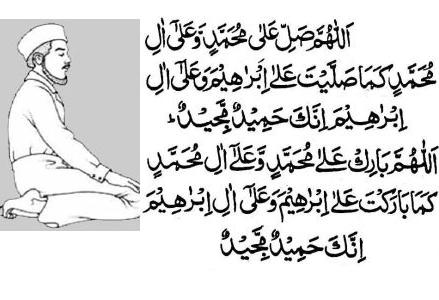
In the sitting posture of Salaah, we pray "O Allah, make the needs of Muhammad and his people be met." We also pray "O Allah, send blessings on Muhammad and his people." We are praying for the cause of Muhammad, the person of Muhammad, but also for his followers, that they have not only their needs, but blessings as well. That they have not only their immediate needs, but to have extra things, happiness in their existence.


Moreover, we 'officially' end the Salaah by turning to the right and the left, reciting the Tasleem [As salaamu 'alaykum wa rahmatullah, may the peace and mercy of Allah be on you].

Even praying alone, we still do this, and it's not restricted to communal prayers. It is said that we do this in order to greet the angels. Another way of looking at this, however, is that this serves as a training. In the midst of our worship of Allah, we are conditioned to care about other people.

In addition, in the family the family prays together in Jamaa'ah. They pray for each other and with each other. So we have here family connected by blood, but also connected [i.e. formed] by their shared belief in Almighty Allah.

This should bring us to a better understanding of the Prophet's statement [peace and blessings be on him] "None of you have Imaan until [Hattaaa] you love for your brother what you love for yourself." [Muslim].

Faith in God is deficient unless it is accompanied by- at minimum-  concern for one's brother. This is a value Islam seeks to develop within its followers.

What to do when family members are detrimental for our spiritual development

This scenario is one faced very often, by Muslims with Non Muslim family members, as well as Muslims dealing with [Muslim] family with different ideas of what it means to practice the religion.

The Qur'an gives us a powerful set of guidelines to answer this query.

"O believers, Indeed, some of your wives and your children are enemies to you." [Q 64:14]

We have to stop for a moment. Enemies is an extreme term to use. It means that they [the family members] have the potential to bring you harm when they are not on the same page spiritually. The verse continues to give us instructions.

ا أَيُّهَا الَّذِينَ آمَنُوا إِنَّ مِنْ أَزْوَاجِكُمْ وَأَوْلَادِكُمْ عَدُوًّا لَّكُمْ فَاحْذَرُوهُمْ وَإِن تَعْفُوا وَتَصْفَحُوا وَتَغْفِرُوا فَإِنَّ اللَّهَ غَفُورٌ رَّحِيمٌ
[1] Beware of them[Fah-dharhum].

Knowing that they can bring harm, one takes precautions. If they go in a direction that seeks to take you to Haraam, or to that which brings harm, even though they may not realize the harm they are bringing, be on the lookout!

In modern times we talk about toxic people or narcissistic  personalities. Included in this are folks who are emotionally manipulative or even guilty of emotional blackmail. We are told to limit our interactions with these types. Extend this to, for example, those who constantly backbite or gossip. In Islam, the listener is also deemed as guilty as the speaker. So if we know these types, when they start, change the subject or leave the conversation. Similarly, if they offer you drugs, alcohol and the like, simply decline and avoid that environment.

[2] "If you pardon" [wa in Ta'foo]

Try to be understanding of their situation or condition. Try to excuse them, even though you are taking precautions to limit their harm to you.

[3] "Overlook" [wa tas-fahoo]

To be forbearing, to put up with it all to a point. To be patient. One need not turn everything into an argument.

In the age of internet and mass communication, we often hear about the Haraam Police. This is a nickname give to Muslims who are always so preoccupied with the issues of other people. They will police your clothes and your Facebook posts. They will critique your beard, women's Hijaab and the like. They have stations everywhere, and will even spend time critiquing Imams. They will analyze speeches of Imams and scholars, especially the famous ones, for theological mistakes, for mispronunciation of Qur'anic sentences. They will even publish books of 'refutations' regarding these personalities "deviance" and YouTube videos will follow suit.

We can understand the command to overlook in that sense as well. Don't let it bother you. You don't need to become the Haraam police yourselves, Take precautions, yet be understanding and overlook their issues. Strive to be better yourself, and avoid becoming judgmental. You may end up becoming a positive influence on them. This is precisely the way of the Prophet.


The great Egyptian scholar, Shaikh Muhammad Al-Ghazzali [1917-1996] was once asked "What is the ruling about one who has abandoned prayers? The questioner was probably expecting that the Shaikh would declare such a person a disbeliever and the like. However, the Shaikh gave a beautiful response. He says "His ruling is that YOU take him WITH YOU to the mosque."

To take someone with you is a sign of caring, and that care may indeed change that person's condition and you can become the best of friends. Remember Khalid ibn al-Waleed, who fought the Muslims at Uhud, or Umar ibn al-Khattab, Radee Allahu 'anhumaa. These were foes to Islam and the Prophet himself, yet became the greatest champions of the deen.

[3] "And forgive" [wa taghfiruu]

Forgiveness is the last response in this series of steps. The Prophet practiced this many times, the most important being when he issued an amnesty for all those who had led a two decade bloody campaign against him.

Forgiveness is difficult but doable. It is also one of the main pillars of a high spiritual position, to be yourself forgiving, and not just asking Allah for his forgiveness.

The verse ends "So Indeed, Allah is the Forgiver, Compassionate"

Your 'foes' and yourself receive forgiveness from God. God is intensely forgiving. He does so often. He is the Constantly Merciful.

Understanding Mercy and Forgiveness

Enmity which is causing you stress, coming from whatever quarter, bringing into your life negative energy, striving to take you away from God and what is healthy, Allah can still deal with them. He can bring people to guidance. Allah can heal such people, here in this life.

That is an equation that we best remember.

By the same token, Allah says the Qur'an itself is a healer. He also says to "Make Jihaad against them [the rejectors] with it [i.e. Qur'an], and a mighty Jihaad it is." [Q 25:52]

Allah's healing can come to others by your own hands. To those with bad habits, share with them what the Qur'an says on that habit. To those who oppose Islam based on misinformation, share with them what the Qur'an says on that subject. If necessary, given them a Qur'an to read for themselves.

A Realistic Religion

This deen addresses all angles and all sides. If the majority of human beings could be influenced by only a third of what it teaches, the world would surely be better off. The Muslims have forgotten much of these teachings, that is the only logical explanation behind the many wars being fought in Muslim lands.

May Allah make us stronger as a body of believers, and increase in our our understanding of others, and understanding of our own needs.


Saturday, February 6, 2016

Accessing our lost spiritual wealth

The following is an edited version of the address given at the spirituality session at Toledo Masjid Al-Islam January 11th, 2016.]


We have to begin this subject by referring to the Qur'an. It says that the essence of every human being acknowledges their Lord. Alastu  Berabbikum? Qaaloo Balaa Shahidnaa. "Am I not your Lord", God asks. "Yes, we testify", is the response. It goes on to say that on judgement day, the excuse of "simply" adhering to family/social conventions will not be acceptable in the Divine Court.[ Q 7:172-173]

We also have the hadeeth in which the Prophet reportedly says " Every child is born upon the Fitrah." . This part of the hadeeth can be seen as Tafseer on the verses mentioned earlier. The hadeeth continues "His parents make him a Jew, a Christian, or a Zoroastrian." [Bukhari and Muslim]. So what do we learn?

[1] All humans possess, to use the language of tonight's program- that treasure, or at least they possess the potential to access that treasure.

[2] That treasure is bright, it is shiny and attractive, and is at its brightest in children, especially the very young. This fact is universally know, across religions and cultures. The Bible has it that Jesus says "You shall not enter heaven until you become like these little children." [Matt. 18:3]

Across human cultures, the statements and smiles of children are seen as reflecting an essential goodness and purity. Indeed, adults are often judged by other adults based upon their children's impressions. That is just a fact! In Islamic terminology, this is called Fitrah, the term highlighted in the hadeeth cited earlier.

Moreover, across human societies, crimes against children are seen as among the most horrible of crimes.


[3] Children are raised, influenced by their societies, to become adults with the thinking of that society or their surroundings. Thus, the import of the second part of the hadeeth "the parents make him a Jew, Christian or Zoroastrian".  This part of the hadeeth highlights  for us that treasure becoming lost or, to use another term, buried.


When the treasure gets buried, the consequences are profound. Faith in fellow man as well as faith in God weakens, if not totally dies! Ties between peoples become little more than business transactions. Trust is destroyed. A Vacuum is created, a hole is made. Some attempt to fill it by using drugs. Some turn to alcohol. Some will turn to other items. Others may seek to fill that hole by harming themselves, or others, even going to the route of committing suicide. Others still will turn to materialism as their god, or fill that hole in their own soul by seeking to dominate other human being, seeking after power and authority. They will often proclaim belief in empty, meaningless expressions. They make their lives' mission the acquisition of the biggest phones, the biggest cars. They risk becoming a people dedicated to nothing but indulgence.


Why tell us about the original acknowledgement?

After God says all of Adam's children recognize, in their own core, we are told

"Thus, do we [Allah] explain clearly the signs so that perhaps they will return " { Q 7:174]

وَكَذَلِكَ نُفَصِّلُ الآيَاتِ وَلَعَلَّهُمْ يَرْجِعُونَ
This means that Allah has told us this in order that we may return to it. He has told us a treasure exists and has even given us a map.


Continuing with this analogy. By stages, we are taught how to read the map. Messengers of God come to give us tips, to instruct us as to its symbols. There is even a discipline that must be adhered to if we are going to read the map correctly.

The  role of ritual

All religions have the rituals of worship, fasting and prayer, in some sense or another. These concepts have survived the corruptions that have taken place over the countless generations. However, in Islam we have Al Kitaab Al Mubeen, The Clear Scripture and we also have the Straight Path. "All paths lead to God", the popular saying goes. However, the Islam of the Qur'an and Prophet Muhammad constitutes the straight path. The shortest distance between two points is a straight line. That is Islam. Islam is the path that gets you there quick.

We have prayer and fasting, but we also have a discipline. This is shown in what the religion says about pork. Yes, Allah created pigs, yet he also says we are not to consume them. God created grapes, yet he says we are not to consume wine. These are NOT petty injunctions. These are examples of the discipline needed to study that map and bring out the treasure which has been hidden for so long!

So all of the authentic teachings and rules of Islam are present for our benefit and welfare.


Can antiquity be our guide?

When we talk about guidance, we tend to look at the past. For Muslims of all shades and madhaahib, we will look to the time of the Prophet. For Christians, they will focus upon the person of Christ. In this practice, we are indirectly acknowledging that there are deficiencies in today's way of thinking.

There is truth in this, however we can also view this in another way. Our Recent past, as recently as our parents and grandparents, can likewise provide us with keys to unlocking that treasure. Our recent past includes people we admire in our family line or in our society. I am not talking about actors and politicians. I am talking about figures who were truly about what is right, especially those we saw personally and was able to access personally.

Think about what you admire and love within them. Perhaps they were hard working, courageous. People dedicated to prayer, overcoming serious problems. These positive things are also a source of guidance. After all, Allah does not make mistakes. He placed you in your family and in your unique set of circumstances as a foundation.


Contemporary mindset very evil

The prevalent mindset in today's world is directed by evil forces. In politics, social order, even in the imagery of religion. The prevalent mindset promotes violence, xenophobia, racism, enmity between communities, selfishness, distrust, greed and paranoia. It promotes individualism in an unhealthy way, making us easier prey. Moreover, the prevalent mindset is against education.

Education should give us knowledge as well as cultivation, to make us better people. But today there are moves that seek to go against making us better people, In short, the prevalent mindset seeks to lock us out of the treasure.


Be courageous

Don't be afraid to be "weird". The Muslim should particularly be "weird" in the sense that our thinking and mindset be directed by this religion more so than any other consideration.

"And whosoever obeys Allah and his Messengerr have already acheived a mighty acheivement.{ Q 33:71}
وَمَن يُطِعْ اللَّهَ وَرَسُولَهُ فَقَدْ فَازَ فَوْزًا عَظِيمًا
Every child is born upon the Fitrah

Children don't know fiqh or religious labels. They don't even care about that. They do, however, love. They share. They trust. They bring out things in adults. They worship without any urging from their parents.

Watch your toddlers put down a rug and make Sajdah. They do so with joy, and brings joy to the hearts of nearby adults.

The Prophet's grandchildren [Hasan and Husseein] used to climb on his blessed back when he was in Sajdah, and it has happened to us all. Even within the animal kingdom, at the Haram [Makkah, site of the Ka'bah], birds are always circling the Ka'bah [i.e. Tawaf] and never make any droppings on the pilgrims.

Children and animals both exists in a state which recognizes God. For children, the older they get the easier it gets to be taken into another direction, which is mentioned in the hadeeth.


Job of Parents

Parents have to strive to bring up their children right, and the children also push their parents in the right direction, having the correct attitude. The children can give us keys to the treasure, and even tips on how to read the map. When that map is read with the distractions of ego, anger, insecurity, past hurts and the like, you will go in the wrong direction.

So it's more than having a map or even the treasure. It has to be read correctly and the treasure has to be utilized correctly.

Qur'an

"So when you read the Qur'an, seek refuge with Allah from Satan, the rejected enemy." [ Q 16:98]

فَإِذَا قَرَأْتَ الْقُرْآنَ فَاسْتَعِذْ بِاللّهِ مِنَ الشَّيْطَانِ الرَّجِيمِ
We don;t just say 'Bismillah"! People can [and do] be horrible in the name of God. We have to say A 'oodhoo Bellaahee Minash shaytaanir Rajeem.

In a similar way, money cannot solve our problems unless we know how to use it!

As life goes on, the more knowledge and experience we get under our belt, the easier it should be to use that map and utilize the treasure. If we don't have the knowledge/experience, we have to follow those who do.

"So ask the people opf reminder, i.e. knowledge, if you don't know" { Qur'an 16:43, 21:7]
فَاسْأَلُواْ أَهْلَ الذِّكْرِ إِن كُنتُمْ لاَ تَعْلَمُونَ
The guides can take us there, or at least show us where to look and what to zoom in upon.

Addressing our unique needs

All of us have some common needs, but there are needs that are unique. A person needing evidence that God exists is not the same as one needing to learn the details of the salaat. The first person is skeptical, while the other simply needs technical support.

Moreover, an astray person, in need of guidance, yet attempts to always argue with the guide or put on a show for the guide, that person needs hidaayah the most, and if the guide cannot deal with them, it is to the loss of that astray person.

In the Seerah literature, we have a report which states that a man came to the Prophet [peace and blessings of Allah be upon him]  complaining that he [the Prophet] was  not giving out wealth correctly. The man said to the Prophet "Fear Allah, O Muhammad" [as the exact wording says Faqaala "AttaqqiLLaah, Yaa Muhammad"].

The man didn't even call him "Prophet or Messenger" . He says "Muhammad". The Prophet responded "who is more in obedience to God that me, who is more trustworthy than me?" [Bukhari and Muslim].

The hadeeth says the man walked away. That man, tradition says, is the progenitor of the Khawaarij [Kharijites], the first terrorists group in the Muslim communitty. This emerged in Iraq, where ISIS has likewise, also emerged.

So when the guides are marginalized or ignored due to ego, the consequences can be devastating, both physically and spiritually.

The same hadeeth goes on to talk about a people who recite the Qur'an, but it doesn't go beyond their throats. They leave the religion the way an arrow leaves the bow when shot out [thus, the name Khawaarij, from the root kharaja 'he left']

While we see this hadeeth as predicting a political rebellion, this can also be seen in a spiritual sense. God knows what he's doing. He sent prophets and guides as well. He sent guidance. He sent a map. So don't underestimate the guide. Let him help you, and you help him,

Let us use the map, let us access the treasure for our benefit, and whatever level we are at now. May Alllah be our protector and guide.


Monday, September 28, 2015

Struggling to submit: thoughts on what it means to be a Muslim

Daily we encounter examples that illustrate the hardships faced by those who are conscientious of their faith. It's true that Muslims are not the only ones with these struggles, as recently demonstrated by Kim Davis, a Kentucky county clerk who refused to issue marriage licenses for homosexuals, however Muslims, especially in a Western context, have much more to deal with, especially considering that Islam is widely seen as a foreign religion  that is incompatible with Modern values, and often Muslims in the West are ethnic and racial minorities who automatically generate scrutiny.


At least for the "born Muslims", there exists more social support. "Born Muslims" have a backround in some Islamic culture somewhere. All of their family members are Muslims and are, even if not practicing, comfortable at home and in their professions. But what about the person who spent time investigating religion, perhaps going through a crisis of faith, and discovers Islam for themselves? Surely, such persons will have a different struggle. In many ways their struggle will be even more rough than the born Muslim in the West. The person who accepts Islam on their own has to deal with family dynamic, that will be reflected in problems both big and small.


Recently the media highlighted the case of Charee Stanley, an airline flight attendant. As a "new" Muslim, she has been learning about her faith and applying it, and upon learning about the religion's prohibitions on alcohol [which includes serving it], she stopped serving it on flights. What she would do was to have co-workers serve it. Eventually, a detractor raised an issue, and she was subsequently suspended from her job at ExpressJet.[ See Stanley's interview on The View. https://search.yahoo.com/yhs/search?p=charee+stanly+on+the+view&ei=UTF-8&hspart=mozilla&hsimp=yhs-002].


How this particular case will play out in the airline world and perhaps the courts remains to be seen, but what was interesting to this writer is the diversity of views, even surprising ones from unexpected sources, such as Sheikh Yasir Qadhi [head of the Al-Maghrib institute], who found her position "clearly unreasonable" , creating future hurdles in accommodating "reasonable issues" such as Hijaab and beard.

So, what about the worker in a business that sells alcohol? In some places in USA, most of such businesses are owned and operated by Muslims. Similarly, Muslims work in the stock market, in the banking system, restaurants, hotels and the like.
On issues relating to alcohol and drugs, this writer feels very strongly that these are categorically Haraam and that Muslims are to not enter into such activities for their livelihood. Yet, the truth is that people-including Muslims- need to earn an income. Even attaining a degree usually requires acquiring loans, in which interest will always be a component.

So what do we do? On a personal level, there may or may not be easy solutions. Some may be able to get along very well without attaining a college degree, to buy their vehicles without resorting to loans, while for others this may very well be impossible. The same can be said of those in other businesses or sources of income that are questionable or clearly Haraam.

While we have concentrated on income, the struggle can capture many other areas of life. Persons in relationships that are not marriages. Marriage with Non Muslims, family dynamics, struggling with the social life, and many other areas.

Institutional building is needed


If we are going to live in the West, we have to recognize that these situations will not simply go away. These types of problems will continuously pop up, and-in fact- will endure. On an individual level, Muslims may be able to control their diet, the moments they pray, the clothes they wear. This person may even be blessed with a magical solution to all of their issues,yet, we must say, that American Muslims of all sects, nationalities and orientations, must work together to create united efforts to minimize [if not totally eliminate] the need to find our bread and butter in questionable occupations. That means Muslims must form their own banks/credit unions, they must create funds and open up housing for New Muslims, they must cooperate, live in their own neighborhoods, form strong bonds that will have an impact both socially and politically.

Personal level- do what you can

To use an analogy, all of us look at the ingredients when shopping at a grocery store. Mainly, we search to make sure our food is not Haraam, but some mistakes may end up being committed along the way, out of ignorance or necessity. But we have to keep making effort to make sure our food is actually lawful.


If a person is in a questionable  business, he or she should strive to find a better -Halaal-job. Make some effort. Allah says that he provides from sources a person cannot even imagine, if that person has Taqwaaa. [Q 65:2-3]. If he or she has a relationship that's not marriage, the solution, if love and compatibility are there, to get married. In terms of income issues and education, housing etc, a family can work together- share all the expenses, and end up avoiding Ribaa, paying off loans, paying for an education. But all of this requires patience, discipline, foresight, and intelligence. It also requires thinking as family, thinking as community, thinking and acting based upon the interests of the big picture.

Consider the story of the Barrientos sisters. These four Texas sisters were able to eliminate $180,000 in debt in just eighteen months by sharing the load[ see http://abcnews.go.com/Business/texas-sisters-erased-182k-debt-18-months/story?id=33485609]

Islam sees the spiritual and the material as connected to each other. Even our food can affect our souls. Our financial situation can color our relationship with God. That's a simple fact, regardless of whether we like it or not. So we have to have faith, use the minds given to us by Allah, take some actions and go from there.

Tuesday, May 27, 2014

Contemplating Islamic principles: Marriage, love and family ties in today's world

Introduction

We often say that "Islam is the answer", that all of  the contents of the Qur'an and the Sunnah have all we need for guidance, even though the scripture and the Prophet to whom it was revealed, upon whom we pray for God's choicest of blessings and peace, was sent forth fourteen centuries ago, in the Arabian peninsula.

Yet, this assertion is under constant scrutiny. It is questioned, even by some believing, practicing Muslims.There are a number of examples from the Islamic texts, terms and concepts, particularly from the realm of social relations, that are cited, be it Jizyah, Dhihaar{Ft.#1}, AhlidhDhimmah, and so forth. Should these type of concepts be revived in a modern, complex and diverse world? If so, in what fashion? If these things should be consigned to the past, would that not deny the assertion that Islam has all the answers? Would it not show Islam to be relevant only to a particular moment in the past?

To answer this question, we would like to examine the example of male-female relations.


Relations between men and women a  foundation for healthy life

This statement needs no textual evidence to back it up. Adults know this instinctively. Humans seek out the companionship of the opposite sex, be it through Halaal or Haraam means. If unsuccessful, that failure can lead to many problems, creating bitterness that can eventually lead even to things such as suicide and murder, as we recently seen with Elliot Rodger, a young man who, due to his failures with women, went on a rampage in Santa Barbara, California , killing seven people as well as himself.

In the time of the Prophet, Sall Allahu 'alayhi wa sallam, there were men who swore off women. One says he will fast continously, and another says he will even undergo castration, that way there is no distractions and they can simply devote their time to worship.The Prophet responds to this by saying "I fast and I break fast [meaning that he doesn't continously fast], and I marry women." He says " Marriage is my Sunnah, and whosoever abandons my Sunnah is not of me." [ Bukhari, 62:1, narrated by Anas ibn Malik]


Searching for love

Worldwide people have grown up watching movies and hearing about 'soulmates', seeking out 'love'{ft.2}. The modern world's method is for dating to take place, the couple go out for a couple years, discover is they are indeed compatible in all areas, 'fall in love' and marry. Admittedly the emotional tie is the norm. There is no objection, either religious, moral or legal, to wanting to love and be loved. But we have to admit, Islam - God's Deen for the benefit and health of humanity, is actually very realistic. What we mean by this is that while the rhetoric of love is very appealing, this pattern of repeated relationships people go through, having the ups and downs of emotional attachments even when unmarried, brings forth constant instability. Countless problems are created because of this instability, a pattern that repeats itself so much that a person, even a 'catch'- may never move forward towards other important life areas.


Looking at some of the options available 

Islam does not lend support to sexual relations, except in a certain context, i.e. the marriage context. Even in that, Islamically [as per the Sunnah], marriage is very easy. Agreement [Qubool] between the parties, a gift to symbolize the man's responsibility in this serious manner [Mahr or dowry], a ceremony [Ft.3], the agreement being witnessed by a minumum of two witnesses.Forced relationships are Haraam.

Society may have certain expectations that are unrealistic or unreachable for certain peoples. Moreover, there are also traditional demands about having spouses from the same race or social status, village, family or tribe etc, leading to extreme stress and late marriage, if at all.

The Qur'an has this to say, as an example of the options available. The quoted translation is from Saheeh International.

And whoever among you cannot [find] the means to marry free, believing women, then [he may marry] from those whom your right hands possess of believing slave girls. And Allah is most knowing about your faith. You [believers] are of one another. So marry them with the permission of their people and give them their due compensation according to what is acceptable. [They should be] chaste, neither [of] those who commit unlawful intercourse randomly nor those who take [secret] lovers... 4:25

To put it in another way, if the normal avenue of marriage is unavailable for a man, he should expand his field of potential mates to include those whom he would not usually seek out. Why not seek out, or at least be open to, a woman who already has children? Or a widow, as there are many women who have been widowed as a result of the war in Syria and Iraq.

Islam repeatedly connects solving social problems with the religious life. A woman struggling, for whatever reason, does not need limited charity. Charity, although good and a religious pillar, is of a limited reach. However, a woman or a mother with children with no support will find long-term solution in being with a man who at least is willing to deliver emotional, moral, physical and of course financial support. That- in term- will see the development of love, of families melding together, of becoming attached and loving children.

We also admit that Islam allows a limited polygamy. All of these allowances from the Most Wise Creator, if done with maturity, planning, a realistic [as opposed to ideal] outlook, can bring forth more peace in neighborhoods, responsibility, less burden on governments. Men and women learning to expand their scope of care and support. In the end, that is the miracle of miracles. Community oriented and socially responsible human beings who seek to obey Allah and his Messenger.

Footnotes
[1] Dhihaar was a common divorce method in Pre-Islamic Arabia designed to maximize suffering to a woman, so that she could neither expect support from her husband nor seek out a new husband. The Qur'an [ 58:2-3] outlawed this practice.

[2] An interesting fact is that the Arabic word for love, Hubb, is from the same root as the word Habb, which means seed. The ideas interchanging within these words are obvious. From the seedling we may get a fruit producing tree, benefitting generations. The same can be said of love.

[3] In many societies the important thing is the signing of the marriage agreement ['Aqd], the ceremony only being for public consumption. Moreover, it is often the case that neither the groom nor bride are at the signing, being signed instead by representatives.

Monday, April 1, 2013

In the belly of the Beast: questions on Islamic devotion in prison


[1] There are so many ideas associated with Islam, and countless books, CDs, and brochures published by different sects. How can we determine what is correct?

Answer: Obviously, the two authorities for Muslims are the Qur’an, which is the book of Allah, and the goodly model that is present within the example of Prophet Muhammad, Sall Allahu ‘alayhi wa sallam. It’s true that all the sects say this, and it’s also true that there are countless books with fancy Arabic titles and proposing to present all of the solutions to our questions. In our view, the following methodology is needed, especially for the New Muslim, but it’s just as relevant for a veteran Muslim as well. [1] Have faith in Allah, understand that he is one and alone. The God concept of Islam is easily found within the Qur’an, a few examples are 2:255, 24:35, and 112:1-4.  [2] Be regular in Salaah [daily [prayers]. This also requires learning how to offer it. There are many brothers in all the prisons from whom it can be learned, it’s largely uniform across sectarian lines, and an abundance of books, pamphlets and instructional materials are also widely available. [3] Be a consistent reader of the Qur’an. Have it be your ultimate authority on what’s authentic, because it is often the case that ideas spread word of mouth are not only contrary to Islam, but also dangerous in one sense or another.

[2] Are we allowed to be friendly with Non Muslims?

Answer: The Qur’an only forbids friendships with those who would be detrimental to us spiritually and who display enmity towards Islam! Thus, Allah says: “and when you see those engaged in vanities about Our signs [i.e. Quranic revelation] , then turn away from them until they turn to a different way of speaking. If Shaytaan [the Devil] makes you forget, then upon being reminded, sit not with those who are bent on being a people of wrongdoing.” [Q 6: 69]. Another verse reads “...when you hear the verses of Allah rejected and ridiculed, do not sit with them… if you did, you would be like them.” [Q 4:140]

It is often said that Islam forbids relations with Non Muslims, but this is simply not true! This misconception stems from an incorrect translation of the word Awliyaa’ [singular Waali], found in the Qur’an 4:144, 5:57 and other texts. These verses are to be understood in context, and to be seen in context of patron-client nation states. Muslims are forbidden in these verses from taking as protectors those whose enmity has already been proven, a common sense teaching! 

Here, we should remember that the Qur’an itself allows us to eat the food of Non Muslims, which means dining as well, as well as marriage with Jews and Christians [ Q 5:5]. Moreover, a just and fair way of dealing with those who deal with us in a similar way, even though there are religious differences, is the command of the Qur’an in 60:8-9.

[3] Do we cut relations with Non Muslim family?
To cut relation simply due to religious differences is not correct. Islam sees as extremely important the family ties. Indeed, remember that the Qur’an directly uses parents as an example, if they want us to commit idolatry, we can’t obey that, but we are to keep goodly ties with them in life.

[4] Interactions with Pseudo Islamic groups [Nation of Islam, Five per centers, Moorish Science temple, etc...]

Admittedly this is a tricky question. Without doubt, the God concept and the racially oriented teachings of such groups are contrary to Islam. Yet, usually such beliefs are adopted out of ignorance about authentic Islam, and once they are exposed to what’s true, their hearts turn towards that. We recommend dealing with such people in understanding, compassion and patience. Keep in mind the following verse: “  And it was by God's grace that thou [O Prophet] didst deal gently with thy followers, for if thou had been harsh and hard of heart, they would indeed have broken away from thee. Pardon them, and pray that they be forgiven.." [Q 3:159, Muhammad Asad translation]

[5] Is Salaatul Jumu’ah [Friday prayers] valid in prisons?
The Qur’an and Hadeeth literature both give us the conditions for Friday prayers. It’s purpose, like all the other prayers, is “the remembrance of Allah” [Q 61:9]. It also serves as a social function, in the sense that hearts are united and relationships established by attending the services and praying together. Thus, we find the argument that Jumu’ah prayers are invalid in prisons due to lack of public access as baseless. We have to remember that many of the views advanced by some jurists, yesterday and to some extent today as well, are views that were shaped in circumstances different than today’s prison system. Historically, the Madhaahib [schools of jurisprudence] had different ideas as to the number of attendees necessary for Friday prayers, the Shafi’ees held that at least 30 are needed, whereas some Shi’ah authorities in Iraq, Iran and even Lebanon held that Friday prayers were invalid when the ruling government was unjust [Ghayrul ‘aadil].  In any case, it has to be remembered that the Prophet, Sall Allahu ‘alayhi wa sallam, said that the whole earth is a place of prayer, and this certainly includes prisons! The conditions for Friday prayers are well known and established, [1] It is recommended to bath beforehand, wear one’s best and clean clothes, and to smell good [ Bukhari 11:3], [2] To listen attentively to the Khutbah [sermon] and be silent during [ Bukhari 11:35] [3] The Khutbah is divided into two sections, with a pause for Du’a between them. Those brief moments between the Khutbah’s first and second parts are important moments in which Du’a is heard and accepted by Allah [Tabaraani].

May Allah keep our hearts firm upon his deen, we seek his forgiveness, mercy and guidance.