Sunday, July 7, 2013
The transformative power of Ramadan
Friday prayer at Toledo Masjid. Examines both the technical details of the fast as well as the method by which the fast can be used to make us better people.

Monday, July 1, 2013
Towards a healthy spiritual life: contemplating Islamic principles
Life is a journey. We are always on the journey, even if we are physically confined to a certain place or space. The longer one lives, the more we learn and develop. This is true for all human beings, or perhaps a better description, should be true for all human beings.
Religion comes forth in order to deliver guidance as to how to live with yourself, with other humans, with those who agree with you and those who disagree with you. It is true that there are what we could call theological truisms, but it is the living and functioning in this world that is the main goal and function of religion. The theological truisms, such as believe in the One God, who is invisible to the human eye, accepting as true the commissioning of Prophets and messengers, the sending forth of scripture, the final one being the Qur'an [as per Islamic teachings], are all connected with, in some way or another, to the way humans are suppose to live here!
Important information on this topic is given in the Qur'an, the scripture sent forth to the Prophet Muhammad, upon whom be peace and blessings. There are also some sayings of the Prophet that we could reference, but for our purposes only one seems prudent: " I have been sent to perfect morals" [ Musnad Ahmad].
Introducing Soorah Al Hujuraat
The Tafseer books are in general agreement as to the circumstances [Sibaab an Nuzool] surrounding the revelation of Soorah # 49. The Prophet was in his home, and some tribesmen from Banu Tameem came looking for him, yelling "O Muhammad, come out!" [some reports say that they used the term "Ahmad" rather than Muhammad] . It was certainly an example of bad manners. In any case, the Soorah was sent forth, dealing with this and other issues. I highly recommend a study of the text for yourself.
We will not seek to look at the whole of the Soorah in this brief post, but rather we will take a quick glace at some of its Blessed contents.
O Believers! Do not place yourselves before Allah and his messenger, rather, have Taqwaa of Allah, Surely, Allah is Hearer, knower.[ Q 49:1]
يَا أَيُّهَا الَّذِينَ آمَنُوا لَا تَرْفَعُوا أَصْوَاتَكُمْ فَوْقَ صَوْتِ النَّبِيِّ وَلَا تَجْهَرُوا لَهُ بِالْقَوْلِ كَجَهْرِ بَعْضِكُمْ لِبَعْضٍ أَن تَحْبَطَ أَعْمَالُكُمْ وَأَنتُمْ لَا تَشْعُرُونَ
O believers! Do not elevate your voices above the voice of the Prophet, do not be loud with him in speech, nor treat his speech as the speech of others, lest your deeds become nullified while you are not perceptive.[Q 49:2]
these two verses introduce the Soorah. The guidance of the Qur'an and the messenger are the most important sources. They are not to be treated in the same way one treats the works of lawyers, scholars, philosophers and lay people. This textual and spiritual hierarchy is necessary in order as to not have any confusion. Islam, as found in the Qur'an and Prophetic guidance, is perfected. When perfection and its opposite are mixed, there will arise natural confusion. Notice here, as throughout the Qur'an, the formula "God and his messenger". God is represented by the Qur'an, so the Qur'an will have to serve as primary foundational pillar.
So, what does God say? What does Allah tell us that is relevant for a healthy spiritual life? A life that is, in a sense, protected. Here are some examples of the Divine speech:
يَا أَيُّهَا الَّذِينَ آمَنُوا إِن جَاءكُمْ فَاسِقٌ بِنَبَأٍ فَتَبَيَّنُوا أَن تُصِيبُوا قَوْمًا بِجَهَالَةٍ فَتُصْبِحُوا عَلَى مَا فَعَلْتُمْ نَادِمِينَ
" O believers! When a "Faasiq" [an immoral person who breaks the normal rules of behavior] comes with any information, investigate it, lest you bring harm to a people unknowingly and become regretful afterwards." [Al-Qur'an 49:6]
This references not only war situations, or exercising caution with media or internet reports, but even within our own small circles. Notice the verse says "investigate" rather than outright rejection of the report. In our own lives, we may have those who love to see discord. "Misery loves company" as the saying goes. This should not be the source of our downfall,what other people say or do. Indeed, this is even connected to the teaching known as Husnudh dhann, or positive conjecture. The first and foremost rule in Islamic ethics, as well as even within the Fiqh, is to assume the best BEFORE assuming the worst. That certainly does not imply blind following, but rather in having a generally positive outlook on life and on human beings. That positive thinking is the best step in getting or in having a healthy spiritual life.
More practical steps
The same Soorah tells us to not ridicule others, not to give defamatory names, nor insulting [49:11] . No commentary is needed on this, except to perhaps consider what Muhammad the Prophet is reported to have said. "Love for your brother what you love for yourself". Would we like to be made fun of? Or insulted?
يَا أَيُّهَا الَّذِينَ آمَنُوا اجْتَنِبُوا كَثِيرًا مِّنَ الظَّنِّ إِنَّ بَعْضَ الظَّنِّ إِثْمٌ وَلَا تَجَسَّسُوا وَلَا يَغْتَب بَّعْضُكُم بَعْضًا أَيُحِبُّ أَحَدُكُمْ أَن يَأْكُلَ لَحْمَ أَخِيهِ مَيْتًا فَكَرِهْتُمُوهُ وَاتَّقُوا اللَّهَ
إِنَّ اللَّهَ تَوَّابٌ رَّحِيمٌ
" O believers, [1] Do not engage in much conjecture, verily, conjecture is sometimes sinful. [2] Do not spy on one another,[3] Do not backbite on one another, would you like to eat the meat of your dead brother? Nay, you would hate this. Have Taqwaa of Allah, verily, Allah is Oft-Returning, Compassionate.[ Q 49:12]
Now we come to the heart of this post. Conjecture [Dhann] can be destructive, and, as the verse says, a sin. The principle of assuming the best before assuming the worst, especially when there is no evidence of wrong play or ill will, is another key element of a healthy spiritual existence. The verse goes on to speak of spying. Why the prohibition for spying? Because everyone has a private life, quarters of their existence, even if not sinful, that is not needed to share with the world. Moreover, to search out for the wrongs or for the shortcomings of others is in itself a sign of a diseased heart. Indeed, there is wisdom in the Prophetic hadeeth which says "blessed is the one who is so busy with their own faults they forget the faults of others" [ narrated by Anas and reported by Al Bazzaar]. Backbiting, in a similar way, is a sign of a sick heart, one that requires treatment in the Divine clinic. We go back to a hadeeth cited before, love for your brother what you love for yourself. That should be sufficient as a comment.

"O Humanity! Verily We [God] have created you from a single male and female, made you into peoples and groupings for the purpose of learning from one another. Verily, in Allah's sight the most honorable are those with the highest amount of Taqwaa in your midst. Verily, Allah is the Knowing, the Aware." [Q 49:13]
This verse tells us the reasons behind the differences we find among the human race. Our cultures, cooking style, languages, etc.. are all placed there by the Divine plan, in order for us to derive mutual benefit. It is not an accident of nature or an oddity. The Qur'an places emphasis on traveling to lands other than your own, as that is a means for growth. Xenophobia is, thus, an entirely Un Islamic feeling to hold onto. Our own experience is that there are, and will continue to be, people of great potential, even religiously, but who hold to racist views, jealousies and even fear of other languages, other peoples, etc.., thus, holding themselves back. They deny the blessings Allah has given to them by framing everything in racial terms.They have engaged in conjecture [Dhann] solely on the basis of a skin color or national origin. This also implies some sort of racial or ethnic superiority, which is condemned here in the above verse. Throughout Soorah Al-Baqarah, and even mentioned briefly in Soorah Al Jumu'ah, we find that elements among the Children of Israel are condemned for this way of thinking.
Conclusion
All of these elements are connected. If we have unhappy lives, we have to ask ourselves the reason. Do we put our desires or our opinions as first, elevating our whims above the guidance of the Almighty and above the goodly model of the messenger, Sall Allahu 'alayhi wa sallam? Do we elevate our voices over that of Islam? Are we willing to reject good advice or guidance simply because the wrapping is not a color we like? Do we judge and feel suspicious all the time? Do we allow ourselves to be inspired by the Devil? I am reminded of Randy Linn, the arsonist of the Islamic center of Greater Toledo, who, in court for his crime, said that he had been inspired by Fox News. He had been convinced Muslims were here, preparing some anti-American acts, because of the comments he heard on that channel.
This article is not a full commentary on this Soorah. Indeed, I have studied this Soorah so much that I am tempted to write a book on it. This article seeks to look at some of the things that we could do, or avoid, in order to have a healthy spiritual life. Basically, we are to look at both internal and external factors. Both are connected. Throughout the Soorah, we read about Taqwaa, a healthy awareness, respect for God. This translates into our relations with others as well. One need only take a glance at the Qur'an, 4:1.
Comments and discussion are welcome. Wa Lillaahit-Tawfeeq.
Religion comes forth in order to deliver guidance as to how to live with yourself, with other humans, with those who agree with you and those who disagree with you. It is true that there are what we could call theological truisms, but it is the living and functioning in this world that is the main goal and function of religion. The theological truisms, such as believe in the One God, who is invisible to the human eye, accepting as true the commissioning of Prophets and messengers, the sending forth of scripture, the final one being the Qur'an [as per Islamic teachings], are all connected with, in some way or another, to the way humans are suppose to live here!
Important information on this topic is given in the Qur'an, the scripture sent forth to the Prophet Muhammad, upon whom be peace and blessings. There are also some sayings of the Prophet that we could reference, but for our purposes only one seems prudent: " I have been sent to perfect morals" [ Musnad Ahmad].
Introducing Soorah Al Hujuraat
The Tafseer books are in general agreement as to the circumstances [Sibaab an Nuzool] surrounding the revelation of Soorah # 49. The Prophet was in his home, and some tribesmen from Banu Tameem came looking for him, yelling "O Muhammad, come out!" [some reports say that they used the term "Ahmad" rather than Muhammad] . It was certainly an example of bad manners. In any case, the Soorah was sent forth, dealing with this and other issues. I highly recommend a study of the text for yourself.
We will not seek to look at the whole of the Soorah in this brief post, but rather we will take a quick glace at some of its Blessed contents.
يَا أَيُّهَا الَّذِينَ آمَنُوا لَا تَرْفَعُوا أَصْوَاتَكُمْ فَوْقَ صَوْتِ النَّبِيِّ وَلَا تَجْهَرُوا لَهُ بِالْقَوْلِ كَجَهْرِ بَعْضِكُمْ لِبَعْضٍ أَن تَحْبَطَ أَعْمَالُكُمْ وَأَنتُمْ لَا تَشْعُرُونَ
O believers! Do not elevate your voices above the voice of the Prophet, do not be loud with him in speech, nor treat his speech as the speech of others, lest your deeds become nullified while you are not perceptive.[Q 49:2]
these two verses introduce the Soorah. The guidance of the Qur'an and the messenger are the most important sources. They are not to be treated in the same way one treats the works of lawyers, scholars, philosophers and lay people. This textual and spiritual hierarchy is necessary in order as to not have any confusion. Islam, as found in the Qur'an and Prophetic guidance, is perfected. When perfection and its opposite are mixed, there will arise natural confusion. Notice here, as throughout the Qur'an, the formula "God and his messenger". God is represented by the Qur'an, so the Qur'an will have to serve as primary foundational pillar.
So, what does God say? What does Allah tell us that is relevant for a healthy spiritual life? A life that is, in a sense, protected. Here are some examples of the Divine speech:
يَا أَيُّهَا الَّذِينَ آمَنُوا إِن جَاءكُمْ فَاسِقٌ بِنَبَأٍ فَتَبَيَّنُوا أَن تُصِيبُوا قَوْمًا بِجَهَالَةٍ فَتُصْبِحُوا عَلَى مَا فَعَلْتُمْ نَادِمِينَ
" O believers! When a "Faasiq" [an immoral person who breaks the normal rules of behavior] comes with any information, investigate it, lest you bring harm to a people unknowingly and become regretful afterwards." [Al-Qur'an 49:6]
This references not only war situations, or exercising caution with media or internet reports, but even within our own small circles. Notice the verse says "investigate" rather than outright rejection of the report. In our own lives, we may have those who love to see discord. "Misery loves company" as the saying goes. This should not be the source of our downfall,what other people say or do. Indeed, this is even connected to the teaching known as Husnudh dhann, or positive conjecture. The first and foremost rule in Islamic ethics, as well as even within the Fiqh, is to assume the best BEFORE assuming the worst. That certainly does not imply blind following, but rather in having a generally positive outlook on life and on human beings. That positive thinking is the best step in getting or in having a healthy spiritual life.
More practical steps
The same Soorah tells us to not ridicule others, not to give defamatory names, nor insulting [49:11] . No commentary is needed on this, except to perhaps consider what Muhammad the Prophet is reported to have said. "Love for your brother what you love for yourself". Would we like to be made fun of? Or insulted?
يَا أَيُّهَا الَّذِينَ آمَنُوا اجْتَنِبُوا كَثِيرًا مِّنَ الظَّنِّ إِنَّ بَعْضَ الظَّنِّ إِثْمٌ وَلَا تَجَسَّسُوا وَلَا يَغْتَب بَّعْضُكُم بَعْضًا أَيُحِبُّ أَحَدُكُمْ أَن يَأْكُلَ لَحْمَ أَخِيهِ مَيْتًا فَكَرِهْتُمُوهُ وَاتَّقُوا اللَّهَ
إِنَّ اللَّهَ تَوَّابٌ رَّحِيمٌ
" O believers, [1] Do not engage in much conjecture, verily, conjecture is sometimes sinful. [2] Do not spy on one another,[3] Do not backbite on one another, would you like to eat the meat of your dead brother? Nay, you would hate this. Have Taqwaa of Allah, verily, Allah is Oft-Returning, Compassionate.[ Q 49:12]
Now we come to the heart of this post. Conjecture [Dhann] can be destructive, and, as the verse says, a sin. The principle of assuming the best before assuming the worst, especially when there is no evidence of wrong play or ill will, is another key element of a healthy spiritual existence. The verse goes on to speak of spying. Why the prohibition for spying? Because everyone has a private life, quarters of their existence, even if not sinful, that is not needed to share with the world. Moreover, to search out for the wrongs or for the shortcomings of others is in itself a sign of a diseased heart. Indeed, there is wisdom in the Prophetic hadeeth which says "blessed is the one who is so busy with their own faults they forget the faults of others" [ narrated by Anas and reported by Al Bazzaar]. Backbiting, in a similar way, is a sign of a sick heart, one that requires treatment in the Divine clinic. We go back to a hadeeth cited before, love for your brother what you love for yourself. That should be sufficient as a comment.
"O Humanity! Verily We [God] have created you from a single male and female, made you into peoples and groupings for the purpose of learning from one another. Verily, in Allah's sight the most honorable are those with the highest amount of Taqwaa in your midst. Verily, Allah is the Knowing, the Aware." [Q 49:13]
This verse tells us the reasons behind the differences we find among the human race. Our cultures, cooking style, languages, etc.. are all placed there by the Divine plan, in order for us to derive mutual benefit. It is not an accident of nature or an oddity. The Qur'an places emphasis on traveling to lands other than your own, as that is a means for growth. Xenophobia is, thus, an entirely Un Islamic feeling to hold onto. Our own experience is that there are, and will continue to be, people of great potential, even religiously, but who hold to racist views, jealousies and even fear of other languages, other peoples, etc.., thus, holding themselves back. They deny the blessings Allah has given to them by framing everything in racial terms.They have engaged in conjecture [Dhann] solely on the basis of a skin color or national origin. This also implies some sort of racial or ethnic superiority, which is condemned here in the above verse. Throughout Soorah Al-Baqarah, and even mentioned briefly in Soorah Al Jumu'ah, we find that elements among the Children of Israel are condemned for this way of thinking.
Conclusion
All of these elements are connected. If we have unhappy lives, we have to ask ourselves the reason. Do we put our desires or our opinions as first, elevating our whims above the guidance of the Almighty and above the goodly model of the messenger, Sall Allahu 'alayhi wa sallam? Do we elevate our voices over that of Islam? Are we willing to reject good advice or guidance simply because the wrapping is not a color we like? Do we judge and feel suspicious all the time? Do we allow ourselves to be inspired by the Devil? I am reminded of Randy Linn, the arsonist of the Islamic center of Greater Toledo, who, in court for his crime, said that he had been inspired by Fox News. He had been convinced Muslims were here, preparing some anti-American acts, because of the comments he heard on that channel.
This article is not a full commentary on this Soorah. Indeed, I have studied this Soorah so much that I am tempted to write a book on it. This article seeks to look at some of the things that we could do, or avoid, in order to have a healthy spiritual life. Basically, we are to look at both internal and external factors. Both are connected. Throughout the Soorah, we read about Taqwaa, a healthy awareness, respect for God. This translates into our relations with others as well. One need only take a glance at the Qur'an, 4:1.
Comments and discussion are welcome. Wa Lillaahit-Tawfeeq.
Monday, April 1, 2013
In the belly of the Beast: questions on Islamic devotion in prison
Tuesday, January 8, 2013
Comparing the scriptures: a glance at Biblical and Quranic texts
Introduction
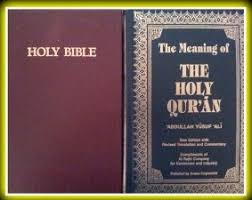
This article is not designed to antagonize nor offend readers of any faith. Nor is it a polemical device. Rather, it is an educational and discussion tool, on a subject we have been long asked to address. The reader is encouraged to verify the quotations for themselves. The Biblical references are from the NIV [NIV study Bible, Zondervan, Grand Rapids, Michigan 2002 edition] unless otherwise stated, and the Quranic texts are translated by the author, unless otherwise stated.
God concept
The basic idea or understanding of how to conceptualize the Almighty is the same as between the Bible and the Qur'an.
"I am the Lord your God, who teaches you what is best for you, who directs you in the ways you should go.." [Isaiah 48:18]
"God is not a man that he should lie, nor a son of man that he should change his mind." [Numbers 23:19]
"Hear, O Israel: The Lord our God, the Lord is one." [Deuteronomy 6:4]
"Say: He is Allah alone! Allah the eternal. He does not give birth, nor was he given birth to, and nothing exists like him. "[Qur'an 112:1-4]
"And place your trust in the Living One [Al-Hayy] who does not die, and celebrate his praise, and he is sufficient as aware of the sins of his servants" [Qur'an 25:58]
“Allah![1] Nothing deserves worship except He, the Self-Subsisting, Eternal. Slumber does not overtake him, neither does sleep. To Him belongs what is in the Heavens and what is in the Earth. Who possesses abilities of intercession, except by His permission? He knows what is between them, and what is behind them. None grasp of his knowledge, except by his will. His throne encompasses the Heavens and the Earth, He does not tire in protecting them both, and He is the Most High, the Magnificent” [Q 2:255]
Ethics
“Honor your father and your mother, as the Lord your God has commanded you, so that you may live long and that it may go well with you in the land the Lord your God is giving you.
[2] "WE" refers to God himself. The plural used is a royal plural, given to denote grandeur and authority. The Bible repeatedly uses this, such as in Genesis 1:1, "In the beginning, God [Elohim] created the heavens and the Earth." Elohim is plural of Eloh!
This article is not designed to antagonize nor offend readers of any faith. Nor is it a polemical device. Rather, it is an educational and discussion tool, on a subject we have been long asked to address. The reader is encouraged to verify the quotations for themselves. The Biblical references are from the NIV [NIV study Bible, Zondervan, Grand Rapids, Michigan 2002 edition] unless otherwise stated, and the Quranic texts are translated by the author, unless otherwise stated.
God concept
The basic idea or understanding of how to conceptualize the Almighty is the same as between the Bible and the Qur'an.
"I am the Lord your God, who teaches you what is best for you, who directs you in the ways you should go.." [Isaiah 48:18]
"God is not a man that he should lie, nor a son of man that he should change his mind." [Numbers 23:19]
"Hear, O Israel: The Lord our God, the Lord is one." [Deuteronomy 6:4]
"Say: He is Allah alone! Allah the eternal. He does not give birth, nor was he given birth to, and nothing exists like him. "[Qur'an 112:1-4]
"And place your trust in the Living One [Al-Hayy] who does not die, and celebrate his praise, and he is sufficient as aware of the sins of his servants" [Qur'an 25:58]
“Allah![1] Nothing deserves worship except He, the Self-Subsisting, Eternal. Slumber does not overtake him, neither does sleep. To Him belongs what is in the Heavens and what is in the Earth. Who possesses abilities of intercession, except by His permission? He knows what is between them, and what is behind them. None grasp of his knowledge, except by his will. His throne encompasses the Heavens and the Earth, He does not tire in protecting them both, and He is the Most High, the Magnificent” [Q 2:255]
Ethics
“Honor your father and your mother, as the Lord your God has commanded you, so that you may live long and that it may go well with you in the land the Lord your God is giving you.
“You shall not murder.
“You shall not commit adultery.
“You shall not steal.
“You shall not give false testimony against your neighbor.
“You
shall not covet your neighbor’s wife. You shall not set your desire on
your neighbor’s house or land, his male or female servant, his ox or
donkey, or anything that belongs to your neighbor.”[Deuteronomy 5:16-21]
"Hence,
do not kill your children for fear of poverty : it is We[#2] who
shall provide sustenance for them as well as for you. Verily, killing
them is a great sin.And do not commit adultery -for, behold, it is an abomination and an evil way.And
do not take any human being's
life -[the life] which God has willed to be, sacred-otherwise than in
[the pursuit of] justice. Hence, if anyone has been slain wrongfully,
We have empowered the defender of his rights [to exact a just
retribution] ; but even so, let him not exceed the bounds of equity
in [retributive] killing. [And as for him who has been slain
wrongfully -] behold, he is indeed succoured [by God] !And do not touch the substance of an orphan, save to improve it, before he comes of age.
And be true to every promise - for, verily, [on Judgment Day] you will
be called to account for every promise which you have made !
" [ 17:31-34 Muhammad Asad translation, The Message of the Qur'an]
" [ 17:31-34 Muhammad Asad translation, The Message of the Qur'an]
Broadly speaking, these two topics are arguably the most important. The two scriptures share the same vision here. While differences do exist between the two, it is the similarities that outweigh the differences.
Notes
[1] "Allah" is the name of God in Arabic, just as Dios is in Spanish and Khuda in Farsi and Urdu. It refers to the One and Only God.
[2] "WE" refers to God himself. The plural used is a royal plural, given to denote grandeur and authority. The Bible repeatedly uses this, such as in Genesis 1:1, "In the beginning, God [Elohim] created the heavens and the Earth." Elohim is plural of Eloh!
Thursday, November 29, 2012
Some pictures, Hajj
 |
| The Ka'bah |
 |
| Roof of Masjid Al-Haram,Tahajjud prayers |
 |
| Outside of Masjid Al-Haram, site of the Ka'bah |
 |
| After Friday prayer: Look at that diverse crowd |
 | ||||||
| Outside of the hotel, Friday prayer crowd |
An American Imam's first Hajj
[Note: The following was an article about my recent Hajj -pilgrimage to Makkah-published at onislam.net.]
 I was blessed to perform the Hajj (pilgrimage) this year.
It was my first time to go on Hajj, and I would like to share my experience of this blessed journey for the benefit of readers who have not yet performed this important pillar of Islam.
Arriving in Madinah
My visit to Madinah was very special.
We were blessed to stay in a hotel right across the street from Al-Masjid an-Nabawi (the sacred mosque of the Prophet). Visiting Madinah and the Prophet’s mosque is not part of the Hajj rites, but is a highly recommended thing to do.
The mosque has a peaceful feeling at all times; it has a unique atmosphere. The Prophet is reported to have said:
It is ideal for private prayer, contemplation and reflection. One feature that can be found there is regular teaching circles (halaqas) taking place in languages as diverse as Urdu, French and even Russian, in addition of course to Arabic.
In Makkah
Pilgrimage to Makkah is not only associated with the importance of the city in Prophet Muhammad's life, but the main rites date back to Prophet Abraham’s era, and all Muslims follow his message of tawheed (monotheism) until today.
These are the rites that I was enthusiastically doing in Makkah:
Circumambulating around the Ka’bah (Tawaf)
When I arrived in Makkah, mainly to the Haram mosque, the first sight of the Ka’bah was overwhelming.
When I first arrived and had the opportunity to do ‘Umrah, and while doing Tawaf (circumambulation around the Ka’bah seven rounds), I pondered on the importance of the famous hadith in which the Prophet is reported to have said:
{Our Lord! Bestow on us what is good in this world, and also what is good in the next life, and protect us from the punishment of the hellfire.} (Al-Baqarah 2: 201)
The main purpose of Hajj is to create awareness, a consciousness that is to influence the remainder of one’s life. One’s entire orientation is to be as Prophet Abraham, peace be upon him, totally for God and Divine morals/ethics.
Performing Sa’i
The next important act is the brisk walking between the two hills of Safa and Marwa seven times, an act known as Sa’i.
It commemorates the struggle that Prophet Abraham’s wife, Hagar, went
through with her infant son Ishmael, alone in the desert searching for
water.
As the tradition goes, she ran back and forth seven times, and the last time Zamzam water gushed forth under the feet of her baby. That place is known as the well of Zamzam.
It seems that the lesson is that of striving, that faith must include personal effort in order to accomplish what needs to be done, be it at a spiritual or worldly level. Indeed, the Quran testifies to this in saying:
{Surely, God does not change the condition of a people until they change what is inside themselves.} (Ar-Ra’d 13: 11)
Going to the City of Tents
A few days later, we went to Mina, also known as “tent city”. There are no rites held in that place, the pilgrim only prays and socializes, and cares for others. The climax of it all is the day of ‘Arafah, when the pilgrim goes to mount ‘Arafat, spending the whole day there connecting to God. It was really a humbling experience.
The Hajj is ‘Arafah
On the day of ‘Arafah, I was amazed by the masses of pilgrims directing towards ‘Arafat. Here, there are no specific rituals. I was on my own, praying and doing spiritual actions and supplications till the time of Maghreb (sunset). It was a powerful day, and I now understood why the Prophet said:
The next important aspect of Hajj is the symbolic stoning of Satan. We do this for three days, confronting Satanic challenges directly. I actually found this to be the easiest rite of Hajj, as the Saudi authorities have made a highway of sorts around the three pillars that are stoned.
It is difficult to put all of one’s experiences and observations of hajj in one article. Every pilgrim will have a different struggle, and encounter lessons unique to him/her.
It is our advice that as soon as one is able to make Hajj answer the call of God, and allow it to direct your future life and perceptions.
http://www.onislam.net/english/reading-islam/living-islam/personal-stories/in-their-own-words/460202-my-journey-to-hajj.html
An American Imam’s First Hajj

The main purpose of Hajj is to create awareness, a consciousness
that is to influence the remainder of one’s life.
It was my first time to go on Hajj, and I would like to share my experience of this blessed journey for the benefit of readers who have not yet performed this important pillar of Islam.
Arriving in Madinah
My visit to Madinah was very special.
We were blessed to stay in a hotel right across the street from Al-Masjid an-Nabawi (the sacred mosque of the Prophet). Visiting Madinah and the Prophet’s mosque is not part of the Hajj rites, but is a highly recommended thing to do.
The mosque has a peaceful feeling at all times; it has a unique atmosphere. The Prophet is reported to have said:
"The prayer in my mosque (Al-Madinah mosque) is better than one thousand prayers in any other mosque with the exception of Al-Haram mosque (in Makkah), and a prayer in Al-Haram mosque is better than one hundred thousand prayers." (Ahmad)
It is ideal for private prayer, contemplation and reflection. One feature that can be found there is regular teaching circles (halaqas) taking place in languages as diverse as Urdu, French and even Russian, in addition of course to Arabic.
In Makkah
Pilgrimage to Makkah is not only associated with the importance of the city in Prophet Muhammad's life, but the main rites date back to Prophet Abraham’s era, and all Muslims follow his message of tawheed (monotheism) until today.
These are the rites that I was enthusiastically doing in Makkah:
Circumambulating around the Ka’bah (Tawaf)
When I arrived in Makkah, mainly to the Haram mosque, the first sight of the Ka’bah was overwhelming.
When I first arrived and had the opportunity to do ‘Umrah, and while doing Tawaf (circumambulation around the Ka’bah seven rounds), I pondered on the importance of the famous hadith in which the Prophet is reported to have said:
"Whoever
performs Hajj for Allah's pleasure and does not have sexual relations
with his wife and does not do evil or sins then he will return [after
Hajj free from all sins] as if he were born anew." (Al-Bukhari)
There,
I acquainted with pilgrims from every nation imaginable and from places
previously unknown to me. It occurred to me that Hajj is the ritual of
unity and diversity. Different groups with different colors and
languages were reciting the Quran and some supplicating in their
languages. In turn, I started to recite my favorite supplication:{Our Lord! Bestow on us what is good in this world, and also what is good in the next life, and protect us from the punishment of the hellfire.} (Al-Baqarah 2: 201)
The main purpose of Hajj is to create awareness, a consciousness that is to influence the remainder of one’s life. One’s entire orientation is to be as Prophet Abraham, peace be upon him, totally for God and Divine morals/ethics.
Performing Sa’i
| the lesson is that of striving, that faith must include personal effort in order to accomplish what needs to be done |
As the tradition goes, she ran back and forth seven times, and the last time Zamzam water gushed forth under the feet of her baby. That place is known as the well of Zamzam.
It seems that the lesson is that of striving, that faith must include personal effort in order to accomplish what needs to be done, be it at a spiritual or worldly level. Indeed, the Quran testifies to this in saying:
{Surely, God does not change the condition of a people until they change what is inside themselves.} (Ar-Ra’d 13: 11)
Going to the City of Tents
A few days later, we went to Mina, also known as “tent city”. There are no rites held in that place, the pilgrim only prays and socializes, and cares for others. The climax of it all is the day of ‘Arafah, when the pilgrim goes to mount ‘Arafat, spending the whole day there connecting to God. It was really a humbling experience.
The Hajj is ‘Arafah
On the day of ‘Arafah, I was amazed by the masses of pilgrims directing towards ‘Arafat. Here, there are no specific rituals. I was on my own, praying and doing spiritual actions and supplications till the time of Maghreb (sunset). It was a powerful day, and I now understood why the Prophet said:
"Hajj is ‘Arafah." (Al-Hakim)
Stoning the Devil The next important aspect of Hajj is the symbolic stoning of Satan. We do this for three days, confronting Satanic challenges directly. I actually found this to be the easiest rite of Hajj, as the Saudi authorities have made a highway of sorts around the three pillars that are stoned.
It is difficult to put all of one’s experiences and observations of hajj in one article. Every pilgrim will have a different struggle, and encounter lessons unique to him/her.
It is our advice that as soon as one is able to make Hajj answer the call of God, and allow it to direct your future life and perceptions.
http://www.onislam.net/english/reading-islam/living-islam/personal-stories/in-their-own-words/460202-my-journey-to-hajj.html
Thursday, September 13, 2012
Defending the Prophet: methodology of Qur'an and Sunnah

A movie depicting the 'controversial' sides of the life of the Prophet [Sall Allahu 'alayhi wa sallam] has prompted protests at US embassies in some areas of the Muslim world, and even has resulted in the tragic and unjustified killing of the US envoy to Libya, Christopher Stevens.
That this 'movie' [which I watched, a very cheesy collection of disparate images and themes] trailer is an attempt to provoke Muslims to react emotionally is obvious when we consider the 'mystery' [as BBC words it] surrounding those who produced it. Indeed, the logistics of making "Innocence of Muslims" sounds like some sort of really badly prepared James Bond film. It is also a bit suspicious that the film would only recently be translated into Arabic and that, on the anniversary of the 9/11 attack, in the middle of a fierce presidential contest, increased tensions between Iran and Israel, in the midst of what is going on in Syria, that this intellectual suicide of a production would be promoted within Muslim media outlets.
Yet, the heart of the issue is not the motivations of Sam Bacile or whatever made up names he and his associates [or whatever agencies/organizations they are involved with]. The issue is not what they say, because they have always been speaking against the Prophet, against the Qur'an and and Islam. That is apparent throughout the Qur'an itself, which actually quotes some of those insults. Rather, the core issue lies within us, US, the followers of Islam!
Self-control
The love Muslims have for the Messenger of Allah is apparent to anyone even slightly familiar with Islam.This has been briefly outlined in our comments on Soorah Al-Kauthar [[url] http://shamsuddinwaheed.blogspot.com/2008/04/al-kauthar-legacy-of-prophet_03.html/[url]]. Yet, we cannot allow our love to be used and manipulated for political or ideological purposes. To use an analogy, if an African American is called "The N word", a violent response would not be acceptable. The recipient of the insult who responds with violence will not be let off by the legal system just because his feelings were hurt, even if pushed into it by way of instigation.
Allah says in the Qur'an " O you who have faith! Be those who consistently stand before God, witnesses for justice [and fair play]. Do not allow the opposition of another people to direct you in any way other than that of justice [and fair play]. Be just, as [the doing of ] justice is the closest [act that displays] piety. God is aware of what you do. God's promise, to those with faith, and who conduct themselves as doers of good/ those who reconcile, is [Divine] forgiveness/protection, and a magnificent reward." [Q 5:8-9].
The Prophet was called names, many of which are recorded in the Qur'an. Among those names and insults are "Crazy" [Majnoon], "Soothsayer" [Kaahin], "an ear:" [Udhunun][ft.1], yet, not only does the Qur'an stay silent in terms of some violent response, it speaks of the Prophet's congenial nature in general, and of overlooking and forgiving those who, out of hatred and jealousy, seek to provoke [ 9:128 and 2:109].
We need to be reminded of the Qur'anic description of believers. Among the characteristics, we have it that when ignorant people address us, we are to say 'peace' and leave them alone [Q 25:63].
Evidence is key to addressing controversy
The best source of evidence, or material for which to prove one's case Islamically, or when referencing the Prophet, is the Qur'an itself.We are told, in Arabic, wa jaahidhum bihi Jihaadan Kabeeran. "and make Jihad with it [i.e. Qur'an], and a mighty Jihad it is." [Q 25:52].
The Qur'an needs to become central in our explanations, because it is the most important source in Islam! It contains all we need in order to combat, intellectually, those whose hearts are filled with hatred.
Prophet's actions as related in the Hadeeth literature
In Madinah, where he was in control, there was present therein enemies, of all stripes. One narration [Saheeh Al-Bukhari 78:38] states that while with his wife, the youthful and spirited 'A'ishaa, May Allah be pleased with her, enemies came to him and said, to his face "Die"! Yet, he, the head of state, did not respond. When his wife made a response out of emotion, he told her "be gentle!" [Mahlan].
Moreover, it is well known, even to the anti-Islamic forces, that when the Prophet, upon whom be peace and blessings, overcame his enemies in their own capital [Makkah], he issued an amnesty, one which even extended to those who brutally killed his uncle!
Such a man would not give approval to attacks on innocent parties.
Concluding thoughts:
This "Innocence of Muslims" production has raised an issue with the true age of 'A'ishaa at the time of marriage. It is popularly assumed that the marriage took place at six, and its consummation at nine. Before analyzing this, it's important to remember that in the hadeeth literature to a great extent and to a lesser on the books of Tareekh and Fiqh, we find quotes and statements that are often devoid of any context, leaving the reader to just muddle through. Now, this narration about her age, which may be something as simple as misstating two numbers on the part of a narrator, has been examined by a number of writers, particularly in English and Urdu, from many angles, found to be untrue in light of other hadeeths and historical facts. For this writer, I think its sufficient to note that the Seerah literature says that A'ishaa had been engaged before her engagement and subsequent marriage to the Prophet, i.e. in the time before Islam, to one Jubair ibn Mut'im. Marriages were not something to just discard like unwanted food, and 'child marriage' was not a habit of the Arabs. The point being is that two engagements by the age of at least 6, that would be untenable to say the least! Moreover, while the hadeeth and seerah literature tell us many of the objections raised against the Prophet, the issue of 'A'ishaa and his marriage to her is not mentioned, meaning, had the opponents, contemporary to the Prophet, been able to say something about it, they would have, but there is no record of them ever doing so! Indeed, it is only a modern controversy, with the advent of Orientalist writers [many of whose pioneering scholars were Christian clergy] in the last century, that has made his marriage with her an issue at all!
If this line of reasoning is not convincing, let us turn to the Qur'an. It speaks of 'age of marriage' [Balaagh an Nikaah]. The verse [ 4:6] referenced deals specifically with property, being turned over by guardians of wards when they reach Balaagh an Nikaah. That is certainly not at six or nine years of age, for males or females, in any society!
We do not say this in consideration of Western sensitivities. Indeed, it's diverse even now, with legal marriageable ages varying from 16-21, while just a century or two before marriages at younger ages were not uncommon. We say these things in investigation of truth, of shining light wherein no light had been present before.
A Muslim's moral compass is the word of Allah, over culture, habits or any other source. This includes how we deal with others, and our perception of Allah's messenger, the final Prophet, a mercy to all nations.
Footnotes
[1] "He is an ear", is recorded in Qur'an 9:61. Al Fat-h al Qadeer [Imam Shawkanee] says that they used this expression to denote their view that the Prophet was naive, unable to distinguish between truth and falsehood."
Subscribe to:
Posts (Atom)